Motion Planning for Example Finding Evasive Targets in a Cluttered - - PDF document

motion planning for
SMART_READER_LITE
LIVE PREVIEW

Motion Planning for Example Finding Evasive Targets in a Cluttered - - PDF document

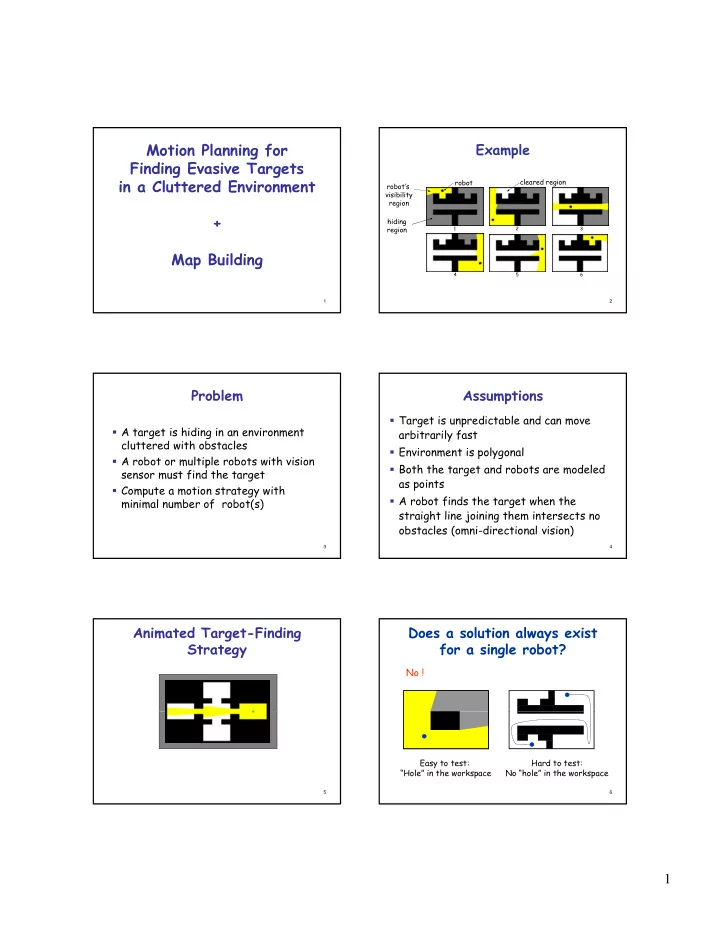
Motion Planning for Example Finding Evasive Targets in a Cluttered Environment cleared region robot robots visibility region + hidin hiding region 1 2 3 Map Building 4 5 6 1 2 Problem Assumptions Target is unpredictable


slide-1
SLIDE 1

1

Motion Planning for Finding Evasive Targets in a Cluttered Environment

1

+ Map Building

Example

robot’s visibility region hidin cleared region robot

2

hiding region

1 2 3 4 5 6

Problem

A target is hiding in an environment cluttered with obstacles A robot or multiple robots with vision

3

m p sensor must find the target Compute a motion strategy with minimal number of robot(s)

Assumptions

Target is unpredictable and can move arbitrarily fast Environment is polygonal B th th t t d b t d l d

4

Both the target and robots are modeled as points A robot finds the target when the straight line joining them intersects no

  • bstacles (omni-directional vision)

Animated Target-Finding Strategy

5

Does a solution always exist for a single robot?

No !

6

Hard to test: No “hole” in the workspace Easy to test: “Hole” in the workspace

slide-2
SLIDE 2

2 Effect of Geometry on the Number of Robots

7

Two robots are needed

Effect of Number n of Edges

Minimal number of robots N = Θ(log n)

8

Effect of Number h of Holes

9

N=Θ( h)

Information State

(x ) a = 0 or 1 c = 0 or 1 b = 0 or 1

visibility region

  • bstacle edge

free edge

10

Example of an information state = (x,y,a=1,b=1,c=0) An initial state is of the form (x,y,a=1,b=1,...,u=1) A goal state is any state of the form (x,y,a=0,b=0,..., u=0)

(x,y) 0 cleared region 1 contaminated region

Critical Line

a=0 b=1

(x,y,a=0,b=1)

contaminated area

11

( ,y,a , )

Information state is unchanged

(x,y,a=0,b=1)

a=0 b=1 a=0 b=0

(x,y,a=0,b=0)

Critical line

cleared area

Grid-Based Discretization

12

Ignores critical lines Visits many “equivalent” states Many information states per grid point Potentially very inefficient

slide-3
SLIDE 3

3

Discretization into Conservative Cells

13

In each conservative cell, the “topology” of the visibility region remains constant, i.e., the robot keeps seeing the same obstacle edges

Discretization into Conservative Cells

14

In each conservative cell, the “topology” of the visibility region remains constant, i.e., the robot keeps seeing the same obstacle edges

Discretization into Conservative Cells

15

In each conservative cell, the “topology” of the visibility region remains constant, i.e., the robot keeps seeing the same obstacle edges

16

Search Graph

{Nodes} = {Conservative Cells} X {Information States} Node (c,i) is connected to (c’,i’) iff:

  • Cells c and c’ share an edge (i.e., are adjacent)
  • Moving from c, with state i, into c’ yields state i’

Initial node (c,i) is such that:

17

Initial node (c,i) is such that

  • c is the cell where the robot is initially located
  • i = (1, 1, …, 1)

Goal node is any node where the information state is (0, 0, …, 0) Size is exponential in the number of edges

Example

A

(C,a=1,b=1) (D,a=1) (B,b=1)

18

B C D E

a b

slide-4
SLIDE 4

4

A

(C,a=1,b=1) (D,a=1) (B,b=1)

Example

19

B C D E

(E,a=1) (C,a=1,b=0)

A

(C,a=1,b=1) (D,a=1) (B,b=1)

Example

20

B C D E

(E,a=1) (C,a=1,b=0) (B,b=0) (D,a=1)

A

(C,a=1,b=1) (D,a=1) (B,b=1)

Example

21

C D E

(E,a=1) (C,a=1,b=0) (B,b=0) (D,a=1) Much smaller search tree than with grid-based discretization !

B

Example of Target-Finding Strategy

22

Visible Cleared Contaminated

More Complex Example

23

1 2 3

Example with Recontaminations

3 2 1

24

6 5 4

slide-5
SLIDE 5

5 Example with Linear Number

  • f Recontaminations

Recontaminated area 2 1

25

4 3

Example with Two Robots

(Greedy algorithm)

26

Example with Two Robots

27

Example with Three Robots

28

Robot with Cone of Vision

29

Other Topics

Dimensioned targets and robots, three- dimensional environments Non-guaranteed strategies C t d l t ti d

30

Concurrent model construction and target finding Planning the escape strategy of the target

slide-6
SLIDE 6

6

Map Building

Laser range finder

31

Sensing

32

Alignment of Contours

33

Merging of Four Partial Models

34

Dealing with Uncertainty

35

1. Simultaneous Localization and Mapping (SLAM)

  • 2. Next-Best View (NBV) Planning

Next-Best View Planning

36

slide-7
SLIDE 7

7

NBV Example 1

37

NBV Example 2

38

Map Building with NBV

39

3D Mapping

40