Half a century of renovating Key Technologies: Reality and Fiction - - PowerPoint PPT Presentation

half a century of renovating
SMART_READER_LITE
LIVE PREVIEW

Half a century of renovating Key Technologies: Reality and Fiction - - PowerPoint PPT Presentation

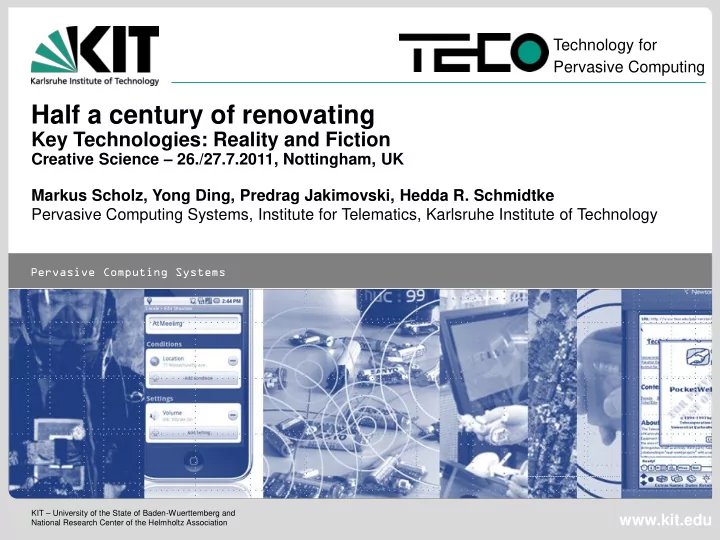
Technology for Pervasive Computing Half a century of renovating Key Technologies: Reality and Fiction Creative Science 26./27.7.2011, Nottingham, UK Markus Scholz, Yong Ding, Predrag Jakimovski, Hedda R. Schmidtke Pervasive Computing


slide-1
SLIDE 1

KIT – University of the State of Baden-Wuerttemberg and National Research Center of the Helmholtz Association

www.kit.edu Technology for Pervasive Computing

Pervasive Computing Systems

Half a century of renovating

Key Technologies: Reality and Fiction

Creative Science – 26./27.7.2011, Nottingham, UK Markus Scholz, Yong Ding, Predrag Jakimovski, Hedda R. Schmidtke Pervasive Computing Systems, Institute for Telematics, Karlsruhe Institute of Technology

slide-2
SLIDE 2

Technology for Pervasive Computing

2 12.08.2011

Who we are ...

... is home of the

first web browser on a PDA mediacups particle computers

... develops

new concepts, such as

implicit interaction context-awareness context proximity

new types of hardware

extremely low power extremely low cost

Technology for Pervasive Computing

slide-3
SLIDE 3

Technology for Pervasive Computing

3 12.08.2011

Who we are ...

Technology for Pervasive Computing

... is home of the

first web browser on a PDA mediacups particle computers

... develops

new concepts, such as new types of hardware

... applies ideas

industrial applications retail applications smart business items

slide-4
SLIDE 4

Technology for Pervasive Computing

4 12.08.2011

Our Story

An elderly man of around 70 years is renovating an

  • ld country house he has inherited

While removing old remains of technology in the house he is reminded of all the technologies he has witnessed during his life, from electricity cabling to the smart wall paper

slide-5
SLIDE 5

Technology for Pervasive Computing

5 12.08.2011

The Future of Computing: Factors

Size: How small is a computer? Cost: What does a computer cost? Density: How many computers per squaremeter (or cubic meter)? Degree of connection: How many computers need to work together to perform a certain function? Example: Today‘s Smart Phone: 7cm³, 200$, 0.1/m², 1

slide-6
SLIDE 6

Technology for Pervasive Computing

6 12.08.2011

Activity/Context Recognition on Mobile Phones

Context Recognition: anytime machine learning and classification activity service ActiServ: an App- Store for activity patterns Abstraction: reasoning to generate coarse-grained situation descriptions for situation logging: uncertainty conflicting information Context prediction

slide-7
SLIDE 7

Technology for Pervasive Computing

7 12.08.2011

Stage 1: a Safer Airport (5cm³, 10$, 4m², 2)

Today‘s sensor nodes can already achieve this if

prices drop somewhat as sensor nodes are deployed throughout large environments activity recognition mechanisms become reliable enough to be suitable for safety applications sensor nodes can be installed more easily applications can be deployed more easily to sensor networks

slide-8
SLIDE 8

Technology for Pervasive Computing

8 12.08.2011

Safety Critical Applications: Projects Landmarke (2008- 2011) and Koordinator (2011+)

slide-9
SLIDE 9

Technology for Pervasive Computing

9 12.08.2011

Landmarke

slide-10
SLIDE 10

Technology for Pervasive Computing

10 12.08.2011

… please stay tuned we‘ll be back in a minute …

slide-11
SLIDE 11

Technology for Pervasive Computing

11 12.08.2011

Stage 1.1: Smart Homes (5cm³, 5$, 4m², 2)

… then these advances can also make it into the mass market

slide-12
SLIDE 12

Technology for Pervasive Computing

12 12.08.2011

Stage 2: the Smart Grid (5cm³, 10$, 0.1m², 1000)

Wireless Sensor Networks Technology for Smart Communication

Market

slide-13
SLIDE 13

Technology for Pervasive Computing

13 12.08.2011

Smart TecO System

Smart Lab

SmartTecO System

  • 1. Web interface
  • 2. Connection with WSNs
  • 3. Remote control

WSNs based on µParts FHZ1300 FHZ1300 FS20 system FHT80b system Plugwise system for energy sensing

slide-14
SLIDE 14

Technology for Pervasive Computing

14 12.08.2011

Prototype

slide-15
SLIDE 15

Technology for Pervasive Computing

15 12.08.2011

Lightweight Context-Aware Sensing Acting System

Context recognition for Generator/Consumer Example: Open Cast Mining [UbiComp 2010] Distributed Collaborative Sensing [Behaviour Monitoring and Interpretation 2010]

slide-16
SLIDE 16

Technology for Pervasive Computing

16 12.08.2011

Industrial Scenario

Source: de.wikipedia.org

Open-cast mining

  • Extraction of raw materials without tunneling
  • Continuous transport via conveyor belt system
  • Expensive to monitor
slide-17
SLIDE 17

Technology for Pervasive Computing

17 12.08.2011

Distributed Sensing, Reasoning, and Acting

Crucial: energy consumption and robustness

  • Simple reasoning
  • Local communication

local reasoning steps global knowledge

  • Partial order reasoning
  • Communication between

neighboring nodes

slide-18
SLIDE 18

Technology for Pervasive Computing

18 12.08.2011

Distributed Sensing

Algorithm demonstration

gradient of the measurement value Routing messages along the measurement gradient Establishing a DAG, i.e. a hierarchical network topology purely by measurement

slide-19
SLIDE 19

Technology for Pervasive Computing

19 12.08.2011

Experiments

Experimental implementation

  • JN5139-based sensor node

platform

  • Low-cost mirco-vibration

ballswitch sensor

Two experiments

  • Realistic scale but with simulated

sensor data for showing the general setting of sending and reception of messages in the scenario

  • Smaller scale but with actually

measured sensor data, illustrating how the algorithm works on actual sensor data

slide-20
SLIDE 20

Technology for Pervasive Computing

20 12.08.2011

… please stay tuned we‘ll be back in a minute …

slide-21
SLIDE 21

Technology for Pervasive Computing

21 12.08.2011

Stage 3: Smart Labels (8cm², 1¢, 1000/m³, 1-?)

Printed organic electronics promise to make computing cheaper and more distributed than ever before. Enabling

novel business processes high degree of automation

Technological challenges:

Can such cheap systems be made autonomous? How can we communicate with 1000 computers? ….

slide-22
SLIDE 22

Technology for Pervasive Computing

22 12.08.2011

Novel Business Processes: Collaborative Business Items (2006)

Storage regulations on storage of chemical goods

What can be stored with what? How much can be stored in one place?

Chemical bins that know about their content

slide-23
SLIDE 23

Technology for Pervasive Computing

23 12.08.2011

New Project: TIMBUS – Digital Preservation for Timeless Business Processes and Services

supported by

slide-24
SLIDE 24

Technology for Pervasive Computing

24 12.08.2011

supported by

Legalities Lifecycle Management (LLM) IP Management Data Protection Preservation Specific IT Contracting Preservation Obligations

ESCROW SLA

Information Lifecycle Management Interface Intelligent ERM Value Engineering Service Dependency Monitor

Decision Event Decision Event Decision Event Reasoning Engine

Decision Merger Expediency Store Business Process Preservation Suite Preserved Business Process Storage Exhumation Environment ‘Future Simulated’ Test Bed Authori

  • sation

Organisational Business Process Models

Risk Interface Financial Interface Device Interface Service Interface Decision Event Real SW/HW Formal Representation Emulated and/or Virtualised SW/HW

SaaS/PaaS/ Cloud

Virtualization Enabler Emulation Enabler

Reasoning Engine Reasoning Engine Reasoning Engine

New Project: TIMBUS – Digital Preservation for Timeless Business Processes and Services

slide-25
SLIDE 25

Technology for Pervasive Computing

25 12.08.2011

New Hardware: Polytos (BMBF, SAP)

BMBF excellence cluster: Printed Organic Circuits and Chips

Goals Infrastructure with reader system for massive amounts deployment of organic Smart Labels e.g. in cold chain management Communication protocols for reading from > 1000 Smart Labels per m² Development of a silicon based test bed Testbed

  • 1. Collective transmission of Si-

based transponders

  • 2. Signal superposition
  • 3. USRP detects signal pattern
  • 4. Transmission to PC for further

analysis

slide-26
SLIDE 26

Technology for Pervasive Computing

26 12.08.2011

Superimposed Signals

Pallet contains perishable goods? Receiver

Communication with the pallet as a whole instead of communication with individual tags

slide-27
SLIDE 27

Technology for Pervasive Computing

27 12.08.2011

Superimposed Signals: Addition

slide-28
SLIDE 28

Technology for Pervasive Computing

28 12.08.2011

Collective Transmission

Beyond encoding sets: computation on the channel: average, sum advanced data structures: directed acyclic graphs Result: transmit a set of elements Binary Query: is the element contained in the set? Proportion Query: Which percentage of the pallet sent this element?

slide-29
SLIDE 29

Technology for Pervasive Computing

29 12.08.2011

Summary and Outlook

Where does this go?

Will products be able to organize their own production process? Will they collaborate to support us?

… or will they have other ideas?

slide-30
SLIDE 30

KIT – University of the State of Baden-Wuerttemberg and National Research Center of the Helmholtz Association

www.kit.edu Technology for Pervasive Computing

Pervasive Computing Systems

Half a century of renovating

Key Technologies: Reality and Fiction

Creative Science – 26./27.7.2011, Nottingham, UK Markus Scholz, Yong Ding, Predrag Jakimovski, Hedda R. Schmidtke Pervasive Computing Systems, Institute for Telematics, Karlsruhe Institute of Technology