Gunica Bay/Rio Loco Agenda to Neutralize Detrimental Inputs (GRAND) - - PowerPoint PPT Presentation
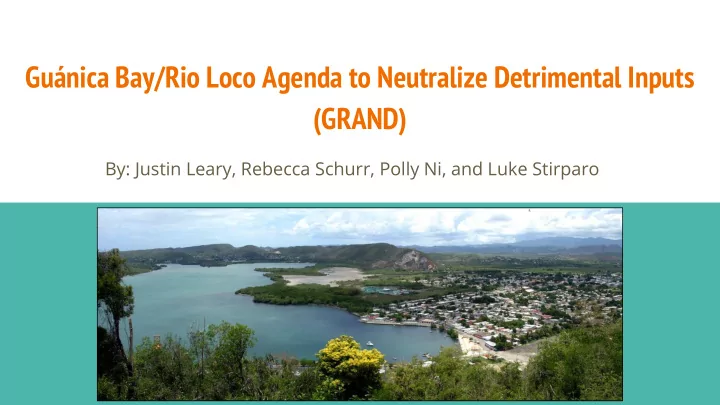
Gunica Bay/Rio Loco Agenda to Neutralize Detrimental Inputs (GRAND) By: Justin Leary, Rebecca Schurr, Polly Ni, and Luke Stirparo History and Background Founded on August 12, 1508, by Juan Ponce de Len Named Gunica, a word derived
History and Background
- Founded on August 12, 1508, by Juan Ponce de León
- Named Guánica, a word derived from the Taíno indigenous culture
○ Means “here is a place with water”
- Was a part of the municipality of Yauco
until 1914 when it became separate
- Watershed includes urbanized areas of
Yauco, a portion of the Lajas Valley agricultural region, and the upper watershed where coffee farming and subsistence agriculture is practiced
History and Background (cont.)
- Human alterations to increase drainage area included:
○ Series of inter basin or inter-watershed water transfers ○ Five reservoirs ○ Two hydroelectric plants (Yauco 1 and 2)
- High levels of deforestation due to sugarcane cultivation
- Ditching and draining of Guánica Lagoon, a large historical lagoon and
adjacent wetland system, in the 1950s in addition to farmland clearing
History and Background (cont.)
- First watershed management plan created in 2008
○ Guánica Bay Watershed Management Plan ○ National Atmospheric and Oceanic Administration (NOAA) ○ The Puerto Rico Department of Natural and Environmental Resources ○ NOAA Coral Reef Management Fellow in Puerto Rico ○ In partnership with the Center for Watershed Protection
- Plan was updated in 2014
○ Protectores de Cuencas and their partners ○ Done to address the EPA’s nine elements of a watershed management plan
Mission Statement
GRAND’s mission is to attain the classification of fishable water quality standards by the EPA in the Guánica Bay/Rio Loco Watershed in the Southwestern corner of Puerto Rico by the year 2040.
Problem 1: Coral Degradation
Issue:
- Coral degradation is an arising
issue throughout the world, Guánica Bay is no exception. Solution:
- Build basins/wetlands to contain the nutrients
- Introduce new agricultural methods such as hydroseeding
- Implement more farms to practice shade grown coffee
Problem 2: High Nitrate Levels
Issue:
- Hurricanes Irma and Maria amplified nitrate effluent.
- Sources of nitrates include fertilizers from local farms and waste from residential
areas.
- Excess nitrate encourages algal blooms which cause low dissolved oxygen levels,
killing aquatic wildlife.
Solution:
- Surround waterways and sources of nitrate with aquatic buffers:
○ Man-made wetlands ○ Shade grown coffee
Problem 3: Erosion and Sediment Transport
Issue:
- The Rio Loco has severe erosion problems
- Abandoned infrastructure and lack of mature
trees in riparian zone cause instability of river banks
- Sediments are running into the river from
exposed soils and dirt roads throughout agricultural areas
- Loss of reservoir capacity due to sediment build
up
- Sediments traveling into the Guánica Bay are
harming corals
Solutions for Erosion and Sediment Transport
Solution:
- Bank Stabilization project including removing old infrastructure and planting
native trees
- Sediment transport reduction by stabilizing dirt roads and using hydro
seeding techniques to protect bare soils.
GRAND Goals
- Build basins/wetlands to contain the nutrients
- Introduce new agricultural methods such as hydroseeding to limit
sediment run off.
○ Currently, 20 acres of land was stabilized. By 2040, Grand proposes to stabilize more than 150 acres of land.
- Implement more farms to practice shade grown coffee
- Ensure nitrate-nitrogen levels are 10 ppm or below.
- Carry out bank stabilization projects along the Rio Loco