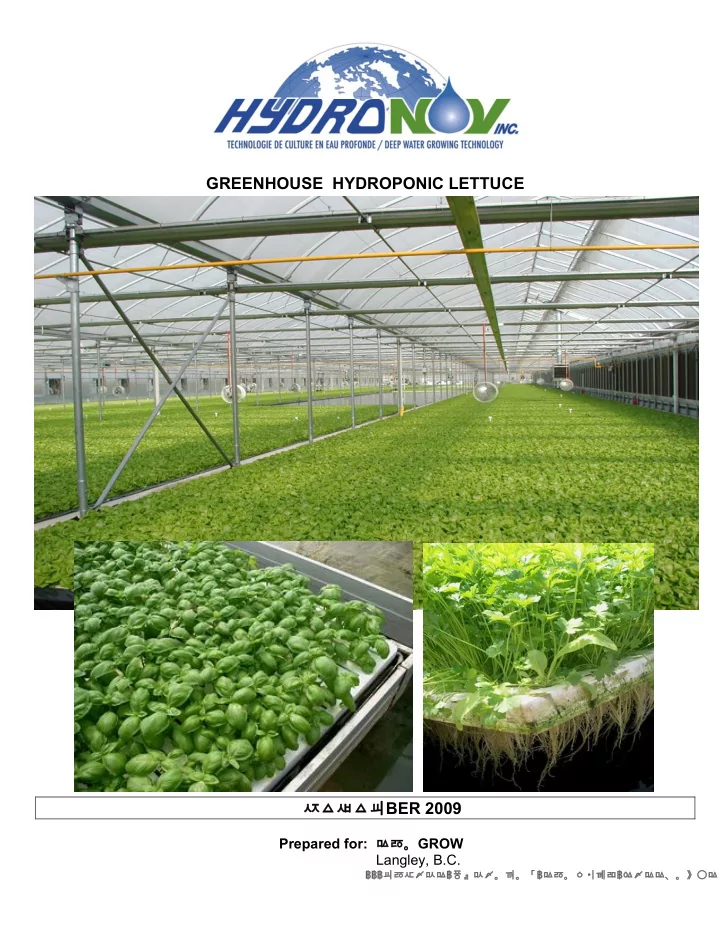
GREENHOUSE HYDROPONIC LETTUCE BER 2009 Prepared for: GROW - - PDF document

greenhouse hydroponic lettuce ber 2009 prepared for grow
SMART_READER_LITE
LIVE PREVIEW

GREENHOUSE HYDROPONIC LETTUCE BER 2009 Prepared for: GROW - - PDF document

GREENHOUSE HYDROPONIC LETTUCE BER 2009 Prepared for: GROW Langley, B.C. HydroNov Inc . an international leader


slide-1
SLIDE 1

GREENHOUSE HYDROPONIC LETTUCE BER 2009

Prepared for: GROW Langley, B.C.

slide-2
SLIDE 2

2 HydroNov Inc. an international leader in greenhouse production since 1987, has developed and adapted several agricultural production technologies, leading to harvest far superior to traditional growing method, both in quality and quantities. HydroNov's distinctive approach is to get involved on a long term basis into technical and production supervision, bringing 20 years of hands-on experience available to each new project. HydroNov has been active and successful during the last 15 years, in exporting and implementing its technology over 30 hectares in Canada, China, Mexico, USA, Japan. Projects are currently under development in Dubai, Malaysia, Ivory Coast, Mongolia and China More information, pictures & videos at: www.hydronov.com

MIRABEL, CANADA, J7N 2H4

slide-3
SLIDE 3

3

Harvest Transportation System

Conveyors transports the harvested lettuce into the service building where these are packed and kept in the cold storage room until sold.

1 > Introduction of the growing technology All this expansion has been done based on the development of a revolutionary growing technique, the Floating Rafts Technology (FRT), for vegetables and flowers.

■ Floating Rafts Technology is certainly the most “water-conscious” system among existing hydroponic growing systems. One of its key features is the use of a large volume of water allowing enormous buffer for fertilisation and oxygen control as well as economic plants transportation by floatation. This large buffer brings a level of security and easiness that no other growing system can match. ■ With FRT absolutely no water is lost through soil or growing media, no direct evaporation to the sun, no dumping of growing solution, no dripping gutters; just plant’s needs, making it the most economical system in terms of water needs. ■ FRT leads also to a much higher productivity, bringing up the possibility to grow up to 17 crops/year of lettuce for example, at average head weight of 200 grams ■ FRT provides an integrated internal transportation system, simply using growing water as a conveyor system. A biological support base is quickly established in the growing pools, giving the plant this extra strength. No herbicides or fungicides are ever needed.

slide-4
SLIDE 4

4 On all locations, market has been answering with enthusiasm to the arrival of a new upscale commodity, grown under a protected environment, fresh, clean, and with a constant supply. Butterhead has been adopted as a main standard for most of the greenhouse production for one simple reason: European breeders have been offering since the middle of the past century Butterhead varieties selected for their ability to grow well indoor. It was then and still is the standard lettuce for Western Europe, although recently the offer is much wider, just like in North America. No other types of lettuce seeds adapted for indoor production were offered until recently. Constant research is now bringing up the possibility to also produce a wider base of lettuce types including Romaine COS, Curly Lolo Biondo and Lolo Rosso, Oak Leaf green and red, as well as Leaf green and Red. Besides lettuce, other leafy crops can also be grown successfully, including aromatic herbs, medicinal herbs, American spinach, Chinese spinach, watercress, ….. Among other production choices: Cooler night locations would be suitable for the production of red lettuces, due to a natural mix

  • f quality light and cool nigh weather. The market has great expectations for a reliable source of

quality greenhouse red lettuce. Red Butterhead, Lolo’s, Oak Leaf and Red Leaf types are showing great market possibilities

slide-5
SLIDE 5

5 The COS Romaine type has been a very fast growing market segment among the field grown

  • lettuce. Beside the big size field types, greenhouse production is coming up with smaller one,

bringing more quality and taste compare to its field grown counterpart Mix Grown is an example of a product that can be easily grown in a greenhouse and marketed as a specialty item

slide-6
SLIDE 6

6

slide-7
SLIDE 7

7 A recent evolution of the FRT system is bringing up the possibility to produce all those direct seeded high density crop , either herbs like basil, greens like Arugula or baby version of vegetables like spinach and lettuce

slide-8
SLIDE 8

8

> HIGH DENSITY FLOATING SYSTEM FOR SEEDED CROPS

> The HD board developed for this application integrates the advantages of Floating Rafts Technology with the simplicity and spacing flexibility of peat based media. > The end result is a highly mechanized system, where 5 workers can produce up to 320,000 KG of first quality baby leaf vegetables per hectare per year. > The direct production costs are limited to a small quantity of peat mix and a variable quantity of raw seeds, usually available at low cost. Direct labor cost is greatly reduced, the machines specially developed for this process having the capacity to supply several hectares of production within 1 shift per day.

slide-9
SLIDE 9

9 2 > PROJECT DESCRIPTION

The preliminary project presented here is based on year round daily harvest of lettuce

2.1 Localisation & Climatic conditions

Available weather statistics for the potential location are indicating a climate with cool nigh temperature year round, an important factor for quality leafy vegetables. We are as well expecting humidity to be on the high side, and winter light not sufficient to grow a quality crop without artificial lighting

  • Detailed weather statistics will need to be provided when location is confirmed

2.2 Choice of production systems HydroNov has developed over time 2 different yet complementary floating rafts systems:

  • The 1 inch block system for whole head production

* Will produce more weight per surface * Do require more labour for handling of individual head * Appropriate for densities between 20 and 100 plants per M2 * Will produce regular and small size lettuces

  • The peat base system for high density seeded crop

* Fully automated system from seeding to harvest * For densities from 500 to 2,000 seeds per M2 * Will produce baby type seeded vegetables like baby spinach, mizuna, and all baby lettuces

2.3 Project Numbers

We will for now limit our project description to whole head lettuce The high density vegetables remains an option to consider . The choice between whole head and high

density is a question of market. Obviously high density leaf must sell at a higher price to compensate the lower productivity.

slide-10
SLIDE 10

Crop Butterhead lettuce Dimensions (meters) Production area Block identification 1 Length 150.0 m Width 153.6 m Covered area 23 040 m2 Growing area 19 833 m2 Production boards 26 096 Nursery area Length 150.0 m Width 48 m Covered area 7 200 m2 Growing area 4 958 m2 Nursery boards 6 524 Testing area Testing Boards Summary Total Project Area 31 315 m2 Total greenhouse area 30 240 m2 Total growing area 24 791 m2 Working & Transportation area 5 449 m2 NetHouse circulation area 0 m2 Packing & Warehouse area 1 075 m2 Capacity of Production Density 24.0 plants / m2 Annual Crop rotation 17.0 / year Total Harvest / m2 408 Marketable plants 85% Potential harvest per square meter 347 plants/m2/year for growing area 6 878 071 plant/year for sale 573 173 dozen/year 1 432 931 KILOS/year From testing Area Other greens 0 KILOS/year Expected Production Hours Expected Water Requirements (litres) 82,796 At Fill-up 7,437,360 On monthly basis 1,239,560 PROJECTIONS & ANALYSIS ADAPTED TO LOCAL CONDITIONS BASED ON AVAILABLE DATA ALL NUMBERS MENTIONED FOR INFORMATION ONLY. * IMPORTANT NOTICE PROJECT DESCRIPTION AND PRODUCTION CAPACITY / PHASE 1 Location: McBride HydroNov ecoGROW Greenhouse BC Customer: ecoGROW

slide-11
SLIDE 11

3- Project Cost

Building, equipment and Services for the project are proposed at a firm price of 7,432,432 CND$. Other expenses related to land preparation, infrastructure and construction are estimated at $1,455,000.

McBride HydroNov ecoGROW greenhouse

PRICE SUMMARY / PHASE 1 $ CDN 1- Land & services 200,000 Primary services 2-Greenhouse building 1,642,368 800,000 Installation 3-Greenhouse equipments 1,827,840 4-Services building+equipments 183,456 55,000 Internal partitions 5- Cold storage area 87,360 6- Floating raft growing system 2,032,128 7- Production equipment 833,280 100,000 Misc 8- Delivery & insurances 112,000 9-Installation & Concrete works 294,000 300,000 Concrete & Drainage 10- Follow-up/ Prod. Supplies 420,000 11-TOTAL $7,432,432 $1,455,000

$8,887,432

TERMS AND CONDITIONS *TRAVELLING EXPENSES INCLUDED * C.I.F. SITE * STATUS OF PROPOSAL : Preliminary * PAYABLE BY IRREVOCABLE LETTER OF CREDIT * ALL IN CDN $

slide-12
SLIDE 12

4 - Financial results

Based on HydroNov’s experience with large-scale greenhouse production, a project that is presenting the necessary elements can become a highly profitable venture, able to normally show a payback period of 36 to 60 months. Here are the major elements to be considered regarding the potential profitability of modern greenhouse production:

  • Sunny, temperate weather year round, or ecoPHASER + LED; Cooler nights;

Manageable relative humidity.

  • Proximity to urban markets and/or access to export markets; or ecoPHASER Cold

storage.

  • Access to good quality water;
  • Available labour force at competitive price;
  • Accessibility to competitive energy sources (ecoPHASER biomass).
  • Efficient management (trained by HydroNov)

This section is presenting the production capacity of this project, and is giving an idea of the potential financial results from such production. Although based on similar production circumstances and adapted to local conditions, the financial information presented here is given as information and indication only, and can never be understood or interpreted as a guarantee

  • f future performance.

.

Some important items have a positive effect for the potential success of this project. Among those, light availability* (supplemented by artificial lighting), and weather conditions, size of the product, sales price, labour, energy cost, and financing costs have a major influence.

  • Quantity and quality of available natural and artificial light along with average weather

conditions will allow regular and fast cropping of high quality product, without the burden

  • f investing in heavy heating,(except where CHP surplus is available, an important

positive factor).

  • Trend has already been created for Greenhouse Boston lettuce to be sold between 150

and 250 grams. This project should be able to easily maintain a 200 grams minimum for its product, and still keep a fast turnover based on 17 crops per year.

  • Selling price has been budgeted at an average of 9,70 $ per dozen; This selling price

should allow an easy penetration of the market.

  • Labour and energy costs normally account for 15% of a north climate greenhouse
  • peration costs. This figure is here reduced to 7% for this project, a decisive advantage.

NB: there are 2000 + sunshine hours per annum – in the McBride region, 2028 in Mirabel Quebec, home of the HydroNov first and most successful greenhouse, since 1998.

slide-13
SLIDE 13

13

Based on those assumptions and several others, this project is definitively presenting financial interest, with a profit before taxes of 43 %, and a return on investment of 23% Sales are budgeted at 5,5 M $, bringing in a gross profit after depreciation of 2,4 M $, a net profit before taxes and financing of 1,6 M $ and a cash-flow profit before debt service and depreciation of 2,1 M $ PRO-FORMA FINANCIAL STATEMENT 12 MONTHS / JAN.-DEC.

TOTAL % SALES 5,594,385 $ RAW MATERIALS 1,216,775 $ 22% DIRECT LABOUR 993,549 $ 18% FACTORY OVERHEAD 985,000 $ 18% GROSS PROFIT 2,399,061 $ 42.9% SALES/ADMINISTRATION 718,958 $ 13% PROFIT BEFORE FINANCE COSTS 1,680,102 $ 30.0% FINANCE COSTS

  • $

0% PROFIT BEFORE TAXES 1,680,102 $ 30% INCOME TAXES

  • $

0% NET PROFIT 1,680,102 $ 30%

slide-14
SLIDE 14

14 CASH-FLOW

12 MONTHS / JAN.-DEC. JAN. FEB. SALES 400,200 $ 376,533 $ 5,594,385 $ CASH INFLOW 400,200 400,200 5,594,385 EXPENSES RAW MATERIALS 88,813 88,813 1,127,962 DIRECT LABOUR 59,466 67,713 993,549 FACTORY OVERHEAD 82,083 82,083 985,000 AMORTIZATION

  • 40,833
  • 40,833
  • 490,000

SALES/ ADMINISTRATION 54,731 52,873 718,958 INTEREST DEBT IMMOBILISATION INCOME TAXES 244,260 $ 250,649 $ 3,335,470 $ CASH SURPLUS 155,940 149,552 2,170,102 CASH AT THE BEGINNING 155,940 CASH AT THE END 155,940 $ 305,492 $

RETURN ON INVESMENT (R.O.I.)

23%

ESTIMATED OVER 10 YEARS

155,940 149,552 2,170,102 CASH INFLOW YEAR 1 2,170,102 INVESTMENT

(8,500,000) $

YEARS 1

2,170,102 $

2

2,191,803 $

3

2,213,721 $

4

2,235,859 $

5

2,258,217 $

6

2,280,799 $

7

2,303,607 $

8

2,326,643 $

9

2,349,910 $

10

2,373,409 $

N= 10 INDEXATION= 0.01 T.I.= 0.1

slide-15
SLIDE 15

15

5 > TYPICAL EQUIPMENT LIST

  • Lot #1

Infrastructure

  • Land leveling & preparation
  • Primary services as electricity, telephone, water, sewage
  • Lot #2

Greenhouse building

slide-16
SLIDE 16

16

Lot #3 Greenhouse equipment

  • Computerized climate control system
  • Outside weather station
  • Sections climate computers
  • PC link computer
  • Electrical & control equipment
  • Heating system
  • Burners for heating and CO2
  • Hot water for pool heating
  • Horizontal ventilation system
  • H.A.F. Fans
  • Shade / Energy curtain
  • Concrete pool's structure
slide-17
SLIDE 17

17

Lot #4 Services building

slide-18
SLIDE 18

18

Lot #6 Lettuce Growing System

  • Protection & Polyethylene pool's liner; Germination area
  • Polystyrene floating production rafts; Polystyrene floating nursery rafts
  • High volume circulation pumps; P.V.C. irrigation system;
slide-19
SLIDE 19

19

  • Germination area
slide-20
SLIDE 20

20

Lot #7 Production equipment by HydroNov

  • Transplantation units; Harvest line; Washing line
  • Harvest conveyors
  • Washing conveyor
  • High pressure washing pump
  • Transfer conveyors
  • Packing conveyor
  • Packing table
  • Refuse conveyors
slide-21
SLIDE 21

21

  • Nutrients feeding system
  • Oxygen venturi system
  • Pools heating/ cooling system
slide-22
SLIDE 22

22

Lot # 8, 9 & 10 Installation supervision & production start up by HydroNov

  • Project supervisors on site for construction period
  • Specialized installation supervisor on site for construction period
  • Production supervisor for production start up period; regular follow-up
  • Complete & detailed grower book
  • Delivery & insurances to site
  • Office computer and production follow up software

> A custom management tool allowing efficient follow-up:

  • Seeding, transplanting, harvesting schedule; Production budgeting and simulations
  • Fertilisation calculation and follow-up; Pests scouting and control

> A reference tool based on 25 years experience