GREAT LAKES/ST. LAWRENCE SEAWAY TRANSPORTATION SYSTEM, OPPORTUNITIES - - PowerPoint PPT Presentation

great lakes st lawrence seaway transportation system
SMART_READER_LITE
LIVE PREVIEW

GREAT LAKES/ST. LAWRENCE SEAWAY TRANSPORTATION SYSTEM, OPPORTUNITIES - - PowerPoint PPT Presentation

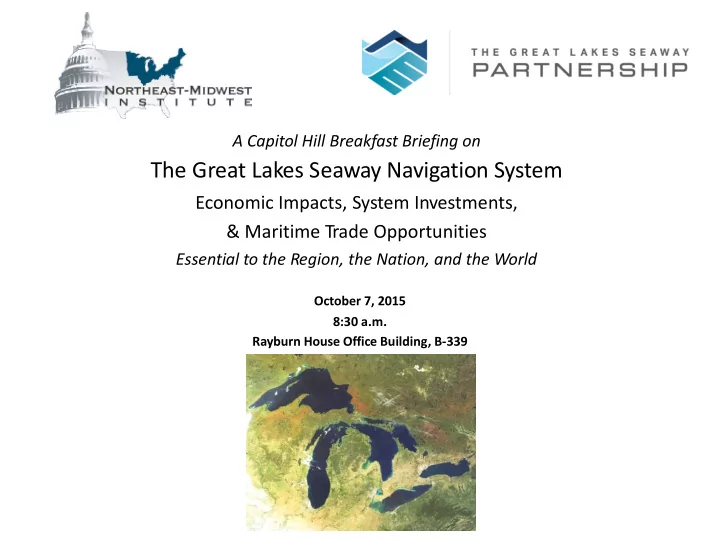
A Capitol Hill Breakfast Briefing on The Great Lakes Seaway Navigation System Economic Impacts, System Investments, & Maritime Trade Opportunities Essential to the Region, the Nation, and the World October 7, 2015 8:30 a.m. Rayburn House


slide-1
SLIDE 1

A Capitol Hill Breakfast Briefing on

The Great Lakes Seaway Navigation System

Economic Impacts, System Investments, & Maritime Trade Opportunities

Essential to the Region, the Nation, and the World

October 7, 2015 8:30 a.m. Rayburn House Office Building, B-339

slide-2
SLIDE 2

Prepared by: Martin Associates 941 Wheatland Ave., Suite 203 Lancaster, PA 17603

October 7, 2015

www.martinassoc.net

GREAT LAKES/ST. LAWRENCE SEAWAY TRANSPORTATION SYSTEM, OPPORTUNITIES AND CHALLENGES

slide-3
SLIDE 3

The GL/SLS System

160 Million Tons Annually 100 Ports 8 States 2 Provinces U.S. Flag Fleet Canadian Flag Fleet International Cargo

2

slide-4
SLIDE 4

The GL/SLS Is a Key Economic Catalyst to the U.S. and Canadian Economies

  • 92,923 direct jobs
  • 66,005 induced jobs
  • 67,905 indirect jobs

226,833 jobs generated

by marine cargo activity

  • Direct revenue from supply of services to cargo and

vessels

$33.6 billion of direct

business revenue

  • $4.4 billion direct wages and salaries -- $47,000 average

salary for direct employees

  • $6.9 billion re-spending/local consumption
  • $2.9 billion indirect income

$14.1 billion total

personal income and local consumption

  • $1.5 billion of state/provincial and local tax revenue
  • $3.0 billion of federal tax revenue

$4.5 billion of federal,

state/provincial and local taxes

3

slide-5
SLIDE 5

Distribution of Direct Jobs by Country

10,000 20,000 30,000 40,000 50,000 60,000 70,000 80,000 90,000 100,000 Direct Induced Indirect

Job Impacts by Country

Canada U.S.

4

slide-6
SLIDE 6

Total Jobs by State and Province

5

48,332 Jobs 28,081 Jobs 6,271 Jobs 26,819 Jobs 7,177 Jobs 8,777 Jobs 1,967 Jobs 854 Jobs 35,013 Jobs 63,542 Jobs

slide-7
SLIDE 7

Direct, Induced and Indirect Jobs Created by U.S. and Canadian Flag Lakers

6

107,612 Jobs 101,568 Jobs

slide-8
SLIDE 8

Nearly 500,000 Additional Jobs with Users Are Related to the Cargo Activity on the GL/SLS

  • 393,262 related jobs in the U.S.
  • 84,331 related jobs in Canada

477,593 jobs related to

the marine cargo activity

  • $83.9 billion related revenue in the U.S.
  • $31.6 billion related revenue in Canada

$115.5 billion of

related business revenue

  • $18.2 billion related wages and salaries
  • $4.5 billion re-spending/local consumption

$22.7 billion related

personal income and local consumption

  • $5.1 billion of related taxes in the U.S.
  • $1.9 billion of related taxes in Canada

$7.0 billion of related

federal, state/provincial and local taxes

7

slide-9
SLIDE 9

Since 2009, $6.9 Billion of Public and Private Sector Investment on the GL/SLS $4.0 $1.7 $1.2

Billions of 2013 $

Vessel Ports & Terminals Waterway Infrastructure

8

slide-10
SLIDE 10

Investment on the GL/SLS is Driven by Private Sector Investment $4.6 $2.3

Billions of 2013 $

Private Sector Ports and Terminals

9

slide-11
SLIDE 11

Opportunities

Focus on near port/on-port industrial development:

  • Bulk and aggregates
  • Steel manufacturing/assembly
  • Leverage industrial development to maximize use of ports
  • Higher value commodities

Development of clean energy port complex:

  • Wind energy:
  • In-land project development
  • Off-shore production
  • Manufacturing and educational/research complex
  • LNG bunkering:
  • Compliance with ECA
  • Bio fuels – wood chips

10

slide-12
SLIDE 12

Marcellus and Utica Shale Deposits Present Significant Opportunities

11

slide-13
SLIDE 13

Energy Market

Provide vessel transit for LNG and NGL to serve East Coast as well as export Provide fuel for local markets:

  • Trucking
  • Vessel
  • Utilities

Supply oil fields:

  • Fracking Sand
  • Equipment

12

slide-14
SLIDE 14

Develop Liner Service

 Development of liner services:

  • Cleveland aggressively pursued development of liner service
  • Identification of local markets now using coastal ports:
  • Containers
  • RoRo, Project Cargo
  • Break Bulk
  • Minimize port calls on GL/SLS to maintain schedule integrity

13

slide-15
SLIDE 15

Polar Routing of Energy Projects??

14

slide-16
SLIDE 16

Opportunities

 Enhance federal opportunities to expand regional trade and economic development

  • Maximize U.S. Seaway Corporation (SLSDC) authorities to include bonds,

loans and other federal assistance

  • Ensure future national maritime and transportation policies, regulations,

and laws incorporate Great Lakes Seaway System maritime commerce

  • ptions for resiliency

15

slide-17
SLIDE 17

Challenges

 Growth in vessel size  Limited shipping season  Maintenance dredging issues:

  • Lack of maintaining St. Marys River at authorized depth costs U.S. Flag

maritime industry nearly $20 million/year

 Ice breaking issues:

  • 2015 season ice impacts
  • Loss of 3.2 million tons from January through April 2015 (US Flag)
  • Nearly 2,000 jobs impacted
  • $355.6 million of revenue lost

16

slide-18
SLIDE 18

Challenges

 Limited volume for multiple liner services  Tolls  Insurance  Transload of grain into containers  Decline in coal use in utilities:

  • Substitute fuels
  • LNG
  • Wind energy

 Enforcement of ECA’s:

  • Low sulphur fuel requirements
  • Scrubbers
  • LNG propulsion

17

slide-19
SLIDE 19

THANK YOU!

18

slide-20
SLIDE 20

A Capitol Hill Breakfast Briefing on

The Great Lakes Seaway Navigation System

Economic Impacts, System Investments, & Maritime Trade Opportunities

Essential to the Region, the Nation, and the World

October 7, 2015 8:30 a.m. Rayburn House Office Building, B-339