
SLIDE 1
Saint Paul Regional Water Services
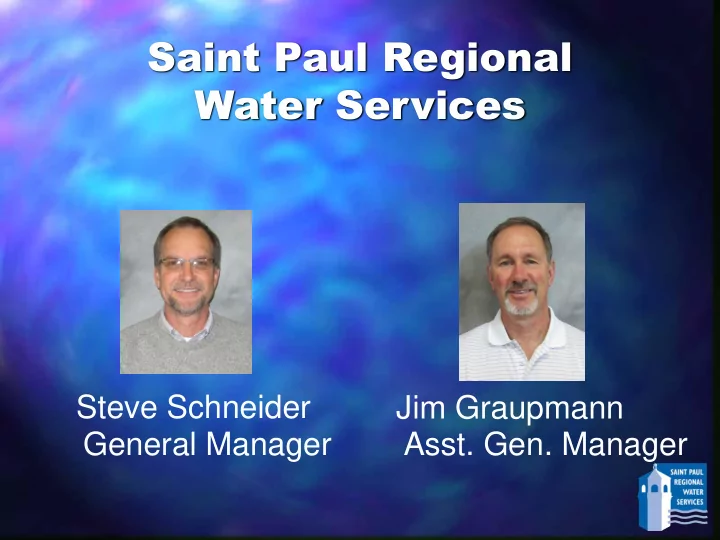
Steve Schneider General Manager Jim Graupmann
- Asst. Gen. Manager
Water Services Steve Schneider Jim Graupmann General Manager - - PowerPoint PPT Presentation
Saint Paul Regional Water Services Steve Schneider Jim Graupmann General Manager Asst. Gen. Manager Facts and Figures Ave. day production 40 MG Population served 433,000 Accounts 95,460 Miles of water main 1,200
SPRWS water production and distribution assets are
Future improvements are needed to replace aging
Risk-based approach to asset management has been
How severe are the consequences of asset failure? How likely is it for the asset to fail?
1,200 miles of water
27% over 100 years old 43% over 80 years old 48% 6-inch diameter 70% cast iron (1960s or
100-150 main breaks
98% of main breaks are
Year of install (not necessarily age) Diameter Length Prior breaks Storm sewer crossings Pressure/elevation Land use Pressure zone Proximity to tank Soil type
Provides a road map of improvements needed over
Anticipates future water demands and regulations
Prioritizes the projects
Provides an implementation
Water treatment and supply. Water main replacements.
Continued investment critical for success.
Quantity drove system design. System was designed and built
in an era of expanding population and water consumption.
Water age in the system was
not a design consideration.
Few drinking water regulations
looked at water in the distribution system.
Quality & quantity drive system design. Due to lower per capita consumption,
we need to reduce storage volumes and production rates.
We know increased water age has a
negative impact on water quality.
More drinking water regulations are
being applied to water quality in the distribution system (disinfection by-
products, total coliform rule, lead and copper rule).
Water main construction is coordinated with street
Cost of utility work is highly dependent on restoration
More arterial street restoration vs. residential street
Changes in system demands.
43% of the system is more than 80 years old. Over half of the system is unlined cast iron pipe. Distribution maintenance:
Uni-directional flushing Hydrant inspection Valve operation Break repair Etc.
Board of Water Commissioners are committed to
Over $325 million of investments are included in the
Funding is split between pay-as-you-go and debt.
SRF funding will continue to be sought.
Private service line replacement assistance may be
Quality water production
Success requires
Investment requirements