Managing Insects on a Budget Tom A. Royer, Extension Entomologist 1 - - PowerPoint PPT Presentation

managing insects on a budget
SMART_READER_LITE
LIVE PREVIEW

Managing Insects on a Budget Tom A. Royer, Extension Entomologist 1 - - PowerPoint PPT Presentation

Oklahoma No Till Conference, 2016 Managing Insects on a Budget Tom A. Royer, Extension Entomologist 1 Should Pesticides be used in an IPM Program? Utilizes all suitable pest management tactics.. Biological Cultural


slide-1
SLIDE 1

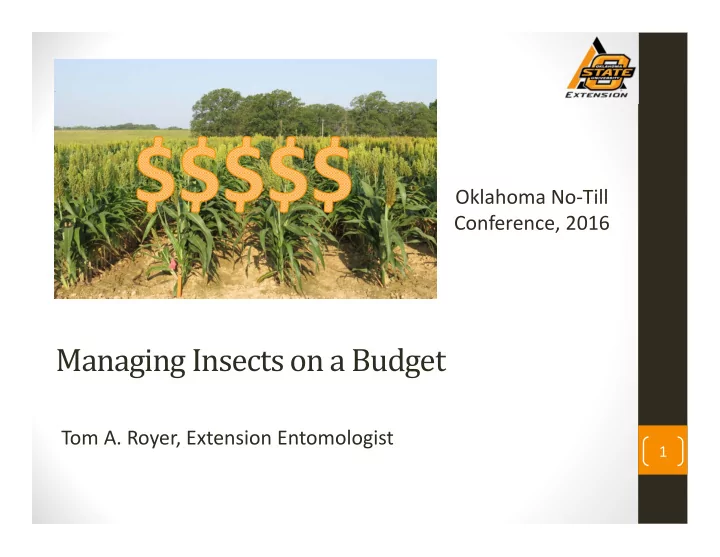
Managing Insects on a Budget

Tom A. Royer, Extension Entomologist Oklahoma No‐Till Conference, 2016

1
slide-2
SLIDE 2

“Utilizes all suitable pest management tactics…………..”

  • Biological
  • Cultural
  • Host Plant Resistance
  • Mechanical/Physical
  • Host Plant Resistance
  • Pesticides
  • Regulatory

Should Pesticides be used in an IPM Program?

2

slide-3
SLIDE 3

Chemical Control (Using an Insecticide Economically)

  • Follow LABEL recommendations for:
  • Rate
  • Frequency
  • Coverage
  • Use properly calibrated equipment designed to

deliver thorough coverage

  • Spot treat only infested areas if possible
  • Protect beneficial insects and limit run‐off

3

slide-4
SLIDE 4

Pest Management:

Decision Thresholds!

  • Economic Injury Level (EIL)
  • The break‐even point between the

cost of control and the loss in yield without control

  • This must be measured in some way
  • Not feasible for all pests

4

slide-5
SLIDE 5

Injury vs. Damage

  • Injury: the effect of pest activities on host

physiology that is usually deleterious

  • Centered on pest activities
  • Damage: the measurable loss of host

value (yield, quality, aesthetics).

  • Centered on crop and its response to

injury

5

slide-6
SLIDE 6

Calculating an Economic Injury Level

  • Calculating Loss per Insect
  • Not as easy as it might first seem
  • Different insects, different types of injury
  • Difference in crop susceptibility (variety,

growth stage)

  • Can be obtained by:
  • Crude field observations
  • Simulated damage
  • Experimentation with various insect

numbers at various crop growth stages

6

slide-7
SLIDE 7

How is an EIL Developed?

  • Value of Crop is known
  • Absolute pest numbers are related to

injury

  • Injury is related to yield loss
  • Effectiveness of control is measured

7

slide-8
SLIDE 8

The Economic Injury Level (EIL)

  • Economic Injury Level – defines the break‐even point at

which the cost of control ($) equals the loss in yield ($) if the pest is not controlled

EIL =__C__ VIDK

C = Cost of control V = Value of commodity I = Physical injury/pest unit D = Loss/unit of physical injury K = Loss prevented by control

8

slide-9
SLIDE 9

Pest Management:

Decision Thresholds!

  • Economic (Treatment)Threshold (ET)
  • The pest density at which management

action should be taken to prevent an increasing pest population from reaching the economic‐injury level

  • Not feasible for all pests (plant diseases,

weeds)

9

slide-10
SLIDE 10

Economic Threshold (ET)

  • Is also called the ”action threshold”; it is

a pest population level or a damage threshold that allows a grower to control the pest before it exceeds the EIL.

  • It can be fixed, or calculated:
  • ET=EIL*C where C = a factor of

population increase over unit of time

10

slide-11
SLIDE 11

How is an ET Developed?

  • Sampling method is selected for accurately

estimating pest numbers or injury level (index)

  • Sample method is related to absolute pest

levels

  • ET is set below the EIL, used as a prediction, or

trigger

  • ET = EIL x Time Factor (fixed or predictive)
  • Fixed = x % below threshold to provide time to treat
  • Descriptive = EIL x C‐x where C = factor of increase per

unit time

11

slide-12
SLIDE 12

How is an ET Set?

  • Thresholds are set for efficient (economic)

application of corrective pesticide applications

  • They can be adjusted based on insect biology

(change in temperature, crop stage)

  • Example: Greenbug thresholds are different

for January vs October, because greenbugs can multiply much faster in Oct.

12

slide-13
SLIDE 13

Using an Economic Threshold

5 10 15 20 25 30 35 40 1 4 7 10 13 16 20 23 26 29

Days Aphids per Tiller

Aphids Untreated EIL ET

Spray Decide

13

slide-14
SLIDE 14

Using an Economic Threshold

5 10 15 20 25 30 35 40 1 4 7 10 13 16 20 23 26 29

Days Aphids per Tiller

Aphids Treated EIL ET

Spray Decide

14

slide-15
SLIDE 15

Using an Economic Threshold

Pest resurgence

5 10 15 20 25 30 35 40 1 4 7 10 13 16 20 23 26 29

Days Aphids per Tiller

Aphids Treated EIL ET

Spray Decide Spray Decide

15

slide-16
SLIDE 16

Using an Economic Threshold

Pest resurgence

5 10 15 20 25 30 35 40 1 4 7 10 13 16 20 23 26 29

Days Aphids per Tiller

Aphids Treated EIL ET

Spray Decide Spray Decide

16

slide-17
SLIDE 17

Updated Expert Systems

Cereal Aphid and Sorghum Headworm

http://entoplp.okstate.edu/gbweb/index3.htm

17

http://entoplp.okstate.edu/shwweb/index.htm

slide-18
SLIDE 18

Updated Expert Systems

Cereal Aphid and Sorghum Headworm

  • Cereal Aphid Expert System:
  • A computer program located at

http://www.pswcrl.ars.usda.gov/gbweb/index.htm

  • Developed by USDA ARS, SST Development Group and

OSU.

  • Includes a calculator for determining economic thresholds for

greenbug infestations

  • Sorghum Headworm Decision Support System
  • A computer program located at

http://entoplp.okstate.edu/shwweb/index.htm

  • Developed jointly by USDA, Oklahoma State, Texas A&M

and West Texas A&M University

  • Includes a calculator for determining economic thresholds for

headworm infestations

18

slide-19
SLIDE 19

How does “Glance ‘n Go” Sampling for Greenbugs Work?

  • Record counts of

infested tillers, i.e. that have one or more greenbugs and or mummies on a Glance ‘n Go form, which is based

  • n the time of year, and

the pre‐determined economic threshold.

19

slide-20
SLIDE 20

Sorghum Headworm Sampling

  • Record counts of

medium and large headworms collected in a shake bucket which is based on a pre‐ determined economic threshold

20

slide-21
SLIDE 21

myFields Economics

21

Oklahoma State University

slide-22
SLIDE 22

Managing Insects on a Budget

  • Thanks!
  • Kris Giles, Norm Elliott,

Ali Zarrabi, Jason Warren

  • Oklahoma Wheat

Commission

  • Great Plains Oilseed

Association

  • Oklahoma Canola

Commission

  • Oklahoma Cooperative

Extension Service and the Agricultural Experiment Station

22

slide-23
SLIDE 23

Should Pesticides be used in an IPM Program?

  • Pesticides can to be used in an IPM program, however
  • nly as a last resort and of course in a manner that is

legal.

  • Pesticides are to be used when there is no risk of

environmental damage or when benefits outweigh the

  • risks. Use pesticides only when other control practices

aren’t available, economical or practical.

  • Must monitor pest populations in the field.
  • Identify the pest
  • Compare pest population and the economic threshold
  • Life stage susceptible to pesticide?
  • Crop stage and preventable loss.

23