SLIDE 1 10/18/2011 1
Mary Ann Dickinson Thomas Pape
SAVING INDUSTRIAL WATER IN SAVING INDUSTRIAL WATER IN THE GREAT LAKES: THE GREAT LAKES:
Opportunities and Challenges Opportunities and Challenges
Alliance for Water Efficiency
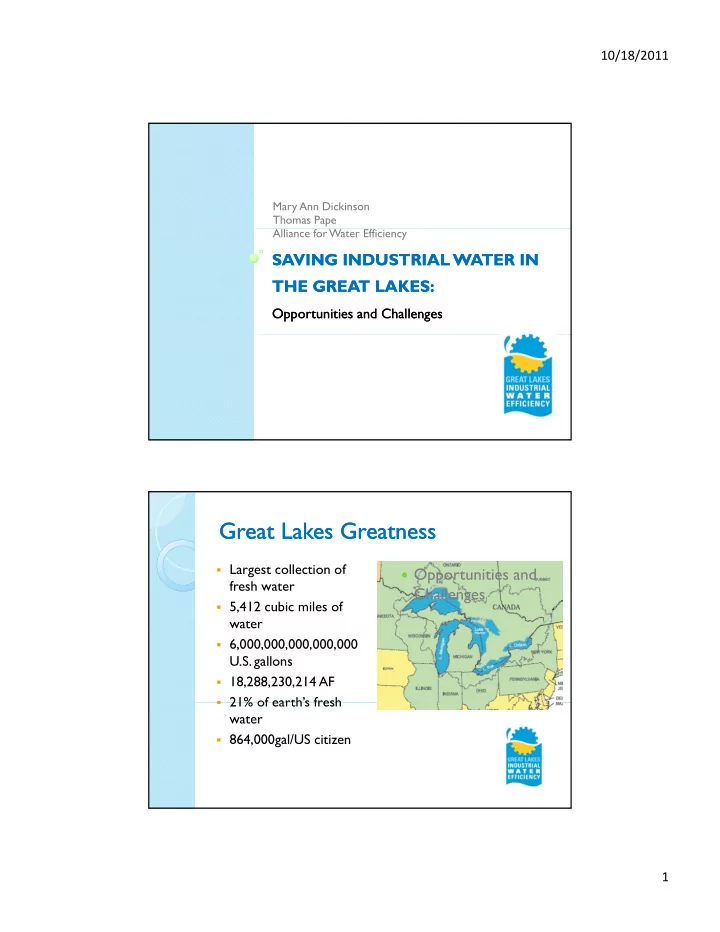
Great Lakes Greatness Great Lakes Greatness
Largest collection of
fresh water
Opportunities and
Challenges
5,412 cubic miles of
water
6,000,000,000,000,000
U.S. gallons
18,288,230,214 AF 21% of earth’s fresh
Challenges
21% of earths fresh
water
864,000gal/US citizen
SLIDE 2
10/18/2011 2
Consumptive Water Use* by Sector Consumptive Water Use* by Sector
* Consumptive = Withdrawal - Return
Industrial Sector Major Water Users Industrial Sector Major Water Users
Food & beverage products Ceramics, clay, glass & stone, products Paper & pulp products Metal refining and plating Transportation equipment Chemicals
SLIDE 3 10/18/2011 3
Grant Project Grant Project T eam T eam
1.
Mary Ann Dickinson – Project Director
2.
Thomas Pape – Project Manager
3.
Ken Mirvis – Communications
4.
William Hoffman – Project Engineer
5.
Jeff Edstrom – Environmental Assessment Advisor
6.
Townsend Albright – Loan Development Advisor
7.
Jeffrey Hughes – Administration
8.
Bill Christiansen – Research
9.
Molly Garcia – Finance Administration
Advisory Advisory Committee Committee
1.
Lynn Broaddus, Johnson Foundation at Wingspread
2.
Claus Dunkelberg, Milwaukee Water Council
3
Ed Gl tf lt Alli f th G t L k
3.
Ed Glatfelter, Alliance for the Great Lakes
4.
J.B. Hoyt, Whirlpool Corporation
5.
Dale Phenicie, Council of Great Lakes Industries
6.
Tim Loftus, Chicago Metropolitan Agency for Planning
7.
Jeffrey Ripp, Wisconsin Public Service Commission
8.
Karen Sands, Milwaukee Metropolitan Sewerage District
9.
Adam Rix, Watermark Initiative
SLIDE 4
10/18/2011 4
Grant Project Time Line Grant Project Time Line
Task 1: Research and Discovery
(Weeks 1-12)
Task 2: Conduct Site Assessments
(Weeks 12-40)
Task 3: Develop Viable Financing Plan
(Weeks 1-20)
Task 4: Assess Environmental Benefits
(Weeks 40 60) (Weeks 40-60)
Task 5: Findings and Recommendations
(Weeks 60-72)
Final Report: 8/10/12
Grant Project Grant Project Goal Goal
Achieve environmental
b fi i h G L k benefits in the Great Lakes ecosystem through demonstration of sustainable water use reduction in the industrial water use sector
SLIDE 5 10/18/2011 5
Project Project Method Method
Reach out to industries to create
awareness of proven technologies and
- pportunities for efficiency
Offer technical assistance to conduct
- r verify benefit/cost analyses
Identify barriers to implementing
recommended efficiency actions
Create structure for low interest loans
to offset implementation costs
The Target Market The Target Market
Industries common to Great Lakes area Industries receiving water from public
Industries receiving water from public utility sources in Great Lakes Basin
Industries sustaining or growing in
marketplace
Industries or users that are high volume
SLIDE 6
10/18/2011 6
Assessment Assessment Factors Factors
Participation by target
industries industries
Implementation of measures Water use reductions Financing feedback Implementation results
Implementation results
Benefit-cost assessment Environmental assessment
Marketing Piece Marketing Piece
SLIDE 7
10/18/2011 7
Industries Marketed Industries Marketed
Pharmaceutical Agricultural products processing
g p p g
Beverage and food production Dairy products Appliance & electronics manufacturing Plastics molders
V hi l f i
Vehicle manufacturing Metal platers Others?
Industries Visited on Site Industries Visited on Site
MI Bell’s Brewery WI Diedrich Tanning g OH Whirlpool OH Equastar WI Reliable Plating Works WI Harley-Davidson NY LaFarge Concrete WI Law Tanning WI Pho-Tronics WI Mickey’s Linen Service
SLIDE 8
10/18/2011 8
Project Sites Chosen Project Sites Chosen
Tanning Industry Appliance Manufacturing Appliance Manufacturing Beverage Production Metal Plating Chemical Compounding
Opportunities Opportunities
Many water intensive industries
Attracted to plentiful water Attracted to plentiful water
Little water efficiency assistance Eager to be cost competitive Desire to preserve the resource Low prime rate
Low prime rate
The new greening of the industries
SLIDE 9 10/18/2011 9
Challenges Challenges
Relocation of industry: Should they stay or go? Plentiful rainfall: 50+ inches/year Plentiful water: low water prices Plentiful infrastructure: high overhead costs Dwindling customer base: little utility support Greenwashing: uncertain level of commitment Very short payback required: cherry picking
Very short payback required: cherry picking
Regulations & rates: savings negated?
Reasons for Optimism Reasons for Optimism
There is HUGE
HUGE savings potential.
Most measures are simple and fast. Sustainability Chiefs are enthusiastic to carry
the ball.
World competition requires lowering
Evolving use of Great Lakes requires
sustainable consumption and better water sustainable consumption and better water quality.
Plentiful rainfall to harvest.
SLIDE 10
10/18/2011 10