
SLIDE 1
Great Lakes Restoration Efforts
1
- Dr. Marie Colton
Director, Great Lakes Environmental Research Laboratory March 7, 2012
Great Lakes Restoration Efforts Dr. Marie Colton Director, Great - - PowerPoint PPT Presentation
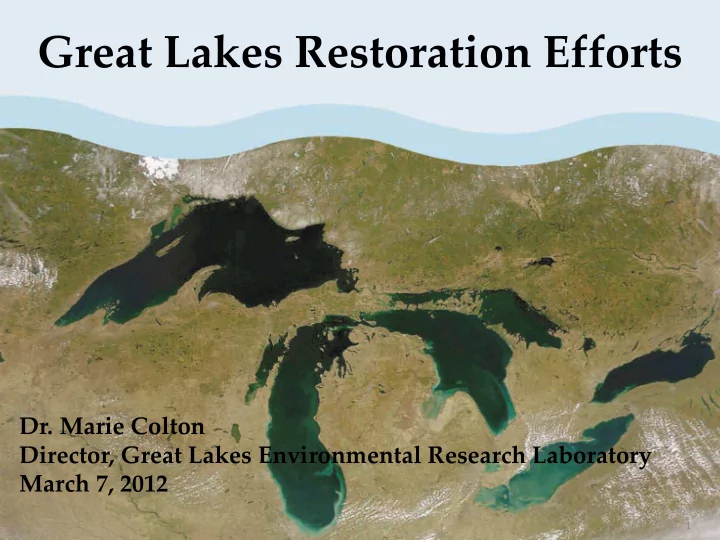
Great Lakes Restoration Efforts Dr. Marie Colton Director, Great Lakes Environmental Research Laboratory March 7, 2012 1 COMPARE: U.S. COASTLINE 11,000 miles of coastline 20% of the worlds freshwater 95,000 square miles of lake surface
1
Director, Great Lakes Environmental Research Laboratory March 7, 2012
2
11,000 miles of coastline 20% of the world’s freshwater 95,000 square miles of lake surface
COMPARE: U.S. COASTLINE
Why a Freshwater Restoration Imperative?
Resource loss and contamination, climate accentuated, economic
3
worldwide by 2025
– Increasing severe shortages in SE and SW United States
– 50% rivers and 66% of lakes now impaired. – 62 million in 45 states exposed to unsafe drinking water
population growth, economic recession – leading to geopolitical stresses = interstate and international conflicts.
– Water supplies in 70% of counties threatened due to climate change by
to 3:1 benefit-cost ratio on restoration investment)
U.S. Secretary of State Hillary Rodham Clinton appears with Canadian Foreign Affairs Minister Lawrence Cannon in Niagara Falls, Canada, 2009,following a ceremony to celebrate the 100th anniversary of the Boundary Waters Treaty of 1909.
4
Clean Water Act:
Established the structure for regulating discharges
waters and regulating quality standards for surface waters
Great Lakes Water Quality Agreement (GLWQA)
Expresses the commitment of U.S. and Canada to “restore and maintain the chemical, physical and biological integrity of the Great Lakes Basin Ecosystem”
GLWQA Renewed
Amendments to GLWQA
Designated 43 “Areas of Concern” (AOCs)
American Recovery and Reinvestment Act (ARRA)
Enacted to spur economic growth and create jobs
Great Lakes Restoration Initiative
Great Lakes Legacy Act
Provides funding to clean up contaminated sediment in U.S. and binational AOCs
Great Lakes Regional Collaboration
federal partners, etc.
the Great Lakes”
5
Executive Order 13340 (2004) Strategy to Protect & Restore the Great Lakes (2005) Unprecedented support from over 1,500 stakeholders including Governors, Mayors, tribes (2005) GLRI was signed into Public Law on 30 October 2009
1 2 3 4
6
Toxics 6% Invasives 4% Habitat 50% Nearshore 9% Accountability 29%
Distribution of Funds by Focus Area
7
Template Level Reporting Interagency Agreement Reporting Program Manager Focus Area Leads Project Leads Funds Manager REGIONAL WORKING GROUP
GLRI Funds Management
8
Restoration Center, National Marine Fisheries Service
– Awarded $35 million since 2008 through ARRA, congressional base appropriations, and the GLRI
material
Programs
– $11.55 million since 2010 through GLRI and congressional base appropriations to protect 6264 acres of coastal habitat
9
RESTORATION Milwaukee River Estuary AOC Fish Passage Project
Mequon-Theinsville Dam Fishway
Lime Kiln Dam Removal restores 31 miles of Milwaukee River mainstem.
Milwaukee River Estuary AOC Fish Passage Project
RESULT: Target species, Northern Pike, documented and photographed passing through fishway. SOCIETAL IMPACT: Milwaukee intercity youth corps helping to restore over 75 miles of Milwaukee River tributary streams.
Muskegon Lake AOC Habitat Restoration Project
To date, 10,251 linear feet of degraded shoreline has been restored. Local middle school involved in monitoring some of the 24 acres of wetlands restored by the project.
expertise) should be established to:
– Provide assessments of progress in key areas – Shepherd the design and implementation of monitoring and evaluation efforts – Help provide a scientific basis for setting priorities across disparate actions
metrics of progress that are more in line with the underlying science
Results Act measures that currently comprise the Action Plan
evaluation and reprioritization of efforts will need to be accomplished, ideally using an adaptive management framework
Max in 1979 95% Max in 2012 ~ 5%--Record low March 3, 2009, ~ 84% 1973-2002 mean: 54%
16
On February 20, 2012, the western basin of Lake Erie was dominated by suspended minerals, with a possible diatom (phytoplankton) bloom occurring in the central basin
– Expect the unexpected – Establishing an effective decision- making process for dispersing large amount of $$ in a short period of time – Transparency of decision making processes – Communications – Funds management – Measures of success – Issue of scale…going from particular projects to overall regional restoration
– Effectively integrating science with public policy in a way to influence social dynamics and produce sustainable results Adaptive and Predictive Management
Why Support the Plan?
20
21
11,000 miles of coastline 20% of the world’s freshwater 95,000 square miles of lake surface
23
Alpena Duluth Milwaukee Chicago Cleveland Toronto Detroit Muskegon Au Gres Ann Arbor
23
24
11,000 miles of coastline 20% of the world’s freshwater 95,000 square miles of lake surface
25
Dunes Creek Daylighting Project
Restored Dunes Creek in location where a parking lot constructed in the 1930’s used to be. Lake Michigan is now connected to the 7,407-acre watershed via almost 6 miles of open stream.