GR GRI 30 I 303: Wat ater an and Eff d Efflue uent nts 2018 - - PowerPoint PPT Presentation

gr gri 30 i 303 wat ater an and eff d efflue uent nts
SMART_READER_LITE
LIVE PREVIEW

GR GRI 30 I 303: Wat ater an and Eff d Efflue uent nts 2018 - - PowerPoint PPT Presentation

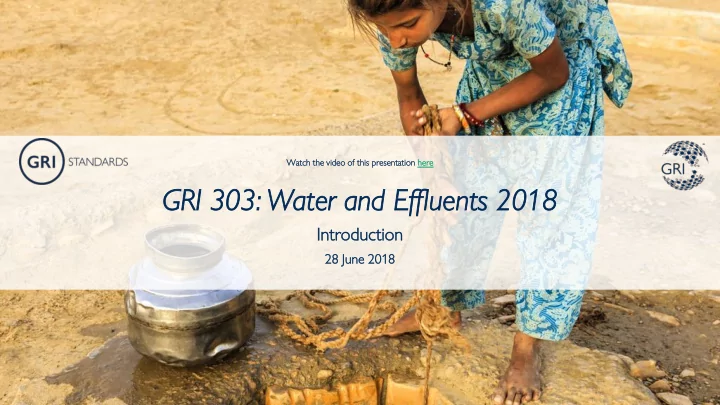
Watc tch h the vide deo of this pres esen entat tatio ion n here GR GRI 30 I 303: Wat ater an and Eff d Efflue uent nts 2018 18 Int ntrodu duction tion 28 June ne 2018 About the GRI Standards The GRI Standards are the

slide-1
SLIDE 1

Watc tch h the vide deo of this pres esen entat tatio ion n here

GR GRI 30 I 303: Wat ater an and Eff d Efflue uent nts 2018 18

Int ntrodu duction tion

28 June ne 2018

slide-2
SLIDE 2

About the GRI Standards

  • The GRI Standards are the most widely used framework for

sustainability reporting. They provide the common language for

  • rganizations to report publicly about their impacts on the

economy, the environment, and society

  • Reporting publicly drives improvement within organizations and

informs decision makers such as investors or governments

  • The GRI Standards are structured as a set of interrelated,

modular standards. They include:

  • Three universal Standards that apply to every organization

preparing a sustainability report

  • 33 topic-specific Standards (on e.g., water, occupational health and

safety, anti-corruption) for reporting on the identified material topics

slide-3
SLIDE 3

Review of GRI 303

Development process

  • The Standard is issued by the Global Sustainability Standards

Board (GSSB), GRI’s independent standard-setting body, following its Due Process Protocol

  • The Standard has been developed through a transparent and

inclusive process and in the public interest, including:

  • input from an expert multi-stakeholder working group, with

representatives from civil society, investors, business and international and governmental institutions

  • nearly 800 comments from stakeholders received on the exposure

drafts

Please visit the GRI website for more information about the standard setting process and the development of this Standard

slide-4
SLIDE 4

Worki king g group member bers: s:

  • ACTIAM
  • Aditya Birla Group
  • CDP
  • Ceres
  • Glencore
  • Guess
  • Heineken
  • Industrial Development Corporation of

South Africa

  • International Council on Mining and Metals

(ICMM)

  • International Union for Conservation of

Nature (IUCN)

  • Sustainability Standards Accounting Board

(SASB)

  • The Pacific Institute
  • UN PRI
  • World Resources Institute (WRI)
  • World Wildlife Fund (WWF)

Review of GRI 303

  • The Standard is issued by the Global Sustainability Standards

Board (GSSB), GRI’s independent standard-setting body, following its Due Process Protocol

  • The Standard has been developed through a transparent and

inclusive process and in the public interest, including:

  • input from an expert multi-stakeholder working group, with

representatives from civil society, investors, business and international and governmental institutions

  • nearly 800 comments from stakeholders received on the exposure

drafts

Please visit the GRI website for more information about the standard setting process and the development of this Standard Development process

slide-5
SLIDE 5

Why review GRI 303?

  • To reflect internationally-agreed best practice and recent

developments in water stewardship and reporting

  • To harmonize with other reporting frameworks and address the

needs of various stakeholder groups:

  • Metrics, concepts, and data collection methodology from the CEO

Water Mandate Corporate Water Disclosure Guidelines and CDP Water Questionnaire 2018 have been included

  • The Standard is grounded on the Sustainable Development Goals

Objectives

slide-6
SLIDE 6

Key features of updated GRI 303

  • New specific management approach content, to focus on how

water is managed as a shared resource and how impacts are managed at a local level

  • Revised water discharge content from GRI 306: Effluents and Waste

2016, including more detail on reporting the quality of water discharges

  • New disclosure to report water consumption, to measure water

that is not returned to the environment

  • Greater emphasis on measuring impacts in areas with water stress,

to understand impact in the most sensitive locations

slide-7
SLIDE 7

Key features of updated GRI 303

  • Provisions have been introduced to allow flexibility with reporting
  • n both critical freshwater resources, as well as other water that an
  • rganization is managing
  • New recommendations to report facility level information for

water withdrawal and water consumption

  • New quantitative and qualitative content to report impacts in the

supply chain, to start changing the status quo in how organizations consider these impacts

  • Updated terminology and extensive guidance on how to compile

the data

slide-8
SLIDE 8

Overview of disclosures

Management approach disclosures 303-1 Interactions with water as a shared resource 303-2 Management of water discharge-related impacts Topic-specific disclosures 303-3 Water withdrawal 303-4 Water discharge 303-5 Water consumption Each disclosure can have additional requirements on how to compile or present the information, along with recommendations and guidance

slide-9
SLIDE 9

a. A description of how the organization interacts with water, including how and where water is withdrawn, consumed, and discharged, and the water-related impacts caused or contributed to, or directly linked to the organization’s activities, products or services by a business relationship (e.g., impacts caused by runoff). b. A description of the approach used to identify water-related impacts, including the scope of assessments, their timeframe, and any tools or methodologies used. c. A description of how water-related impacts are addressed, including how the

  • rganization works with stakeholders to steward water as a shared resource,

and how it engages with suppliers or customers with significant water-related impacts. d. An explanation of the process for setting any water-related goals and targets that are part of the organization’s management approach, and how they relate to public policy and the local context of each area with water stress.

Management approach disclosures

Disclosure 303-1 Interactions with water as a shared resource

slide-10
SLIDE 10

a. A description of any minimum standards set for the quality of effluent discharge, and how these minimum standards were determined, including: i. how standards for facilities operating in locations with no local discharge requirements were determined; ii. any internally developed water quality standards or guidelines; iii. any sector-specific standards considered; iv. whether the profile of the receiving waterbody was considered.

Management approach disclosures

Disclosure 303-2 Management of water discharge-related impacts

slide-11
SLIDE 11

a. Total water withdrawal from all areas in megaliters, and a breakdown of this total by the following sources, if applicable: i. Surface water; ii. Groundwater; iii. Seawater; iv. Produced water; v. Third-party water. b. Total water withdrawal from all areas with water stress in megaliters, and a breakdown of this total by the following sources, if applicable: i. Surface water; ii. Groundwater; iii. Seawater; iv. Produced water; v. Third-party water, and a breakdown of this total by the withdrawal sources listed in i-iv. (continues on next slide)

Topic-specific disclosures

Disclosure 303-3 Water withdrawal

slide-12
SLIDE 12

c. A breakdown of total water withdrawal from each of the sources listed in Disclosures 303-3-a and 303-3-b in megaliters by the following categories: i. Freshwater (≤1,000 mg/L Total Dissolved Solids); ii. Other water (>1,000 mg/L Total Dissolved Solids). d. Any contextual information necessary to understand how the data have been compiled, such as any standards, methodologies, and assumptions used.

Topic-specific disclosures

Disclosure 303-3 Water withdrawal (continued)

Impor

  • rtant

nt informa

  • rmati

tion

  • n for compiling

ng the e data:

  • Required to use publicly available and credible tools and methodologies to assess areas with water stress

Definition of ‘freshwater’: water with concentration of total dissolved solids equal to or below 1,000 mg/L

slide-13
SLIDE 13

a. Total water discharge to all areas in megaliters, and a breakdown of this total by the following types of destination, if applicable: i. Surface water; ii. Groundwater; iii. Seawater; iv. Third-party water, and the volume of this total sent for use to other

  • rganizations, if applicable.

b. A breakdown of total water discharge to all areas in megaliters by the following categories: i. Freshwater (≤1,000 mg/L Total Dissolved Solids); ii. Other water (>1,000 mg/L Total Dissolved Solids). c. Total water discharge to all areas with water stress in megaliters, and a breakdown of this total by the following categories: i. Freshwater (≤1,000 mg/L Total Dissolved Solids); ii. Other water (>1,000 mg/L Total Dissolved Solids). (continues on next slide)

Topic-specific disclosures

Disclosure 303-4 Water discharge

slide-14
SLIDE 14

d. Priority substances of concern for which discharges are treated, including: i. how priority substances of concern were defined, and any international standard, authoritative list, or criteria used; ii. the approach for setting discharge limits for priority substances of concern; iii. number of incidents of non-compliance with discharge limits. e. Any contextual information necessary to understand how the data have been compiled, such as any standards, methodologies, and assumptions used.

Topic-specific disclosures

Disclosure 303-4 Water discharge (continued)

Impor

  • rtant

nt informa

  • rmati

tion

  • n for compiling

ng the e data:

  • Guidance on how to define substances of concern

Definition of ‘freshwater’: water with concentration of total dissolved solids equal to or below 1,000 mg/L

slide-15
SLIDE 15

a. Total water consumption from all areas in megaliters. b. Total water consumption from all areas with water stress in megaliters. c. Change in water storage in megaliters, if water storage has been identified as having a significant water-related impact. d. Any contextual information necessary to understand how the data have been compiled, such as any standards, methodologies, and assumptions used, including whether the information is calculated, estimated, modeled, or sourced from direct measurements, and the approach taken for this, such as the use of any sector-specific factors.

Topic-specific disclosures

Disclosure 303-5 Water consumption

Definition of ‘water consumption’: sum of all water that has been withdrawn and incorporated into products, used in the production of crops or generated as waste, has evaporated, transpired, or been consumed by humans or livestock, or is polluted to the point

  • f being unusable by other users, and is therefore not released back to surface water, groundwater, seawater, or a

third party over the course of the reporting period Impor

  • rtant

nt informa

  • rmati

tion

  • n for compiling

ng the e data:

  • Recommended formula for calculating water consumption:

water consumption = water withdrawal – water discharge

slide-16
SLIDE 16

Topic-specific disclosures

Important guidance supporting compilation of data for all topic-specific disclosures

slide-17
SLIDE 17

Changes to the GRI Glossary

New and updat ated te terms: ms:

  • catchment
  • effluent
  • freshwater
  • groundwater
  • produced water
  • runoff
  • seawater
  • surface water
  • third-party water
  • water consumption
  • water discharge
  • water stewardship
  • water storage
  • water stress
  • water withdrawal
slide-18
SLIDE 18

How to use this Standard

Standar dards ds/Disc isclosur

  • sures

es Core Compr prehensiv ehensive GRI 103: Managem agement ent Approach

  • ach 2016

Disclosures 103-1 to 103-3 All All GRI 303: Water er and d Eff ffluent luents s 2018 Manag agem emen ent appr proach ch disclos closur ures es Disclosures 303-1 to 303-2 All All Topic ic-spec specific ific disclos closur ures es Discloures 303-3 to 303-5 At least one All

Reasons for omisison apply for Disclosures 103-2 and 103-3 and all disclosures in GRI 303

Requirements for reporting disclosures in accordance with the GRI Standards

slide-19
SLIDE 19

How to use this Standard

Effective date

  • The use of this Standard is required for reports or other materials

published on or after 1 January 2021. Earlier adoption is encouraged

  • GRI 303: Water 2016 can continue to be used for reports or other

materials published on or before 31 December 2020 Advice for new and existing reporters

  • New reporters are advised to start reporting with the new 2018

Standard

  • Existing users of GRI 303: Water 2016 are advised to start the

transition to the new 2018 Standard as soon as possible Date by which the use of this Standard becomes mandatory

slide-20
SLIDE 20

Available resources

Frequently asked questions

  • Consult the frequently asked questions about this Standard on the

GRI Standards website

  • For any questions that are not covered in the FAQ, send an email

to standards@globalreporting.org Translations

  • Translations into key languages will be available from Q4 2018.

Keep an eye on the GRI Standards website for the upcoming translation schedule

slide-21
SLIDE 21

Available resources (continued)

Sign up for the live webinars

  • 19 September (9-10 AM CEST). Register for free here.
  • 19 September (4-5 PM CEST). Register for free here.

Download the GRI 303: Water and Effluents 2018 Standard here.

slide-22
SLIDE 22

www.globalreporting.org/WaterStandardReview standards@globalreporting.org

THANK YOU

Amsterdam – Beijing – Bogota – Johannesburg – New Delhi – New York – São Paulo