Precision EW Measurements from ATLAS Extracting sin 2 eff - - PowerPoint PPT Presentation

precision ew measurements from atlas
SMART_READER_LITE
LIVE PREVIEW

Precision EW Measurements from ATLAS Extracting sin 2 eff - - PowerPoint PPT Presentation

Precision EW Measurements from ATLAS Extracting sin 2 eff Introduction Why measure sin 2 eff ? New triple-diff l Drell-Yan Cross Sections d 3 Systematic Uncertainties Extraction of sin 2 eff Measurement of the Drell-Yan triple


slide-1
SLIDE 1

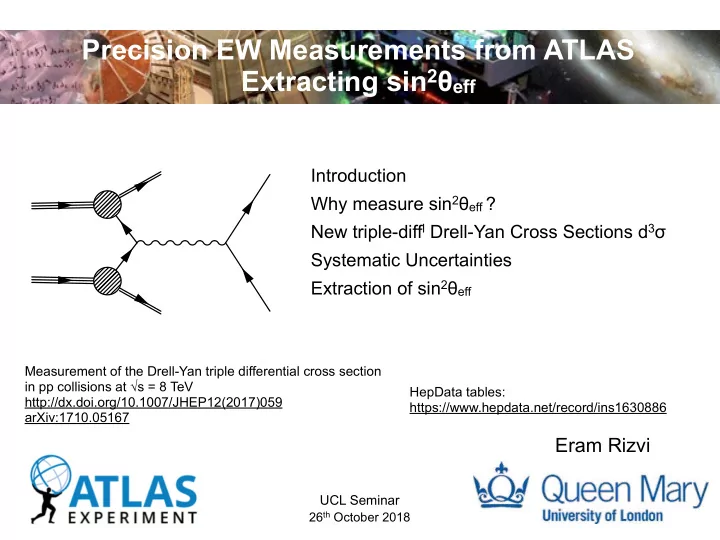
Precision EW Measurements from ATLAS Extracting sin2θeff

UCL Seminar

Eram Rizvi

26th October 2018

Introduction Why measure sin2θeff ? New triple-diffl Drell-Yan Cross Sections d3σ Systematic Uncertainties Extraction of sin2θeff

Measurement of the Drell-Yan triple differential cross section in pp collisions at √s = 8 TeV http://dx.doi.org/10.1007/JHEP12(2017)059 arXiv:1710.05167 HepData tables: https://www.hepdata.net/record/ins1630886

slide-2
SLIDE 2

UCL Seminar − 26th October 2018 Eram Rizvi

Model

ℓ, γ

Jets† Emiss

T

  • L dt[fb−1]

Limit Reference

Extra dimensions Gauge bosons CI DM LQ Heavy quarks Excited fermions Other

ADD GKK + g/q 0 e, µ 1 − 4 j Yes 36.1

n = 2 1711.03301

7.7 TeV

MD

ADD non-resonant γγ 2 γ − − 36.7

n = 3 HLZ NLO 1707.04147

8.6 TeV

MS

ADD QBH − 2 j − 37.0

n = 6 1703.09127

8.9 TeV

Mth

ADD BH high pT ≥ 1 e, µ ≥ 2 j − 3.2

n = 6, MD = 3 TeV, rot BH 1606.02265

8.2 TeV

Mth

ADD BH multijet − ≥ 3 j − 3.6

n = 6, MD = 3 TeV, rot BH 1512.02586

9.55 TeV

Mth

RS1 GKK → γγ 2 γ − − 36.7

k/MPl = 0.1 1707.04147

4.1 TeV

GKK mass

Bulk RS GKK → WW /ZZ multi-channel 36.1

k/MPl = 1.0 CERN-EP-2018-179

2.3 TeV

GKK mass

Bulk RS gKK → tt 1 e, µ ≥ 1 b, ≥ 1J/2j Yes 36.1

Γ/m = 15% 1804.10823

3.8 TeV

gKK mass

2UED / RPP 1 e, µ ≥ 2 b, ≥ 3 j Yes 36.1

Tier (1,1), B(A(1,1) → tt) = 1 1803.09678

1.8 TeV

KK mass

SSM Z ′ → ℓℓ 2 e, µ − − 36.1

1707.02424

4.5 TeV

Z′ mass

SSM Z ′ → ττ 2 τ − − 36.1

1709.07242

2.42 TeV

Z′ mass

Leptophobic Z ′ → bb − 2 b − 36.1

1805.09299

2.1 TeV

Z′ mass

Leptophobic Z ′ → tt 1 e, µ ≥ 1 b, ≥ 1J/2j Yes 36.1

Γ/m = 1% 1804.10823

3.0 TeV

Z′ mass

SSM W ′ → ℓν 1 e, µ − Yes 79.8

ATLAS-CONF-2018-017

5.6 TeV

W′ mass

SSM W ′ → τν 1 τ − Yes 36.1

1801.06992

3.7 TeV

W′ mass

HVT V ′ → WV → qqqq model B 0 e, µ 2 J − 79.8

gV = 3 ATLAS-CONF-2018-016

4.15 TeV

V′ mass

HVT V ′ → WH/ZH model B multi-channel 36.1

gV = 3 1712.06518

2.93 TeV

V′ mass

LRSM W ′

R → tb

multi-channel 36.1

CERN-EP-2018-142

3.25 TeV

W′ mass

CI qqqq − 2 j − 37.0

η−

LL

1703.09127

21.8 TeV

Λ

CI ℓℓqq 2 e, µ − − 36.1

η−

LL

1707.02424

40.0 TeV

Λ

CI tttt ≥1 e,µ ≥1 b, ≥1 j Yes 36.1

|C4t| = 4π CERN-EP-2018-174

2.57 TeV

Λ

Axial-vector mediator (Dirac DM) 0 e, µ 1 − 4 j Yes 36.1

gq=0.25, gχ=1.0, m(χ) = 1 GeV 1711.03301

1.55 TeV

mmed

Colored scalar mediator (Dirac DM) 0 e, µ 1 − 4 j Yes 36.1

g=1.0, m(χ) = 1 GeV 1711.03301

1.67 TeV

mmed

VV χχ EFT (Dirac DM) 0 e, µ 1 J, ≤ 1 j Yes 3.2

m(χ) < 150 GeV 1608.02372

700 GeV

M∗

Scalar LQ 1st gen 2 e ≥ 2 j − 3.2

β = 1 1605.06035

1.1 TeV

LQ mass

Scalar LQ 2nd gen 2 µ ≥ 2 j − 3.2

β = 1 1605.06035

1.05 TeV

LQ mass

Scalar LQ 3rd gen 1 e, µ ≥1 b, ≥3 j Yes 20.3

β = 0 1508.04735

640 GeV

LQ mass

VLQ TT → Ht/Zt/Wb + X multi-channel 36.1

SU(2) doublet ATLAS-CONF-2018-032

1.37 TeV

T mass

VLQ BB → Wt/Zb + X multi-channel 36.1

SU(2) doublet ATLAS-CONF-2018-032

1.34 TeV

B mass

VLQ T5/3T5/3|T5/3 → Wt + X 2(SS)/≥3 e,µ ≥1 b, ≥1 j Yes 36.1

B(T5/3 → Wt)= 1, c(T5/3Wt)= 1 CERN-EP-2018-171

1.64 TeV

T5/3 mass

VLQ Y → Wb + X 1 e, µ ≥ 1 b, ≥ 1j Yes 3.2

B(Y → Wb)= 1, c(YWb)= 1/ √ 2 ATLAS-CONF-2016-072

1.44 TeV

Y mass

VLQ B → Hb + X 0 e,µ, 2 γ ≥ 1 b, ≥ 1j Yes 79.8

κB= 0.5 ATLAS-CONF-2018-024

1.21 TeV

B mass

VLQ QQ → WqWq 1 e, µ ≥ 4 j Yes 20.3

1509.04261

690 GeV

Q mass

Excited quark q∗ → qg − 2 j − 37.0

  • nly u∗ and d∗, Λ = m(q∗)

1703.09127

6.0 TeV

q∗ mass

Excited quark q∗ → qγ 1 γ 1 j − 36.7

  • nly u∗ and d∗, Λ = m(q∗)

1709.10440

5.3 TeV

q∗ mass

Excited quark b∗ → bg − 1 b, 1 j − 36.1

1805.09299

2.6 TeV

b∗ mass

Excited lepton ℓ∗ 3 e, µ − − 20.3

Λ = 3.0 TeV 1411.2921

3.0 TeV

ℓ∗ mass

Excited lepton ν∗ 3 e, µ, τ − − 20.3

Λ = 1.6 TeV 1411.2921

1.6 TeV

ν∗ mass

Type III Seesaw 1 e, µ ≥ 2 j Yes 79.8

ATLAS-CONF-2018-020

560 GeV

N0 mass

LRSM Majorana ν 2 e, µ 2 j − 20.3

m(WR) = 2.4 TeV, no mixing 1506.06020

2.0 TeV

N0 mass

Higgs triplet H±± → ℓℓ 2,3,4 e, µ (SS) − − 36.1

DY production 1710.09748

870 GeV

H±± mass

Higgs triplet H±± → ℓτ 3 e, µ, τ − − 20.3

DY production, B(H±±

L

→ ℓτ) = 1 1411.2921

400 GeV

H±± mass

Monotop (non-res prod) 1 e, µ 1 b Yes 20.3

anon−res = 0.2 1410.5404

657 GeV

spin-1 invisible particle mass

Multi-charged particles − − − 20.3

DY production, |q| = 5e 1504.04188

785 GeV

multi-charged particle mass

Magnetic monopoles − − − 7.0

DY production, |g| = 1gD, spin 1/2 1509.08059

1.34 TeV

monopole mass

Mass scale [TeV] 10−1 1 10

√s = 8 TeV √s = 13 TeV

ATLAS Exotics Searches* - 95% CL Upper Exclusion Limits

Status: July 2018

ATLAS Preliminary

  • L dt = (3.2 – 79.8) fb−1

√s = 8, 13 TeV

*Only a selection of the available mass limits on new states or phenomena is shown.

†Small-radius (large-radius) jets are denoted by the letter j (J).

2

O v e r 6 f b-1 d a t a c

  • l

l e c t e d a t √ s = 7 , 8 , 1 3 T e V N

  • s

m

  • k

i n g g u n s , n

  • s

i g n a l s , n

  • B

S M h i n t s

New Physics Searches

slide-3
SLIDE 3

UCL Seminar − 26th October 2018 Eram Rizvi 3

The Standard Model

Probing EW and QCD sector of Standard Model over 12 orders of magnitude!

These measurements

pp

500 µb−1 80 µb−1

W Z t¯ t t

t-chan

WW H

total

t¯ tH

VBF VH

Wt

2.0 fb−1

WZ ZZ t

s-chan

t¯ tW t¯ tZ tZj 10−1 1 101 102 103 104 105 106 1011

σ [pb]

Status: July 2018

ATLAS Preliminary Run 1,2 √s = 7,8,13 TeV

Theory LHC pp √s = 7 TeV Data 4.5 − 4.6 fb−1 LHC pp √s = 8 TeV Data 20.2 − 20.3 fb−1 LHC pp √s = 13 TeV Data 3.2 − 79.8 fb−1

Standard Model Total Production Cross Section Measurements

slide-4
SLIDE 4

UCL Seminar − 26th October 2018 Eram Rizvi

−3 −2 −1 1 2 3

meas

σ ) /

meas

O −

fit

(O

)

2 Z

(M

s

α )

2 Z

(M

(5) had

α ∆

t

m

b

R

c

R

b

A

c

A

0,b FB

A

0,c FB

A (Tevt.)

lept eff

Θ

2

sin )

FB

(Q

lept eff

Θ

2

sin (SLD)

l

A (LEP)

l

A

0,l FB

A

lep

R

had

σ

Z

Γ

Z

M

W

Γ

W

M

H

M 1.3

  • 0.2

0.5

  • 0.7

0.0 0.6 0.0 2.4 0.8 0.1

  • 0.7
  • 2.1

0.1

  • 0.9
  • 1.0
  • 1.5
  • 0.2

0.3 0.1

  • 1.5

0.0

4

Electroweak Precision Observables - sin2θeff

sin2θW is a fundamental SM parameter of the SM Specifies the mixing between EM and weak fields Relates the Z and W couplings gZ and gW (and their masses)

sin2 θW = 1 − g2

W

g2

Z

= 1 − m2

W

m2

Z

Higher order EW corrections modify this to an effective mixing angle dependent on fermion flavour f

sin2 θf

eff = (1 − m2 W

m2

Z

) · (1 + ∆r)

At leading order EW scheme dependent corrections incorporated into Δr → Δr(mH , mtop , …) With known mh EW sector of SM is over-constrained

  • mZ = 91.1876 GeV
  • Gµ = 1.16637 x 10⁻⁵ GeV-2
  • αQED(0) = 1/137.035
  • …. several others ….

GFitter 2018

Global EW fit of all precision data

slide-5
SLIDE 5

UCL Seminar − 26th October 2018 Eram Rizvi 5

2

Final Precision on sin2θeff

Electroweak Precision Observables - sin2θeff

GFitter 2014

sin2θeff precision ± 50x10-5 equivalent to ± 25 MeV in mW Measurement of one observable can predict the other mW ⇔ sin2θW

m2

W =

πα(0) √ 2Gµ sin2 θW 1 1 − ∆r

mW and sin2θeff allows self-consistency check of SM New physics hidden in the higher order corrections ?? Valuable test in absence of direct BSM signals First LHC results on sin2θeff CMS(7TeV): ± 320 x10-5 ATLAS(7TeV): ± 120 x10-5 LEP: ± 29 x10-5 SLD: ± 26 x10-5 CDF+D0: ± 35 x10-5

sin2 θf

eff = (1 − m2 W

m2

Z

) · (1 + ∆r)

EW scheme dependent corrections incorporated into Δr → Δr(mH , mtop , new physics) In context of EFT extension to SM EW oblique parameters S, T, U, Y, W incorporate new BSM dim-6 operators in self-energy terms

slide-6
SLIDE 6

UCL Seminar − 26th October 2018 Eram Rizvi 6

Electroweak Precision Observables - mW

New ATLAS measurement of mW reaches ±19 MeV precision ATLAS approaches precision of combined LEP + Tevatron measurement Theory prediction from EW fit has uncertainty ±8 MeV

arXiv:1701.07240

slide-7
SLIDE 7

UCL Seminar − 26th October 2018 Eram Rizvi 7

102 103 0.23 0.232 0.234 sin2θ

lept eff

mH [GeV]

χ2/d.o.f.: 11.8 / 5

A

0,l fb

0.23099 ± 0.00053 Al(Pτ) 0.23159 ± 0.00041 Al(SLD) 0.23098 ± 0.00026 A

0,b fb

0.23221 ± 0.00029 A

0,c fb

0.23220 ± 0.00081 Q

had fb

0.2324 ± 0.0012 Average 0.23153 ± 0.00016

∆α = 0.02758 ± 0.00035 ∆α m = 178.0 ± 4.3 GeV

Previous generation of sin2θW measurements LEP/SLD Several different observables and asymmetries used Al = polarisation L/R asymmetry at SLD AFB = forward/backward asymmetry in Z→bb Long-standing 3.2σ discrepancy between LEP and SLD

0,b

Physics Reports 427 (2006) 257–454

Electroweak Precision Observables - sin2θeff

slide-8
SLIDE 8

UCL Seminar − 26th October 2018 Eram Rizvi 8

Drell—Yan Measurement at ATLAS

Q (GeV)

10

2

10

3

10

σ

  • 9

10

  • 8

10

  • 7

10

  • 6

10

  • 5

10

  • 4

10

  • 3

10

  • 2

10

  • 1

10 1 10

2

10

3

10

4

10

5

10

6

10

= 13 TeV s

Total NLO Cross Section Z Contribution Contribution

*

γ Interference (Modulus)

*

γ Z/

Q (GeV) d2σ dmℓℓd|yℓℓ| dσ dmℓℓ Measure triple differential cross sections: Drell-Yan

≡ d3σ dm``d|y``|d cos θ∗

Measurements access range of x > 4×10⁻⁴ 0 < |y| < 3.6 46 ≤ m ≤ 200 GeV (or mll)

13 TeV range

FCAL FCAL Drell—Yan cross section Large event rates and clean final-state allow high experimental precision Can be integrated to derive

slide-9
SLIDE 9

UCL Seminar − 26th October 2018 Eram Rizvi 9

Pq = e2

l e2 q(1 + cos2 θ∗)

+ eleq 2m2

``(m2 `` − m2 Z)

sin2 θW cos2 θW ⇥(m2

`` − m2 Z)2 + Γ2 Zm2 Z

⇤ ⇥v`vq(1 + cos2 θ∗) + 2a`aq cos θ∗⇤ + m4

``

sin4 θW cos4 θW ⇥(m2

`` − m2 Z)2 + Γ2 Zm2 Z

⇤ ⇥(a2

` + v2 `)(a2 q + v2 q)(1 + cos2 θ∗) + 8a`v`aqvq cos θ∗⇤.

(2)

pure ɣ* interference Z/ɣ* pure Z

cos θ∗ = pz,`` m``|pz,``| p+

1 p− 2 − p− 1 p+ 2

q m2

`` + p2 T,``

leptonic decay angle in Collins-Soper frame

fq(x,Q2) = parton density functions

forward = cos θ* > 0 backward = cos θ* < 0 Asymmetry

AFB = d3σ(cos θ∗ > 0) − d3σ(cos θ∗ < 0) d3σ(cos θ∗ > 0) + d3σ(cos θ∗ < 0) .

d3 dm``dy``d cos ✓∗ = ⇡↵2 3m``s X

q

Pq h fq(x1,Q2) f ¯

q(x2,Q2) + (q ↔ ¯

q) i

  • 0.15
  • 0.1
  • 0.05

0.05 0.1 0.15 0.2 0.25 0.3 60 80 100 120 140 160 180 200 Afb Mee pp→ ee uubar→ ee ddbar→ ee

AFB

0.0 0.3 0.15

up-type down-type pp mll / GeV

60 80 100 120 140 160 180 200

  • 0.15

Triple-differential Z/ɣ* Measurement Motivation

Sensitive to sin2 θW Sensitive to PDFs f(x,Q2)

lepton and quark angle or anti-lepton / anti-quark angle

Zll vertex more sensitive than Zqq to sin2 θW (by factor ∼ 5u − 20d,s)

slide-10
SLIDE 10

UCL Seminar − 26th October 2018 Eram Rizvi 10

Z

y

  • 5
  • 4
  • 3
  • 2
  • 1

1 2 3 4 5 AU 0.5 1 1.5 2 2.5 3 3.5

  • 3

10 × Z boson exchange u u d d c c s s b b

γ

y

  • 5
  • 4
  • 3
  • 2
  • 1

1 2 3 4 5 AU 0.5 1 1.5 2 2.5 3 3.5

  • 3

10 × exchange γ u u d d c c s s b b

θ θ σ

cs

θ cos

  • 1
  • 0.8
  • 0.6
  • 0.4
  • 0.2

0.2 0.4 0.6 0.8 1

cs

θ dcos σ d 200 400 600 800 1000 1200 1400 1600 1800 2000 2200

3

10 × d d u u s s b +b c c

d gd+g u gu+g ) d , c , s g(s,c,d)+g(

Number of Events

θ θ σ d d u u s s b +b c c

d gd+g u gu+g ) d , c , s g(s,c,d)+g(

cos θ* In different m regions y spectrum shape changes dramatically for mll ≠ mZ Additionally cos θ* spectrum has sensitivity to gluon PDF via gq terms

Triple-differential Z/ɣ* Measurement Motivation

sensitive to difference in u-type and d-type due to Z vs ɣ* couplings on- and off-shell y dependence measures x distribution of PDFs

x1,2 = m`` √s e±y

At LHC direction of incoming quark is unknown Therefore there is ambiguity in defining θ* (not a problem at Tevatron) Ambiguity dilutes AFB Dilution is reduced at large |y| due to valence quark boost ⇒ greater sensitivity to sin2θeff at larger y zero sensitivity at y=0 Sensitivity to uv & dv valence quarks at |y| > 1

slide-11
SLIDE 11

UCL Seminar − 26th October 2018 Eram Rizvi

Uncertainty Source CC electrons x10-5 CF electrons x10-5 Muons x10-5 Combined x10-5 PDF 100 100 90 90 MC statistics 50 20 50 20 Elec energy scale 40 60 — 30 Elec energy res. 40 50 — 20 Muon energy scale — — 50 20 higher order corrs 30 10 30 20 Other source 10 10 20 20

11

JHEP09(2015)049 ATLAS measurement of sin2 θeff limited by PDF uncertainty Values are in units of 10-5 of sin2 θeff

Triple-differential Z/ɣ* Measurement Motivation

lept eff

θ

2

sin

0.225 0.23 0.235

PDG Fit LEP+SLC

LR

SLD, A

0,l FB

LEP, A

0,b FB

LEP, A CDF D0 CMS ATLAS combined µ ATLAS, ATLAS, e CF ATLAS, e CC

ATLAS

  • 1

= 7 TeV, 4.8 fb s

5 fb-1 √s = 7 TeV Previous ATLAS measurement of sin2 θW

slide-12
SLIDE 12

UCL Seminar − 26th October 2018 Eram Rizvi 12

Run-I Measurements from ATLAS

d2σ dmℓℓd|yℓℓ|

dσ dmℓℓ

≡ d3σ dm``d|y``|d cos θ∗

On-shell DY 8 TeV Neutral current - e & µ channels 46 < m < 200 GeV Extended to high y with FCAL analysis arXiv:1710.05167 Hepdata triple-differential cross sections d3σ =

Day in 2012

  • 1

fb Total Integrated Luminosity 5 10 15 20 25 1/4 1/6 1/8 1/10 1/12

= 8 TeV s

Preliminary ATLAS

LHC Delivered ATLAS Recorded Good for Physics

  • 1

Total Delivered: 22.8 fb

  • 1

Total Recorded: 21.3 fb

  • 1

Good for Physics: 20.3 fb

Complete 2012 data set analysed Centre of mass energy √s = 8 TeV ∫L dt = 20.2 fb-1 7M di-electron events (CC) 9M di-muon events (CC) 1M forward di-electron events (CF) AFB(m,|y|) Use d3σ to derive ancillary measurements for purely visual purposes

slide-13
SLIDE 13

UCL Seminar − 26th October 2018 Eram Rizvi 13

  • ≥ 2 isolated muons
  • muon |η| < 2.4
  • muon pT > 20 GeV
  • opposite charge

Muon Selection Central Electron Selection

  • ≥ 2 good quality “medium” electrons
  • electron |η| < 2.4 excl. 1.37 < |η| < 1.52
  • electron ET > 20 GeV

Forward Electron Selection

  • 1 good quality “tight” central electron
  • electron |η| < 2.47 excl. 1.37 < |η| < 1.52
  • electron ET > 25 GeV
  • 1 good quality “tight” forward electron
  • electron 2.5 < |η| < 4.9 excl. 3.0 < |η| < 3.4
  • electron ET > 20 GeV

Central-forward topology (CF) One electron with |η| < 2.4 One electron with 2.5 < |η| < 4.9

Central-Central:

Central-central topology (CC) Two leptons with |η| < 2.4

Central-Forward:

ATLAS Z/ɣ* d3σ Cross Section √s = 8 TeV

Identical dataset and almost identical selection as ATLAS angular coefficients analysis (see later)

JHEP12(2017)059

slide-14
SLIDE 14

UCL Seminar − 26th October 2018 Eram Rizvi 14

Already good precision achieved for run-II ! Need to ensure phase-space corners are well covered e.g. boosted Zs access high pT lepton efficiencies For run-I lepton pT ~ 200 GeV

(For run-II we should reach lepton pT ~ 400 GeV)

Performance Considerations

Electron Channel Energy scale typically <1% in peak region dominates error at large |cos θ*| → ~3% efficiency error typically <0.5% in peak region larger at at large cos θ* (even at small |y|) → ~2-3% Muon Channel In peak region at m~mZ momentum scale dominates sys error → ~0.6% compared to 0.8% stat error Tracking misalignments <1% upto 2% at small cos θ* or large y High Rapidity Electron Channel Energy scale / resolution dominates error at large |cos θ*| & y → ~5% compared to ~3% stat error Combination of channels constrains correlated systematic uncertainties Improved precision for combined central channels

slide-15
SLIDE 15

UCL Seminar − 26th October 2018 Eram Rizvi 15

Electroweak Backgrounds

g b t W − t ¯ t

Wt diboson (WW) diboson (ZZ)

t¯ t

diboson (WZ) Several sources of so-called “electroweak” backgrounds yielding isolated leptons pairs: diboson background 3-6% contribution estimated from MC DY → tau production modes found to be negligible contribution top background 2-10% contribution top (largest at high cos θ*) below 5% for high y channel background estimated from MC

¯ q q Z Z

γ γ l− l+

photon induced (ɣɣ) photon induced background 2-5% contribution (largest at large m) background estimated from MC

slide-16
SLIDE 16

UCL Seminar − 26th October 2018 Eram Rizvi

Entries / 2 GeV

2

10

3

10

4

10

5

10

6

10

7

10

8

10

9

10

Data µ µ → * γ Z/

  • Pred. unc.

Diboson τ τ → * γ Z/ Fake lept. µ µ → γ γ Top quark

ATLAS

  • 1

= 8 TeV, 20.2 fb s

channel µ Central rapidity | > 1.0

µ µ

|y

[GeV]

µ µ

m 60 80 100 120 140 160 180 200 Data / Pred. 0.9 0.95 1 1.05 1.1

Triple-differential Z/ɣ* Cross Sections √s = 8 TeV

Electron Channel Muon Channel High Rapidity Electron Channel multijet background multijet production has large cross section at LHC contributes to background via:

  • b,c quark leptonic meson decays
  • misidentification of hadron jet as calorimeter electron

soft leptons produced typically contributing processes involve complex hadronisation simulation ⇒ use data to estimate this background electron / muon channel at m ~ mZ b/g is <0.1% significant off-peak upto to 15% low mee less than 5% everywhere in muon channel Simulation describes data well

slide-17
SLIDE 17

UCL Seminar − 26th October 2018 Eram Rizvi 17

cosθ* for m < mZ Simulation describes data well cosθ* for m > mZ

After b/g subtraction asymmetry is much larger in CF channel

ATLAS Z/ɣ* d3σ Cross Section √s = 8 TeV

https://link.springer.com/article/10.1007%2FJHEP12%282017%29059

JHEP12(2017)059

80 < m < 91 GeV 66 < m < 80 GeV 116 < m < 150 GeV ee channel µµ channel forward channel

slide-18
SLIDE 18

UCL Seminar − 26th October 2018 Eram Rizvi 18

Triple-differential Z/ɣ* Binning

mll = [46, 66, 80, 91, 102, 116, 150, 200] GeV 7 bins |yll| = [0.0, 0.2, 0.4, 0.6, 0.8, 1.0, 1.2, 1.4, 1.6, 1.8, 2.0, 2.2, 2.4] 12 bins cos θ∗= [-1.0, -0.7, -0.4, 0.0, 0.4, 0.7, 1.0] 6 bins Total bins = 504 mll = [66, 80, 91, 102, 116, 150] GeV 5 bins |yll| = [1.2, 1.6, 2.0, 2.4, 2.8, 3.6] 6 bins cos θ∗= [-1.0, -0.7, -0.4, 0.0, 0.4, 0.7, 1.0] 6 bins Total bins = 150 Central Rapidity Channel High Rapidity Channel Binning choice optimised for

  • control experimental bin migrations
  • statistical precision
  • physics sensitivity

measure in electron + muon channels check for consistency of channels combine both measurements account for 331 correlated systematic errors improved result for both statistical & systematic precision x2 channels

slide-19
SLIDE 19

UCL Seminar − 26th October 2018 Eram Rizvi 19

CC fiducial cross section definition

  • lepton pT > 20 GeV
  • lepton |η| < 2.5
  • 46 < mll < 200 GeV
  • Unfolding to Born level lepton kinematics

(dressed level available as a correction factor)

CF fiducial cross section definition

  • lepton pT > 25 GeV & lepton |η| < 2.5
  • lepton pT > 20 GeV & lepton 2.5 < |η| < 4.9
  • 66 < mll < 150 GeV
  • Unfolding to Born level lepton kinematics

(dressed level available as a correction factor)

Cross sections unfolded using iterative Bayesian unfolding

d3σ dm`` d|y``| d cos θ∗

  • l,m,n

= Mlmn

i jk

· Ndata

i jk − Nbkg i jk

Lint 1 ∆m`` · 2∆|y`` | · ∆cos ✓∗

i,j,k = reco bin indices l,m,n = Born bin indices M = inverted response matrix Δ = bin widths in each variable

Triple-differential Z/ɣ* Unfolding & Combination

Remove influence of ATLAS detector by unfolding Use ATLAS detector simulation to quantify event resolution migrations and efficiency losses Define the particle-level phase space of the final quoted result Unfolding

slide-20
SLIDE 20

UCL Seminar − 26th October 2018 Eram Rizvi

Combine CC electron & muon channel measurements in averaging procedure Minimise difference between two measurements Taking correlated uncertainties into account

20

χ2

tot(m, b) =

X

i

[µi − mi(1 − P

j γi jbj)]2

δ2

i,statµimi(1 − P j γi jbj) + (δi,uncmi)2 +

X

j

b2

j

µi = measurement mi = averaged value bj = systematic error source strength

nuisance parameter left free in fit but constrained no extra degrees of freedom due to additional constraint

ɣij = correlated sys uncertainty on point i from error source j

bin-to-bin correlated error sources j including

  • lepton trigger, ID, isolation efficiencies
  • lepton scale and resolution uncertainties
  • background contributions
  • etc….

i data points j systematic error sources

Combination

Triple-differential Z/ɣ* Unfolding & Combination

Method allows cross-calibration of systematics between e and µ channels Improves statistical and systematic precision

slide-21
SLIDE 21

UCL Seminar − 26th October 2018 Eram Rizvi 21

Integrated single differential cross section

dσ dmℓℓ

electron & muon CC channels combined Prediction from Powheg with CT10 PDFs Partial NNLO (QCD) + NLO (EW) k-factors included: → 1-dimensional in mll Calculated with FEWZ in Gµ EW scheme → k-factor ~ 1.03 Powheg has known mismodelling of A0 angular polarisation coefficient (goes negative) → reweighted vs pT,Z and yll Computed with DYNNLO electron/muon combination gives χ2/ndf = 12.8/7

  • range band: data uncertainty (excl. lumi ± 1.9%)

blue band: MC stat + PDF uncertainty (CT10 68% eigenvectors)

Single-differential Z/ɣ* Cross Sections √s = 8 TeV

2d cross sections in back-up d2σ dmℓℓd|yℓℓ|

slide-22
SLIDE 22

UCL Seminar − 26th October 2018 Eram Rizvi 22

Triple-differential Z/ɣ* Cross Sections √s = 8 TeV

[pb/GeV] * θ |dcos

ll

d|y

ll

dm σ

3

d

1 2 3 4 5

ATLAS

< 91 GeV

ll

80 < m

  • 1

= 8 TeV, 20.2 fb s

Data 1.0] ± → 0.7 ± *[ θ Prediction cos σ ∆ 0.7] ± → 0.4 ± *[ θ Prediction cos σ ∆ 0.4] ± → 0.0 ± *[ θ Prediction cos σ ∆ Pred./Data 0.8 1 1.2 Data *<-0.7] θ

  • Pred. [-1.0<cos

Pred./Data 0.9 1 1.1 Data *<-0.4] θ

  • Pred. [-0.7<cos

Pred./Data 0.9 1 1.1 Data *<0.0] θ

  • Pred. [-0.4<cos

Pred./Data 0.9 1 1.1 Data *<0.4] θ

  • Pred. [0.0<cos

Pred./Data 0.9 1 1.1 Data *<0.7] θ

  • Pred. [0.4<cos

Pred./Data 0.8 1 1.2 Data *<1.0] θ

  • Pred. [0.7<cos

|

ll

|y 0.2 0.4 0.6 0.8 1 1.2 1.4 1.6 1.8 2 2.2 2.4

[pb/GeV] * θ |dcos

ll

d|y

ll

dm σ

3

d

0.02 0.04 0.06 0.08 0.1 0.12 0.14 0.16 0.18 0.2 0.22

ATLAS

< 66 GeV

ll

46 < m

  • 1

= 8 TeV, 20.2 fb s

Data 1.0] ± → 0.7 ± *[ θ Prediction cos σ ∆ 0.7] ± → 0.4 ± *[ θ Prediction cos σ ∆ 0.4] ± → 0.0 ± *[ θ Prediction cos σ ∆ Pred./Data 0.8 1 1.2 Data *<-0.7] θ

  • Pred. [-1.0<cos

Pred./Data 0.8 1 1.2 Data *<-0.4] θ

  • Pred. [-0.7<cos

Pred./Data 0.9 1 1.1 Data *<0.0] θ

  • Pred. [-0.4<cos

Pred./Data 0.9 1 1.1 Data *<0.4] θ

  • Pred. [0.0<cos

Pred./Data 0.8 1 1.2 Data *<0.7] θ

  • Pred. [0.4<cos

Pred./Data 0.8 1 1.2 Data *<1.0] θ

  • Pred. [0.7<cos

|

ll

|y 0.2 0.4 0.6 0.8 1 1.2 1.4 1.6 1.8 2 2.2 2.4

[pb/GeV] * θ |dcos

ll

d|y

ll

dm σ

3

d

0.05 0.1 0.15 0.2 0.25 0.3

ATLAS

< 80 GeV

ll

66 < m

  • 1

= 8 TeV, 20.2 fb s

Data 1.0] ± → 0.7 ± *[ θ Prediction cos σ ∆ 0.7] ± → 0.4 ± *[ θ Prediction cos σ ∆ 0.4] ± → 0.0 ± *[ θ Prediction cos σ ∆ Pred./Data 0.8 1 1.2 Data *<-0.7] θ

  • Pred. [-1.0<cos

Pred./Data 0.8 1 1.2 Data *<-0.4] θ

  • Pred. [-0.7<cos

Pred./Data 0.9 1 1.1 Data *<0.0] θ

  • Pred. [-0.4<cos

Pred./Data 0.9 1 1.1 Data *<0.4] θ

  • Pred. [0.0<cos

Pred./Data 0.8 1 1.2 Data *<0.7] θ

  • Pred. [0.4<cos

Pred./Data 0.8 1 1.2 Data *<1.0] θ

  • Pred. [0.7<cos

|

ll

|y 0.2 0.4 0.6 0.8 1 1.2 1.4 1.6 1.8 2 2.2 2.4

46 < m < 66 GeV 66 < m < 80 GeV 80 < m < 91 GeV → |yll| → |yll| → |yll| Central rapidity electron & muon combined result Large forward-backward asymmetry at low mass, decreasing to ~zero at mll ~ mZ Upper plots: shaded regions highlight equal |cos θ*|

≡ d3σ dm``d|y``|d cos θ∗

slide-23
SLIDE 23

UCL Seminar − 26th October 2018 Eram Rizvi 23

Triple-differential Z/ɣ* Cross Sections √s = 8 TeV

91 < m < 102 GeV electron / muon combination gives χ2/ndf = 489.4 / 451

Pred./Data 0.8 1 1.2 Data *<-0.7] θ

  • Pred. [-1.0<cos

Pred./Data 0.9 1 1.1 Data *<-0.4] θ

  • Pred. [-0.7<cos

Pred./Data 0.9 1 1.1 Data *<0.0] θ

  • Pred. [-0.4<cos

Pred./Data 0.9 1 1.1 Data *<0.4] θ

  • Pred. [0.0<cos

Pred./Data 0.9 1 1.1 Data *<0.7] θ

  • Pred. [0.4<cos

Pred./Data 0.8 1 1.2 Data *<1.0] θ

  • Pred. [0.7<cos

|

ll

|y 0.2 0.4 0.6 0.8 1 1.2 1.4 1.6 1.8 2 2.2 2.4

Data precision reaches ~0.5% for mll ~ mZ Good agreement with Powheg based predictions incl. NNLO/NLO k-factor (and A0 polarisation correction) Interesting features at high |y| + large |cos θ*| ≈ 1 ….

[pb/GeV] * θ |dcos

ll

d|y

ll

dm σ

3

d

1 2 3 4 5 6

ATLAS

< 102 GeV

ll

91 < m

  • 1

= 8 TeV, 20.2 fb s

Data 1.0] ± → 0.7 ± *[ θ Prediction cos σ ∆ 0.7] ± → 0.4 ± *[ θ Prediction cos σ ∆ 0.4] ± → 0.0 ± *[ θ Prediction cos σ ∆ Pred./Data 0.8 1 1.2 Data *<-0.7] θ

  • Pred. [-1.0<cos

Pred./Data 0.9 1 1.1 Data *<-0.4] θ

  • Pred. [-0.7<cos

Pred./Data 0.9 1 1.1 Data *<0.0] θ

  • Pred. [-0.4<cos

Pred./Data 0.9 1 1.1 Data *<0.4] θ

  • Pred. [0.0<cos

Pred./Data 0.9 1 1.1 Data *<0.7] θ

  • Pred. [0.4<cos

Pred./Data 0.8 1 1.2 Data *<1.0] θ

  • Pred. [0.7<cos

|

ll

|y 0.2 0.4 0.6 0.8 1 1.2 1.4 1.6 1.8 2 2.2 2.4

→ |yll|

→ |yll|

slide-24
SLIDE 24

UCL Seminar − 26th October 2018 Eram Rizvi 24

Triple-differential Z/ɣ* Cross Sections √s = 8 TeV

102 < m < 116 GeV 116 < m < 150 GeV 150 < m < 200 GeV

[pb/GeV] * θ |dcos

ll

d|y

ll

dm σ

3

d

0.02 0.04 0.06 0.08 0.1 0.12 0.14 0.16 0.18 0.2

ATLAS

< 116 GeV

ll

102 < m

  • 1

= 8 TeV, 20.2 fb s

Data 1.0] ± → 0.7 ± *[ θ Prediction cos σ ∆ 0.7] ± → 0.4 ± *[ θ Prediction cos σ ∆ 0.4] ± → 0.0 ± *[ θ Prediction cos σ ∆ Pred./Data 0.8 1 1.2 Data *<-0.7] θ

  • Pred. [-1.0<cos

Pred./Data 0.8 1 1.2 Data *<-0.4] θ

  • Pred. [-0.7<cos

Pred./Data 0.9 1 1.1 Data *<0.0] θ

  • Pred. [-0.4<cos

Pred./Data 0.9 1 1.1 Data *<0.4] θ

  • Pred. [0.0<cos

Pred./Data 0.8 1 1.2 Data *<0.7] θ

  • Pred. [0.4<cos

Pred./Data 0.8 1 1.2 Data *<1.0] θ

  • Pred. [0.7<cos

|

ll

|y 0.2 0.4 0.6 0.8 1 1.2 1.4 1.6 1.8 2 2.2 2.4

[pb/GeV] * θ |dcos

ll

d|y

ll

dm σ

3

d

0.005 0.01 0.015 0.02 0.025 0.03 0.035 0.04

ATLAS

< 150 GeV

ll

116 < m

  • 1

= 8 TeV, 20.2 fb s

Data 1.0] ± → 0.7 ± *[ θ Prediction cos σ ∆ 0.7] ± → 0.4 ± *[ θ Prediction cos σ ∆ 0.4] ± → 0.0 ± *[ θ Prediction cos σ ∆ Pred./Data 0.8 1 1.2 Data *<-0.7] θ

  • Pred. [-1.0<cos

Pred./Data 0.8 1 1.2 Data *<-0.4] θ

  • Pred. [-0.7<cos

Pred./Data 0.9 1 1.1 Data *<0.0] θ

  • Pred. [-0.4<cos

Pred./Data 0.9 1 1.1 Data *<0.4] θ

  • Pred. [0.0<cos

Pred./Data 0.8 1 1.2 Data *<0.7] θ

  • Pred. [0.4<cos

Pred./Data 0.8 1 1.2 Data *<1.0] θ

  • Pred. [0.7<cos

|

ll

|y 0.2 0.4 0.6 0.8 1 1.2 1.4 1.6 1.8 2 2.2 2.4

[pb/GeV] * θ |dcos

ll

d|y

ll

dm σ

3

d

0.002 0.004 0.006 0.008 0.01 ATLAS < 200 GeV

ll

150 < m

  • 1

= 8 TeV, 20.2 fb s

Data 1.0] ± → 0.7 ± *[ θ Prediction cos σ ∆ 0.7] ± → 0.4 ± *[ θ Prediction cos σ ∆ 0.4] ± → 0.0 ± *[ θ Prediction cos σ ∆ Pred./Data 0.8 1 1.2 Data *<-0.7] θ

  • Pred. [-1.0<cos

Pred./Data 0.8 1 1.2 Data *<-0.4] θ

  • Pred. [-0.7<cos

Pred./Data 0.8 1 1.2 Data *<0.0] θ

  • Pred. [-0.4<cos

Pred./Data 0.8 1 1.2 Data *<0.4] θ

  • Pred. [0.0<cos

Pred./Data 0.8 1 1.2 Data *<0.7] θ

  • Pred. [0.4<cos

Pred./Data 0.8 1 1.2 Data *<1.0] θ

  • Pred. [0.7<cos

|

ll

|y 0.2 0.4 0.6 0.8 1 1.2 1.4 1.6 1.8 2 2.2 2.4

→ |yll| → |yll| → |yll|

slide-25
SLIDE 25

UCL Seminar − 26th October 2018 Eram Rizvi 25

Triple-differential Z/ɣ* Cross Sections √s = 8 TeV

≡ d3σ dm``d|y``|d cos θ∗

High y region has greatest sensitivity to sin2 θW and PDFs High y analysis shows much larger asymmetry High rapidity channel Showing selected bins

[pb/GeV] * θ |dcos

ee

d|y

ee

dm σ

3

d 0.05 0.1 0.15 0.2 0.25 0.3 0.35

Data Total unc. Prediction

High rapidity e channel < 80 GeV

ee

66 < m | < 2.8

ee

2.4 < |y

ATLAS

  • 1

= 8 TeV, 20.1 fb s

* θ cos

  • 1
  • 0.8
  • 0.6
  • 0.4
  • 0.2

0.2 0.4 0.6 0.8 1

  • Pred. / Data

0.9 1 1.1 [pb/GeV] * θ |dcos

ee

d|y

ee

dm σ

3

d 0.5 1 1.5 2 2.5 3 3.5 4 4.5

Data Total unc. Prediction

High rapidity e channel < 91 GeV

ee

80 < m | < 2.8

ee

2.4 < |y

ATLAS

  • 1

= 8 TeV, 20.1 fb s

* θ cos

  • 1
  • 0.8
  • 0.6
  • 0.4
  • 0.2

0.2 0.4 0.6 0.8 1

  • Pred. / Data

0.9 1 1.1 [pb/GeV] * θ |dcos

ee

d|y

ee

dm σ

3

d 1 2 3 4 5 6

Data Total unc. Prediction

High rapidity e channel < 102 GeV

ee

91 < m | < 2.8

ee

2.4 < |y

ATLAS

  • 1

= 8 TeV, 20.1 fb s

* θ cos

  • 1
  • 0.8
  • 0.6
  • 0.4
  • 0.2

0.2 0.4 0.6 0.8 1

  • Pred. / Data

0.9 1 1.1 [pb/GeV] * θ |dcos

ee

d|y

ee

dm σ

3

d 0.05 0.1 0.15 0.2 0.25

Data Total unc. Prediction

High rapidity e channel < 116 GeV

ee

102 < m | < 2.8

ee

2.4 < |y

ATLAS

  • 1

= 8 TeV, 20.1 fb s

* θ cos

  • 1
  • 0.8
  • 0.6
  • 0.4
  • 0.2

0.2 0.4 0.6 0.8 1

  • Pred. / Data

0.9 1 1.1 | < 3.6 [pb/GeV] * θ |dcos

ee

d|y

ee

dm σ

3

d 0.01 0.02 0.03 0.04 0.05

Data Total unc. Prediction

High rapidity e channel < 150 GeV

ee

116 < m | < 2.8

ee

2.4 < |y

ATLAS

  • 1

= 8 TeV, 20.1 fb s

* θ cos

  • 1
  • 0.8
  • 0.6
  • 0.4
  • 0.2

0.2 0.4 0.6 0.8 1

  • Pred. / Data

0.8 1 1.2

66 < m < 80 GeV 80 < m < 91 GeV 91 < m < 102 GeV 102 < m < 116 GeV 116 < m < 150 GeV 2.4 < |y| < 2.8 cos θ* cos θ* cos θ* cos θ* cos θ*

slide-26
SLIDE 26

UCL Seminar − 26th October 2018 Eram Rizvi 26

Forward-Backward Asymmetry

FB

A

  • 0.1
  • 0.05

0.05 0.1 0.15

Data Prediction

| < 0.2

ll

0.0 < |y

ATLAS Preliminary

  • 1

= 8 TeV, 20.2 fb s

| < 0.4

ll

0.2 < |y | < 0.6

ll

0.4 < |y

FB

A

  • 0.1

0.1 0.2 0.3

| < 0.8

ll

0.6 < |y | < 1.0

ll

0.8 < |y | < 1.2

ll

1.0 < |y

FB

A

  • 0.2
  • 0.1

0.1 0.2 0.3

| < 1.4

ll

1.2 < |y | < 1.6

ll

1.4 < |y | < 1.8

ll

1.6 < |y

[GeV]

ll

m

60 80 100 120 140 160 180 200

FB

A

  • 0.2
  • 0.1

0.1 0.2 0.3

| < 2.0

ll

1.8 < |y

[GeV]

ll

m

60 80 100 120 140 160 180 200

| < 2.2

ll

2.0 < |y

[GeV]

ll

m

60 80 100 120 140 160 180 200

| < 2.4

ll

2.2 < |y

Central rapidity channel

AFB = d3σ(cos θ∗ > 0) − d3σ(cos θ∗ < 0) d3σ(cos θ∗ > 0) + d3σ(cos θ∗ < 0) .

Note: AFB derived from unfolded cross section measurements Asymmetry increases with |y| Due to better determination of initial quark direction (less dilution) (high |y| access higher x valence PDF) symmetric uncertainties cancel in AFB Scale, resolution, backgrounds

slide-27
SLIDE 27

UCL Seminar − 26th October 2018 Eram Rizvi 27

FB

A

  • 0.6
  • 0.4
  • 0.2

0.2 0.4 0.6

Data Prediction

| < 1.6

ll

1.2 < |y

ATLAS Preliminary

  • 1

= 8 TeV, 20.1 fb s

| < 2.0

ll

1.6 < |y | < 2.4

ll

2.0 < |y

[GeV]

ee

m

70 80 90 100 110 120 130 140 150

FB

A

  • 0.6
  • 0.4
  • 0.2

0.2 0.4 0.6 0.8

| < 2.8

ll

2.4 < |y

[GeV]

ee

m

70 80 90 100 110 120 130 140 150

| < 3.6

ll

2.8 < |y

Forward-Backward Asymmetry — high rapidity

High rapidity channel For AFB measurements uncorrelated sources dominate: data stats are factor 2 larger than MC stat / multijet unc / bg MC stats correlated sources ~ factor 10 smaller

slide-28
SLIDE 28

UCL Seminar − 26th October 2018 Eram Rizvi 28

Summary - I

  • New d3σ measurement of DY cross section at √s = 8 TeV available
  • on-shell analysis covers phase space 46 < m < 200 GeV
  • Precision of 0.5% attained at m = mZ
  • Data compatible with NNLO pQCD ⊗ NLO EW
  • Data available on HepData with full systematic breakdown

Now extract sin2θeff using this data

[pb/GeV] * θ |dcos

ll

d|y

ll

dm σ

3

d

1 2 3 4 5

ATLAS Preliminary

< 91 GeV

ll

80 < m

  • 1

= 8 TeV, 20.2 fb s

Data 1.0] ± → 0.7 ± *[ θ Prediction cos σ ∆ 0.7] ± → 0.4 ± *[ θ Prediction cos σ ∆ 0.4] ± → 0.0 ± *[ θ Prediction cos σ ∆ Pred./Data 0.8 1 1.2 Data *<-0.7] θ

  • Pred. [-1.0<cos

Pred./Data 0.9 1 1.1 Data *<-0.4] θ

  • Pred. [-0.7<cos

Pred./Data 0.9 1 1.1 Data *<0.0] θ

  • Pred. [-0.4<cos

Pred./Data 0.9 1 1.1 Data *<0.4] θ

  • Pred. [0.0<cos

Pred./Data 0.9 1 1.1 Data *<0.7] θ

  • Pred. [0.4<cos

Pred./Data 0.8 1 1.2 Data *<1.0] θ

  • Pred. [0.7<cos

|

ll

|y 0.2 0.4 0.6 0.8 1 1.2 1.4 1.6 1.8 2 2.2 2.4

Method of using unfolded d3σ cross sections never used before

slide-29
SLIDE 29

UCL Seminar − 26th October 2018 Eram Rizvi 29

Extracting sin2θeff

At LHC / Tevatron largest uncertainty ~ PDFs worse at LHC due to pp collisions worse at larger √s due to lower x (more dilution) Typically experiments measure AFB → unfold detector effects / dilution → fit for sin2θeff → or, perform detector level template fits to AFB → estimate PDF uncertainties on extraction D0 + CDF combination 2017

sin2 θlept

eff = 0.23148 ±0.00027 (stat.)

±0.00005 (syst.) ±0.00018 (PDF)

CMS 8 TeV

sin2 θlept

eff = 0.23101 ± 0.00036(stat) ± 0.00018(syst) ± 0.00016(theory) ± 0.00030(pdf)

sin2 θlept

eff = 0.23101 ± 0.00052.

sin2 θ lept

eff

= 0.2308 ± 0.0005(stat.) ± 0.0006(syst.) ± 0.0009(PDF) = 0.2308 ± 0.0012(tot.).

ATLAS 7 TeV LHCb 7 & 8 TeV

sin2 θeff

W = 0.23142 ± 0.00073(stat) ± 0.00052(sys) ± 0.00056(theo) dominated by PDF

slide-30
SLIDE 30

UCL Seminar − 26th October 2018 Eram Rizvi 30

sin2θw variations correlated across m spectrum PDF variations anti-correlated about m=91

(GeV)

ll

m

70 80 90 100 110

FB

A ∆

0.005 − 0.005

0.0012 ± 0.0008, ± 0.0004, ± =

l eff

θ

2

sin δ NNPDF3.0 uncertainty NNPDF3.0 replicas

A ∆

CMS These correlations can be exploited Use data to constrain PDFs → reduce uncertainty For NNPDF incompatible replicas rejected by data

Extracting sin2θeff — PDF Profiling

Other PDF sets: uncertainties given as eigenvector variations Introduce nuisance parameters for each PDF eigenvector Fit data + PDF nuisance parameters to constrain PDFs Variation of AFB from PDF replicas and sin2θw Approximation to performing full PDF fit to data

x

3 −

10

2 −

10

1 −

10

ref

)

2

(x,Q

V

)/xu

2

(x,Q

V

xu 0.8 0.9 1 1.1

2

= 8317 GeV

2

Q MMHT14 MMHT14 profiled NNPDF3.1 x

3 −

10

2 −

10

1 −

10

ref

)

2

(x,Q

V

)/xd

2

(x,Q

V

xd 0.7 0.8 0.9 1 1.1

2

= 8317 GeV

2

Q MMHT14 MMHT14 profiled NNPDF3.1

Example of profiling using d3σ pseudo-data Pseudo-data produced with NNPDF set Predictions generated using MMHT Pseudo-data are profiled using predictions Profiled PDFs move towards MMHT uv compared to MMHT reference dv compared to MMHT reference Profiling works for uv but fails for dv where PDF set has insufficient flexibility → use several PDF sets

slide-31
SLIDE 31

UCL Seminar − 26th October 2018 Eram Rizvi 31

ATLAS uses 2 methods (same data set / similar selections):

ATLAS-CONF-2018-037/

Extracting sin2θeff

Use QCD predictions from NNLOJet Use higher order EW corrections event weights to vary sin2θeff Perform PDF profiled fit to d3σ data Use QCD predictions from DYTurbo Use higher order EW corrections event weights to vary sin2θeff Perform PDF profiled fit to data

common NLO EW corrections

Both analyses were blinded to value of sin2θeff Compare sensitivities and results Ai - Angular coefficient analysis methodology used here arXiv:1606.00689 Triple Differential cross section analysis Fit to unfolded d3σ cross sections differential in m,|y|, cosθ*

slide-32
SLIDE 32

UCL Seminar − 26th October 2018 Eram Rizvi 32

Extracting sin2θeff — d3σ

  • 1

2 3 4 5 6 0.5 1 1.5 2 d3σ/dmlld|yll|dcosθ* [pb/GeV] |yll| NNLO |yll| Triple Differential [Central Region] 91<mll<102 GeV

NNLOJET

√s ‾ = 8 TeV

±0.7 < cos(θ) < ±1.0 ±0.4 < cos(θ) < ±0.7 ±0 < cos(θ) < ±0.4

NNLOJET

Comparisons to NNLOjet - collaboration with IPPP (Nigel Glover & Duncan Walker) Provide fiducial NNLO QCD predictions for varying sin2θW Full set of NNLO predictions = ~3-4 days grid time Applfast interface under development (for PDF uncertainties)
 QCD scale uncertainties µR & µF ~0.5% … …but larger dependence observed in some kinematic regions…

LHC EW Working Group: https://indico.cern.ch/event/707971/

Parton level event generator at NN(N)LO QCD using antenna subtraction Processes available: pp → H, H+J, Z, Z+J, W±, W±J, VH, dijets ep → 1,2J e+e− → 3J ...

NNPDF 3.1 NNLO Gµ EW scheme: mW, mZ, Gµ input params

slide-33
SLIDE 33

UCL Seminar − 26th October 2018 Eram Rizvi 33

Extracting sin2θeff — d3σ

Slides from Duncan Walker

  • 0.2

0.4 0.6 0.8 1 0.5 1 1.5 2 cosθ* |yll|

LO Constraints on cos(θ)*

NNLOJET

Max cos(θ)*(Δ yll) Allowed region 0.7 < cosθ* < 1.0 0 < cosθ* < 0.4 0.4 < cosθ* < 0.7

NNLOJET

  • 0.2

0.4 0.6 0.8 1 0.5 1 1.5 2 cosθ* |yll|

LO Constraints on cos(θ)*

NNLOJET

LO Allowed LO Part. Allowed LO Forbidden 0.7 < cosθ* < 1.0 0 < cosθ* < 0.4 0.4 < cosθ* < 0.7

NNLOJET

  • θ∗ =

(∆) 1 + (∆) → θ∗ ≤ (2(

  • − ||))

1 + (2(

  • − ||))

∆ θ∗ O(α2

) →

NNLOJET

  • θ∗
  • NNLOJET

Region corresponds to Z recoiling against jet

⇒ Use differential AFB in “forbidden region” Scale uncertainty cancels in AFB All data points can be used in fit

scale choice µ2 = m2 + p2T,ll Equivalent to m2 at LO Apt choice for recoil jet topology

Observe large theory stat & scale errors in “forbidden region” predictions

slide-34
SLIDE 34

UCL Seminar − 26th October 2018 Eram Rizvi 34

ATLAS-CONF-2018-037/

|AFB| increases with y AFB negative m<mZ Smallest for cos θ* ~ 0 Triple differential AFB(m,|y|, cos θ*)

0.5 1.0 1.5 2.0 |yll| −0.3 −0.2 −0.1 0.0 0.1 0.2 AFB ATLAS Preliminary 8 TeV, 20.2 fb−1, eeCC + µµCC 66 GeV< mll <80 GeV Data NNLOJET

| cos θ| < 0.4 0.4 < | cos θ| < 0.7 | cos θ| > 0.7

0.5 1.0 1.5 2.0 |yll| −0.02 −0.01 0.00 0.01 0.02 0.03 0.04 0.05 AFB ATLAS Preliminary 8 TeV, 20.2 fb−1, eeCC + µµCC 80 GeV< mll <91 GeV Data NNLOJET

| cos θ| < 0.4 0.4 < | cos θ| < 0.7 | cos θ| > 0.7

0.5 1.0 1.5 2.0 |yll| 0.00 0.05 0.10 0.15 AFB ATLAS Preliminary 8 TeV, 20.2 fb−1, eeCC + µµCC 91 GeV< mll <102 GeV Data NNLOJET

| cos θ| < 0.4 0.4 < | cos θ| < 0.7 | cos θ| > 0.7

0.5 1.0 1.5 2.0 |yll| −0.1 0.0 0.1 0.2 0.3 0.4 0.5 0.6 AFB ATLAS Preliminary 8 TeV, 20.2 fb−1, eeCC + µµCC 102 GeV< mll <116 GeV Data NNLOJET

| cos θ| < 0.4 0.4 < | cos θ| < 0.7 | cos θ| > 0.7

1.5 2.0 2.5 3.0 3.5 |yll| −0.05 0.00 0.05 0.10 0.15 0.20 0.25 0.30 AFB ATLAS Preliminary 8 TeV, 20.2 fb−1, eeCF 91 GeV< mll <102 GeV Data NNLOJET

| cos θ| < 0.4 0.4 < | cos θ| < 0.7 | cos θ| > 0.7

ard-backward asymmetry, A , shown as extracted from the

Data NNLOJET

| cos θ| < 0.4 0.4 < | cos θ| < 0.7 | cos θ| > 0.7

Extracting sin2θeff — d3σ

Use predictions of differential AFB(m,|y|, cos θ*) from NNLOjet

i.e. defined in slices of equal |cosθ*|

Apply identical event reweighting to vary sin2θeff for NLO EW effects in Improved Born Approximation (IBA)

slide-35
SLIDE 35

UCL Seminar − 26th October 2018 Eram Rizvi 35

Angular Coefficients Full 5d cross section decomposed into 9 polynomials & 9 coefficients Ai(m,y,pT) Description is complete to all orders in QCD

  • only in full phase space of decay leptons

ATLAS uses 2 methods (same data set / similar selections):

  • Perform fit to unfolded AFB from d3σ cross sections differential in m,|y|, cosθ*
  • Ai - Angular coefficient analysis (methodology used here arXiv:1606.00689)

A3 and A4 related to sin2θeff (A3 contributes for pT,Z > 100 GeV)

AF B = 8 3A4

in full phase space

dσ dpZ

T dyZ dmZ d cos θ dφ = 3

16π dσU+L dpZ

T dyZ dmZ

⇢ (1 + cos2 θ) + 1 2 A0(1 − 3 cos2 θ) + A1 sin 2θ cos φ +1 2 A2 sin2 θ cos 2φ + A3 sin θ cos φ + A4 cos θ +A5 sin2 θ sin 2φ + A6 sin 2θ sin φ + A7 sin θ sin φ

  • .

factorised production dynamics from decay kinematics

ATLAS-CONF-2018-037/

Extracting sin2θeff — Angular Coefficients

CF m:- {80, 100} GeV |y|:- {1.6, 2.5, 3.6} Using y and m binned data allows PDFs to be profiled Bin data in m, |y| CC (x2 channels): m:- {70, 80, 100, 125} GeV |y|:- {0.0, 0.8, 1.6, 2.5}

slide-36
SLIDE 36

UCL Seminar − 26th October 2018 Eram Rizvi 36

unfolded folded Analysis method uses folded MC templates in full phase-space Perform likelihood fits to folded templates on m & |y| bins Use event-wise reweighting to vary sin2θeff in templates Like performing analytic interpolation:

  • known harmonic polynomials fitted to data
  • reduces PDF sensitivity

Detector simulation

known harmonic polynomials

ATLAS-CONF-2018-037/

Extracting sin2θeff — Angular Coefficients

0.229 0.23 0.231 0.232 0.233 0.234 0.235

l eff

θ

2

sin

0.05 0.06 0.07 0.08 0.09 0.1 0.11

4

A

Improved Born Approximation Effective Born

ATLAS Simulation Preliminary

* (NLO QCD) γ = 8 TeV, Z/ s 100 GeV ≤

ll

m ≤ 80 GeV

Use linear interpolation model to extract sin2θeff

slide-37
SLIDE 37

UCL Seminar − 26th October 2018 Eram Rizvi 37

ATLAS-CONF-2018-037/

Extracting sin2θeff — Angular Coefficients

CT10 CT14 NNPDF31 MMHT14

| < 0.8

ll

0 < |y | < 1.6

ll

0.8 < |y | < 2.5

ll

1.6 < |y | < 0.8

ll

0 < |y | < 1.6

ll

0.8 < |y | < 2.5

ll

1.6 < |y | < 0.8

ll

0 < |y | < 1.6

ll

0.8 < |y | < 2.5

ll

1.6 < |y | < 0.8

ll

0 < |y | < 1.6

ll

0.8 < |y | < 2.5

ll

1.6 < |y | < 0.8

ll

0 < |y | < 1.6

ll

0.8 < |y | < 2.5

ll

1.6 < |y | < 0.8

ll

0 < |y | < 1.6

ll

0.8 < |y | < 2.5

ll

1.6 < |y | < 2.5

ll

1.6 < |y

Pull

4 − 3 − 2 − 1 − 1 2 3 4

NNPDF31 MMHT14

CC

ee

CC

µ µ

CF

ee < 80

ll

70 < m < 100

ll

80 < m < 125

ll

100 < m < 80

ll

70 < m < 100

ll

80 < m < 125

ll

100 < m

Preliminary

  • 1

8 TeV, 20.2 fb

ATLAS Preliminary

Consistency checks: pull of sin2θeff for different data sub-sets

slide-38
SLIDE 38

UCL Seminar − 26th October 2018 Eram Rizvi 38

Channel eeCC µµCC eeC F eeCC + µµCC eeCC + µµCC + eeC F Central value 0.23148 0.23123 0.23166 0.23119 0.23140 Uncertainties Total 68 59 43 49 36 Stat. 48 40 29 31 21 Syst. 48 44 32 38 29 Uncertainties in measurements PDF (meas.) 8 9 7 6 4 pZ

T modelling

7 5 Lepton scale 4 4 4 4 3 Lepton resolution 6 1 2 2 1 Lepton efficiency 11 3 3 2 4 Electron charge misidentification 2 1 1 < 1 Muon sagitta bias 5 1 2 Background 1 2 1 1 2

  • MC. stat.

25 22 18 16 12 Uncertainties in predictions PDF (predictions) 37 35 22 33 24 QCD scales 6 8 9 5 6 EW corrections 3 3 3 3 3

Uncertainties on sin2θeff x 10-5 Extracted value / uncertainties of sin2θeff from d3σ agrees with angular analysis Better precision from CF channel than CC (higher sensitivity / less dilution) Dominated by PDF uncertainty Sizeable uncertainty from data statistics

ATLAS-CONF-2018-037/

Extracting sin2θeff — Angular Coefficients

slide-39
SLIDE 39

UCL Seminar − 26th October 2018 Eram Rizvi 39

eff l

θ

2

sin 0.23 0.231 0.232

0.00036 ± 0.23140 ATLAS: 8 TeV 0.00043 ± 0.23166

CF

ATLAS: ee 0.00049 ± 0.23119

CC

µ µ +

CC

ATLAS: ee 0.00120 ± 0.23080 ATLAS: 7 TeV 0.00053 ± 0.23101 CMS: 8 TeV 0.00106 ± 0.23142 LHCb: 7+8 TeV 0.00033 ± 0.23148 Tevatron 0.00026 ± 0.23098

l

SLD: A 0.00029 ± 0.23221

0,b FB

LEP-1 and SLD: A 0.00016 ± 0.23152 LEP-1 and SLD: Z-pole

ATLAS Preliminary

ATLAS sin2θeff √s = 8 TeV

ATLAS reaches precision of single LEP/SLD experiments and combined CDF/D0 precision

0.23140 ± 0.00021 (stat.) ± 0.00024 (PDF) ± 0.00016 (syst.), as: sin2 θ`

eff =

CT10 CT14 MMHT14 NNPDF31 sin2 θ`

eff

0.23118 0.23141 0.23140 0.23146 Uncertainties in measurements Total 39 37 36 38 Stat. 21 21 21 21 Syst. 32 31 29 31

x 10-5

ATLAS-CONF-2018-037/

Preliminary result Released at ICHEP 2018

slide-40
SLIDE 40

UCL Seminar − 26th October 2018 Eram Rizvi 40

Triple Differential cross-section method:

  • Use NNLO Z+j predictions in “forbidden region” ?
  • use mixed method:

fit AFB(m,|y|,|cosθ*|) for |cosθ*| < 0.4 & m< 66 GeV fit d3σ for m> 66 GeV & |cosθ*| < 0.4 (we already did this and find PDF uncertainty is reduced!)

  • using full d3σ in fit yields smallest PDF uncertainty
  • perform complete NNLO QCD fit (not PDF profiling)

Summary - II

ATLAS determination of sin2θeff is nearing completion Timescale - aim for final publication spring 2019 More detailed validation of DYTurbo vs NNLOjet Project is actively pursued in LPCC Electroweak Working Group: ATLAS / CMS / LHCb / Theory Angular coefficients method:

  • adjust to d3σ experimental selection
  • evaluate statistical uncertainty with bootstraps
  • a few experimental checks to complete (SFs etc)
  • PDF profiling tests
  • PDF reweighting tests
  • include A3 ?

cross sections have larger PDF sensitivity allowing in-situ PDF constraints angular coefficients reduce PDF sensitivity through known harmonic polynomials

Much to be gained from LHC combination

  • LHCb has higher y acceptance (but lower luminosity)
  • CMS measurement has no ‘forward’ acceptance but complementary central channel

Now have 150 fb-1 of data at √s=13 TeV → factor 15 higher statistical sample (incl factor 2 from cross section) …but larger √s means lower x → worse dilution

slide-41
SLIDE 41

UCL Seminar − 26th October 2018 Eram Rizvi 41

Backup

slide-42
SLIDE 42

UCL Seminar − 26th October 2018 Eram Rizvi 42

Integrated double-differential cross section

d2σ dmℓℓd|yℓℓ|

χ2/ndf = 103.4/84 electron & muon channel combination

Double-differential Z/ɣ* Cross Sections √s = 8 TeV

Experimental precision exceeds theoretical precision

slide-43
SLIDE 43

UCL Seminar − 26th October 2018 Eram Rizvi 43

Integrated double-differential cross section

d2σ dmℓℓd|yℓℓ|

χ2/ndf = 103.4/84 electron & muon channel combination

Double-differential Z/ɣ* Cross Sections √s = 8 TeV

[pb/GeV] |

ll

d|y

ll

dm σ

2

d

0.001 0.002 0.003 0.004 0.005 0.006 0.007

Data Total unc. Prediction

< 200 GeV

ll

150 < m

ATLAS

  • 1

= 8 TeV, 20.2 fb s

Central rapidity channel

|

ll

|y 0.2 0.4 0.6 0.8 1 1.2 1.4 1.6 1.8 2 2.2 2.4

  • Pred. / Data

0.9 1 1.1

Statistically limited in highest mass bin

slide-44
SLIDE 44

UCL Seminar − 26th October 2018 Eram Rizvi 44

Extracting sin2θeff — PDFs

13 TeV range

In pp Drell-Yan collisions we do not know direction of incoming quark → ambiguity in defining cos θ* Rely on valence quarks! At high x quarks dominate not anti-quarks parton momentum fraction of proton

x1,2 = m √s exp±y

Large |y| → large x less dilution

measurement region measurement region

slide-45
SLIDE 45

UCL Seminar − 26th October 2018 Eram Rizvi 45

NLO EW Corrections

70 80 90 100 110 120 130 140 150

[GeV]

ll

m

0.012 − 0.01 − 0.008 − 0.006 − 0.004 − 0.002 − 0.002 0.004 0.006

4

A ∆

= 0.23113, EW LO

W 2

s = 0.22352, EW FF no boxes

W 2

s = 0.22352, EW FF with boxes

W 2

s

ATLAS Simulation Preliminary

* (NLO QCD) γ = 8 TeV, Z/ s

NNLO QCD predictions determined using LO EW theory Close to Z pole: QED corrections can be factorised from higher order EW corrections

¯ e W d νe u e W d ¯ e W u νe d e W u

weak boson box diagrams Change to A4 using NLO corrections Improved Born Approximation absorbs NLO EW effects into form factors Initial / final state QED/QCD radiative effects are factorised calculation performed using DIZET library 6.21

Parameter Value Description Measured mZ 91.1876 GeV Mass of Z boson mH 125.0 GeV Mass of Higgs boson mt 173.0 GeV Mass of top quark mb 4.7 GeV Mass of b quark 1/α(0) 137.0359895(61) QED coupling constant in Thomson limit Gµ 1.166389(22) · 10−5 GeV−2 Fermi constant from muon lifetime Calculated mW 80.353 GeV Mass of W boson sin2 θW 0.22351946 On mass-shell-value of weak mixing angle α(m2

Z)

0.00775995 1/α(m2

Z)

128.86674175 ZPAR(6) − ZPAR(8) 0.23175990 sin2θ`

e f f (m2 Z) (e, µ,τ)

ZPAR(9) 0.23164930 sin2θu

e f f (m2 Z) (up quark)

ZPAR(10) 0.23152214 sin2θd

e f f (m2 Z) (down quark)

slide-46
SLIDE 46

UCL Seminar − 26th October 2018 Eram Rizvi 46

Z, γ ¯ f f = ¯ f ¯ f A f f (1) + ¯ f ¯ f Z f f (2) + ¯ f ¯ f ′ W f ′ f (3) + ¯ f W f ′ W f (4) + ¯ f ¯ f H f f (5) + ¯ f (Z)Z f H f (6) + ¯ f (Z)H f Z f (7)

NLO EW Corrections

f f = f f f γ (1) + f f f Z (2) + f f f ′ W (3) + f f f H (4)

W + µ W − ν = d u (1) + Z W + (2) + γ W + (3) + H W + (4) + W (5) + Z (6) + γ (7)

¯ e W d νe u e W d ¯ e W u νe d e W u

Z→ ff corrections fermionic self-energy corrections boson self-energy corrections W and Z box diagrams

slide-47
SLIDE 47

UCL Seminar − 26th October 2018 Eram Rizvi 47

23

EW Corrections

  • Existing MC samples used for analysis are missing higher order EW corrections
  • Factorize gauge invariant set of EW corrections from QCD, and interface with existing MC samples via “after-burn” approach
  • Interface to DIZET and KKMC libraries adapted to pp collisions, developed for LEP, to compute EW form factors
  • Exact O(α) + higher order terms
  • Dependent on event kinematics s, t = s*(1-cosθ)/2
  • Insert as event weights in MC sample
  • Weights can also be embedded for effective (LO) EW scheme
  • Difference between this and EW FF is quoted to be ~22*10-5 for Tevatron and CMS (studies ongoing to confirm)
  • Allows us to study EW effects at the per-mil level, and scan sin2θW within a single MC sample
  • Studies to be done cross-checking with PowhegEW generator
  • More detailed info here. Will have dedicated talk in next meeting from Elzbieta!
slide-48
SLIDE 48

UCL Seminar − 26th October 2018 Eram Rizvi 48

|

ll

|y

0.2 0.4 0.6 0.8 1 1.2 1.4 1.6 1.8 2 2.2 2.4

* θ |dcos

ll

d|y

ll

/dm σ

3

d

0.5 1 1.5 2 2.5 3 3.5 4 4.5

* < 0) θ Data (cos * > 0) θ Data (cos POWHEG (NLO+K-factor) DYTurbo (NLO+NLL) *| < 1.0 θ 0.7 < |cos *| < 0.7 θ 0.4 < |cos *| < 0.4 θ 0.0 < |cos

< 102 GeV

ll

91 < m

|

ll

|y

0.2 0.4 0.6 0.8 1 1.2 1.4 1.6 1.8 2 2.2 2.4

Data / DYTurbo

0.9 0.95 1 1.05 1.1

|

ll

|y

0.2 0.4 0.6 0.8 1 1.2 1.4 1.6 1.8 2 2.2 2.4

Powheg / DYTurbo

0.9 0.95 1 1.05 1.1

Initial comparisons of DYTurbo (NLO+NLL) with Powheg (NLO x [NNLO ⊗ NLO EW] k-factor) Prediction code needs tuning / optimisation for:

  • integration time & precision for fiducial d3σ
  • large QCD scale µR & µF dependence observed in some kinematic regions
  • optimisation of resummation scale µResum in NLL

Could indicate improved resummation is needed (move to NNLL?)

Extracting sin2θeff — QCD predictions

work in progress

DYTurbo - Stefano Camarda

slide-49
SLIDE 49

UCL Seminar − 26th October 2018 Eram Rizvi 49

New ATLAS method: Perform QCD & EW fit to d3σ cross sections differential in m,|y|, cosθ* Ai - Angular coefficient analysis (methodology used here arXiv:1606.00689) Target precision on sin2θeff about 30 x 10-5 (total uncertainty) :

  • use large 20 fb-1 luminosity data sample at √s=8TeV
  • include FCAL forward electron kinematic region - better sensitivity
  • use unfolded d3σ to gain PDF sensitivity
  • perform simultaneous fit to PDFs and sin2θeff on same data

Ingredient list: State-of-the-art fiducial QCD predictions ⊗ NLO EW corrections NLO ( + NLL ?) NNLO ( + NNLL ?) d3σ measurement is inclusive in pT,Z but resummations may be important in some kinematic regions Method combine best NNLO QCD & NLO EW predictions Use xFitter framework to perform χ2 fits

Use method of PDF profiling to optimise PDF eigenvalues arXiv:1402.6623 Account for correlated experimental systematics

Scan for optimum value of sin2θeff Toolkits: DYTurbo : (NLO + NLL) or (NNLO + NNLL) resummation for small pT,Z predictions MCFM: NLO DYres: Powheg: NLO + PS NNLOjet: ?? This is very much work-in-progress ! Can illustrate status since d3σ cross sections are published

Extracting sin2θeff — QCD predictions

slide-50
SLIDE 50

UCL Seminar − 26th October 2018 Eram Rizvi 50

0.04 − 0.02 − 0.02 0.04 0.06 0.08 [pb / GeV/c]

Z T

/dp σ d ⋅ σ 1/

  • 1

L = 20.3 fb

= 8 TeV; s Z; → pp

ATLAS Data uncorrelated δ total δ Theory Theory + shifts CT14 CT14-opt

20 40 [GeV/c]

Z T

p 0.95 1 Theory/Data

Tune resummation calculation on ATLAS 8 TeV Z pT data Default settings µR = µF = µResum =0.5 mll g = 1.0 GeV2 Initial optimisation prediction µR = 0.34 × mll µF = 0.49 × mll µResum = 0.41 × mll g = 1.04 GeV2

  • non-perturbative parameter g
  • µR & µF & µResum

nlo Alternatively - switch to using AFB in some regions where scale errors are large?

Extracting sin2θeff — QCD predictions

DYTurbo - Stefano Camarda xFitter - Sasha Glazov & co

work in progress

slide-51
SLIDE 51

UCL Seminar − 26th October 2018 Eram Rizvi 51

√s=7 TeV L ~ 5 fb-1 √s=8 TeV L ~ 20 fb-1 √s=13 TeV L ~ 120 fb-1 √s=14 TeV ? L ~ 300 fb-1 √s=14 TeV ? L ~ 3000 fb-1

LHC Schedule to 2035

L = Total amount of data collected Peak LHC Intensity

Peak LHC Intensity [cm2s-1] L = Total amount of data collected [fb-1]

LS = Long Shutdown for repairs and upgrades Year End We are here! Large increases in intensity Requires significant changes to LHC magnets Higher intensity means faster degradation of experiments run 1 run 2 run 3

High Lumi Upgrade

* actual schedule slipped by 1 year e.g. LS3 starts 2023

slide-52
SLIDE 52

UCL Seminar − 26th October 2018 Eram Rizvi 52

Classic problem: how to constrain PDFs at high x for BSM searches? Measure cross sections at high rapidity FCAL forward electrons → PDF sensitivity up to x=1 at m=500 GeV

High Mass W/Z/ɣ*

13 TeV range

M = 500 GeV FCAL

x

slide-53
SLIDE 53

UCL Seminar − 26th October 2018 Eram Rizvi 53

High Mass Z/ɣ* Production at √s = 8 TeV

https://arxiv.org/abs/1609.08157

General models of new physics SM Lagrangian extended by dimension 6 operators They describe new physics appearing at scale m > √s

★ new EW vector bosons ★ new EW fermions ★ EW compositeness…

Effective field theory (EFT) attempts to encapsulate this For DY production 4 propagator form-factors introduced: S , T , Y , W

  • Y and W increase with √s
  • S and T do not grow with √s
  • 4
  • 2

2 4

  • 6
  • 4
  • 2

2 4 6 W⨯ 103 Y⨯ 103

LEP I-II CMS s = 8TeV 19.7fb-1 ATLAS s = 8TeV 20.3fb-1

Current constraints based on neutral current HMDY 8 TeV data ⇒ Cannot yet compete with LEP LHC data can help constrain Y & W

slide-54
SLIDE 54

UCL Seminar − 26th October 2018 Eram Rizvi

Q (GeV)

10

2

10

3

10

  • 1

pb GeV dQ σ d

  • 9

10

  • 8

10

  • 7

10

  • 6

10

  • 5

10

  • 4

10

  • 3

10

  • 2

10

  • 1

10 1 10

2

10

3

10

4

10

5

10

6

10

= 13 TeV s

NLO Cross Section

+

W NLO Cross Section

  • W

54

(GeV)

ll

m

200 400 600 800 1000 1200 1400 1600 1800 2000

= 8 TeV) s ( σ = 13 TeV) / s ( σ 1 2 3 4 5 6 7

Neutral current Cross section enhancement > factor 5 at large mll Similar for charged current Z/ɣ* → ll

High Mass W/Z/ɣ* Inclusive Cross Sections

Charged current First measurement off-shell high mT W± production Analogous to neutral current Z/ɣ* measurement

sensitive to PDF flavour decomposition at high x W+ → u/dbar + c/sbar W− → d/ubar + s/cbar

slide-55
SLIDE 55

UCL Seminar − 26th October 2018 Eram Rizvi 55

Q (GeV)

10

2

10

3

10

  • 1

pb GeV dQ σ d

  • 9

10

  • 8

10

  • 7

10

  • 6

10

  • 5

10

  • 4

10

  • 3

10

  • 2

10

  • 1

10 1 10

2

10

3

10

4

10

5

10

6

10

= 13 TeV s

Total NLO Cross Section Z Contribution Contribution

*

γ Interference (Modulus)

*

γ Z/ NLO Cross Section

+

W NLO Cross Section

  • W

Z

ɣ*

  • At large Q σ(W+) > σ(W−) >= σ(ɣ*)

by ~ factor 2

  • Run-II total ∫L~120 fb-1
  • Lumi ~ 4-5 times larger than Run-I
  • Factor >2 larger cross section at 13 TeV

⇒ order of magnitude more data

High mass DY reaches high x region Factor 5 higher x than on-shell Z at 8 TeV At M=300-500 can achieve ~ 2% precision for |y| < 1

Three measurement regimes: mµµ < mZ − low muon pT / low x partons mµµ = mZ − ultra-high precision mµµ > mZ − high muon pT / new physics / high x partons

High Mass W/Z/ɣ* Production at √s = 13 TeV

slide-56
SLIDE 56

UCL Seminar − 26th October 2018 Eram Rizvi 56

  • 15
  • 10
  • 5

5 10 15

  • 15
  • 10
  • 5

5 10 15 W⨯104 Y⨯104

LEP I-II

pp→ℓ+ℓ- pp→ℓν

dotted: 8TeV, 20fb-1 13TeV, 0.1ab-1 solid: 13TeV, 0.3ab-1 dashed: 13TeV, 3ab-1 Stringent constraints on Y & W from LEP 100 fb-1 of NC data Z/ɣ* → l+l− reaches LEP precision 20 fb-1 of CC data W → lν surpasses LEP by factor 4! Discussions with Andrea / Riccardo et al Request for unfolded cross sections Additional gains in NC channel measuring decay angles cos θ* yll mll → triple differential cross sections

https://arxiv.org/abs/1609.08157

Started analysis of high mass DY cross sections in run-II @ √s=13 TeV Simultaneous measurement in NC & CC channels

High Mass W/Z/ɣ* Production at √s = 13 TeV