Governing Mega-Event Security: A Case Study of G2014 Dr Suzanne - - PDF document

governing mega event security a case study of g2014
SMART_READER_LITE
LIVE PREVIEW

Governing Mega-Event Security: A Case Study of G2014 Dr Suzanne - - PDF document

15/06/2012 Governing Mega-Event Security: A Case Study of G2014 Dr Suzanne Young Professor Simon Mackenzie Scottish Centre for Crime and Justice Research University of Glasgow The study: The Governance of Security and the Analysis of Risk


slide-1
SLIDE 1

15/06/2012 1

Governing Mega-Event Security: A Case Study of G2014

Dr Suzanne Young Professor Simon Mackenzie Scottish Centre for Crime and Justice Research University of Glasgow

The study: The Governance of Security and the Analysis of Risk for Sporting Mega-Events: an analysis of security planning for the Glasgow Commonwealth Games (G2014)

 The Team

  • Professor Michele Burman (SCCJR/Glasgow), Professor Nick Fyfe

(SIPR/Dundee), Professor Simon Mackenzie (SCCJR/Glasgow), Professor Chris Johnson (Computer Science/Glasgow), Dr Niall Hamilton-Smith (SCCJR/Stirling), Dr Suzanne Young (SCCJR/Glasgow) and Jon Pickering (SCCJR/Glasgow)  Methodology

  • Observations of security planning processes
  • Interviews with key security stakeholders from Strathclyde

Police and the Organising Committee  Funding Council:

  • This research has been funded by the European Commission:

Freedom, Justice and Security (Prevention of and Fight Against Crime), Award No. HOME/2009/ISEC/FP/C2-4000000592.

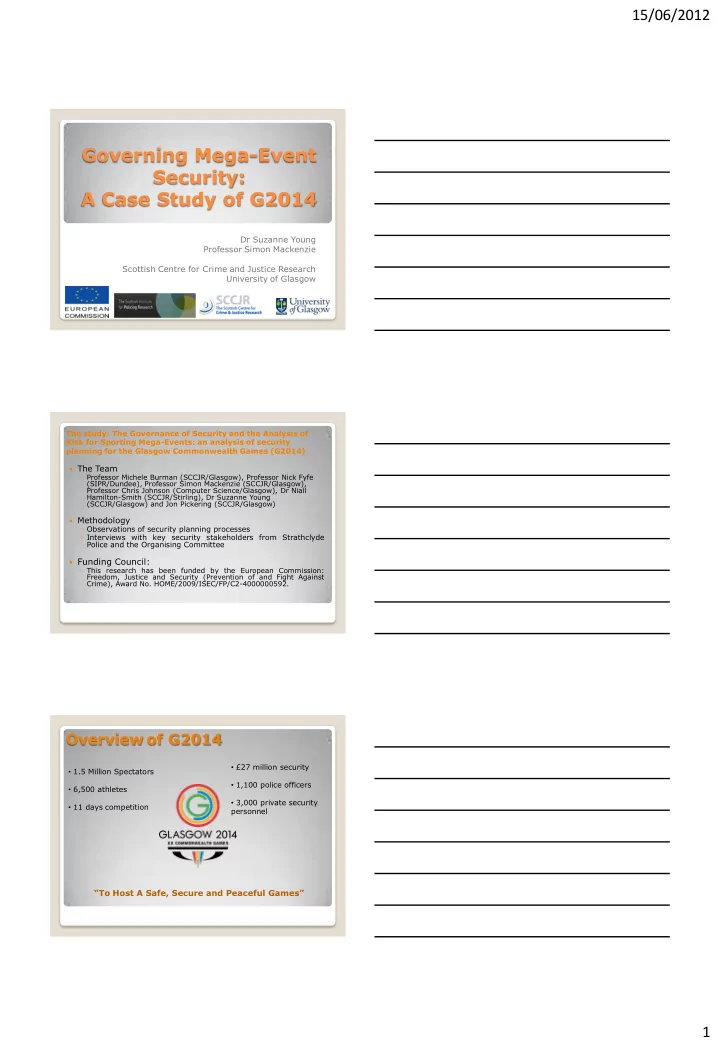
  • 1.5 Million Spectators
  • 6,500 athletes
  • 11 days competition
  • £27 million security
  • 1,100 police officers
  • 3,000 private security

personnel

“To Host A Safe, Secure and Peaceful Games”

Overview of G2014

slide-2
SLIDE 2

15/06/2012 2

Culture

  • f High

Security Cultural ideologies of risk Advancements in crime control Internationalisation

  • f security

Political and bureaucratic contexts of security

Mega-events as a study of security

Political context of G2014

Scottish Police Reform 2013 Scottish Fire and Rescue Reform 2013 Glasgow Bid for 2018 Youth Olympics UEFA Euro 2020 Bid (with Wales and Ireland) Scottish Referendum 2014

Bureaucratic context of G2014

 Governance of security

  • Multi-level governance
  • Nodal governance

 Ownership of risk and responsibilisation

  • Blurring the boundaries of accountability

[T]he blurring of responsibilities creates an ambiguity and uncertainty in the minds of policy-makers and public about who is responsible and can lead to government actors passing off responsibility to privatised providers when things go wrong. Worse still is the scapegoating raised by more complex governance systems. (Stoker, 1998: 22)

slide-3
SLIDE 3

15/06/2012 3

Bureaucratic context of G2014

 Governance of security

  • Multi-levelled nodal governance

 Ownership of risk and responsibilisation

  • Blurring the boundaries of accountability

[T]he blurring

  • f

responsibilities creates an ambiguity and uncertainty in the minds of policy- makers and public about who is responsible and can lead to government actors passing

  • ff

responsibility to privatised providers when things go

  • wrong. Worse still is the scapegoating raised by

more complex governance systems. (Stoker, 1998: 22)

Our thoughts so far...

 Risk conflict:

  • Reputation versus securitisation versus sporting

spectacle

 G2014 is enabling security to be introduced into

communities (i.e. athletes village) to enhance the city profile.

 Mega-events highlight how security is an international

'business' for both the Government and private stakeholders.

slide-4
SLIDE 4

15/06/2012 4

Discussion questions

 Is mega-event security unique in comparison

to everyday policing?

 How can mega-events enhance our

understanding about the internationalisation

  • r standardisation of crime control?

 Can the multi-level partnership working tell

us something about the future of securitisation?