Google is Really Different. The Dalles, OR (2006) Huge Datacenters - - PDF document

google is really different
SMART_READER_LITE
LIVE PREVIEW

Google is Really Different. The Dalles, OR (2006) Huge Datacenters - - PDF document

COMP 790-088 -- Distributed File Systems Google File System COMP 790-088 -- Fall 2009 17 17 Google is Really Different. The Dalles, OR (2006) Huge Datacenters in 25+ Worldwide Locations each > football field Datacenters house


slide-1
SLIDE 1

17 17

COMP 790-088 -- Fall 2009

COMP 790-088 -- Distributed File Systems

Google File System

18 18

COMP 790-088 -- Fall 2009

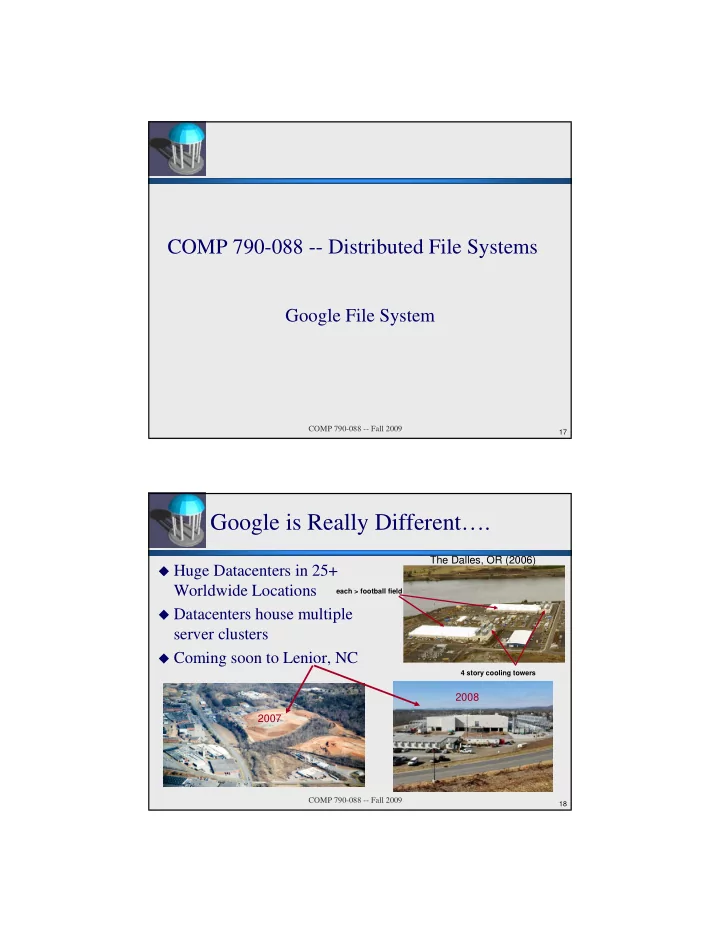
Google is Really Different….

Huge Datacenters in 25+

Worldwide Locations

Datacenters house multiple

server clusters

Coming soon to Lenior, NC

each > football field 4 story cooling towers

The Dalles, OR (2006) 2007 2008

slide-2
SLIDE 2

19 19

COMP 790-088 -- Fall 2009

Google is Really Different….

Each cluster has hundreds/thousands of Linux systems on

Ethernet switches

500,000+ total

servers

20 20

COMP 790-088 -- Fall 2009

Google Hardware Today

slide-3
SLIDE 3

21 21

COMP 790-088 -- Fall 2009

Google Environment

Clusters of low-cost commodity hardware

Custom design using high-volume components ATA disks, not SCSI (high capacity, low cost, somewhat

less reliable)

No “server-class” machines

Local switched network

Low end-to-end latency more available bandwidth low loss

22 22

COMP 790-088 -- Fall 2009

Google File System Design Goals

Familiar operations but NOT Unix/Posix

Specialized operation for Google applications

record_append()

GFS client API code linked into each application

Scalable -- O(1000s) of clients Performance optimized for throughput

No client caches (big files, little temporal locality)

Highly available and fault tolerant Relaxed file consistency semantics

Applications written to deal with issues

slide-4
SLIDE 4

23 23

COMP 790-088 -- Fall 2009

File and Usage Characteristics

Many files are 100s of MB or 10s of GB

Results from web crawls, query logs, archives, etc. Relatively small number of files (millions/cluster)

File operations:

Large sequential (streaming) reads/writes Small random reads (rare random writes)

Files are mostly “write-once, read-many.” Mutations are dominated by appends, many from hundreds of

concurrent writers

process process process

Appended file

24 24

COMP 790-088 -- Fall 2009

GFS Basics

Files named with conventional pathname hierarchy

E.g., /dir1/dir2/dir3/foobar

Files are composed of 64 MB “chunks” Each GFS cluster has servers (Linux processes):

One primary Master Server Several “Shadow” Master Servers Hundreds of Chunk Servers

Each chunk is represented by a Linux file

Linux file system buffer provides caching and read-ahead Linux file system extends file space as needed to chunk size

Each chunk is replicated (3 replicas default)

Chunks are checksummed in 64KB blocks for data integrity
slide-5
SLIDE 5

25 25

COMP 790-088 -- Fall 2009

Master Server Functions

Maintain file name space (atomic create, delete names) Maintain chunk metadata

Assign immutable globally-unique 64-bit identifier Mapping from files name to chunk(s) Current chunk replica locations

Refresh dynamically from chunk servers

Maintain access control data Manage chunk-related actions

Assign primary replica and version number Garbage collect deleted chunks and stale replicas

Stale replicas detected by old version numbers when chunk servers report

Migrate chunks for load balancing Re-replicate chunks when servers fail

Heartbeat and state-exchange messages with chunk servers

26 26

COMP 790-088 -- Fall 2009

GFS Protocols for File Reads

Minimizes client interaction with master:

  • Data operations directly with chunk servers.
  • Clients cache chunk metadata until new open or timeout
slide-6
SLIDE 6

27 27

COMP 790-088 -- Fall 2009

GFS Relaxed Consistency Model

Writes that are large or cross chunk boundaries may be broken into multiple

smaller ones by GFS

Sequential writes successful:

One copy semantics, writes serialized.

Concurrent writes successful:

One copy semantics Writes not serialized in overlapping regions

Sequential or concurrent writes with failure:

Replicas may differ Application should retry

All replicas equal

28 28

COMP 790-088 -- Fall 2009

GFS Applications Deal with Relaxed Consistency

Mutations

Retry in case of failure at any replica Regular checkpoints after successful sequences Include application-generated record identifiers and

checksums

Reading

Use checksum validation and record identifiers to

discard padding and duplicates.

slide-7
SLIDE 7

29 29

COMP 790-088 -- Fall 2009

GFS Chunk Replication (1/2)

1 2 1 2 1 2

Master Client C1 C2 C3 primary Client

F i n d L

  • c

a t i

  • n

C1,C2(primary),C3

  • 1. Client contacts

master to get replica state and caches it

LRU buffers at chunk servers

  • 2. Client picks any chunk

server and pushes data. Servers forward data along “best” path to others.

ACK ACK ACK

30 30

COMP 790-088 -- Fall 2009

GFS Chunk Replication (2/2)

1 2 1 2 1 2

Master Client C1 C2 C3 Client W r i t e Write

1 2 1 2

write order write order ACK ACK success/failure

  • 3. Client sends write

request to primary

  • 4. Primary assigns write order

and forwards to replicas

  • 5. Primary collects ACKs and

responds to client. Applications must retry write if there is any failure.

s u c c e s s / f a i l u r e

slide-8
SLIDE 8

31 31

COMP 790-088 -- Fall 2009

GFS record_append()

Client specifies only data and region size;

server returns actual offset to region

Guaranteed to append at least once atomically File may contain padding and duplicates

Padding if region size won’t fit in chunk Duplicates if it fails at some replicas and client

must retry record_append()

If record_append() completes successfully, all

replicas will contain at least one copy of the region at the same offset

32 32

COMP 790-088 -- Fall 2009

GFS Record Append (1/3)

1 2 1 2 1 2

Master Client C1 C2 C3 primary Client

F i n d L

  • c

a t i

  • n

C1,C2(primary),C3

  • 1. Client contacts

master to get replica state and caches it

LRU buffers at chunk servers

  • 2. Client picks any chunk

server and pushes data. Servers forward data along “best” path to others. ACK ACK ACK

slide-9
SLIDE 9

33 33

COMP 790-088 -- Fall 2009

GFS Record Append (2/3)

1 2 1 2 1 2

Master Client C1 C2 C3 Client W r i t e Write

1@ 2@ 1@ 2@

write order write order ACK ACK

  • ffset/failure
  • 3. Client sends write

request to primary

  • 4. If record fits in last chunk, primary

assigns write order and offset and forwards to replicas

  • 5. Primary collects ACKs and responds to

client with assigned offset. Applications must retry write if there is any failure. s u c c e s s / f a i l u r e

34 34

COMP 790-088 -- Fall 2009

GFS Record Append (3/3)

1 2 1 2 1 2

Master Client C1 C2 C3 W r i t e Retry on next chunk

  • 3. Client sends write

request to primary

  • 4. If record overflows last chunk,

primary and replicas pad last chunk and offset points to next chunk Pad to next chunk Pad to next chunk

  • 5. Client must retry write from beginning
slide-10
SLIDE 10

35 35

COMP 790-088 -- Fall 2009

Metrics for 2 GFS Clusters (2003)

210 MB/file (70 MB/replica) 75 MB/file (10 MB/replica) 13.5 KB/chunk (mostly checksums) 80 bytes/file

36 36

COMP 790-088 -- Fall 2009

File Operation Statistics

(???)