GMA 101, Comprehensive Planning 101, and Planning Commission Best - - PDF document

gma 101 comprehensive planning 101 and planning
SMART_READER_LITE
LIVE PREVIEW

GMA 101, Comprehensive Planning 101, and Planning Commission Best - - PDF document

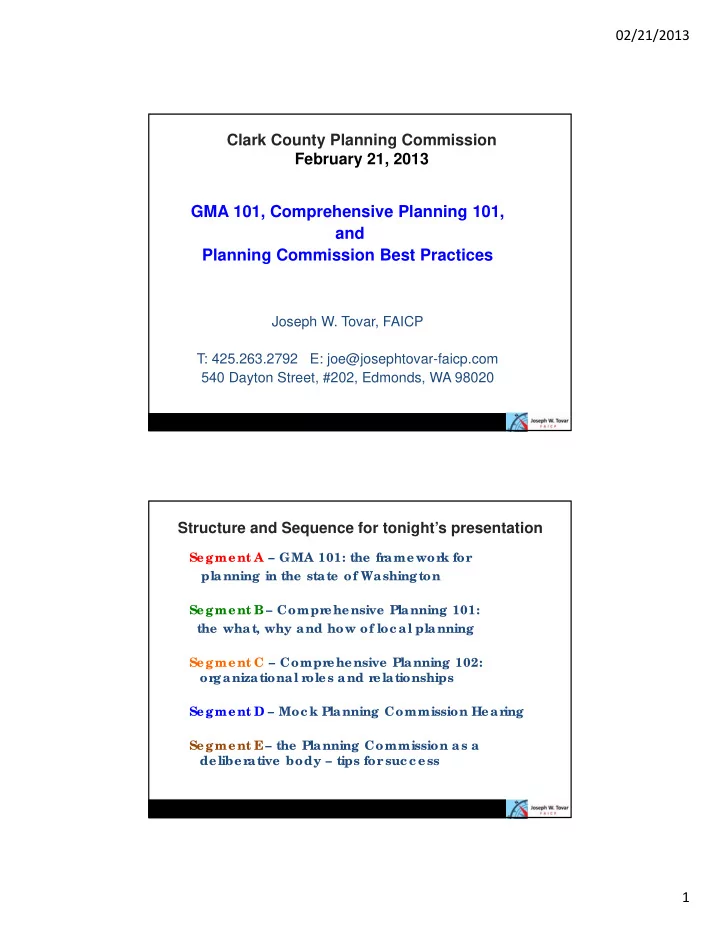
02/21/2013 Clark County Planning Commission February 21, 2013 GMA 101, Comprehensive Planning 101, and Planning Commission Best Practices Joseph W. Tovar, FAICP T: 425.263.2792 E: joe@josephtovar-faicp.com 540 Dayton Street, #202, Edmonds,


slide-1
SLIDE 1

02/21/2013 1 Clark County Planning Commission February 21, 2013

GMA 101, Comprehensive Planning 101, and Planning Commission Best Practices

Joseph W. Tovar, FAICP T: 425.263.2792 E: joe@josephtovar-faicp.com 540 Dayton Street, #202, Edmonds, WA 98020

Structure and Sequence for tonight’s presentation

Segment A – GMA 101: the fr amewor k for planning in the state of Washington Segment B – Compr ehensive Planning 101: the what, why and how of loc al planning Segment C – Compr ehensive Planning 102:

  • r

ganizational r

  • les and r

elationships Segment D – Moc k Planning Commission Hear ing Segment E – the Planning Commission as a deliber ative body – tips for suc c ess

slide-2
SLIDE 2

02/21/2013 2 Segment A GMA 101: the fr amewor k for planning in the state of Washington

Planning is about looking at the big picture, taking the long‐term view, and thinking about the inter‐connectedness of decisions

slide-3
SLIDE 3

02/21/2013 3

Washington’s population of 6.8 M makes it the 2nd most populous western state, but the 2nd smallest in land area

7 4 8 6

Source: Washington State Office of Financial Management

5

1990 2014 2026 2002 1978

Washington’s state-wide population growth: past, present and future

slide-4
SLIDE 4

02/21/2013 4

New Jersey Maryland North Carolina Georgia Maine Vermont Washington Oregon California Hawaii

Washington is one of ten states that have some form or degree of “growth management” state law

Bottom up Top down 40 Planning Enabling States California Washington @1990 Oregon @1973 Who is required to plan? Local choice All cities and counties 29 of 39 counties and cities within All 36 counties and cities within State agency

  • versight of

decisions? No Generally, no Yes Commerce GMHB Yes LCDC LUBA Urban Growth Areas required by law? No No, though some counties have done so Yes Yes Separate Environmental Law? No California Environmental Quality Act State Environmental Policy Act No Separate Shoreline Law? No California Coastal Act Shoreline Management Act No STATE PLANNING STATUTES

Washington’s middle path

slide-5
SLIDE 5

02/21/2013 5

Most of Washington’s 6.8 M population is concentrated in five regions: Puget Sound, Clark County, Yakima,Tri‐Cities and Spokane Washington has very diverse physical and economic geographies

slide-6
SLIDE 6

02/21/2013 6

  • 1962 Planning Enabling Act (RCW 36.70) passed
  • 1971 State Environmental Policy Act (SEPA) passed by legislature
  • 1972 Shoreline Management Act (SMA) adopted by the voters
  • 1990 Growth Management Act (RCW 36.70A) Part I passed by

legislature

  • 1990 Initiative 547 (more “Top Down” model) rejected by voters
  • 1991 Growth Management Act Part II passed by legislature
  • 1995 Chapter 36.70B RCW (Regulatory Reform) passed by legislature
  • 2006 Initiative 933 (pay or waive for regulations) rejected by voters
  • 2009 GMA/SMA clarification passed by the legislature

Prohibition of expanding UGAs into floodplains passed

  • 2012 SEPA reform bill passed legislature

GMA in context: milestones in statutory chronology GMA consists of Goals and Requirements

REQUIREMENTS have the legal force of law and must be complied with They are enforced by the Growth Management Hearings Board GOALS are aspirational expressions of intent to guide local choices

slide-7
SLIDE 7

02/21/2013 7 (1) Urban growth. Encourage development in urban areas where adequate public facilities and services exist or can be provided in an efficient manner. (2) Reduce sprawl. Reduce the inappropriate conversion

  • f undeveloped land into sprawling, low‐density

development. (3) Transportation. Encourage efficient multimodal transportation systems that are based on regional priorities and coordinated with county and city comprehensive plans.

Excerpts of Planning Goals RCW 36.70A.020

(6) Property rights. Private property shall not be taken for public use without just compensation having been

  • made. The property rights of landowners shall be

protected from arbitrary and discriminatory actions. (7) Permits. Applications for both state and local government permits should be processed in a timely and fair manner to ensure predictability. (8) Natural resource industries. Maintain and enhance natural resource‐based industries, including productive timber, agricultural, and fisheries industries.

Planning Goals (Cont’d)

slide-8
SLIDE 8

02/21/2013 8 (10) Environment. Protect the environment and enhance the state's high quality of life, including air and water quality, and the availability of water. (11) Citizen participation and coordination. Encourage the involvement of citizens in the planning process and ensure coordination between communities and jurisdictions to reconcile conflicts.

Planning Goals (Cont’d) “Each county and city that is required or chooses to plan…shall establish and broadly disseminate to the public a public participation program identifying procedures providing for early and continuous public participation in the development and amendment of comprehensive land use plans and development regulations implementing such plans. ….” GMA Requirements have the force of law: Public participation requirement at RCW 36.70A.140

slide-9
SLIDE 9

02/21/2013 9

GMA requirements: Urban, Rural and Resource Lands

Urban RCW 36.70A.110 Rural RCW 36.70A.070(5) Agricultural Resource RCW 36.70A.060 Forestry Resource RCW 36.70A.060 Mineral Resource RCW 36.70A.060

All land must be designated as

  • ne of five types

Urban Ag Resource Forest Resource Rural Rural

RCW 36.70A.210 (1) The legislature recognizes that counties are regional governments within their boundaries, and cities are primary providers of urban governmental services within urban growth areas.

Role clarification for cities, counties, special districts

slide-10
SLIDE 10

02/21/2013 10

Snohomish County King County

RCW 36.70A.200 Essential Public Facilities may not be precluded by city or county plans or regulations

King County v. Snohomish County Sound Transit v. City of Tukwila Port of Seattle v. City of Des Moines, et al.

Segment B Compr ehensive Planning 101: the what, why and how of loc al planning

slide-11
SLIDE 11

02/21/2013 11

Defined at RCW 36.70A.020(4) as: “ A generalized coordinated land use policy statement of the governing body of a county

  • r city that is adopted pursuant to this

chapter (the GMA).”

What is a comprehensive plan? What is a development regulation?

Defined at RCW 36.70A.020(7) as: “ …the controls placed on development or land use activities by a county or city, including, but not limited to, zoning ordinances, critical areas

  • rdinances, shoreline master programs, official

controls, planned unit development ordinances, subdivision ordinances, and binding site plan

  • rdinances together with any amendments

thereto.”

slide-12
SLIDE 12

02/21/2013 12

Sample Comp Plan Goals and Policies

GOAL LU‐ 2 Policy LU‐ 7

LAND USE ELEMENT

Establish land use patterns that promote walking, biking, and using transit to access goods, services, education, employment, and recreation. Promote small‐scale commercial activity centers within neighborhoods that encourage walkability, and provide

  • pportunities for employment and “third

places.”

Sample Comp Plan Goals and Policies

GOAL ED‐ 9 Policy ED‐ 5

ECONOMIC DEVELOPMENT ELEMENT

Facilitate private sector economic development through partnerships and coordinating funding opportunities. Coordinate with local community and technical colleges, and other institutions

  • f higher learning, including the University
  • f Washington, to train a workforce that is

prepared for emerging job markets.

slide-13
SLIDE 13

02/21/2013 13

Consistency PERMITS Zoning, subdivision, building, etc. RCW 36.70B.020(4) Consistency

CAPITAL BUDGET DECISIONS RCW 36.70A.120 Internal Consistency

Community Vision

SMA GOALS & REQUIREMENTS

  • Ch. 90.58 A RCW

Countywide Policies 36.70A.210 CAPITAL PROJECTS Roads, parks, public buildings, water, sewer, surface water systems

REGS

OTHER PLANNING ACTIVITIES RCW 36.70A.120

POLICIES & PROGRAMS Annexation & tax policies, education & volunteer programs

NOTE: Every “action” is subject to SEPA review Ch. 43.21C RCW

GMA GOALS & REQUIREMENTS

  • Ch. 36.70A RCW

State Laws Regional Plan Comprehensive Plan Implementation

PLAN

Internal Consistency Design Rural (counties) Parks & Rec. Economic Development Shorelines Utilities Capital Facilities Transportation Housing Land Use Environment Solar Energy

PLAN

Conservation Subarea Plans (Neighborhood)

Comprehensive Plan Elements (Chapters)

Future Land Use Map

Required RCW 36.70A.070 Required (if state $) RCW 36.70A.070 Optional RCW 36.70A.070 Comprehensive

PLAN

Comprehensive Plan contents RCW 36.70A.070

slide-14
SLIDE 14

02/21/2013 14

Policy Decisions “The Rules” Project Permits or Permissions Must be consistent with adopted Policies and Regulations

Com prehensive Plan Shoreline Master Plan Developm ent Regulations Rezone ( Area-W ide Map Change) Rezone ( Site-Specific Map Change) Master Developm ent Plan Perm it Subdivision ( 5 or m ore lots) Street Vacation Application Adm inistrative Design Perm it Short Plat ( 4 lots or less)

QUASI-JUDICIAL Decisions

Substantial Developm ent Perm it Building Perm it Right of W ay Perm it Hom e Occupation Perm it

Impact of public comment Degree of discretion in making decision

ADMINISTRATIVE Decisions LEGISLATIVE Decisions

MORE

LESS TYPES OF LAND USE DECISIONS

Variance Conditional Use Perm it

  • Fig. 2

The Food Chain

slide-15
SLIDE 15

02/21/2013 15

The Land Use Decision‐making Food Chain At the top of the decision making food chain is where BOCC/City council and planning commissions should live

Segment C Compr ehensive Planning 102:

  • r

ganizational r

  • les and r

elationships

slide-16
SLIDE 16

02/21/2013 16

The American ideal of the public meeting Not the ideal: Public meetings as reality TV

slide-17
SLIDE 17

02/21/2013 17 QUESTION: how do we get to the point where

  • ur comprehensive planning process, including

public meetings, looks more like the first image and less like the second? ANSWER: Recognize that the planning commission, the planning staff, and the elected

  • fficials each have distinct roles, prerogatives

and mutual obligations, and that they are all

  • rganized around a shared mission.

What is the “Shared Mission”?

 Serving the citizens of our community  Helping shape our community’ s future and honor its past  Working together to build a great county/great city  Insert your community’s Mission Statement here

slide-18
SLIDE 18

02/21/2013 18

SHARED MISSION

County Commission or City Council, Planning Commission, and Planning Staff Roles:

  • rganizing around a shared mission

Board of County Commissioners

  • r City Council

elected

Policy Makers

Planning Commission appointed

Policy Advisors

Professional Planning Staff hired

Policy Administrators

Prerogatives Obligations

BOCC/City Council’s Role

  • BOCC/City Council’s role: POLICY MAKERS
  • As directly elected officials, they represent and are

accountable to the citizens

  • In the council‐manager form of city government, the

Council hires, provide direction to, and evaluates the performance of the city manager

  • In the strong mayor form of city government, the Mayor

hires, provides direction to, and evaluates performance of a chief administrator and/or department heads

slide-19
SLIDE 19

02/21/2013 19

BOCC/City Council’s Role (cont’d)

  • Appoint citizens to the Planning Commission, provide

policy direction regarding the work program and allocate resources to achieve it

  • Take final action on all legislative matters, including the

adoption and amendment of comprehensive plans, development regulations and capital budgets

  • Take final action on those quasi‐judicial matters that

local code assigns to the legislative body

Planning Commission’s Role

  • Role: POLICY ADVISORS to the BOCC/City Council
  • The Planning Commission is the first and primary body

responsible for soliciting and hearing public input on land use matters in a community

  • Planning Commission members bring an important expertise to

the consideration of plans and implementation – they reflect the perspective, experience, and values of their community

  • The Commissioners listen to the staff recommendation and

public input, weigh all the evidence, pay attention to the relevant criteria, and then make a thoughtful well‐considered recommendation to the BOCC/City Council

slide-20
SLIDE 20

02/21/2013 20

Planning Staff’s many Roles

THE GUIDE

Staff’s Roles (cont’d)

  • Roles: POLICY ADVISORS to the Planning Commission and

BOCC/City Council, ADMINISTRATORS and ENFORCERS of the plans & regulations adopted by Council

  • Assure the legal sufficiency of the process, including notice,

maintenance of the record, and communicating with the public and agencies

  • Provide a professional recommendation, taking care to outline

the range of alternatives, the merits/demerits of each

slide-21
SLIDE 21

02/21/2013 21

BOCC/City Council Obligations to Planning Commission

  • Respect and support the Planning Commission’s Role
  • Appoint citizens to the Planning Commission who will

commit the time and care needed to do their job right

  • Carefully review the recommendations from the

Commission ‐ take the time to understand the record and the Commission’s rationales

  • Avoid “cherry‐picking” from the Commission’s record ‐ give

weight to the final outcome of their deliberations

BOCC/Council Obligations to Planning Commission (cont’d)

  • Agree with the Planning Commission when you can,

disagree when you must

  • When disagreeing with Commission, take the time to

explain “why”

  • Provide periodic two‐way feedback to the planning

commission ‐ meet jointly at least annually

slide-22
SLIDE 22

02/21/2013 22

BOCC/City Council Obligations to Staff

  • Rely on the staff to administer and enforce council’s

adopted policies and regulations ‐ don’t “micro‐manage”

  • Keep the workload priorities and schedule expectations in

alignment with the resources available

  • Give appropriate deference to technical judgments within

the staff’s areas of expertise

  • If unhappy with staffs’ administrative decisions or job

performance, take the matter up privately through channels, not publicly

Planning Commission’s Obligations

  • Respect and support the BOCC/City Council’s roles

and prerogatives

  • Do your homework. Read the packet of

information before the meetings

  • If you have questions that can be clarified before

the meeting, call or email the staff

  • Give careful consideration and weight to all the

public testimony, facts, and criteria that govern a particular land use decision

slide-23
SLIDE 23

02/21/2013 23

Planning Commission’s Obligations (cont’d)

  • Have an open mind, treat all parties with due

respect, and learn to persuade rather than argue

  • At a hearing, address applicants, citizens and staff

by surname or title. Informal use of first names may suggest undue influence

  • Give appropriate deference to technical judgments

within the staff’s areas of expertise

  • Gracefully accept that the BOCC/City Council will

not always agree with the Planning Commission’s recommendations

Staff’s Obligations

  • Present thorough, objective analysis, reasonable alternatives,

and professional recommendations based on good facts and best practices

  • Carry forward and explain the Planning Commission

recommendation to the BOCC/City Council, even if the staff did not agree with some part of it

  • Respect and support the Commission’s policy‐advising role and

the BOCC/City Council’s policy‐making prerogatives, including their prerogative to disagree with staff and Planning Commission recommendations

  • Provide responsive, complete, and timely answers to questions
slide-24
SLIDE 24

02/21/2013 24 Segment D Moc k Planning Commission Hear ing

Santana Sand & Gravel proposed Comprehensive Plan Amendment from Mineral Resource Lands to Urban and from Industrial to R-24 multifamily The Players Planning Commission Chairman Gatekeeper Planning Commissioner Noble Planning Commissioner Leary Planning Commissioner Singer Staff Project Planner Hauser Staff Transportation Planner Wheeler-Walker Staff Environmental Planner Woody D. Brees Citizen Post Citizen Fenster Citizen Reasoner Citizen Parks

slide-25
SLIDE 25

02/21/2013 25

Forbes Valley – topography and hydrology

Only access to Santana property is via Forbes Creek Drive, which now carries 3,000 ADT in a paved two lane section with no sidewalks, curb, or gutter.

ELEVATION 100 ELEVATION 200 ELEVATION 100

Forbes Creek Dr..

Forbes Valley existing land uses and Comp Plan designations

SINGLE FAMILY 4/ACRE SINGLE FAMILY 1/ACRE SINGLE FAMILY 4/ACRE SINGLE FAMILY 4/ACRE

SINGLE FAMILY 4/ACRE INDUSTRIAL

Santana Co. defunct gravel pit – 65 acre single ownership site of proposed Comprehensive Plan Amendment from Mineral Resource Lands to Urban with a density of 24 units/acre INDUSTRIAL

slide-26
SLIDE 26

02/21/2013 26

What was actually approved and built!

SINGLE FAMILY 4/ACRE SINGLE FAMILY 1/ACRE SINGLE FAMILY 4/ACRE SINGLE FAMILY 4/ACRE

SINGLE FAMILY 4/ACRE INDUSTRIAL

INDUSTRIAL

Segment E Planning Commission as a deliber ative body: tips for suc c ess

  • Recap from mock hearing
  • Model Meeting Agenda ‐ meeting tips on reverse
  • Tips for tracking proposed amendatory language
  • Tips for transmitting Planning Commission

recommendations to the elected officials

  • Tips for feedback loops to the planning commission
  • Taking stock ‐ “retreats” and annual reports
  • Q and A
slide-27
SLIDE 27

02/21/2013 27

To recap . . .

slide-28
SLIDE 28

02/21/2013 28

Planning Commission: be one of the few good men and women who are willing to do the important job

  • Do the homework required
  • Attend meetings regularly
  • Keep open mind, listen, weigh,

persuade, be persuaded

  • Seek agreement but disagree

agreeably

  • Understand and accept the

advisory role

  • From communication comes

understanding

  • From understanding comes respect
  • From respect comes trust
  • From trust comes many good things

Communicate, communicate, communicate!

slide-29
SLIDE 29

02/21/2013 29

Opportunities for communication

  • Directors report every Planning

Commission agenda

  • Planning Commission retreat
  • Annual/semi‐annual joint meeting
  • f Planning Commission with the

BOCC/City Council

  • Site tours with staff and PC

Thank You !

Joseph W. Tovar, FAICP

T: 425.263.2792 E: joe@josephtovar-faicp.com 540 Dayton Street, #202, Edmonds, WA 98020