Global Warming: Global Warming: To summarize the physics of - - PDF document

global warming global warming
SMART_READER_LITE
LIVE PREVIEW

Global Warming: Global Warming: To summarize the physics of - - PDF document

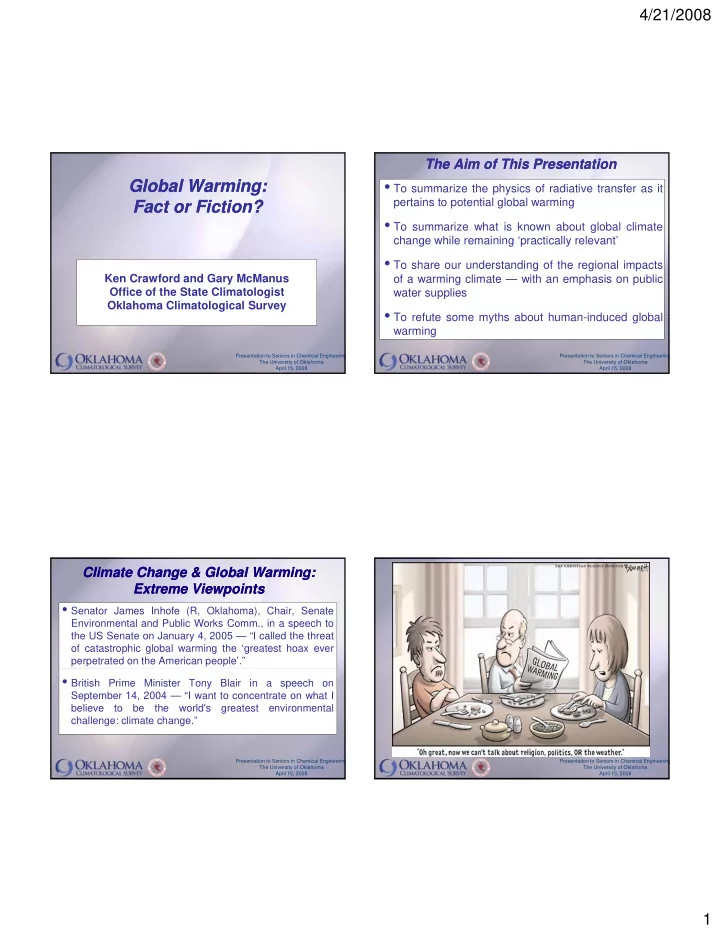
4/21/2008 The Aim of This Presentation The Aim of This Presentation Global Warming: Global Warming: To summarize the physics of radiative transfer as it pertains to potential global warming Fact or Fiction? Fact or Fiction? To


slide-1
SLIDE 1

4/21/2008 1

Global Warming: Fact or Fiction? Global Warming: Fact or Fiction?

Presentation to Seniors in Chemical Engineering The University of Oklahoma April 15, 2008

Ken Crawford and Gary McManus Office of the State Climatologist Oklahoma Climatological Survey

The Aim of This Presentation The Aim of This Presentation

  • To summarize the physics of radiative transfer as it

pertains to potential global warming

  • To summarize what is known about global climate

change while remaining ‘practically relevant’

  • To share our understanding of the regional impacts

Presentation to Seniors in Chemical Engineering The University of Oklahoma April 15, 2008

  • To share our understanding of the regional impacts
  • f a warming climate — with an emphasis on public

water supplies

  • To refute some myths about human-induced global

warming

Climate Change & Global Warming: Extreme Viewpoints Climate Change & Global Warming: Extreme Viewpoints

  • Senator James Inhofe (R, Oklahoma), Chair, Senate

Environmental and Public Works Comm., in a speech to the US Senate on January 4, 2005 — “I called the threat

  • f catastrophic global warming the ‘greatest hoax ever

perpetrated on the American people’.”

Presentation to Seniors in Chemical Engineering The University of Oklahoma April 15, 2008

  • British

Prime Minister Tony Blair in a speech

  • n

September 14, 2004 — “I want to concentrate on what I believe to be the world's greatest environmental challenge: climate change.”

Presentation to Seniors in Chemical Engineering The University of Oklahoma April 15, 2008

slide-2
SLIDE 2

4/21/2008 2 Tunes Are Changing... Tunes Are Changing...

U.S. Secretary of State Condolezza Rice, September 2007 – “It is our responsibility as global leaders to forge a new international consensus on how to solve climate change...If we stay on our present path, we face an unacceptable choice: either we sacrifice global economic

Presentation to Seniors in Chemical Engineering The University of Oklahoma April 15, 2008

unacceptable choice: either we sacrifice global economic growth to secure the health of our planet or we sacrifice the health of our planet to continue with fossil-fuelled growth.”

Anthropogenic climate change is not a new theory… Anthropogenic climate change is not a new theory…

Presentation to Seniors in Chemical Engineering The University of Oklahoma April 15, 2008

It is the confirmation of a prediction:

  • In the late 1890s, Svante Arrhenius theorized about a warming climate

due to the burning of coal.

  • In 1938, Guy Stewart Callendar asserted that warming of the 19th

century forward was due to a rise in CO2.

Presentation to Seniors in Chemical Engineering The University of Oklahoma April 15, 2008

  • “By the year 2000, the increase in atmospheric CO2 … may be

sufficient to produce measurable and perhaps marked change in climate…” — National Medal of Science winner Roger Revelle and the U.S. President’s Scientific Advisory Committee, 1965.

The Fundamental Physics The Fundamental Physics

Presentation to Seniors in Chemical Engineering The University of Oklahoma April 15, 2008

slide-3
SLIDE 3

4/21/2008 3

Properties of Radiation

  • The hot sun radiates at shorter wavelengths that

carry more energy (i.e., intensity varies inversely with λ).

  • A small fraction of this energy is absorbed by the

cooler earth and is re-radiated at longer wavelengths (as predicted by Wein’s Law)

Presentation to Seniors in Chemical Engineering The University of Oklahoma April 15, 2008

wavelengths (as predicted by Wein s Law).

  • Solar radiation has peak intensities in the shorter
  • wavelengths. This radiation is very intense in the

region we know as the visible portion of the spectrum.

  • In pictorial form….

The Sun’s Electromagnetic Spectrum

Presentation to Seniors in Chemical Engineering The University of Oklahoma April 15, 2008

Radiation From The Sun Versus Earth Radiation From The Sun Versus Earth

Presentation to Seniors in Chemical Engineering The University of Oklahoma April 15, 2008 (μm)

Balancing Act Balancing Act

  • If objects only absorb or emit radiation, they would become

very hot or very cold.

Objects do both - absorb and emit

  • Kirchhoff’s Law tells us:

Good absorbers are good emitters

  • Presentation to Seniors in Chemical Engineering

The University of Oklahoma April 15, 2008

Poor absorbers are poor emitters The atmosphere has both properties As a result, the earth converts sunlight to longwave

radiation and/or to heat energy to drive atmospheric motions.

slide-4
SLIDE 4

4/21/2008 4

Earth’s Energy Budget: Part I

  • Absorption and re-emission of radiation at the

earth's surface is only one part of an intricate web of heat transfer in the earth’s planetary domain.

  • Equally

important are selective absorption and emission

  • f

radiation from molecules in the t h If th th did t h

Presentation to Seniors in Chemical Engineering The University of Oklahoma April 15, 2008

atmosphere. If the earth did not have an atmosphere, surface temperatures would be too cold to sustain life. If too many gases which absorb and emit infrared radiation were present in the atmosphere, surface temperatures would be too hot to sustain life.

Absorption of Radiation by Gases in the Atmosphere

Conceptually, this is a very important slide. It deals with ‘selective absorbers’ Note the

Presentation to Seniors in Chemical Engineering The University of Oklahoma April 15, 2008

selective absorbers . Note the atmospheric window and the greenhouse effect.

Selective Absorbers Selective Absorbers

Presentation to Seniors in Chemical Engineering The University of Oklahoma April 15, 2008

Outgoing Terrestrial Radiation

  • The earth's surface, atmosphere, and clouds emit

radiation in the infrared band and near-infrared band.

  • Outgoing infrared (IR) radiation from the earth's

surface (also called terrestrial radiation) is

Presentation to Seniors in Chemical Engineering The University of Oklahoma April 15, 2008

selectively absorbed by certain molecules, particularly water vapor and carbon dioxide.

  • Gases which absorb IR radiation are termed

collectively as “greenhouse gases”, producing the ‘atmospheric greenhouse effect’.

slide-5
SLIDE 5

4/21/2008 5

Outgoing Terrestrial Radiation

  • Infrared radiation from greenhouse gases in the

atmosphere is emitted in all directions, including back to the earth's surface. It is this re-emission to the earth's surface that maintains a higher temperature on our planet than would be possible

Presentation to Seniors in Chemical Engineering The University of Oklahoma April 15, 2008

without the atmosphere.

Global Energy Balance

  • If we consider the atmosphere alone, we find that

the atmosphere experiences net radiative cooling.

  • If earth had no atmosphere, the globally averaged

surface temperature would be

  • 18

ºC. But, because our earth does have an atmosphere, the

Presentation to Seniors in Chemical Engineering The University of Oklahoma April 15, 2008

p , average surface temperature actually is 15 ºC.

Global Energy Balance

  • The atmosphere acts as a greenhouse because
  • f gases that selectively allow solar radiation to

pass through but absorb and then re-emit terrestrial radiation. The ‘greenhouse gases’ are selective as to which wavelengths they will

Presentation to Seniors in Chemical Engineering The University of Oklahoma April 15, 2008

  • absorb. For example, ozone absorbs shortwave

ultraviolet radiation whereas water vapor absorbs infrared radiation more readily.

  • Most of the sun's radiation that passes through

the atmosphere to reach the earth is in the visible part of the spectrum.

Global Energy Balance

  • Most of the earth's radiation that escapes from

the atmosphere is in the infrared band between 8 microns and 11 microns.

  • This region of the spectrum is called the

“atmospheric window”. A i k i f th i ibl i f d d t

Presentation to Seniors in Chemical Engineering The University of Oklahoma April 15, 2008

  • A quick view of the visible, infrared and water

vapor satellite images for the day is the best illustration of these radiative processes at work.

slide-6
SLIDE 6

4/21/2008 6

Presentation to Seniors in Chemical Engineering The University of Oklahoma April 15, 2008

The Scientific Consensus The Scientific Consensus

Presentation to Seniors in Chemical Engineering The University of Oklahoma April 15, 2008

IPCC: Intergovernmental Panel on Climate Change IPCC: Intergovernmental Panel on Climate Change

  • Established in 1988 by United Nations Environment Program

and World Meteorological Organization

  • Not to do research, but to synthesize and assess it
  • Response to scientific predictions of the 1970s: global warming

due to greenhouse gas emissions likely to become a problem

Presentation to Seniors in Chemical Engineering The University of Oklahoma April 15, 2008

  • Today: scientific experts from > 130 countries
  • Most recent report: > 800 authors & > 2500 peer reviewers
  • Historically unprecedented: scale, scope, ambition
  • Summary approved by consensus (including representatives of

the Bush Administration) at meetings of the IPCC

The following represents the VAST MAJORITY

  • f scientific expertise on global climate change

The following represents the VAST MAJORITY

  • f scientific expertise on global climate change

Important to remember, however:

  • Projections versus observations
  • Think GLOBALLY and DECADALLY
  • Modeled temperature projections represent a RANGE of possible

i d d t i t l (i SCENARIOS)

Presentation to Seniors in Chemical Engineering The University of Oklahoma April 15, 2008

warming, dependent upon societal responses (i.e. SCENARIOS)

  • Natural variability will still occur (i.e. hot years, cold years,

wet and dry)

  • Regional projections are still somewhat uncertain
slide-7
SLIDE 7

4/21/2008 7

Observational Evidence: The Globe is Warming Observational Evidence: The Globe is Warming

Presentation to Seniors in Chemical Engineering The University of Oklahoma April 15, 2008

‘Warming of the ‘Warming of the climate system is climate system is unequivocal unequivocal, as is , as is now evident from now evident from

  • bservations of
  • bservations of

increases in global increases in global average air and average air and

Presentation to Seniors in Chemical Engineering The University of Oklahoma April 15, 2008

average air and average air and

  • cean temperatures,
  • cean temperatures,

widespread melting widespread melting

  • f snow and ice, and
  • f snow and ice, and

rising global average rising global average sea level.’ sea level.’ “Paleoclimate information supports the interpretation that the warmth of the last half century is unusual in at least the previous 1300 years.” “Paleoclimate information supports the interpretation that the warmth of the last half century is unusual in at least the previous 1300 years.”

Presentation to Seniors in Chemical Engineering The University of Oklahoma April 15, 2008

  • ‘Global atmospheric concentrations
  • f

carbon dioxide, methane and nitrous

  • xide

have increased markedly as a result

  • f

human activities since 1750 and now far exceed pre-industrial values determined from ice cores spanning many thousands of years.

Presentation to Seniors in Chemical Engineering The University of Oklahoma April 15, 2008

  • The

global increases in carbon dioxide concentration are due primarily to fossil fuel use and land- use change, while those of methane and nitrous oxide are primarily due to agriculture.’

slide-8
SLIDE 8

4/21/2008 8

“The observed widespread warming of the atmosphere and ocean, together with ice mass loss, support the conclusion that it is extremely unlikely that global climate change of the past fifty years can be explained without external forcing….”

NCAR model run

actual data natural + anthropogenic

Presentation to Seniors in Chemical Engineering The University of Oklahoma April 15, 2008

natural variability

Projections Projections

Presentation to Seniors in Chemical Engineering The University of Oklahoma April 15, 2008

The IPCC Consensus The IPCC Consensus

  • Higher confidence now exists in projected patterns of warming than

exists for other elements such as rainfall.

  • It is very likely that hot extremes, heat waves, and heavy precipitation

events (due to higher moisture content in the atmosphere) will continue to become more frequent.

  • Snow cover is projected to contract and sea ice is projected to shrink

in both the Arctic and Antarctic. Thus, sea levels will rise.

Presentation to Seniors in Chemical Engineering The University of Oklahoma April 15, 2008

  • Storm tracks are projected to move poleward, with resultant changes

in wind, precipitation, and temperature patterns.

  • Increasing atmospheric CO2 concentrations will lead to increasing

acidification of the ocean.

  • Anthropogenic CO2 emissions during the 21st century will contribute

to warming & sea level rise for more than a millennium, due to the long timescales required for removal of this gas.

‘Continued greenhouse gas emissions at or above current rates would cause further warming and induce many changes in the global climate system during the 21st century that would very likely be larger than those observed during the 20th century.’ ‘Continued greenhouse gas emissions at or above current rates would cause further warming and induce many changes in the global climate system during the 21st century that would very likely be larger than those observed during the 20th century.’

Presentation to Seniors in Chemical Engineering The University of Oklahoma April 15, 2008

slide-9
SLIDE 9

4/21/2008 9

Projected temperature changes for the early and late 21st century Projected temperature changes for the early and late 21st century

Presentation to Seniors in Chemical Engineering The University of Oklahoma April 15, 2008

Extreme Temperatures Will Increase Extreme Temperatures Will Increase

Presentation to Seniors in Chemical Engineering The University of Oklahoma April 15, 2008 Presentation to Seniors in Chemical Engineering The University of Oklahoma April 15, 2008

Average of 19 climate models. 2007.

Presentation to Seniors in Chemical Engineering The University of Oklahoma April 15, 2008

slide-10
SLIDE 10

4/21/2008 10

Don’t panic just yet. There are uncertainties: El Ni ? The poleward side of the sub- tropics will get drier due to the poleward shift of the extra tropical The Wet Get Wetter…The Dry Get Drier The Wet Get Wetter…The Dry Get Drier What about Oklahoma?

Presentation to Seniors in Chemical Engineering The University of Oklahoma April 15, 2008

El Nino? La Nina? Geography? the extra-tropical storm track (jet stream).

Presentation to Seniors in Chemical Engineering The University of Oklahoma April 15, 2008

  • Annual

precipitation is projected to decrease across the southwestern United States, especially during the summer.

  • Warmer temperatures will cause more evaporation in summer and

less soil moisture.

  • As a result, drier conditions will contribute to severe episodes of

extreme heat, particularly across the southwest USA.

  • ‘Ordinary’ droughts (e g

2005 2006) may be transformed into a

The Continental Picture

Presentation to Seniors in Chemical Engineering The University of Oklahoma April 15, 2008

  • Ordinary droughts (e.g., 2005-2006) may be transformed into a

style of the ‘30s- and ‘50s.

  • Warmer temperatures and drier conditions in summer will increase

the risk and intensity of wildfires.

  • But…climate model projections are uncertain because the impact

depends on socio-economic responses to climate change.

Winners and Losers

“There will be winners and losers from the impacts of climate change, even within a single region, but globally the losses are expected to far outweigh the benefits.”

Presentation to Seniors in Chemical Engineering The University of Oklahoma April 15, 2008

g

National Academies’ Report “Understanding and Responding to Climate Change”

slide-11
SLIDE 11

4/21/2008 11

“Water is the delivery mechanism

  • f most climate change impacts”

“Water is the delivery mechanism

  • f most climate change impacts”

The Bottom Line

Presentation to Seniors in Chemical Engineering The University of Oklahoma April 15, 2008

Kathy Jacobs Executive Director Arizona Water Institute Kathy Jacobs Executive Director Arizona Water Institute

Consider the Following Headline Consider the Following Headline

Presentation to Seniors in Chemical Engineering The University of Oklahoma April 15, 2008

Weather Headline From The Sunday Oklahoman Printed on December 31, 1989 — To Summarize the Biggest Weather Headlines in Oklahoma During the 1980s.

Consider Headlines Already Being Written

(From The Norman Transcript)

Consider Headlines Already Being Written

(From The Norman Transcript)

Presentation to Seniors in Chemical Engineering The University of Oklahoma April 15, 2008

Or…From The National Geographic Or…From The National Geographic

Presentation to Seniors in Chemical Engineering The University of Oklahoma April 15, 2008

slide-12
SLIDE 12

4/21/2008 12

Consider the Reservoir at Lake Mead, NV

Presentation to Seniors in Chemical Engineering The University of Oklahoma April 15, 2008

“The lake … has a 50% chance of becoming unusable by 2021 ... if demand for water remains unchanged and if human-induced climate change follows. … ‘We have 90% of our water supply coming from Lake Mead’.”

NY Times February 13, 2008

An Even More Ominous Headline…

“Nuclear reactors across the southeast could be forced to throttle back or temporarily shut down later this year because drought is drying up the rivers and lakes that supply power plans with the awesome amounts of cooling water they need to operate.” … “Water is the nuclear industry’s Achilles’ heel.” … “Lake Norman near Charlotte is down to 93 7 feet — less than a foot above the

Presentation to Seniors in Chemical Engineering The University of Oklahoma April 15, 2008

is down to 93.7 feet less than a foot above the minimum set in the license for Duke Energy Corp.’s McGuire nuclear plant.” … “It would cost 10 times that amount [$5-7per megawatt hour] if you had to buy replacement power — especially during the summer.”

Associated Press January 24, 2008

Or…This Editorial From The National Geographic Or…This Editorial From The National Geographic

Presentation to Seniors in Chemical Engineering The University of Oklahoma April 15, 2008

Regionalizing Climate Change: A Look at Oklahoma Regionalizing Climate Change: A Look at Oklahoma

Presentation to Seniors in Chemical Engineering The University of Oklahoma April 15, 2008

slide-13
SLIDE 13

4/21/2008 13

Duration of Wet Period: 15-20 years … versus the dominant 8-12 year cycle Consistency of Wet Period: Most of the 1980s & 1990s confined to a very narrow range of variance

In The Beginning…

Presentation to Seniors in Chemical Engineering The University of Oklahoma April 15, 2008

Magnitude of Wet Period: Larger than any other wet period;

  • n par with deficits of the great

droughts during the 20th century

  • The warm season becomes longer and arrives earlier.
  • The cool season warms and shortens which leads to a longer

frost-free period and growing season.

  • Earlier maturation of winter wheat and orchard crops leave

them more vulnerable to late freeze events.

  • Year-round evaporation from the ground increases as does

transpiration from green vegetation.

Implications for Oklahoma

Presentation to Seniors in Chemical Engineering The University of Oklahoma April 15, 2008

p g g

  • Drought frequency and severity increases, especially during

summer.

  • Drier and warmer conditions will increase the risk of wildfires.
  • Rain-free periods will lengthen, but individual rainfall events will

become more intense.

  • More runoff and flash flooding will occur.

The Oklahoma Climatological Survey’s Official Stance The Oklahoma Climatological Survey’s Official Stance

We conclude the following to be true:

  • The earth’s climate has warmed during the last 100 years
  • The earth’s climate will continue to warm for the foreseeable

future

Presentation to Seniors in Chemical Engineering The University of Oklahoma April 15, 2008

future

  • Much of the global average temperature increases over the

last 50 years can be attributed to human activities, particularly increasing greenhouse gases in the atmosphere

  • Oklahoma will be impacted.

Global Warming: The “Top Ten” Myths Global Warming: The “Top Ten” Myths

Presentation to Seniors in Chemical Engineering The University of Oklahoma April 15, 2008

slide-14
SLIDE 14

4/21/2008 14

  • 1. The current warming is part of a natural cycle
  • 1. The current warming is part of a natural cycle

Claim: The earth has warmed (and cooled) throughout history…how is this different?

  • Past global climate changes have physical explanations
  • Ice Ages – Orbital changes (Milankovitch Theory) and solar

variations

Presentation to Seniors in Chemical Engineering The University of Oklahoma April 15, 2008

variations

  • Cooling of the 1940s through 1970s – pollution and volcanism
  • The warming of the past 50 years cannot be explained by

natural variations alone

  • 1. The current

warming is part of a natural cycle

  • 1. The current

warming is part of a natural cycle Milankovitch Theory Milankovitch Theory

Presentation to Seniors in Chemical Engineering The University of Oklahoma April 15, 2008

a

  • tc

eo y a

  • tc

eo y

  • 2. The earth has begun cooling again
  • 2. The earth has begun cooling again

Claim: 2007 was cold, warming has plateaued since 1998, etc.

  • It is incorrect to mistake short-term variability

(weather) for climate change

  • Others have happened recently, but the long-term

Presentation to Seniors in Chemical Engineering The University of Oklahoma April 15, 2008

Ot e s a e appe ed ece t y, but t e o g te trend has remained positive

  • 1988, 1991-92, 1998
  • La Nina is the likely culprit for the cold 13 months

between from January 2007-2008

  • 2. The earth has begun cooling again
  • 2. The earth has begun cooling again

Presentation to Seniors in Chemical Engineering The University of Oklahoma April 15, 2008

slide-15
SLIDE 15

4/21/2008 15

  • 2. The earth has begun cooling again
  • 2. The earth has begun cooling again

Presentation to Seniors in Chemical Engineering The University of Oklahoma April 15, 2008

  • 3. Antarctica is cooling and gaining ice
  • 3. Antarctica is cooling and gaining ice

Claim: AHA!!! Gore was wrong!

  • Antarctic cooling is a regional phenomenon, and is related to

the ozone hole

  • Ozone hole above south pole causes cooling in stratosphere
  • Thi

t th th l t k i E A t ti d

Presentation to Seniors in Chemical Engineering The University of Oklahoma April 15, 2008

  • This strengthens the polar vortex, keeping E. Antarctica and

Antarctic Plateau from receiving warm air

  • The Antarctic Peninsula, on the other hand, has experienced

some of the most rapid warming over the last 50 years

  • The above scenarios are consistent with the GCM projections
  • Antarctica as a whole is losing ice
  • Larsen Ice Shelf partially gone, Wilkins Ice Shelf is going fast
  • 3. Antarctica is cooling and gaining ice
  • 3. Antarctica is cooling and gaining ice

Presentation to Seniors in Chemical Engineering The University of Oklahoma April 15, 2008

  • 4. Climate models are unreliable
  • 4. Climate models are unreliable

Claim: Scientists can’t even predict the weather next week, let alone 100 years from now

  • There is a difference between weather, which is chaotic and

unpredictable and climate which is weather averaged out over time.

  • “You can't predict with certainty whether a coin will land heads or

Presentation to Seniors in Chemical Engineering The University of Oklahoma April 15, 2008

p y tails, you can predict the statistical results of a large number of coin tosses.”

  • Climate models are based on the same physical equations as

weather forecasting models, which are very successful and validated every day.

  • The chaos that renders weather forecasts useless after a few days

“goes away” as the model results are averaged over longer periods

  • f time
slide-16
SLIDE 16

4/21/2008 16

  • 4. Climate models are unreliable
  • 4. Climate models are unreliable

Presentation to Seniors in Chemical Engineering The University of Oklahoma April 15, 2008

  • 4. Climate models are unreliable
  • 4. Climate models are unreliable

Other results successfully predicted and reconstructed by models:

  • Cooling of the stratosphere
  • Warming of the lower, mid, and upper troposphere

Presentation to Seniors in Chemical Engineering The University of Oklahoma April 15, 2008

  • Warming of ocean surface waters (Cane 1997)
  • Trends in ocean heat content (Hansen 2005)
  • An

energy imbalance between incoming sunlight and

  • utgoing infrared radiation (Hansen 2005)
  • Amplification of warming trends in the Arctic region (NASA
  • bservations)
  • 5. The sun is the culprit
  • 5. The sun is the culprit

Claim: Sun activity and the number of sunspots have increased as we have warmed

  • Solar variations DO affect climate
  • No positive trends in any solar index since the

1960s

Presentation to Seniors in Chemical Engineering The University of Oklahoma April 15, 2008

  • The

correlation between solar activity and temperature ended around 1975

  • 5. The sun is the culprit
  • 5. The sun is the culprit

Presentation to Seniors in Chemical Engineering The University of Oklahoma April 15, 2008

slide-17
SLIDE 17

4/21/2008 17

  • 6. Carbon dioxide changes lag temperature changes
  • 6. Carbon dioxide changes lag temperature changes

Claim: The warming that ended the ice ages came first, then the increases in CO2

Presentation to Seniors in Chemical Engineering The University of Oklahoma April 15, 2008

  • 6. Carbon dioxide changes lag temperature changes
  • 6. Carbon dioxide changes lag temperature changes
  • Warm periods that end ice ages typically last about

5000 years

  • Orbital eccentricities help warm the planet
  • Feedback effects (albedo) allowed for melting of ice

Presentation to Seniors in Chemical Engineering The University of Oklahoma April 15, 2008

  • CO2 is released as melting continues for about 800

years

  • CO2 then becomes the primary cause for the next

~4200 years

  • CO2 does not initiate the warming but acts as an

amplifier once it is underway

  • 7. Water vapor is more important than CO2
  • 7. Water vapor is more important than CO2

Claim: Increased water vapor is actually causing the warming

  • Water vapor is in balance on most timescales (the

hydrologic cycle)

  • T

h t i th i ill i kl (b li t

Presentation to Seniors in Chemical Engineering The University of Oklahoma April 15, 2008

  • Too much water vapor in the air will quickly (by climate

timelines) rain out

  • Not considered a climate forcing because it is a function
  • f temperature
  • It is a feedback effect
  • CO2 and other greenhouse gases stay in the atmosphere

for centuries

  • 8. “It was cold in Slapout this morning!”
  • 8. “It was cold in Slapout this morning!”

Claim: If global warming is happening, why am I freezing?

  • No conclusion about climate can ever be drawn from a

single data point, hot or cold

Presentation to Seniors in Chemical Engineering The University of Oklahoma April 15, 2008

  • A single data point is known as “weather”
  • Remember, THINK DECADALLY AND GLOBALLY
  • CLIMATE VARIABILITY WILL CONTINUE, EVEN IN A

WARMING CLIMATE!

  • Hot year, cold years, wet years, and dry years will

continue to exist

slide-18
SLIDE 18

4/21/2008 18

  • 9. There is no consensus
  • 9. There is no consensus

Claim: Lots of reputable scientists are skeptical that manmade CO2 emissions are causing global warming.

  • With more and more evidence revealed, the skeptical

viewpoint has steadily gone from “the earth is not

Presentation to Seniors in Chemical Engineering The University of Oklahoma April 15, 2008

warming” to “CO2 is not the cause” to “what is the scale of the future warming”

  • A survey of 1000 scientific papers on global climate

change in 2004 – not one rejected the consensus position

  • The IPCC not your cup of tea?
  • 9. There is no consensus
  • 9. There is no consensus

These organizations backed the consensus view of the IPCC:

* National Oceanic and Atmospheric Administration * Environmental Protection Agency * NASA's Goddard Institute of Space Studies * American Geophysical Union

Presentation to Seniors in Chemical Engineering The University of Oklahoma April 15, 2008

* American Institute of Physics * National Center for Atmospheric Research * American Meteorological Society * State of the Canadian Cryosphere * The Royal Society of the UK * Canadian Meteorological and Oceanographic Society

  • 9. There is no consensus
  • 9. There is no consensus

And these:

* Academia Brasiliera de Ciencias (Brazil) * Royal Society of Canada * Chinese Academy of Sciences * Academie des Sciences (France)

Presentation to Seniors in Chemical Engineering The University of Oklahoma April 15, 2008

( ) * Deutsche Akademie der Naturforscher Leopoldina (Germany) * Indian National Science Academy * Accademia dei Lincei (Italy) * Science Council of Japan * Russian Academy of Sciences * Royal Society (United Kingdom)

  • 9. There is no consensus
  • 9. There is no consensus

Or these:

* National Academy of Sciences (United States of America) * Australian Academy of Sciences * Royal Flemish Academy of Belgium for Sciences and the Arts * C ibb A d f S i

Presentation to Seniors in Chemical Engineering The University of Oklahoma April 15, 2008

* Caribbean Academy of Sciences * Indonesian Academy of Sciences * Royal Irish Academy * Academy of Sciences Malaysia * Academy Council of the Royal Society of New Zealand * Royal Swedish Academy of Sciences

slide-19
SLIDE 19

4/21/2008 19

  • 10. Scientists warned of global cooling in the 1970s
  • 10. Scientists warned of global cooling in the 1970s

Claim: First it was global cooling, now global warming!

  • The 1970s was an unusually cold decade, however...
  • Survey of peer-reviewed scientific articles from 1965-

1979 found only SEVEN supported global cooling (including the famous Newsweek article) while 44

Presentation to Seniors in Chemical Engineering The University of Oklahoma April 15, 2008

(including the famous Newsweek article) while 44 predicted warming

  • Review of the literature suggests that greenhouse

warming even then dominated climate scientists’ thinking

  • 10. Scientists warned of global cooling in the 1970s
  • 10. Scientists warned of global cooling in the 1970s

Presentation to Seniors in Chemical Engineering The University of Oklahoma April 15, 2008

Areas Still Under Debate Areas Still Under Debate The fine details should always be debated!

  • Hurricanes
  • Severe weather
  • Climate sensitivity

Presentation to Seniors in Chemical Engineering The University of Oklahoma April 15, 2008

Climate sensitivity

Check things out for yourself Check things out for yourself

  • The IPCC site:

ipcc.ch (start with the technical summary or the FAQ)

  • A site run by climate change scientists: realclimate.org
  • Skeptical de-bunking: skepticalscience.com

Presentation to Seniors in Chemical Engineering The University of Oklahoma April 15, 2008

  • Skeptical view on global warming: globalwarming.org
  • When in doubt: GOOGLE
slide-20
SLIDE 20

4/21/2008 20

Thank You — Questions?

Presentation to Seniors in Chemical Engineering The University of Oklahoma April 15, 2008