Gibsons Foreshore & Seawalk Improvements Mini-Charrette - - - PowerPoint PPT Presentation

gibsons foreshore
SMART_READER_LITE
LIVE PREVIEW

Gibsons Foreshore & Seawalk Improvements Mini-Charrette - - - PowerPoint PPT Presentation

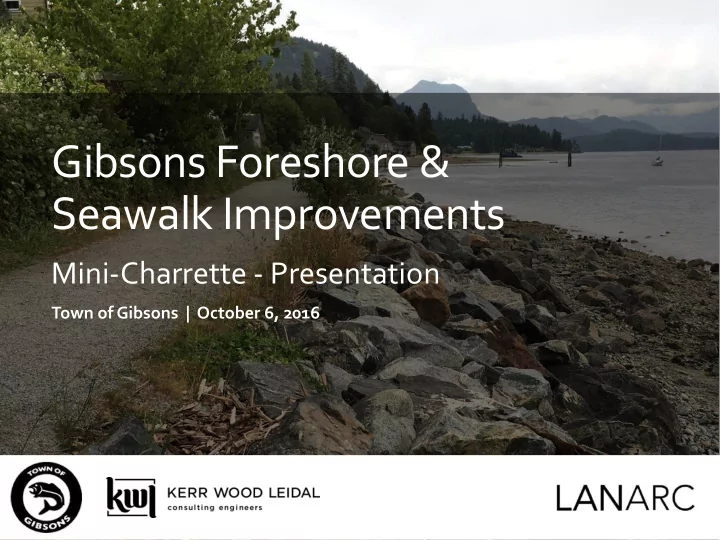
Gibsons Foreshore & Seawalk Improvements Mini-Charrette - Presentation Town of Gibsons | October 6, 2016 Our Team Consulting Team Dave Murray , Project Manager, Water Resources Engineer, KWL David Reid, Facilitator, Landscape

slide-1
SLIDE 1

Gibsons Foreshore & Seawalk Improvements

Mini-Charrette - Presentation

Town of Gibsons | October 6, 2016

slide-2
SLIDE 2

Our Team

Consulting Team

  • Dave Murray, Project Manager, Water Resources Engineer, KWL
  • David Reid, Facilitator, Landscape Architect, Lanarc
  • Kate Evans, Landscape Architect, Lanarc
  • Glenn Hafey, PalegicTechnologies, Marine Construction
  • Diane Sanford, Moonbeam, Marine Biology

Town of Gibsons

  • Emanuel Machado, CAO
  • Andre Boel, Director of Planning
  • Dave Newman, Director of Engineering
slide-3
SLIDE 3

Agenda

Three Sessions:

1.0 Morning Session = Charrette Participants & Designers 2.0 Afternoon Session = Designers (Optional for Charrette Participants)

3.0 Evening Session = Open House (Charrette Participants, Designers, and Public)

slide-4
SLIDE 4

1.0 Morning Agenda

8:45am Doors Open 9:00am Introductions & Background 9:45am Session A – Clarify Objectives (10:15am)

  • -- Break ---

10:30am Session B – Design Ideas 11:30am Facilitated Integration – What Design Ideas Where? (12:oopm) --- End of Morning Session ---

(Key stakeholders invited to stay as participants in the “Designer Session”

slide-5
SLIDE 5

2.0 Afternoon Agenda

1:00 pm Session C – Sorting Concepts Into Integrated Design Approach 1:45 am Session D – Production Assignments

As two working groups, each with planner, engineer, and landscape architect/biologist

(4:00 pm)

  • -- End of Designers Session ---
slide-6
SLIDE 6

Town of Gibsons – Foreshore & Seawalk Improvements | 6

3.0 Evening Agenda

5:00 pm Doors Open to View Display (Informal Discussion) 5:30 pm Presentation

Clarified Objectives, Design Results (Options & Implementation Phasing)

6:15 pm Small Group Discussion of Results

Focused on Questions in a Response Form

6:30 pm Small Group Reporting

Consensus Points and Remaining Issues

7:00 pm Wrap-up & Next Steps

Open House

slide-7
SLIDE 7

Charrette Objectives

  • Review public input received
  • Share info on constraints & opportunities
  • Work creatively to explore all possible solutions
  • After discussion, integrate the best ideas into two

design concepts.

slide-8
SLIDE 8

Charrette Objectives

NOTE:

Results are subject to more detailed analysis prior to production of formal recommendations.

slide-9
SLIDE 9

9

Study Area

From Gibsons Wharf to Armours Beach

slide-10
SLIDE 10

10

Study Area

“generally refers to the area between the natural boundary

  • f the ocean and the lowest tides”

Foreshore

Access Slope Sewer

slide-11
SLIDE 11

11

Historical Uses

Lower Gibsons with Tanker at Wharf

(visible: Ballentine Block, Methodist church, Hill's Marine Shop, Marina House & other buildings along waterfront to Armours Beach, c1950)

Wharf at Gibsons Landing

(visible: large crowd waiting for the ferry with some waterfront buildings, c1952)

Photos (#2211, 423, 541) Courtesy of the Sunshine Coast Museum & Archives

Waterfront and Shoreline Buildings

(visible: immediately East of the Wharf looking towards Armours Beach and Soames Hill, c1950)

slide-12
SLIDE 12

12

Foreshore Today

  • Part of the marine ecosystem (fish and eelgrass)
  • Infrastructure servicing corridor (sanitary sewer)
  • Public recreation trail (oceanfront walkway)

Ecosystem Services for a Range of Uses

slide-13
SLIDE 13

13

Foreshore Today

Photo Tour

Wharf – Southern End of Study Area

N

slide-14
SLIDE 14

14

Foreshore Today

Photo Tour

Access/Seawalk – Looking South to Wharf

N

slide-15
SLIDE 15

15

Foreshore Today

Photo Tour

Access along properties

N

slide-16
SLIDE 16

16

Foreshore Today

Photo Tour

Typical foreshore

N

slide-17
SLIDE 17

17

Foreshore Today

Photo Tour

Cole’s Access

N

slide-18
SLIDE 18

18

Foreshore Today

Photo Tour

Cole’s Old Marine Railway

N

slide-19
SLIDE 19

19

Foreshore Today

Photo Tour

N

Armours Beach – Park and Seawalk

slide-20
SLIDE 20

20

Foreshore Today

Photo Tour

Armours Beach

N

slide-21
SLIDE 21

21

Foreshore – Northern End

  • f Study Area

Foreshore Today

Photo Tour

N

slide-22
SLIDE 22

22

Eelgrass

Foreshore Today

Environmental Protection

N

slide-23
SLIDE 23

23

Design Constraints

Sanitary Sewer

  • Fixed alignment of sanitary sewer in access road
  • May require eventual replacement

Access (Maintenance and Seawalk)

  • Riprap protecting the walkway and sewer pipe below is largely

intact but needs upgrade for access

  • Small section in front of Cole’s Marina– How to upgrade?

Armours Beach

  • Lock-block retaining wall to be reviewed
  • Beach area access to be integrated to new foreshore approach
slide-24
SLIDE 24

24

Design Constraints – Land Tenure/Use

slide-25
SLIDE 25

25

Environmental Constraints

Physical: Beach slope and size of material (sand, gravel, cobble are critical design constraints Climate Change: Possible storm surge increases Estimated sea level rise of 0.5 m by 2050 and 1.0 m by 2100 Biological: The upper intertidal area is largely devoid of

  • bservable aquatic life; however, lower tidal has Rockweed and

Sea Lettuce, Mussels, Barnacles, Sea Stars and trace Oyster The backshore area along the public walkway is largely devoid

  • f any natural riparian vegetation

A fringing and continuous patch of eelgrass appears to be expanding in the nearshore area

slide-26
SLIDE 26

26

Environmental Constraints

“Meadows of the ocean”

  • Stabilize shoreline substrates and

moderate shoreline wave action

  • Serve as a refuge area for marine life,

nurseries and feeding areas, and marine corridors

  • The harbor in Gibsons was the recipient of

eelgrass transplants in the mid 1980’s

  • Mapping began in 2005 (to determine the

size and location) and then was updated in 2013

  • The eelgrass bed has expanded since 2005,

especially along the NW shoreline

Eelgrass

slide-27
SLIDE 27

27

Regulatory Constraints

Coastal Shore Jurisdiction in BC

slide-28
SLIDE 28

28

DFO Input

  • Natural Capital Valuation and Ecosystem services should be

highlighted

  • Become a coastal community champion!
  • DFO generally supports GreenShores approach but there will be

trade offs to protect Eelgrass

  • Ensure forage fish habitat &use are considered in design
  • Encourage public education through signage/ecosystem services
  • Good examples are out there and proven
  • Need an interdisciplinary team on design and implementation
  • Need a phased approach to support long-term climate change
  • Strong focus on natural processes
  • Design lead by core principles/values

Regulatory Approval Required- Review/Authorization

slide-29
SLIDE 29

29

DFO Input

Preference/recommendation for application of Greenshores approach should be consistent with local/site coastal characteristics, maintenance of Natural foreshore processes and that integrates and balances with maintenance & protection of adjacent, significant Eelgrass beds.

Bottom Line

slide-30
SLIDE 30

Town of Gibsons – Foreshore & Seawalk Improvements | 30

GreenShores Approach for Coastal Development

  • A tool for developing the shore while protecting natural shorelines

and habitats

  • Guiding principles:
  • Preserving the integrity or connectivity of shoreline processes
  • Maintaining or enhancing habitat diversity and function
  • Minimizing or reducing pollutants to the environment
  • Reducing cumulative impacts to the shoreline environment
slide-31
SLIDE 31

Future Character?

More natural tree/shrub backshore or More gentle built shoreline?

Future Character?

slide-32
SLIDE 32

Future Character?

How could we apply GreenShores?

Existing Beach Typical Cross Section

Sewer 8H:1V 5H:1V 10H:1V 5H:1V Wave Run-up

2H:1V = 2.3 m 4:1 = 1.14 m 8:1 = 0.6 10:1 = 0.45 m

slide-33
SLIDE 33

Future Character?

How could we apply Greenshores?

Future With SLR- Beach Typical Cross Section Sewer 8H:1V 5H:1V 10H:1V 5H:1V

slide-34
SLIDE 34

Town of Gibsons – Foreshore & Seawalk Improvements | 34

Precedents

  • Examples of restored shorelines
  • ‘GreenShores’ approaches
  • ‘Urban Waterfront’ approaches

Note: the exposure of the Gibsons shoreline to wind and waves will require a customized approach – however these precedents provide general examples of alternative shoreline treatments.

slide-35
SLIDE 35

Town of Gibsons – Foreshore & Seawalk Improvements | 35

Jericho Park

BEFORE AFTER

slide-36
SLIDE 36

Town of Gibsons – Foreshore & Seawalk Improvements | 36

Kitsilano Beach

BEFORE AFTER

slide-37
SLIDE 37

Town of Gibsons – Foreshore & Seawalk Improvements | 37

Spanish Banks

BEFORE AFTER

slide-38
SLIDE 38

Town of Gibsons – Foreshore & Seawalk Improvements | 38

Parksville Beach Nourishment

2008

BEFORE AFTER AFTER

slide-39
SLIDE 39

Town of Gibsons – Foreshore & Seawalk Improvements | 39

Davis Bay after the March 2012 storm

slide-40
SLIDE 40

Town of Gibsons – Foreshore & Seawalk Improvements | 40

GS Ratings Pilot Project #1-

Dick Murphy Park, Campbell River

slide-41
SLIDE 41

Town of Gibsons – Foreshore & Seawalk Improvements | 41

Timber wall removal, beach replenishment and planting GS Ratings Pilot Project #1-

Dick Murphy Park, Campbell River

slide-42
SLIDE 42

Town of Gibsons – Foreshore & Seawalk Improvements | 42

Lazo Road, Town of Comox

Riprap rock buried and logs balasted

slide-43
SLIDE 43

Town of Gibsons – Foreshore & Seawalk Improvements | 43

Sandlance, food for salmon, spawn on beaches

Shore zones support important biological functions

Feeding and resting habitat for migratory birds

  • R. Hocken
  • R. Hocken
slide-44
SLIDE 44
  • Long Term Ideal (2050, 2100 or 2200?)
  • Short Term Phased Improvements
  • Now
  • 2030
  • 2050

Adapting to the Future

slide-45
SLIDE 45

Shoreline dikes over 200 years?

Sea Level Rise (SLR)

slide-46
SLIDE 46
  • Global SLR – gradual increase to high tide
  • 0.5m by 2050, 1.0m by 2100, continues
  • Natural boundary moves up/inland
  • Building flood construction level moves up at point of reconstruction/

end of building life – maintain property values.

  • Gradual shoreline changes over the decades
  • Allow natural boundary/plants to move up?
  • Trail to move up as well (in phases over decades)
  • Eventual dike function?
  • Change in beach shape changes wave run-up
  • Can current design accommodate future changes?

Sea Level Rise

slide-47
SLIDE 47
  • Allow for SLR of 1.0 m + for building lifespans to Yr 2100
  • Allow for SLR 2.0 m + for building lifespans to Yr 2200

Sea Level Rise (SLR)

slide-48
SLIDE 48

Future Character?

Storms and Sea Level Rise

Flood Level Existing 200 year SLR 2100 High Tide &Storm Surge 2.74 3.74 Wave Effects 1.14 1.14 Freeboard 0.6 0.6 FCL 4.5 5.5

slide-49
SLIDE 49

Future Character?

Consider Eelgrass

Cole’s Marina Cross Section

slide-50
SLIDE 50
  • Walking / Health
  • Short-cut Trail / Connections
  • Access to Beach
  • Aesthetics
  • Views to beach / sea
  • Park upland finish / furniture
  • Appropriate Character / Feel of this place?

Waterfront Recreation Values

slide-51
SLIDE 51

Future Characte?

Future Character?

slide-52
SLIDE 52

Future Character?

Future Character?

slide-53
SLIDE 53

Future Character?

Future Character?

slide-54
SLIDE 54

Future Character?

More natural tree/shrub backshore or More engineered and built shoreline?

Future Character?

slide-55
SLIDE 55

Future Characte?

Design Criteria

Define the parameters

 What design life? 25, 50, 100 years?  What flood level do we chose?  What elevation for walkway/service road?  What storm do we protect against?  Distance from Eelgrass Beds?  Beach slopes and size of material?  Anchored logs?  Beach elevation and will there be vegetation?  Access points? Walkway width? Service road width?  Cost premium and eco asset?

Define Criteria

  • Eco Asset
  • Habitat protection
  • Riparian

enhancement

  • Aesthetics and

Recreation

  • Stability
  • Constructability
  • Cost
slide-56
SLIDE 56

Session A: Clarify Objectives

1 Minute Introductions!

  • Name and who you represent
  • Key idea to put on the table
slide-57
SLIDE 57

Session A: Clarify Objectives

  • What are key objectives for this

process today, and for this project carrying forward?

slide-58
SLIDE 58

Session A: Clarify Objectives

  • Safety
  • Access
  • Environment
  • Other?
slide-59
SLIDE 59

Short Break

slide-60
SLIDE 60

1 hour session Reporting back at 11:30:

  • All ideas considered
  • Questions uncovered
  • Sit in two groups
  • Each group to have one each of engineer,

biologist, landscape architect, and planner.

  • Sit in a group where you will hear new

ideas and influence people new to you!

Session B: Design Ideas

slide-61
SLIDE 61

Evaluating the Ideas

Values to Consider

  • Safety of trail use
  • Accessibility (walking, jogging, cycling, inline skates,

disabled?)

  • Maximum views of the waterfront
  • Minimum environmental impact (restoration?)
  • Reconsider need for seawalls or steep sideslopes?
slide-62
SLIDE 62

Report Back

  • Key ideas or concepts for consideration?
  • Remaining questions or points for more

information?

slide-63
SLIDE 63

Idea Integration

What design idea where?

slide-64
SLIDE 64

2.0 Afternoon Agenda

Designers Session

1:00 pm Session C – Sorting Concepts Into Integrated Design Approach 1:45 am Session D – Production Assignments

As two working groups, each with one planner, engineer, and landscape architect

(4:00pm)

  • -- End of Designers Session ---
slide-65
SLIDE 65

Lunch Break!

slide-66
SLIDE 66

2.0 Afternoon Agenda

Designers Session

1:00 pm Session C – Sorting Concepts Into Integrated Design Approach 1:45 am Session D – Production Assignments

As two working groups, each with one planner, engineer, and landscape architect

(4:00pm)

  • -- End of Designers Session ---
slide-67
SLIDE 67

Session C: Design Integration

  • 45 minutes
  • Sit in two groups
  • Each group to have one each of engineer, biologist,

landscape architect, and planner.

  • Try to sit in a different group than you did this morning!
slide-68
SLIDE 68

Evaluating the Ideas

  • Minimize costs of adapting to SLR, and ongoing maintenance.
  • Maximize opportunities for cost sharing with senior

governments or developers.

  • Minimize costs of new shoreline.
  • Consider land impacts of long-term shore protection / dikes.
  • Gain DFO acceptance.
  • Other?
slide-69
SLIDE 69

Session D: Concept Production

Until ~4:00pm Break prior to 5:00pm Open House

slide-70
SLIDE 70

Break until Evening Session (Session 3)