
SLIDE 1
GEOMETRICAL PROPERTIES OF WITH APPLICATIONS
Supanut Chaidee Department of Mathematics, Faculty of Science Chiang Mai University, Thailand Gu Guangzh zhou Discrete Mathematics Seminar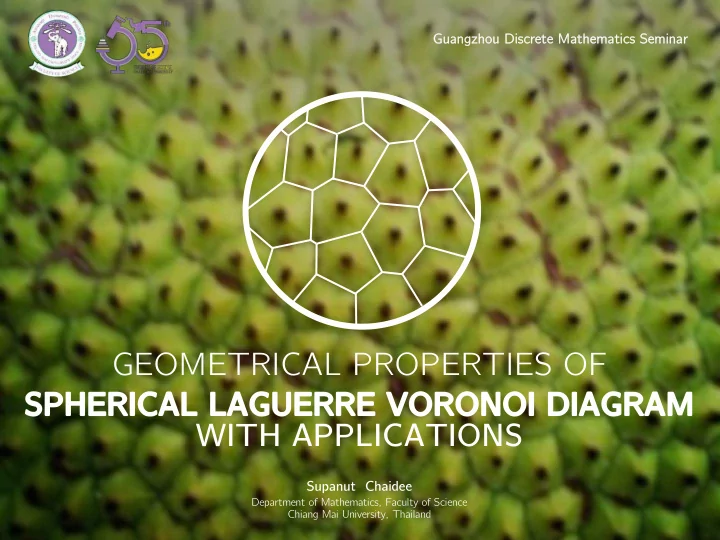
GEOMETRICAL PROPERTIES OF WITH APPLICATIONS Supanut Chaidee - - PowerPoint PPT Presentation
Guangzh Gu zhou Discrete Mathematics Seminar GEOMETRICAL PROPERTIES OF WITH APPLICATIONS Supanut Chaidee Department of Mathematics, Faculty of Science Chiang Mai University, Thailand Mo Moti tivati ation Pa Patterns on the fruit skins
GEOMETRICAL PROPERTIES OF WITH APPLICATIONS
Supanut Chaidee Department of Mathematics, Faculty of Science Chiang Mai University, Thailand Gu Guangzh zhou Discrete Mathematics Seminar Mo Moti tivati ation
There are many phenomena related to polygonal net problems.
Pa Patterns on the fruit skins
Can we use mathematical concepts to model or understand the pattern formation?
?
A skin pattern of “Jackfruit” Artocarpus Heterophyllus Geometrical Viewpoint Computational Geometry the study of algorithms which can be stated in terms of geometry. Points Polygons Tessellation Problem Formulation Understanding phenomena
Tes Tessella ellatio ion Pattern erns
Some problems are related to the space partitioning. Pos
A resident needs to send a letter at a post office near his home! A subdivision of a plane into these regions is called Voronoi diagram.
Vo Voronoi Diagram
Let be a set of sites over . The Vor Voron
where denotes the Euclidean distance between points and in the plane. n R2 V (pi) pi ∈ S d(x, y) x y P = {p1, p2, ..., pn} V (pi) = {x 2 R2|d(x, pi) d(x, pj) for i 6= j}
4 Co Considering on the Re Real-wo world Problem..
Jackfruit skin pattern
5To model this kind of tessellation, weig ights of each generator is important due to real-world phenomena.
?
Is ordinary Voronoi diagram enough for modeling the pattern?Lychee skin pattern
Co Considering on the Re Real-wo world Problem..
6 Vo Voronoi Di Diag agram am
7Voronoi Diagram
V(space/generator/distance) Vo Voronoi Di Diag agram am
8Voronoi Diagram
Each generator comes with its circle.Laguerre Voronoi Diagram
Pi ci P ri ` dL(P, ci) = d(P, Pi)2 − r2 i V(space/generator/distance) Vo Voronoi Di Diag agram am
9 Each generator comes with its circle.Laguerre Voronoi Diagram
Pi ci P ri ` dL(P, ci) = d(P, Pi)2 − r2 i V(sphere/points/Laguerre) Spherical Laguerre Voronoi Diagram (SLVD) The Laguerre Proximity A spherical circle on U corresponding to Pi is ˜ ci = {Q ∈ U| ˜ d(Pi, Q) = Ri} where . 0 ≤ Ri/R < π/2 ˜ dL(P, ˜ ci) = cos ⇣ ˜ d(P, Pi)/R ⌘ cos(Ri/R) O ˜ ci Pi Q P Ri Re Research Scopes
10to construct mathematical models for understanding the polygonal tessellation on the fruit skins
?
We use the spheric ical l Laguerre Vor Voron
?
t=0 t=1Properties of the spheric ical l Laguerre Vor Voron
Co Construction of SLVD VD
11 O Pi Pj ˜ ci ˜ cj π(˜ cj) π(˜ ci) `ij ˜ ci π(˜ ci) O1 ri Pi(xi, yi, zi) ti P ∗
i = (xi/ti, yi/ti, zi/ti)Spherical Laguerre Voronoi diagram Spherical Laguerre Delaunay diagram
Co Corresponding Structures
12 Voronoi-based Model for Generating the Tessellation Patterns of the Fruit Skins [1] K. Sugihara. Laguerre Voronoi Diagram on the Sphere, Journal for Geometry and Graphics, 6:1, 69–81 (2002). [2] S. Chaidee, K. Sugihara. Recognition of Spherical Laguerre Voronoi Diagram, submitted Spherical Laguerre Voronoi diagram Convex polyhedron Spherical Laguerre Delaunay Diagram Co Correspondence between SLVD VD and Pol Polyhedr hedra
Spherical Laguerre Voronoi diagram Convex polyhedron ℒ is a SLVD if and only if there is a convex polyhedron " containing the center of the sphere whose central projection coincides with ℒ. Pr Proposition 13 By definition and construction algorithms Co Correspondence between SLVD VD and Pol Polyhedr hedra
There exists a transformation satisfying the projection preservation properties. The TheoremPolyhedron transformation
f(va) = α β γ δ η η η va For a point in the homogeneous coordinate system, define a map such that f : P 3(R) → P 3(R) va = (ta, xa, ya, za) ∈ P 3(R) ℒ is a SLVD. We We proposed ed algorithms for constructing a polyhedron with respect to SLVD. 14 Tes Tessella ellatio ion Analy lysis is
Convex Spherical Tessellation !={T1, …, Tn}
SLVD
i n v e r s e
recover the generators and their weights. Recognition Problem find the SLVD which best fits to the given tessellation Approximation Problem SL SLVD R Recogni gnition P n Probl blem
There are exactly four degrees of freedom in the choice of a polyhedron ! with respect to the given SLVD. The TheoremPi,j i j k vi,j,k Û ei,j `i,j ˜ ci π(˜ ci) π(˜ cj) ˜ cj Û ei,k Û ej,k Pj,k Pi,k `i,k `j,k
Spherical circle radius ri Spherical circle center coordinates xi, yi Alignment of the plane π(˜ cj) ! " # $“Any choice of the initial pair of planes is sufficient to recognize the SLVD.”
16 Voronoi Approximation of the Spike-containing Objects Voronoi Approximation of the Objects without Spikes
17SL SLVD A Appr pproxi ximation P n Probl blem
Obj Object ect Classifica cation
Spike- containing Objects Objects Without Spikes
1. The object is a convex surface which can be approximated by a sphere. 2. There exists a polygonal net Vo Voronoi Ap Approxima mation Problem
Find the spherical (Laguerre) Voronoi diagram which best fits to the given tessellation.
?
‘Dis Discrepa panc ncy’ is defined as the ratio of sum of different areas to sum of total areas. T or T V or L T: (projected) tessellation on the plane : spherical tessellation on the unit sphere T L V: (projected) spherical Voronoi diagram Voronoi Approximation of the Spike-containing Objects
20 Mai Main Fram amewo work
Tessellation Fitting using ordinary spherical Voronoi diagram The parameters for obtaining the best fit spherical Voronoi diagram Claim min D(x, z, R, h) for obtaining the appropriatex, z, R, h
The discrepancy function D(x, z, R, h) with respect to the variables x, z, R, h The discrepancy depends on the sphere radius R, the spike height h, and the sphere center position (x, z). 0.10 0.15 0.20 0.25 0.30 0.10 0.15 0.20 0.25 0.30 0.0 0.1 0.2 0.3 16 17 18 19 20 0.30 0.35 0.40 0.45 0.50 0.00 0.01 0.02 0.03 Fix R, h and optimize D(x, z) Fix x, z and optimize D(R, h) The Method of Steepest Descent The Circular Search We consider the optimization problem by constructing an iterated (decreasing) sequence tending to the minimum. 21 vij1 vij2 di dj Pi Pj Qij Qji
Weig Weight Appro roxim imatio ion
Tessellation Fitting using spherical Laguerre Voronoi diagram From the fitting result using an ordinary spherical Voronoi diagram, we approximate weight of each generator. The tessellation edges of the given tessellation on the plane are projected onto the sphere. The approximation is done using the fact of SLVD Ex Experimental Results
Fitting with the ordinary spherical Voronoi diagram Fitting with the spherical Laguerre Voronoi diagram Fitting with the ordinary spherical Voronoi diagram Fitting with the spherical Laguerre Voronoi diagram 23 Spherical Laguerre Voronoi Diagram Approximation Problem
24 Tes Tessella ellatio ion Comparis rison
From Al Algorithms, the polyhedron can be constructed Difference of two tessellations The difference between two tessellations occurs.Discrepancy
The ratio between difference area and total area Suppose that the given tessellation ! is not SLVD. We will find the SLVD that approximates the tessellation !. but the SLVD will not coincide with the given tessellation. Given spherical tessellation ! !={T1, …, Tn}minimize the discrepancy
To find the best fit SLVD, we ℒ={L1, …, Ln} SLVD ℒ ∆T ,L = 1 − 1 4π n X i=1 @ mi X j=1 αi,j − (mi − 2)π 1 A 25 Tes Tessella ellatio ion Fit Fittin ing
SLVD
This implies that we adjust the planes. The discrepancy depends on plane parameters Ai, Bi, Ci To de decrease the he dis discrepa panc ncy, we adjust the SLVD. For n tessellation cells, define the discrepancy as a function of x x = (A1, …, An, B1, …, Bn, C1, …, Cn) bypolyhedron halfspaces planes Plane equation Pi : Aix + Biy + Ciz = 1 D(x):= Δ!, ℒ.
Discrepancy function value computed pointwiselyD(x)
Nelder-Mead Method
for finding the local minimumminimize
26 Int Interpr pretation of
SLVD
To interpret the meaning of fitted Voronoi diagram, the following goals are preferable.
Each generator should be close to the center of the cell. The generators should lay inside the cell as much as possible. The radii of spherical circles should be a non-negative number. Ex Experimental Results
Fitting with the ordinary spherical Voronoi diagram Distance Discrepancy Discrepancy 5000 10000 15000 20000 25000 30000 0.01 0.02 0.03 0.04 0.05 0.06 0.07 20 40 60 80 100 0.18 0.20 0.22 0.24 0.26 0.28 Experiments with real data Given Tessellation Fitted SLVD Centroid of Cell Initial Generator Optimized Generator Discrepancy Distance Discrepancy #It. #It. #It. 28 Modeling using Spherical Laguerre Voronoi Diagram
Ch Characteristics of Re Real-Wo World rld Pattern erns
30 Figure from [21] Jackfruit Multiple fruit Lychee Single fruit Figure from [94] Sugar apple Aggregate fruit Figure from [56] Figure from [43] Raspberry Aggregate fruit Mo Modeling Assumpti tions
31 Ge Generator Pushing Model
32 At time t, for each corresponding pair i, j in the spherical Laguerre Delaunay edge Si Simul ulation
33 n = 50, = 1/8, = 10–8 , k = 0.2, t0 = 15 ω ✏ Li ∈ [arccos(1 − 1 n) − π 36, arccos(1 − 1 n) + π 36] Equidistributed Points Random Points We generate the patterns using the following parameters. Co Concluding Re Rema marks ks & Future Works ks
34The properties of SLVD based on the polyhedron help us to solve the recognition and approximation problem. The properties of SLVD based on polyhedra may allow us to define the new kind of the Voronoi diagram. We prop
biological information for generating the tessellation pattern on the sphere using SLVD.
Ac Acknowledgeme ments
35