SLIDE 1
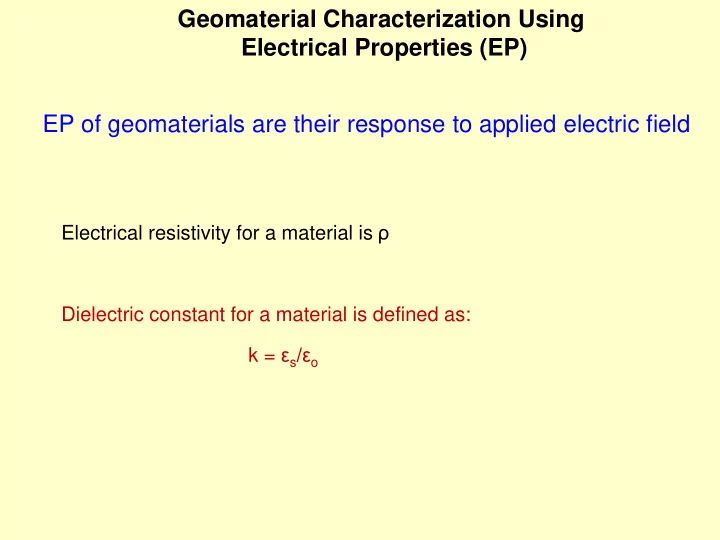
EP of geomaterials are their response to applied electric field
Electrical resistivity for a material is ρ Dielectric constant for a material is defined as: k = εs/εo
Geomaterial Characterization Using Electrical Properties (EP)
SLIDE 2 Geomaterial Characterization Using Electrical Properties
METHODS
- Low frequency resistivity methods (<100 Hz)
- High frequency dielectric methods (104 -109 Hz)
Electrical Resistivity () Dielectric constant (k)
ADVANTAGES OVER OTHER METHODS:
- Non destructive
- Fast and easy
- Incorporate response of the micro-structure (of the soil mass)
SLIDE 3 Parameters influencing Electrical Properties
- f Geomaterials
- Porosity and the pore structure
- Water content
- Salinity level
- Cation exchange capacity of the soil
- Temperature
- Type and Frequency of the current
Parameters influencing Liquefaction of soils
- Grain shape and size
- Porosity & Relative Density
- Variation of Water table
- External Forces/Disturbances---shearing
- Resistivity = f (void ratio)=f (density)
- Change in resistivity= f (change in the void ratio)
= f (change in the density)
SLIDE 4
METHODS FOR LABORATORY MEASUREMENT OF SOIL RESISTIVITY Two-electrode method
Power supply SAMPLE Electrode Electrode Voltage Measurement
SLIDE 5 Four-electrode method
Power supply
SAMPLE
Electrode
~
V
SLIDE 6
Electrical Resistivity Box (100 mm cube)
Plate electrode Plate electrode
Electrode point
L A I V L A R
A= Area of electrodes L= spacing between the electrodes = resistivity R= resistance
SLIDE 7
ELECTRICAL RESISTIVITY BOX (TWO-ELECTRODE METHOD)
12 cm @ 3 cm 12 cm 12 cm Point Electrodes
It is difficult to determine A
L A R a . R
a: shape factor for the electrode
SLIDE 8
1 2 3 4 16 Ebonite ring 55 mm 25 25 25 95 mm Lock nut Top nut SS pointed tip Copper electrode 32 23 20
ELECTRICAL RESISTIVITY PROBE
SLIDE 9
Generalized relationship for Determining Soil Electrical Resistivity = Ae(-(Sr-5)/B) Relationship between Electrical Resistivity and Thermal Resistivity
Log () = CRLog (RT)
CR = A+B.e (-SrC) A, B and C = f (Fine content)
Sr : Degree of saturation
SLIDE 10 Laboratory Investigations
- Two-electrode or four-electrode methods
- Application of :
Surface Network Analyzer (SNA) Impedance analyzer LCR meter
- Methods based on high frequencies (f>107 Hz) are based on the
wave propagation concept.
- Methods based on low frequencies (f<106 Hz) are based on
equivalent elements (as the wavelength is much larger than the size of the measurement device).
SLIDE 11
Field Investigations
Ground Penetrating Radar (GPR) Time Domain Reflectometry (TDR) Capacitance sensor Portable dielectric probe (PDP) Electrical conductivity probe (ECP) Monitoring Slope deformation & Movement
2nd International Symposium and Workshop on Time Domain Reflectometry for Innovative Geotechnical Applications (TDR 2001). www.iti.northwestern.edu/tdr/tdr2001/proceedings/