Genomics and Bioenergy Genomics and Bioenergy Gerald A. Tuskan DOE - - PowerPoint PPT Presentation

genomics and bioenergy genomics and bioenergy
SMART_READER_LITE
LIVE PREVIEW

Genomics and Bioenergy Genomics and Bioenergy Gerald A. Tuskan DOE - - PowerPoint PPT Presentation

Advancing Science with DNA Sequence Genomics and Bioenergy Genomics and Bioenergy Gerald A. Tuskan DOE Joint Genome Institute FAO Seminar October 12, 2007 Advancing Science with DNA Sequence U.S. Energy Consumption U.S. Energy Consumption


slide-1
SLIDE 1

Advancing Science with DNA Sequence
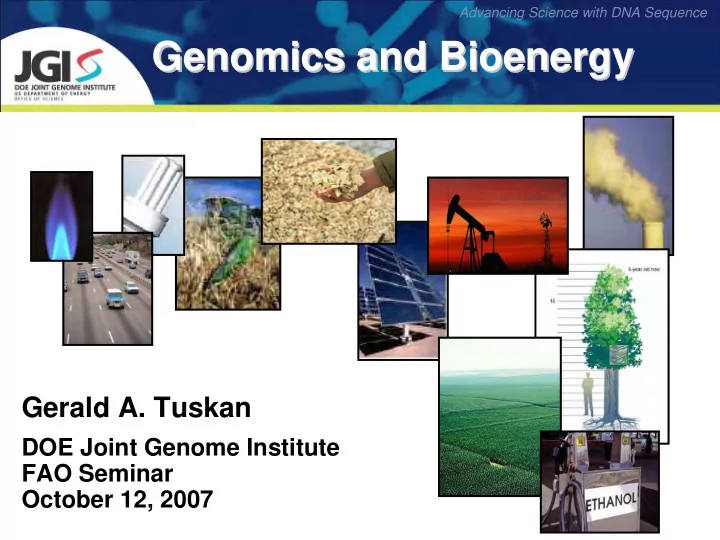
Genomics and Bioenergy Genomics and Bioenergy

Gerald A. Tuskan

DOE Joint Genome Institute FAO Seminar October 12, 2007

slide-2
SLIDE 2

Advancing Science with DNA Sequence

U.S. Energy Consumption U.S. Energy Consumption and the Economy and the Economy

  • The U.S. consumes roughly

26% of the world’s energy; yet represents about 6% of the world’s population

  • There is a linear relationship

between energy consumption and gross domestic product

  • Many developing countries

are adopting the U.S. social, economic and energy-use model

slide-3
SLIDE 3

Advancing Science with DNA Sequence

U.S. Energy Production & U.S. Energy Production & Consumption Consumption

Source: http://www.eia.doe.gov/ Energy Flow 2005 (105 Quadrillion Btu)

slide-4
SLIDE 4

Advancing Science with DNA Sequence

U.S. Energy Consumption by U.S. Energy Consumption by Source and Sector Source and Sector

Source: http://www.eia.doe.gov/

slide-5
SLIDE 5

Advancing Science with DNA Sequence

U.S. Crude Oil Production U.S. Crude Oil Production

  • Domestic production has

declined over the past 20 years and is expected to continue to decline

  • Consumption is growing and

imported oil is meeting this demand

  • Continuing with business as

usual has economic, environmental and national security consequences

Source: http://www.eia.doe.gov/

slide-6
SLIDE 6

Advancing Science with DNA Sequence

Increases in Atmospheric CO Increases in Atmospheric CO2

2

Source: http://cdiac.ornl.gov/ftp/trends/co2/maunaloa.co2

slide-7
SLIDE 7

Advancing Science with DNA Sequence

World CO World CO2

2 Emissions

Emissions

Source: http://www.eia.doe.gov/

slide-8
SLIDE 8

Advancing Science with DNA Sequence

Renewable Energy in the U.S. Renewable Energy in the U.S.

Source: http://www.eia.doe.gov/

slide-9
SLIDE 9

Advancing Science with DNA Sequence

Long Long-

  • term Supply Options

term Supply Options

Source: Steven Koonin, 2006, BP

slide-10
SLIDE 10

Advancing Science with DNA Sequence

How do we . . . How do we . . .

  • Reduce our need for imported sources
  • f energy?
  • Maintain our standard of living?
  • Reduce our carbon emissions?
  • Preserve our energy security?
  • Maintain our reliance on affordable

transportation fuels?

Closed Closed– –loop domestic loop domestic production of lignocellulosic production of lignocellulosic biofuels biofuels

create create ? ?

slide-11
SLIDE 11

Advancing Science with DNA Sequence

Sun

Role of Biology Role of Biology

Poplar Termite Pichia stipitis

Fermenters Feedstocks

  • Tamar wallaby forestomach
  • Poplar biomass degraders
  • Asian Longhorned Beetle gut
  • Elephant Grass decomposers
  • White Rot Fungus
  • Clostridium thermocellum
  • Saccharophagus degradans
  • Acidothermus cellulolyticus
  • Thermoanaerobacter

ethanolicus

  • Pichia stipitis

Soybean, Maize, Switchgrass, Miscanthus, Sorghum, Cotton, Brachypodium

Cellulose Sugar Alcohol Biomass converting

  • rganisms
slide-12
SLIDE 12

Advancing Science with DNA Sequence

Brachypodium

Dedicated Energy Crops Dedicated Energy Crops – – The Monocots The Monocots

Foxtail Millet Maize Potential Energy Crop Model Genome Switchgrass Miscanthus Informative Genome Monocots Sorghum Oryza Potential Energy Crop Model Genome Switchgrass Miscanthus Informative Genome Monocots Model Genome Wheat Informative Genome Monocots Musa

slide-13
SLIDE 13

Advancing Science with DNA Sequence

Dedicated Energy Crops Dedicated Energy Crops – – The Dicots The Dicots

Glycine Eucalyptus

Populus

Populus

Arabidopsis Potential Energy Crop Model Genome Oil production Informative Genome Legumes

Prunus

Glycine Potential Energy Crop Model Genome Woody Perennial Informative Genome Eurosid I Model Genome Eurosid II Informative Genome Populus Prunus Eucalyptus

slide-14
SLIDE 14

Advancing Science with DNA Sequence

Accelerated Domestication Accelerated Domestication

Apply advanced, modern genetic and genomics techniques to accelerate the domestication rate in fast growing short-rotation tree species.

slide-15
SLIDE 15

Advancing Science with DNA Sequence

Corn Domestication Corn Domestication

  • Teosinte

Timeline:

5000 ybp

  • Corn Landraces

2000 ybp

  • Modern Hybrids

Today

slide-16
SLIDE 16

Advancing Science with DNA Sequence

Timeline:

30 M - 200 ybp 120 ybp Wild Stands Today

Populus Populus Domestication Domestication

Clonal Selection Improved Hybrids Domesticated Trees The Future?

slide-17
SLIDE 17

Advancing Science with DNA Sequence

  • Reduced recalcitrance of

cellulose degradation

  • Reduced height growth
  • Compact crown
  • Higher productivity per

unit area

  • Greater number of stems

per unit area

  • Compact root system
  • Drought/Stress tolerance
  • Enhanced radial growth
  • Nutrient use efficiency
  • Greater product yield
  • Reduced flowering

Fully Domesticated Poplar Fully Domesticated Poplar

slide-18
SLIDE 18

Advancing Science with DNA Sequence

Cost ($/ton) Yield (ton/ac/yr)

Current conventional approach

Functional Relationship Between Functional Relationship Between Yield & Cost of Energy Crops Yield & Cost of Energy Crops

Accelerated domestication approach 1st 10 Generations 2nd 10 Generations

slide-19
SLIDE 19

Advancing Science with DNA Sequence

IAA16.3 IAA16.3 Control Control 90-day-old Populus cuttings

stem cross sectional area (cm2)

transgenic control

7.1 4.4

Novel Gene Function: Novel Gene Function: The Aux/IAA16 subgroup The Aux/IAA16 subgroup

AtIAA16 loss-of- function mutants expressed no visible phenotype. RNAi-mediated down- regulation of PoptrIAA16.31 results in radial growth in Populus.

slide-20
SLIDE 20

Advancing Science with DNA Sequence

Summary & Conclusions Summary & Conclusions

  • The U.S. consumes approximately 25% of

the world’s energy.

  • 85% of the U.S. total is from fossil fuels.
  • Short-rotation Populus systems offer a

plausible means of supplying biomass for conversion to liquid transportation fuels.

  • Increases in average productivity will

require accelerated domestication approaches.

  • Access to the complete catalog of Populus

genes will facilitate the development of domesticated tree systems through functional genomics approaches.

slide-21
SLIDE 21

Advancing Science with DNA Sequence