Predisposition of Melanoma Nelleke Gruis Department of Dermatology - - PowerPoint PPT Presentation

predisposition of melanoma
SMART_READER_LITE
LIVE PREVIEW

Predisposition of Melanoma Nelleke Gruis Department of Dermatology - - PowerPoint PPT Presentation

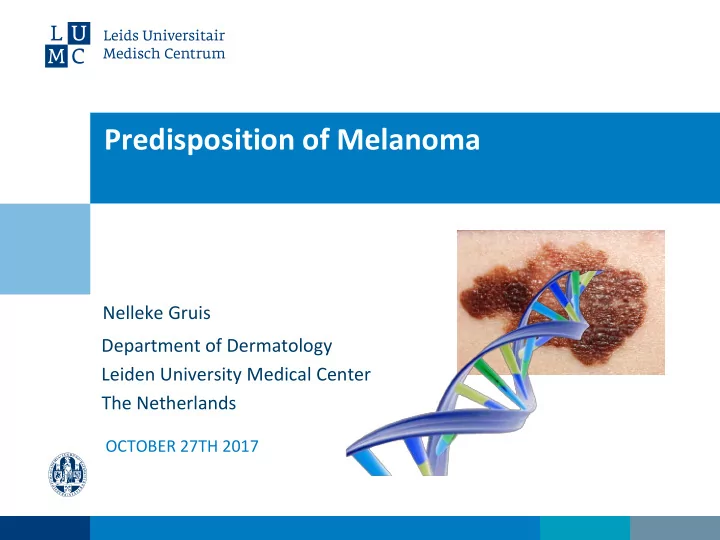
Predisposition of Melanoma Nelleke Gruis Department of Dermatology Leiden University Medical Center The Netherlands OCTOBER 27TH 2017 Melanoma Risk Factors ? Melanoma Predisposition 10% familial Manolio TA et al, Nature 2009 Melanoma

slide-1
SLIDE 1

Predisposition of Melanoma

Nelleke Gruis Department of Dermatology Leiden University Medical Center The Netherlands

OCTOBER 27TH 2017

slide-2
SLIDE 2

Melanoma Risk Factors

?

slide-3
SLIDE 3

Manolio TA et al, Nature 2009

Melanoma Predisposition

10% familial

slide-4
SLIDE 4

10% familial

High risk genes

Melanoma Predisposition

slide-5
SLIDE 5

melanoma in ≥3 relatives on same side of family

Familial Melanoma (scientific definition)

melanoma in 2 first degree relatives

slide-6
SLIDE 6

Nevus phenotype of Familial Melanoma

atypical nevus melanoma

20%

slide-7
SLIDE 7

Melanoma gene; CDKN2A

3 2 1α 1β

p16 p14ARF

12 13 21 22 23 24 11 11 12 13 21.1 21.2 21.3 22.1 22.2 22.3 31 32 33 34.1 34.2 34.3

CHROMOSOME 9

1β 1α 2 3

3% mutations affecting p14ARF only

Kamb et al., Science. 1994;264:436-40.

39% mutation in CDKN2A, affecting both p16 and p14ARF

CDKN2A Chr 9p21

slide-8
SLIDE 8

CDKN2A gene structure and function

RB pathway Cell cycle regulation p53 pathway DNA repair response

slide-9
SLIDE 9

Melanoma gene; CDK4

11.2 12.1 12.2 12.3 13.1 11.1 11 12 13.1 13.2 13.3 14 21.1 15 24.1 22 23 13.2 13.3 21.2 21.3 24.2 24.31 24.33 24.32

CHROMOSOME 12

2 3 1 4 5 6 7 8 activating mutation in exon 2 (R24C; R24H) Since 1996 only reported in 20 families worldwide

Zuo et al., Nat Genet. 1996;12:97.

CDK4 Chr 12q14

slide-10
SLIDE 10

CDK4 function

RB pathway Cell cycle regulation p53 pathway DNA repair response

slide-11
SLIDE 11

CDKN2A mutations worldwide

Goldstein et al., J Med Genet. 2007; 44:99-106

% families with CDKN2A mutations

number of melanoma patients in family

39% 45% 20% 57%

slide-12
SLIDE 12

Penetrance of CDKN2A mutations

Bishop et al., J Natl Cancer Inst. 2002;94:894-903

67% at age 80

EUR AUS USA ALL

30% at age 50

slide-13
SLIDE 13

CDKN2A and multiple primary melanoma

slide-14
SLIDE 14

Risk of other tumors in CDKN2A mutation carriers

De Snoo et al., Clin Cancer Res 2008; 14, 7151

(n=499) (n=1029)

lifetime risk PC :15 % to 20%

slide-15
SLIDE 15

number pancreatic carcinoma patients in family

CDKN2A mutations and pancreatic carc.

Goldstein et al., J Med Genet. 2007; 44:99-106

% families with CDKN2A mutations

slide-16
SLIDE 16

Pancreatic carcinoma and smoking

Potjer et al., Eur J Hum Genet 2014, 1-4

Melanoma: RR 41 Pancreatic Carcinoma: RR 81 Current Smokers have 4 fold increased risk than former or never smokers

slide-17
SLIDE 17

melanoma in ≥3 relatives on same side of family

M,M M M M M

Familial Melanoma (Clinical Practice)

melanoma in 2 first degree relatives: <40 years or multiple primaries in one relative

slide-18
SLIDE 18

CDKN2A and moles

CDKN2A non-carrier CDKN2A carrier CDKN2A does partly explain nevus phenotype

slide-19
SLIDE 19

Melanoma gene; BAP1

BAP1, chr 3p21

  • BAP1 is BRCA1 binding partner-1, involved

in DNA damage response

  • BAP1 mutations in 16 families with mixed

tumor phenotype, including cutaneous melanoma, mesothelioma, uveal melanoma and atypical melanocytic tumors

Wiesner et al. Nature Genetics 2011;43:1018; Abdel-Rahman M H et al. J Med Genet 2011;48:856.

slide-20
SLIDE 20

Melanoma gene; MITF (E318K)

  • MITF: transcription factor driving melanin biosynthesis and many other genes
  • E318K mutation leads to higher MITF activity
  • MITF E318K predisposes to melanoma and renal cell cancer

Bertolotto et al., Nature, 2011;480:94 Yokoyama et al., Nature, 2011;480:99

eumelanin

α-MSH adenylate cyclase cAMP MITF

TYR TYRP1 DCT MC1R

Chr 3p13

slide-21
SLIDE 21

Horn et al., Science, 2013; 339:959

Melanoma gene; TERT (promoter mutation)

  • TERT encodes for catalytic subunit telomerase
  • This prevents degradation of the chromosomal ends following

multiple rounds of replication

  • TERT promotor mutations create a new binding motif for Ets

transcription factor

Chr 5p15

  • 57 bp
slide-22
SLIDE 22

Melanoma genes; POT1 and Shelterin complex

Robles-Espinoza CD et al., Nat Genet. 2014;46:478-81 Aoude LG et al., J Natl Cancer Inst. 2014;107. Print 2015 Feb. Ramiro E et al., Nature 2007; 447, 924-931

ACD, TERF2IP, POT1

slide-23
SLIDE 23

High risk melanoma genes

CDKN2A BAP1

What are the implications for patients/treatment options?

  • CDKN2A: 39%
  • 1% CDK4
  • Less than 1% POT1
  • Less than 1% TERT
  • Less than 1% other mutations in

Shelterin complex genes

  • Less than 1% BAP 1

˜60% still unexplained

  • inheritance of many low risk genes
  • ‘boutique’ mutations
  • ‘mixed cancer’ syndromes
slide-24
SLIDE 24

Melanoma predisposition

10% familial 90% sporadic New (unique) high risk genes??

slide-25
SLIDE 25

Melanoma predisposition

90% sporadic Germline mutations: Low risk melanoma genes Somatic mutations

slide-26
SLIDE 26

Whole exome analysis 121 melanoma/matched normal tissue

  • 15 primary
  • 30 metastatic
  • 76 short term cultures

26-okt-17 26 Insert > Header & footer

Hodis et al Cell. 2012; 150: 251–263

Somatic mutations in melanoma

slide-27
SLIDE 27

BRAF mutation in melanoma

BRAF gene encodes for BRAF protein kinase: Regulates MAPkinase/ERK signal transduction Specific T1796A, V600E mutation in ~ 60% melanoma MAPK pathway hyperactivated

  • Increased proliferation

26-okt-17 27 Insert > Header & footer

Muñoz-Couselo et al., Ann Transl Med, 2015

slide-28
SLIDE 28

Melanoma progression

BRAF, NRAS, NF1, P53, CDKN2A, PTEN

?

slide-29
SLIDE 29

Order of somatic mutations

Sequencing analyses of 293 cancer related genes in 150 areas of 37 primary melanomas and their precursor lesions

26-Oct-17 29 Cutaneous melanoma > Order of the Genetic alterations

Shain et al., N Engl J Med 2015, 373, 1926

slide-30
SLIDE 30

26-okt-17 30 Insert > Header & footer

Shain et al., N Engl J Med 2015, 373, 1926

Order of somatic mutations

slide-31
SLIDE 31

26-okt-17 31 Insert > Header & footer

Met dank aan H. Suleiman Shain et al., N Engl J Med 2015, 373, 1926

Order of somatic mutations

slide-32
SLIDE 32

Horn et al., Science, 2013; 339:959

Melanoma gene; TERT (promoter mutation)

  • TERT encodes for catalytic subunit telomerase
  • This prevents degradation of the chromosomal ends following

multiple rounds of replication

  • TERT promotor mutations create a new binding motif for Ets

transcription factor

Chr 5p15

  • 57 bp
slide-33
SLIDE 33

BRAF –TERT interaction

26-okt-17 33 Insert > Header & footer

Thr 38P

ETS

TERT gene

slide-34
SLIDE 34

Melanoma predisposition

90% sporadic Germline mutations: Low risk melanoma genes Somatic mutations

slide-35
SLIDE 35

SNP-GWAS

Bi-allelic – one of two nucleotide options

(allele 1) …..TAGCCATCGGTA A GTACTCAATGAT….. (allele 2) …..TAGCCATCGGTA G GTACTCAATGAT….. AA AG GG

Adapted from Hunter et al. NEJM 2008

slide-36
SLIDE 36

Bishop et al. Nat Genet. 2009; 41:920-5 Brown et al., Nat Genet 2008; 40:838-40

Melanoma predisposition low risk genes Gene Chr OR MC1R 16q24 1.67 TYR 11q14 1.29 TYRP1 9p23 1.15 ASIP 20q11 1.75

slide-37
SLIDE 37

SNP variant OR ASIP 1.75 MC1R 1.67 TYR 1.29 TYRP1 1.15

eumelanin α-MSH adenylate cyclase cAMP MITF TYR TYRP1 DCT

MC1R

pheomelanin

pheomelanin

MC1R

X

Melanoma susceptibility low risk genes

slide-38
SLIDE 38

Latest GWA results- 2015

Slide provided courtesy of Tim Bishop, Leeds and based on Law, M et al., Nat Genet. 2015; 47: 987–995

slide-39
SLIDE 39

PIGMENTATION

OTHER NAEVI TERT TELOMERE LENGTH

?UVA UVB ?UVA UVB ?UVA UVB

MELANOMA CHARACTERISTICS

BODY SITE SOMATIC MUTATION PROFILE SURVIVAL CNV, etc…

?UVA UVB

Summary- low risk genes

Slide provided courtesy of Tim Bishop, Leeds

slide-40
SLIDE 40

Mitra D, Nature. 2012; 491:449-53

Low risk genes and melanoma progression

MC1R e/e MC1R +/+ Without ultraviolet radiation, BrafCA red mice have an increased rate of melanoma development relative to black and albino BrafCA animals.

slide-41
SLIDE 41

Low risk genes and melanoma progression

Robles-Espinoza CD et al., Nat Commun. 2016;7:12064

1 or 2 MC1R R variants: increased ( UV related) DNA damage Disrupted MC1R: diminished removal CPD and 6-4PP

slide-42
SLIDE 42

Summary Predisposition of Melanoma

BAP1 .BAP1

. TERT .POT1 ACD TERF2IP

Implications for clinical genetic management?

slide-43
SLIDE 43

Acknowledgements

Team 113, Sanger Institute

  • David Adams
  • St. James’ Hospital, Leeds
  • Mark Harland
  • Julia Newton-Bishop

QIMR, Brisbane

  • Nick Hayward

Leiden University Medical Center

  • Mijke Visser
  • Remco van Doorn
  • Eirini Christodoulou
  • Catarina Salgado
  • Nienke van der Stoep
  • Jeroen Laros