Recent Advances in Melanoma Therapy Adil Daud MBBS HS Clinical - - PDF document

recent advances in melanoma therapy
SMART_READER_LITE
LIVE PREVIEW

Recent Advances in Melanoma Therapy Adil Daud MBBS HS Clinical - - PDF document

Recent Advances in Melanoma Therapy Adil Daud MBBS HS Clinical Professor of Medicine, Co-Director, Melanoma Program, University of California, San Francisco Even after melanoma, some people keep on using tanning beds - latimes.com HOME PAGE


slide-1
SLIDE 1

1

Adil Daud MBBS HS Clinical Professor of Medicine, Co-Director, Melanoma Program, University of California, San Francisco

Recent Advances in Melanoma Therapy

http://www.nytimes.com/2010/02/23/health/research/23trial.html?pagewanted=all&_r=0 [4/24/13 2:58:23 PM] Search All NYTimes.com Search Health 3,000+ Topics Research Fitness & Nutrition Money & Policy Views Health Guide Inside Health Advertise on NYTimes.com Enlarge This Image Neemah A. Esmaeilpour for The New York Times ALWAYS WATCHING Randy Williams drove from Jonesboro, Ark., to Houston for treatment. Even after tumors disappeared, he says of his cancer, “I don’t think I’ll ever believe that it’s not coming back.” Target Cancer A Dose of Hope Second article in the series. Complete Series » Q & A with Amy Harmon Related Series: Forty Years' War Enlarge This Image Sarah Phipps for The New York Times FINGERS CROSSED Kerri Adams at home near Oklahoma City. After seeing an improvement from her treatment, she tried not to jinx it, declining to seek new information about the drug, the gene or the cancer. TARGET CANCER

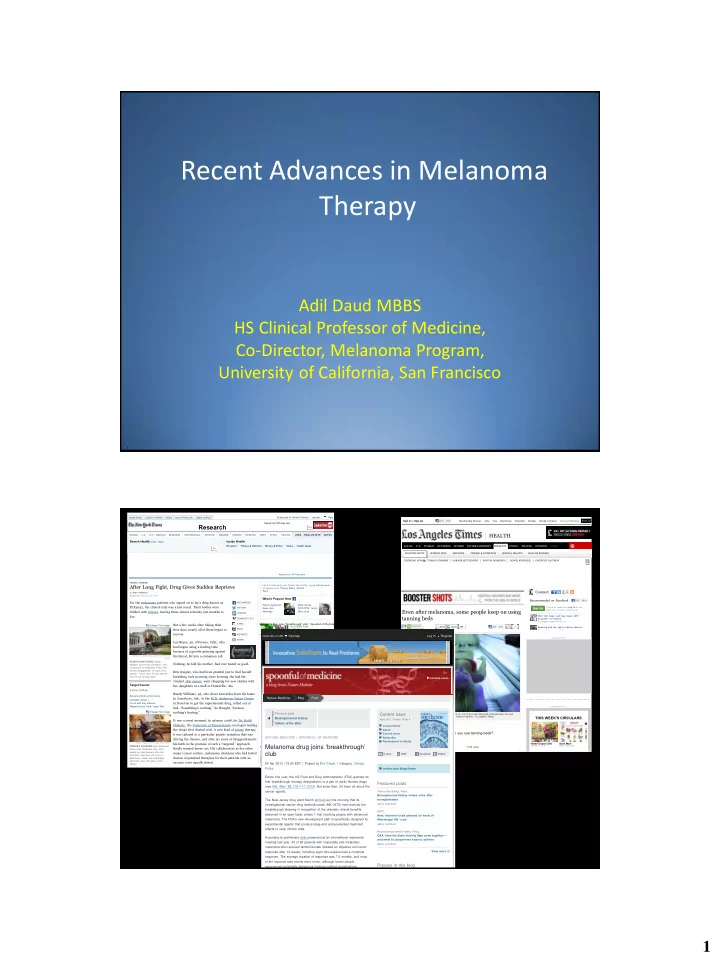
After Long Fight, Drug Gives Sudden Reprieve

By AMY HARMON Published: February 22, 2010

For the melanoma patients who signed on to try a drug known as PLX4032, the clinical trial was a last resort. Their bodies were riddled with tumors, leaving them almost certainly just months to live. But a few weeks after taking their first dose, nearly all of them began to recover. Lee Reyes, 30, of Fresno, Calif., who had begun using a feeding tube because of a growth pressing against his throat, bit into a cinnamon roll. Nothing, he told his mother, had ever tasted as good. Rita Quigley, who had been grateful just to find herself breathing each morning since learning she had the virulent skin cancer, went shopping for new clothes with her daughters at a mall in Huntsville, Ala. Randy Williams, 46, who drove 600 miles from his home in Jonesboro, Ark., to the M.D. Anderson Cancer Center in Houston to get the experimental drug, rolled out of

  • bed. “Something’s working,” he thought, “because

nothing’s hurting.” It was a sweet moment, in autumn 2008, for Dr. Keith Flaherty, the University of Pennsylvania oncologist leading the drug’s first clinical trial. A new kind of cancer therapy, it was tailored to a particular genetic mutation that was driving the disease, and after six years of disappointments his faith in the promise of such a “targeted” approach finally seemed borne out. His collaborators at five other major cancer centers, melanoma clinicians who had tested dozens of potential therapies for their patients with no success, were equally elated.

Log In With Facebook Log in to see what your friends are sharing
  • n nytimes.com. Privacy Policy | What’s
This? What’s Popular Now Well Consequences of the ‘Cinnamon Challenge’ April 22, 2013 Do We Have to Cool Down After Exercise? April 24, 2013, 12:01 AM Ask Well: Double the Workout, Double the Benefits? April 23, 2013 The Lies We Tell in the Exam Room April 22, 2013 How Therapy Can Help in the Golden Years April 22, 2013 Advertise on NYTimes.com Health & Fitness Tools BMI Calculator What’s your score? » France Approves Same-Sex Marriage Allan Arbus, ‘M*A*S*H’ Actor, Dies at 95 HOME PAGE TODAY'S PAPER VIDEO MOST POPULAR TIMES TOPICS

Research

WORLD U.S. N.Y. / REGION BUSINESS TECHNOLOGY SCIENCE HEALTH SPORTS OPINION ARTS STYLE TRAVEL JOBS REAL ESTATE AUTOS RECOMMEND TWITTER LINKEDIN COMMENTS (91) PRINT SHARE E-MAIL REPRINTS Subscribe to Home Delivery Help daudai... Even after melanoma, some people keep on using tanning beds - latimes.com http://www.latimes.com/health/boostershots/la-heb-tanning-bed-sunscreen-melanoma-20130408,0,6698321.story [4/24/13 2:39:29 PM] Comments 15 Email Share 12 Membership Services Jobs Cars Real Estate Subscribe Rentals Weekly Circulars Custom Publishing Place Ad

HEALTH

LOCAL U.S. WORLD BUSINESS SPORTS ENTERTAINMENT HEALTH LIVING TRAVEL OPINION SHOP TRENDING NOW TOBIAS SUMMERS DORNER SETTLEMENT BOSTON BOMBINGS HOWIE KENDRICK GWYNETH PALTROW

Even after melanoma, some people keep on using tanning beds

448 Like 384 Yes No

Do you use tanning beds?

1,014 votes

Your take?

Recommended on Facebook Connect

Like 450k Sign Up Create an account or Log In to see what your friends recommend. With 'Girl Code' and 'Guy Code,' MTV deciphers a franchise 87 people recommend this. Smoking and the right to dumb choices 38 l d h advertisement advertisement

THIS WEEK'S CIRCULARS

Home Depot USA EXPIRES TODAY Save Mart JUST RELEASED BOOSTER SHOTS SCIENCE NOW MEDICINE FITNESS & NUTRITION MENTAL HEALTH HEALTH REFORM Despite their dangers, tanning salons continue to appeal to 1 out of 50 people diagnosed with melanoma, the most deadly form of skin cancer, according to new research. (Robert Gauthier / Los Angeles Times) Sign In or Sign Up Like 450k Melanoma drug joins ‘breakthrough’ club : Spoonful of Medicine

nature.com

Sitemap Log In Register Go

Advanced search

NATURE MEDICINE | SPOONFUL OF MEDICINE

Melanoma drug joins ‘breakthrough’ club

24 Apr 2013 | 15:00 EDT | Posted by Elie Dolgin | Category: Cancer, Policy Earlier this year, the US Food and Drug Administration (FDA) granted its first ‘breakthrough therapy designations’ to a pair of cystic fibrosis drugs (see Nat. Med. 19, 116–117, 2013). But since then, it’s been all about the cancer agents. The New Jersey drug giant Merck announced this morning that its investigational cancer drug lambrolizumab (MK-3475) had received the breakthrough blessing in recognition of the dramatic clinical benefits

  • bserved in an open-label, phase 1 trial involving people with advanced
  • melanoma. The FDA’s new development path is specifically designed for

experimental agents that produce large and unprecedented treatment effects in early clinical trials. According to preliminary data presented at an international melanoma meeting last year, 43 of 85 patients with inoperable and metastatic melanoma who received lambrolizumab showed an objective anti-tumor response after 12 weeks, including eight who experienced a complete

  • response. The average duration of response was 7.6 months, and most
  • f the reported side events were minor, although seven people

experienced potentially dangerous immune-related complications. Previous post Bioengineered kidney makes urine after

E-alert RSS Facebook Twitter nature.com blogs home

Featured posts

Stem cells/cloning, Video Bioengineered kidney makes urine after transplantation add a comment AIDS New, intensive trials planned on heels of Mississippi HIV ‘cure’ add a comment Neuroscience/mental health, Policy Q&A: How the Brain Activity Map came together— and what its proponents hope to achieve add a comment View more

Popular in this blog Current issue

April 2013, Volume 19 No 4 Journal home About Current issue Subscribe Recommend to library

Post Blog Nature Medicine

slide-2
SLIDE 2

2

Devesa SS et al. Atlas of Cancer Mortality in the U.S., 1950–94. Washington, DC: US Govt Print Off; 1999.

Cancer Mortality Rates by State Economic Area Melanoma, White Males, 1970-94

A day at the beach, then and now

slide-3
SLIDE 3

3 Wide Local Excision Skin Recurrence

Sentinel Node Biopsy

Image courtesy of Douglas Reintgen MD, Moffitt Cancer Center

slide-4
SLIDE 4

4

GNAQ 32% G11 45 % NRAS 18 % BRAF 57 % NRAS 15 % BRAF 28 % C-Kit 10%-20% NRAS 15 %

Van Ramsdonk et al N Engl J Med 2010 Dec 2;363 Curtin et al J Clin Oncol 2006 Vol 24, No 26 Lee J H Br J Dermatol. 2011 Apr;164(4):776-84

C-Kit 5 -10 % NRAS 25 % BRAF 10%

Acral Scalp/Face

Trunk/Legs

Uveal

NRAS

C- RAF AKT MEK ERK PI3Kinase

Vemurafenib Daprafenib

MTORC-1 V600E BRAF

Growth/Survival

50% 15% 15-30%

Growth Factor

GTP

P

PTEN AKT

P

PDK

P P RTK

MTORC-2

CDK4/6 Cyclin D1 P p1 6 p2 1 Tremetinib GDC-0973 GSK 456 BKM 120 GDC-0941 MK-2206 Temsirolimus Everolimus 4E-BP1 p70S6K P P

Protein Translation

RB E2F

Proliferation

slide-5
SLIDE 5

5

Flaherty et al, NEJM Bolag et al, Nature Chapman et al, NEJM Sossman et al, NEJM

Response Rate = 81%

Phase III BRIM3 Study design

BRAFV600E mutation Stage

  • ECOG PS (0 vs 1)
  • LDH (↑ vs nl)
  • region

Screening 960 mg po bid (N=337) 1000 mg/m2 iv q3w (N=338) Dacarbazine Vemurafenib Randomization N=675

slide-6
SLIDE 6

6 100

90 80 70 60 50 40 30 20 10 Progression-free survival (%) 6 12 18 24

338 337 63 186 22 77 3 16 100 269 37 113 14 49 3

  • No. at risk

1.6 6.9

Hazard ratio 0.38

(95% CI: 0.32–0.46) Log-rank p<0.001 (post-hoc) Dacarbazine (n=338) Vemurafenib (n=337)

Progression-free survival (February 01, 2012 cut-

  • ff) censored at crossover

Time (months)

Dacarbazine Vemurafenib

100 90 80 70 60 50 40 30 20 10 Overall survival (%) 6 12 18 24 Vemurafenib (n=337) Median f/u 12.5 months Dacarbazine (n=338) Median f/u 9.5 months

338 337 173 280 79 178 24 44 1 244 326 111 231 50 109 4 7

9.7 13.6

Overall survival (February 01, 2012 cut-off) censored at crossover

Hazard ratio 0.70

(95% CI: 0.57–0.87) p<0.001 (post-hoc) Time (months)

Dacarbazine Vemurafenib

  • No. at risk
slide-7
SLIDE 7

7

NRAS

C- RAF AK T MEK ERK PI3Kinase

Vemurafenib Daprafenib

MTORC-1 V600E BRAF

Growth/Survival

50% 15% 15-30%

Growth Factor

GTP

P

PTEN AK T

P

PDK

P P RTK

MTORC-2

CDK4/6 Cyclin D1 P p1 6 p2 1 Tremetinib GDC-0973 GSK 456 BKM 120 GDC-0941 MK-2206 Temsirolimus Everolimus 4E-BP1 p70S6K P P

Protein Translation

RB E2F

Proliferation

CYTOPLASM NUCLEUS CELL MEMBRANE

slide-8
SLIDE 8

8

Progression-Free Survival

Estimated survival function Patients at risk Time since randomization (months) 1.0 0.8 0.6 0.4 0.2 0.0 3 6 9 12 15 18

54 46 25 13 2 54 47 33 26 11 1 54 52 36 29 15 1

Med (mos) HR (95% CI), P-Value Mono D 5.8

150/1 9.2

0.56 (0.37, 0.87), 0.006

150/2 9.4 0.39 (0.25, 0.62),<0.0001 12 mo. PFS rate 9% 26% 41%

Med follow up time 14 mo

HR 0.69 HR 0.56 HR 0.51

Combi-V, Robert et al NEJM 2014 Co-BRIM, Larkin et al NEJM 2014

HR 0.65

slide-9
SLIDE 9

9 William Coley 1862-1936

TUMOR Dendritic cell perforin granzyme cytokines Activated T cell T cell clonal expansion Resting T cell LYMPH NODE TCR CD28 MHC B7 Tumor antigen

Tumor cell Interferons

Anti–PD-1 Anti–PD-L1 Adaptive Resistance to T Cell Killing

Anti-CTLA4

CTLA4

slide-10
SLIDE 10

10

Phase 3 Study of anti-CTLA4 antibody, Ipilimumab

R A N D O M I Z ED

Ipilimumab 3 mg/kg + gp100 Ipilimumab 3 mg/kg

(n = 403) (n = 137) (n = 136)

gp100 Previously Treated Unresectable

  • r Metastatic

Melanoma* (N = 676)

*Enrolled patients with unresectable or metastatic melanoma previously treated with 1 or more of the following: aldesleukin, dacarbazine, temozolomide, fotemustine, or carboplatin.

12

24%

Years

Hodi FS et al. N Engl J Med. 2010;363:711-723.

46%

25 % 14 %

21

slide-11
SLIDE 11

11

Pembrolizumab Phase 1 Progression Free Survival

Analysis cut-off date: April 18, 2014.

Population Median, mo 95% CI Rate, 6 mo IPI-N 5.5 3.4-9.0 48% IPI-T 5.1 3.2-5.6 42% Overall 5.4 3.8-5.6 45% 10 20 30 40 50 60 70 80 90 100 2 4 6 8 10 12 14 16 18 20 22 24

190 172 100 87 84 74 65 56 50 25 22 19 9 n at risk

Progression-Free Survival, % Time, months

IPI naive IPI treated 221 189 113 88 83 73 51 31 31 14 13 12 4

IPI naive IPI treated

Daud et al, SMR 2014

slide-12
SLIDE 12

12

Population Median, mo 95% CI Rate, 12 mo IPI-N NR 22.8-NR 74% IPI-T 22.9 19.8-NR 65%

  • Median OS in total population: 25.9 months (95% CI, 21.1-NR)

Analysis cut-off date: April 18, 2014.

Overall Survival, % 2 4 6 8 10 12 14 16 18 20 22 24 26 28 10 20 30 40 50 60 70 80 90 100 Time, months 190 179 163 151 144 136 134 125 109 64 50 44 26 n at risk IPI naive IPI treated 221 208 184 171 160 144 128 85 69 43 29 25 9 8 3 1

IPI naive IPI treated

Daud et al, SMR 2014

Pembrolizumab Phase 1 Overall Survival

pre-treatment Week 24 pre-treatment Week 24 Response in Bone, Lung, Liver, Skin

slide-13
SLIDE 13

13

Baseline After 9 weeks After 3 weeks

Clinical Activity, Patient 012-305

Images courtesy of W.J. Hwu, MD Anderson Cancer Center. Patient provided written, informed consent to have his images included in congress presentations.

76-year-old male with desmoplastic melanoma with progression after ipilimumab

34%

ORR in Subgroups (RECIST v1.1, Central Review)

<Median ≥Median BRAF inhib Immunotherapy Chemotherapy ≥3 2 1 M1c M1b M1a Overall Wild type Mutant Baseline tumor size Previous therapy

  • No. lines

previous therapy M stage BRAF status Yes No Elevated Normal 1 ≥65 <65 Female Male 10 Q2W 10 Q3W 2 Q3W Overall IPI-T IPI-N Brain metastases LDH level ECOG PS Sex IPI exposure Age Dose/ schedule

Analysis cut-off date: April 18, 2014.

360 84 272 28 63 263 79 105 105 71 127 101 59 180 180 N 143 166 51 218 142 220 140 256 104 215 140 31 327 N 165 195 360

34%

slide-14
SLIDE 14

14

Georgina V. Long, Victoria Atkinson, Paolo A. Ascierto, Benjamin Brady, Caroline Dutriaux, Michele Maio, Laurent Mortier, Jessica C. Hassel, Piotr Rutkowski, Catriona McNeil, Ewa Kalinka-Warzocha, Kerry J. Savage, Micaela Hernberg, Celeste Lebbé, Julie Charles, Catalin Mihalcioiu, Vanna Chiarion-Sileni, Cornelia Mauch, Henrik Schmidt, Dirk Schadendorf, Helen Gogas, Christine Horak, Brian Sharkey, Ian Waxman, Caroline Robert

Nivolumab Improved Survival vs Dacarbazine in Patients with Untreated Advanced Melanoma

SMR (2014)

Phase 3 CA209-066: Study Design

Eligible patients with unresectable stage III or IV melanoma (N=418)

  • BRAF wild-type
  • Treatment-

naïve Stratified by:

  • PD-L1 status†
  • M-stage

R 1:1

Nivolumab

3 mg/kg IV Q2W +

Placebo

IV Q3W

N=210 (206 treated)

Placebo

IV Q2W +

Dacarbazine

1000 mg/m2 IV Q3W

N=208 (205 treated) Treat until progression* or unacceptable toxicity Primary endpoint:

  • OS

Secondary endpoints:

  • PFS
  • ORR
  • PD-L1

correlates

*Patients may be treated beyond initial RECIST v1.1-defined progression if considered by the investigator to be

experiencing clinical benefit and tolerating study drug.

Double- blind

†PD-L1 positive: ≥ 5% tumor cell surface staining.

slide-15
SLIDE 15

15

Primary Endpoint: Overall Survival

HR 0.42 (99.79% CI, 0.25–0.73; P < 0.0001)

(Boundary for statistical significance 0.0021)

NR=not reached. Based on 5 August 2014 database lock Patients who died, n/N Median OS mo (95% CI) Nivolumab 50/210 NR Dacarbazine 96/208 10.8 (9.3–12.1)

Patients at Risk Nivolumab Dacarbazine 210 208 185 177 150 123 105 82 45 22 8 3

Nivolumab (N=210) Dacarbazine (N=208)

Months

10 9 8 7 6 5 4 3 2 1 3 6 9 12 15 18

Patients Surviving (%) 1-yr OS 73% 1-yr OS 42%

Follow-up since randomization: 5.2–16.7 months

Secondary Endpoint: PFS

Based on 5 August 2014 database lock

HR 0.43 (95% CI, 0.34–0.56; P < 0.0001)

210 208 116 74 82 28 57 12 12 1

Months Patients without Progression (%)

Dacarbazine (N=208) Nivolumab (N=210) 10 9 8 7 6 5 4 3 2 1 3 6 9 12 15 18

6-mo PFS 48%

6-mo PFS 19%

Patients at Risk Nivolumab Dacarbazine

slide-16
SLIDE 16

16

Clinical Activity in Patients Who Received the Concurrent Regimen of Nivolumab and Ipilimumab.

Wolchok JD et al. N Engl J Med 2013;369:122-133.

slide-17
SLIDE 17

17

34

Taube et al, Clin Cancer Research, March 2014

slide-18
SLIDE 18

18

PC Tumeh et al. Nature 515, 568-571 (2014) doi:10.1038/nature13954 Baseline density, location and proximity of CD8+, PD-1+, PD-L1+ and CD4+ cells, and T-cell repertoire according to treatment

  • utcome.

Tumeh, P et al, 2014 NSCLC Melanoma RCC

*

Proportion of patients p=0.006

9/25 16*/25 17/17 0/17

*2 pts still under evaluation

42 pts include 18 MEL, 10 NSCLC, 7 CRC, 5 RCC, and 2 CRPC.

Correlation of PD-L1 expression in pretreatment tumor biopsies with clinical outcomes

Association Between Pretreatment Tumor PD-L1 Expression and Clinical Response Response Status PD-L1 Positive

  • no. (%)

PD-L1 Negative

  • no. (%)

Total

  • no. (%)

CR/PR 9 (36) 9 (21) Nonresponder 16* (64) 17 (100) 33 (79) All Patients 25 17 42

Topalian S, et al. NEJM 2012;366:2443-2454.

slide-19
SLIDE 19

19

Antitumor Activity of the Anti-PD-1 Monoclonal Antibody MK-3475 in Melanoma: Correlation of Tumor PD-L1 Expression With Outcome

Adil Daud,1 Omid Hamid,2 Antoni Ribas,3 F. Stephen Hodi,4 Wen-Jen Hwu,5 Richard Kefford,6 Jedd Wolchok,7 Peter Hersey,6 Jeffrey S. Weber,8 Richard Joseph,9 Tara C. Gangadhar,10 Roxana S. Dronca,11 Amita Patnaik,12 Hassane Zarour,13 Anthony M. Joshua,14 Kevin Gergich,15 Dianna Wu,15 Jared K. Lunceford,16 Kenneth Emancipator,16 Marisa Dolled-Filhart,16 Xiaoyun Li,15 Scot Ebbinghaus,15 S. Peter Kang,17 Caroline Robert18

1University of California San Francisco School of Medicine, San Francisco, CA; 2The Angeles Clinic and Research Institute,

Los Angeles, CA; 3David Geffen University of California Los Angeles School of Medicine, Los Angeles, CA; 4Dana-Farber Cancer Institute, Boston, MA; 5The University of Texas MD Anderson Cancer Center, Houston, TX; 6University of Sydney, Sydney, Australia; 7Memorial Sloan-Kettering Cancer Center, New York, NY; 8H. Lee Moffitt Cancer Center, Tampa, FL;

9Mayo Clinic Cancer Center, Jacksonville, FL; 10Abramson Cancer Center of the University of Pennsylvania, Philadelphia,

PA; 11Mayo Clinic, Rochester, MN; 12South Texas Accelerated Research Therapeutics (START), San Antonio, TX;

13University of Pittsburgh, Pittsburgh, PA; 14Princess Margaret Cancer Centre, Toronto, ON, Canada; 15Merck & Co., Inc.,

North Wales, PA; 16Merck & Co., Inc., Rahway, NJ; 17Merck Research Laboratories, Kenilworth, NJ; 18Gustave Roussy, Villejuif, France

Maximum Percent Change From Baseline in Tumor Size

PD-L1 and Radiologically Evaluable Patients With ≥1 Postbaseline Tumor Assessment (n = 106),a RECIST v1.1

Percentage changes >100% truncated at 100%. PD-L1 positivity defined as staining in ≥1% of tumor cells. Analysis cutoff date: 18 October 2013.

aEvaluable patients were those patients in the training set with evaluable tumor PD-L1 expression who had measurable disease at baseline per central review and

≥1 postbaseline tumor assessment. 38

  • 67% of patients experienced a reduction in tumor size
  • n MK-3475

Individual Patients

  • 100
  • 80
  • 60
  • 40
  • 20

20 40 60 80 100

Change From Baseline in Sum of Longest Diameter of Target Lesion, %

PD-L1+ PD-L1–

slide-20
SLIDE 20

20

Response Based on Tumor PD-L1 Expression: RECIST v1.1

PD-L1 and Radiologically Evaluable Patients (n = 113),a Independent Central Review

PD-L1 positivity defined as staining in ≥1% of tumor cells. Analysis cutoff date: 18 October 2013.

aEvaluable patients were those patients in the training set with evaluable tumor PD-L1 expression who had measurable disease at baseline per central review. b1-sided P values calculated by logistic regression, adjusting for dose/schedule.

39

40 58 49 65 13 37 10 20 30 40 50 60 70 80 Overall Response Rate Disease Control Rate

Rate, %

Unselected PD-L1+ PD-L1–

P = 0.0007b P = 0.0070b

slide-21
SLIDE 21

21

Conclusions

  • Unprecedented advances in melanoma therapy
  • BRAF inhibitors may be the primary choice for BRAF

mt patients

– Testing – Resistance to therapy

  • Immunological Therapies

– Ipilimumab – PD-1 (PD-L1)

  • Anti-angiogenic
  • Chemotherapy