SLIDE 1
Urban perspectives
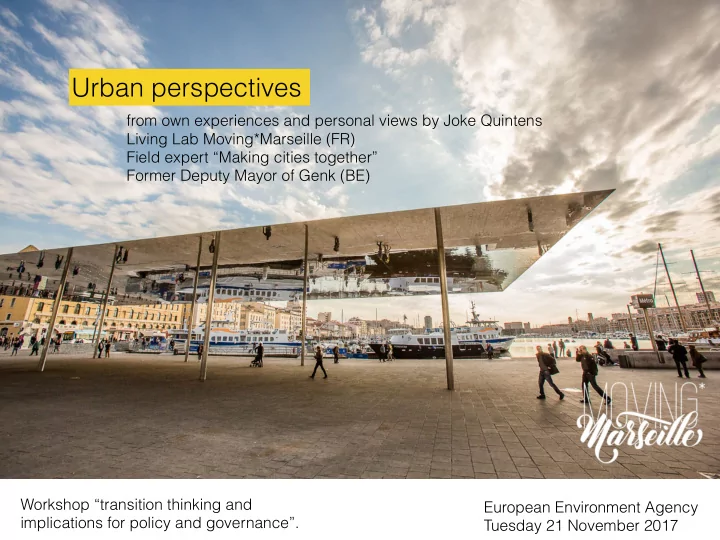
Workshop “transition thinking and implications for policy and governance”. European Environment Agency Tuesday 21 November 2017 from own experiences and personal views by Joke Quintens Living Lab Moving*Marseille (FR) Field expert “Making cities together” Former Deputy Mayor of Genk (BE)
SLIDE 2 Urban perspectives
Workshop “transition thinking and implications for policy and governance”. European Environment Agency Tuesday 21 November 2017 from own experiences and personal views by Joke Quintens Living Lab Moving*Marseille (FR) Field expert “Making cities together” Former Deputy Mayor of Genk (BE)
- 1. What is an urban perspective? Genk and Marseille.
- 2. Be aware of what’s happening in Wetopia.
- 3. Some thoughts, adressing the challenges.
SLIDE 3
Genk and Marseille
SLIDE 4
Genk and Marseille
citizen and Deputy Mayor 65.000 inhabitants in the north-west of Europe / Belgium near the center of Europe - Brussels working class, superdivers topdown (or organised bottom-up) very present local government very organised very performant administration a lot of supported community projects very poor activism suffocation of new initiatives by taking it over transitions: Three former coalmine seats are transformed. ARTS-project, participatory approach, Connecting Nature but also: Platanes, Essers, … citizen, citymaker, matchmaker, living lab 850.000 inhabitants (1,9 mio Métropôle) in the south of Europe / France at the border of Europe with Afrika (mentally and fysically) working class, superdivers, poor & unequal topdown and bottom up are different worlds very absent local government very un-organised administration is very difficult to reach very less supported community projects very strong activism from a need very poor interested local government in activistic projects transitions: New touristic and cultural city to visit. diversity, Cultural Capital, across European borders - from bottom up great transition projects as greening streets and Parc Foresta but also: polution cruises,…
SLIDE 5
SLIDE 6
SLIDE 7
SLIDE 8
video
SLIDE 9
SLIDE 10 In Wetopia we take action to build our community together. Civilians, activists, artists, scientists, entrepreneurs, civil servants, policy makers,… When people have little faith in politics it is necessary that we try to reshape our society together. Meanwhile people are already constructing Wetopia. When you want transitions to work and systems to change, everybody has to be
- involved. Not only scientists and policy
makers with their administrations. Everybody takes/can take responsibilities to accelerate transitions. In Wetopia we see new alliances - also without government, a lot of regaining pride and self-esteem and the strength of a superdivers community.
Wetopia
SLIDE 11
video
SLIDE 12
SLIDE 13
SLIDE 14
Focus of this workshop. Transition thinking. Implications for policy and local, national and EU governance? Old paradigm? Paradigm shift? Changing the system = changing a mindset = growing up. Feeling responsible. Developing participation. See cultural aspect of Genk and Marseille. Normal Science and Post Normal Science. Importance of governance in PNS. Make space to find other and new solutions together. Approach on what does work - “science” gets sometimes in the way of acceleration.
Some thoughts
SLIDE 15 What we can learn from industries:
- pen, outside the box, do-ers, less hierarchy.
an engaged entrepreneur = passionate an engaged scientist = an activist ARTS-project - 5 strategies to accelerate sustainable transitions in cities: upscaling, replicating, coupling, instrumentalizing, embedding. Tools and funds for accelaration of what already exists. European and other projects and networks: comprehensive translations and actions to continue with the results from scientists on the field in cities. More than reports. Transition approach and skills from local citymakers in
- Wetopia. Role of “matchmakers” and Living Labs.
Some thoughts
SLIDE 16 What about funding and research projects in cities with an absent local government? Socio technical transitions need strong and convinced civil servants for the long term approach. Jobcreation, growth are important in de mindset of
- politicians. But what about other value creations?
Multiple values? Shared values? Collective values?
Some thoughts
SLIDE 17
Urban perspectives
Workshop “transition thinking and implications for policy and governance”. European Environment Agency Tuesday 21 November 2017 from own experiences and personal views by Joke Quintens Living Lab Moving*Marseille (FR) Field expert “Making cities together” Former Deputy Mayor of Genk (BE)