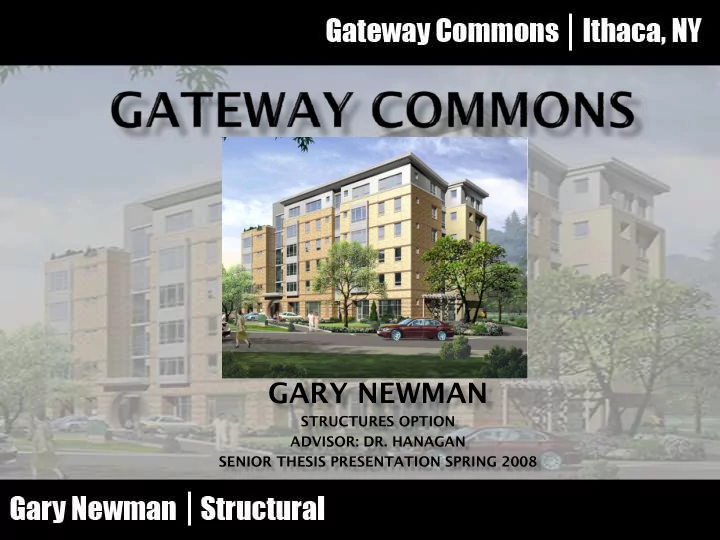
SLIDE 1 GARY NEWMAN
STRUCTURES OPTION ADVISOR: DR. HANAGAN SENIOR THESIS PRESENTATION SPRING 2008
SLIDE 2
- Upscale, mixed use development
- 62’ - 6 stories
- 2 retail and 25 residential spaces.
- 43,000 square feet
- $7.4 million
- December 2005 – April 2007
- Façade of brick, EIFS, and metal panels
- 311 E. Green Street Ithaca, NY
- Located in between downtown area
and nature area
INTRODUCTION
SLIDE 3
INTRODUCTION - BASEMENT
SLIDE 4
INTRODUCTION – FIRST FLOOR
SLIDE 5
INTRODUCTION – 2ND THROUGH 5TH FLOOR
SLIDE 6
INTRODUCTION – 6TH FLOOR
SLIDE 7
EXISTING STRUCTURE
SLIDE 8 EXISTING STRUCTURE - WALLS
- 8” CMU walls
- Reinforced with #5 bars at 4’ o.c.
with standard joint reinforcing
- Fully grouted 1st - 2nd floors
- All wall types are gravity load
bearing only MW2 and MW3 are part of lateral system
SLIDE 9 EXISTING STRUCTURE - FLOORS
Precast concrete hollow core plank
- First floor 10” thick, 2” topped planks
- 2nd – 6th floor 8” thick, un-topped planks
Slab on Grade
- 5” thick SOG, f’c = 3,500 psi
- #4 @ 16” o.c. both ways
SLIDE 10 EXISTING STRUCTURE – LATERAL SYSTEM
- 13 intermediate reinforced masonry shear walls
- 8” CMU reinforced like MW1 except includes boundary elements
SLIDE 11 EXISTING STRUCTURE - FOUNDATIONS
- Walls supported by strip footing, f’c = 3000 psi
- 1’-4” thick concrete retaining walls, f’c = 4000 psi
- Soil with allowable bearing capacity of 5,000 psf
SLIDE 12 PROBLEM STATEMENT
- The existing structure is the best choice for the building’s use
- Tech 2 showed existing system to be cheapest compared to steel and
concrete structures
- Custom structure
- If a change in the architecture of the building was to be considered the large
amount of load bearing walls would make an effective redesign of the architecture almost impossible.
SLIDE 13 PROPOSED SOLUTION
- A structural system that used columns would allow for a more open structure
- A two way concrete system was first proposed but it was too difficult to
determine a feasible column layout
- A one way concrete structure was determined to be the best structure
SLIDE 14 PROPOSED SOLUTION
Goals
- To gain a better understanding of concrete structures and the engineering
design process
- To create a complete and economical structural redesign of Gateway Commons
- To compare the new structure to the old one
- To architecturally design the new structure for an office building to show that
the new structure allows for versatility in architectural redesign
- To determine the cost and schedule of the new structure and determine if the
redesign is economically feasible
SLIDE 15 STRUCTURAL REDESIGN - SLAB
- SOG on first floor and basement are the same as in
- riginal design
- Pan joist slab is good for long spans with relatively
light loads
- Live load increases from 40 psf to 80 psf to allow for
- ffice redesign
- f’c = 5000 psi
- 4.5” top slab to provide 2 hour fire rating
SLIDE 16 STRUCTURAL REDESIGN - SLAB
- Representative design strips of the slab were
designed for in PCA slab
- Bar size, spacing and cut off point used in
slab design
- 7”x 10” ribs spaced at 20” were determined
to withstand the slab shear capacity and deflections
- #4 for top slab and between #4 - #6 for ribs
SLIDE 17 STRUCTURAL REDESIGN - SLAB
- The roof will use the same slab dimensions as the floors and the roof
will continue over 6th floor terrace
- 4” thick roof overhangs either cantilevered from beam or was
designed as a slab between cantilevered beams
SLIDE 18 STRUCTURAL REDESIGN - GIRDERS
- Girders designed as continuous beams
- Width of girders restricted by mechanical openings
and hallways
- Depth controlled by deflection:
Top & Bottom = 14”x 16” Middle = 14”x 18”
SLIDE 19 STRUCTURAL REDESIGN - GIRDERS
- Continuous beams were modeled in SAP
- Design moments for flexure determined by use of pattern loading
- Continuity of slab puts compatibility torsion on the beams
- Moment coefficients were used to determine the net moment the slab puts
- n the girders
SLIDE 20 STRUCTURAL REDESIGN - GIRDERS
- Flexure and shear/torsion reinforcement was calculated by hand
SLIDE 21 STRUCTURAL REDESIGN - COLUMNS
- Floor to floor height is 11’
- Column height will be 9’-6” for 16” deep girders and 9’-8” for 18” deep girders
- Column dimensions are 14”x 24”, f’c = 5000 psi
- SAP model used to determine axial and moment on each column
- Applied to PCA column as factored loads
- Majority of columns use (4) #9. Largest amount of reinforcement is (6) #10
SLIDE 22 STRUCTURAL REDESIGN – LATERAL SYSTEM
WIND
- Basic Wind Speed 90 mph
- Exposure category B
- Base shear N-S = 165.2 kips Base shear E-W = 86.7 kips
SEISMIC
- Site class D
- Seismic Design Category B
- R = 5
- Base Shear = 120 kips
SLIDE 23 STRUCTURAL REDESIGN – LATERAL SYSTEM
- Shear walls are located around the stair towers
- 8” thick ordinary reinforced concrete shear walls
- f’c = 5000 psi
SLIDE 24 STRUCTURAL REDESIGN – LATERAL SYSTEM
- Shear and flexure ETABS models were created
- In the shear model, each wall is assigned its own pier label
- In the flexure model, walls that connect are assigned the same pier label
SLIDE 25 STRUCTURAL REDESIGN – LATERAL SYSTEM
- Shear forces on each wall were factored
and used to design for shear reinforcing
- Moment and axial loads were used to
design for flexure reinforcement.
- In PCA column flexure forces were input
as service loads and load combinations were created
- Large part of wall design carried into small
section over door opening and (2) #5 around opening per ACI 22.6.6.5
- Horizontal shear reinforcing is #4 @ 18”
- Vertical reinforcing controlled by flexure
and is mostly #4 @ 18”
- Pier 3 in flexure model designed as an
isolated wall and required an increase in reinforcement
SLIDE 26 STRUCTURAL REDESIGN – LATERAL SYSTEM
- The eccentricity between the COR and COM was not very large so
torsion was added to direct shear
- Allowable story displacement h/400 = 1.98”
- All displacement values less than 1”
SLIDE 27 STRUCTURAL REDESIGN - FOUNDATIONS
- 9’x 9’x 3’ spread footings for the columns
- Retaining walls will use the same dimensions and reinforcing
- Columns are integrated with retaining walls
- Slab on first floor is supported by retaining walls
SLIDE 28 STRUCTURAL REDESIGN - FOUNDATIONS
- Strip footings will be used for the shear walls and the retaining walls
- Footings will have an f’c = 3000 psi
- Retaining walls will have an f’c = 4000 psi
SLIDE 29 ARCHITECTURE BREADTH
- Where columns are placed on windows the windows can be moved
and the architecture will still work.
SLIDE 30 ARCHITECTURE BREADTH
- A roof will be placed over the 6th floor roof terrace in the redesign of
the structure
- This will be done to allow for this area to have more versatility in a
redesign of the architecture
- The area that was the 6th floor terrace will be able to be redesigned as a
community gathering place that is open to the outdoors.
SLIDE 31
ARCHITECTURE BREADTH
SLIDE 32
ARCHITECTURE BREADTH
SLIDE 33
ARCHITECTURE BREADTH
SLIDE 34
ARCHITECTURE BREADTH
SLIDE 35
ARCHITECTURE BREADTH
SLIDE 36
ARCHITECTURE BREADTH
SLIDE 37
ARCHITECTURE BREADTH
SLIDE 38
ARCHITECTURE BREADTH
SLIDE 39 CONSTRUCTION MANAGEMENT BREADTH
COST
- Cost of existing structure = $2,078,841
- Cost of new structure = $1,293,136
- Total savings of $785,705
- RS Means Facilities Construction Cost Data 2006
SLIDE 40 CONCLUSION
- Pan joist system proved to be compatible with the existing architecture
- The structure allows for versatility in architectural redesign
- The cost of the structure decreases and the schedule increases according
to my results
- I would recommend that Gateway Commons be constructed with the
new pan joist structural system instead of the precast concrete hollow core plank on CMU walls
SLIDE 41
ACKNOWLEDGMENTS
The AE faculty Friends and Family Ryan Biggs Associates Northeast Construction
SLIDE 42
QUESTIONS ?