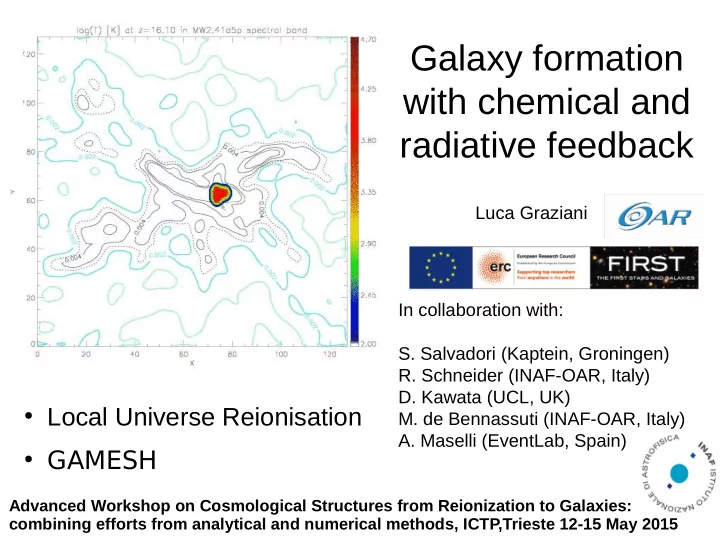
Galaxy formation with chemical and radiative feedback Luca - - PowerPoint PPT Presentation

galaxy formation with chemical and radiative feedback
SMART_READER_LITE
LIVE PREVIEW

Galaxy formation with chemical and radiative feedback Luca - - PowerPoint PPT Presentation

Galaxy formation with chemical and radiative feedback Luca Graziani In collaboration with: S. Salvadori (Kaptein, Groningen) R. Schneider (INAF-OAR, Italy) D. Kawata (UCL, UK) Local Universe Reionisation M. de Bennassuti (INAF-OAR,


slide-1
SLIDE 1

Galaxy formation with chemical and radiative feedback

  • Local Universe Reionisation
  • GAMESH

Luca Graziani

Advanced Workshop on Cosmological Structures from Reionization to Galaxies: combining efforts from analytical and numerical methods, ICTP,Trieste 12-15 May 2015

In collaboration with:

  • S. Salvadori (Kaptein, Groningen)
  • R. Schneider (INAF-OAR, Italy)
  • D. Kawata (UCL, UK)
  • M. de Bennassuti (INAF-OAR, Italy)
  • A. Maselli (EventLab, Spain)
slide-2
SLIDE 2

The FIRST team and collaborators

Matteo de Bennassuti, PhD INAF/OAR Stefania Marassi, Pdoc INAF/OAR Raffaella Schneider, PI INAF/OAR Rosa Valiante, Pdoc INAF/OAR Marco Limongi INAF/OAR Stefania Salvadori Kepteyn, Groningen Simone Bianchi INAF/OAA Andrea Ferrara Scuola Normale Gen Chiaki Tokyo University Kazu Omukai Tohoku University Roberto Maiolino Cambridge

slide-3
SLIDE 3

GAMESH = GAMETE + CRASH + Nbody simulation of Milky Way galaxy formation

N-body simulation: dynamical evolution

  • f DM halos

GAMETE simulation: Star formation, metal production CRASH simulation: RT, gas ionisation heating I0 : GAMETE galaxies → CRASH sources I1 : gas T, ionisation → Star forming halos

  • GAMESH can follow both mergers

and spatial evolution of structures

  • GAMESH implements self-consistent

Radiative and chemical feedback

slide-4
SLIDE 4

GAMESH radiative feedback model

  • GAMESH compares Tvir of each halo with Tgas of the environment

from which cold gas can feed star formation. Tgas < Tvir → star formation allowed in the halo.

  • Tgas must be defined depending on the spatial extension of the

halo environment.

  • If Rvir > 0.1 dx/2 → cells surrounding the halo cell can feed gas

→ Tgas is the volume average over cells. (EXTERNAL FEEDBACK)

  • If Rvir <= 0.1 dx/2 → only the halo cell can feed gas

→ Tgas is the temperature of the halo cell. (LOCAL FEEDBACK)

slide-5
SLIDE 5

GAMESH Results: Pop III SFR, Pop II SFR

Pop II SFR: insensitive to reionisation model. Pop III → Pop II: sensitive to the Radiative feedback model and the interplay with chemical feedback. Pop III bubbles remain isolated in space → Local feedack at high-z Pop III SFR: very sensitive to reionisation model. Both IReion and GAMESH provide values at z=0 in agreeemnt with observed SFR at z=0.

slide-6
SLIDE 6

GAMESH Results: Radiative Feedback stats

Radiative Feedback stats: sensitive to reionisation model. Radiative Feedback stats: not reflected in SFR both at high and low z. Radiative Feedback stats affected by inhomogeneities Radiative Feedback is working quite well even in low spatial resolution grids.

slide-7
SLIDE 7

GAMESH Results: interplay with chemical feedback

IGM metallicity sensitive to reionisation model. Evidence of Interplay between radiative and chemical feedback. High-z enrichment needs corrections. Improve mass resolution N-body Improve enrichment model

slide-8
SLIDE 8

GAMESH Results: interplay with chemical feedback - MW MDF

IGM metallicity sensitive to reionisation model. Evidence of Interplay between radiative and chemical feedback. High-z enrichment needs corrections. Improve low metallicity tail MDF Decent MDF?!

slide-9
SLIDE 9

GAMESH Conclusions

GAMESH is ready and working: first example of semi-analytic and numerical RT

  • Coupling. Self-consistent!

A better GAMETE is in development → Better metal enrichment scheme GAMESH is providing interesting results on low-resolution N-body simulations. Self-consistent radiative and chemical evolution requires better metal enrichment modelling. Better mass resolution simulations could be used to address the Missing Satellite problem!! H2-cooling halos require also better SF prescription and LW RT implementation. A better CRASH is in development → LW RT!!

A new GAMESH will be ready soon!

Graziani et al., 2015, MNRAS, 449, 3, 3137-3148.