Antnio GasparCunha - - PDF document

ant nio gaspar cunha
SMART_READER_LITE
LIVE PREVIEW

Antnio GasparCunha - - PDF document

Antnio GasparCunha


slide-1
SLIDE 1
  • Dept. Polymer Engineering

University of Minho

  • António GasparCunha
  • !

"###$

  • Dept. Polymer Engineering

University of Minho

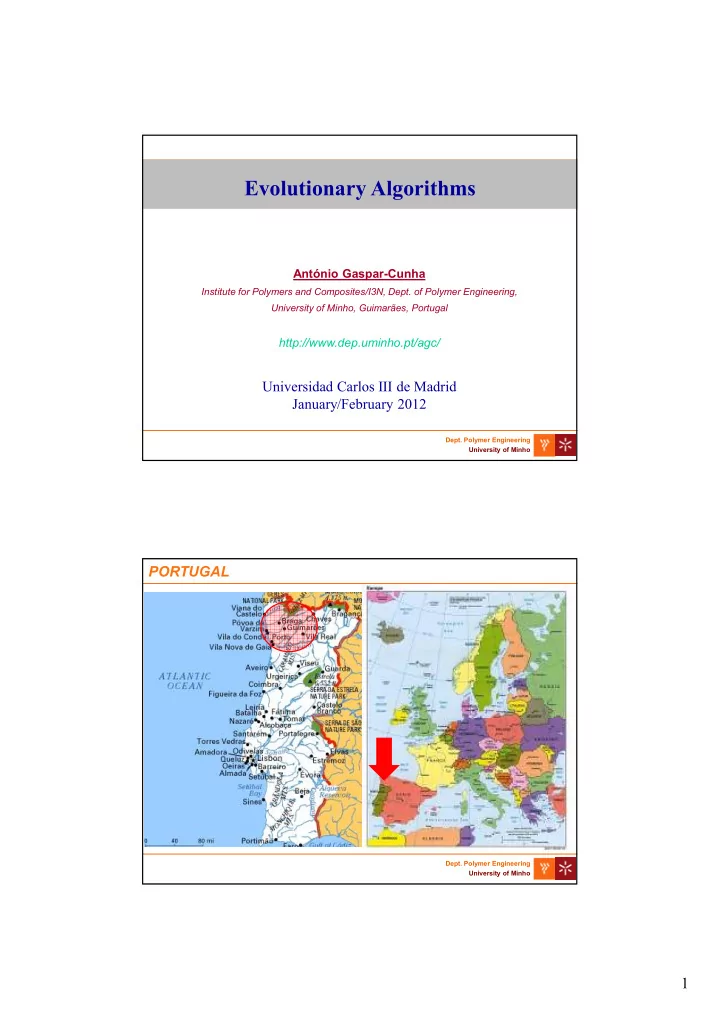
PORTUGAL

slide-2
SLIDE 2
  • Dept. Polymer Engineering

University of Minho

Schools

  • School of Engineering (EENG)
  • !!
  • "

School of Engineering #$$ #% # # #! # Department of Polymer Engineering (DEP) # ! #"&"

UNIVERSITY OF MINHO

  • Dept. Polymer Engineering

University of Minho

Engineering ' ($)* +#* $,$-$ ' ' $$ ' #"!" ' "& "! "".//" ' "! "/ ' "!,% *" '

  • !%

' Institute for Polymers and Composites (IPC) ' #! "!!"

RESEARCH CENTERS

Associate Labs ' $$ * $!$ ' I3N Institute of Nanostructures, Nanomodelling and Nanofabrication

slide-3
SLIDE 3
  • Dept. Polymer Engineering

University of Minho

  • ##$!

## ## ## !

  • $

$! $ $!*! $ ! %

  • #
  • %
  • #

01 #! !2 ! #

  • !"

$ +

  • 1
  • 3#!4

3 #! ! !!

  • !

# !!

  • %2

! "&

1st Cycle and Integrated Master Courses (15 000 Students)

TEACHING

  • Dept. Polymer Engineering

University of Minho

GUIMARÃES

HISTORIC CITY CENTRE – Intramural Area (Classified UNESCO World Heritage Site)

slide-4
SLIDE 4
  • Dept. Polymer Engineering

University of Minho

!" # $ % & '# % ( &(%$$#$ % $ ) # !" ! " #$ ( &(%%%$!$!**%++ #$!,-./&#%./0. !"/./&.$ ! (

&(%%%$!+#!$&'# $&1,2-'#.*$

GUIMARÃES

  • Dept. Polymer Engineering

University of Minho

CONTENTS

% &'! '3#& ' '4 '45#! '6!! '5&&41!& '

slide-5
SLIDE 5

7

  • Dept. Polymer Engineering

University of Minho

CONTENTS

% &()*+,! ' 65#! ''&8 '4 '6 ' ')!9: ' '; '<5#!

  • Dept. Polymer Engineering

University of Minho

CONTENTS

% -&./0*1! '&= ' '4< '6+++4< ';6 5+ ')'6 5 '5&&41!& ';#6&

slide-6
SLIDE 6

>

  • Dept. Polymer Engineering

University of Minho

CONTENTS

% #&2.032 4* ' '+<?45#! '=@# ') 'A5#! ';!<?) '6 '

  • Dept. Polymer Engineering

University of Minho

CONTENTS

% 5&2!.0 '=#6#= ''!41 9#%+%1: '6+& '6 9@&&6'4#:

slide-7
SLIDE 7

B

  • Dept. Polymer Engineering

University of Minho

PEOPLE

67 2 8 7! 69 7 7. 7 ( : % ,;! % 3<= >8

  • Dept. Polymer Engineering

University of Minho

%& '!

António GasparCunha

  • !

"###$

slide-8
SLIDE 8

C

  • Dept. Polymer Engineering

University of Minho

OUTLINE

>* . 3! !2 !

  • Dept. Polymer Engineering

University of Minho

BIBLIOGRAPHY

5* %

  • ,

6

  • ,

#7,

  • 6,

*8!, 59:9; /* <- 7, = > ? % #6, ( @, # , 599A; (* " $1, 6%! ! # ; % , %! #, 6, 3& B%! , 599A; C* , = 6, $ $1, 599A; D* E!!

  • ,

6*-F% #7

  • %!

6, G 8! H , /II5;

slide-9
SLIDE 9

*

  • Dept. Polymer Engineering

University of Minho

MOTIVATION

Sophisticated mathematical models are able to describe adequately a specific process

Governing equations Numerical methods Boundary conditions Heat transfer and flow behaviour Other models System geometry Material properties Operating conditions PROCESS PERFORMANCE

  • Dept. Polymer Engineering

University of Minho

How are these tools can be used to: Set the operating conditions? Design the machine? ETC8

MOTIVATION

slide-10
SLIDE 10
  • Dept. Polymer Engineering

University of Minho

Approaches to optimize the processes (e.g., set the operating conditions, design machines, etc0): ' Use empirical knowledge; ' Use computational tools on a trial and error basis; ' Solve the inverse problem; ' Perform a partial process optimization; ' Develop a global optimization procedure.

MOTIVATION

  • Dept. Polymer Engineering

University of Minho

Use computational tools on a trial and error basis

D

' #

D <?93#

' 3-F/ # ' 3-F(# ' 3-FC& ' @@@

  • +
  • J

4

  • MOTIVATION
slide-11
SLIDE 11
  • Dept. Polymer Engineering

University of Minho

Use computational tools on a trial and error basis

A good performance may be distinct from the best performance

MOTIVATION

( C D A K : 9 5I I 5II /II (II CII / ( C D

8"

  • 3
  • #
  • 1
  • .
  • Dept. Polymer Engineering

University of Minho

D !

' ## ' 3#

D 3#

' # ' # ' & ' @@@ %L

Direct problem: D !

' 3# ' @@@

D ##

' 3# ' # ' # ' & ' @@@

Inverse problem:

%L

Solve the inverse problem MOTIVATION

slide-12
SLIDE 12
  • Dept. Polymer Engineering

University of Minho

Perform a partial process optimization

  • 1. Optimizing for output

' Melt conveying ' Melting (helix angle, number of flights, flight clearance, compression ratio) ' Solids conveying (channel depth, helix angle, number of flights, flight

clearance)

  • 2. Optimizing for power consumption

(helix angle, flight clearance, flight width) EXAMPLE: Optimizing for output (Melt conveying)

( ) ( )

  • :

9

  • :

9 >

+

     

  • +
  • =
  • θ

π       + +       + =

  • π

θ

  • C. Rauwendaal, Polymer Extrusion, Hanser (2001)

MOTIVATION

  • Dept. Polymer Engineering

University of Minho

$ Objective Function Modelling Package

  • #%&'
  • $
  • USER INTERFACE

Optimization Algorithm

RESULTS

Develop a global optimization procedure MOTIVATION

slide-13
SLIDE 13
  • Dept. Polymer Engineering

University of Minho

  • #

1

  • (

( $

  • In most optimization algorithms:

' The search is local ' If one local peak is found the search stops

Develop a global optimization procedure MOTIVATION

  • Dept. Polymer Engineering

University of Minho

91E:

  • 1

MOTIVATION

slide-14
SLIDE 14
  • Dept. Polymer Engineering

University of Minho

91E:

  • 1

MOTIVATION

  • Dept. Polymer Engineering

University of Minho

91E:

  • 1

MOTIVATION

slide-15
SLIDE 15

7

  • Dept. Polymer Engineering

University of Minho

3 "<"3 3+"

' + ' ' ' 1 ' &#! ' %!! ' ' "!#7 ' %!

91E:

  • 1

MOTIVATION

  • Dept. Polymer Engineering

University of Minho

RANDOM SEARCH ' " L #! selecting randomly # # % @ ' " L 1 one point each time, #% #! %% #@ ' Search is very slow L ! %- #-@ MOTIVATION

slide-16
SLIDE 16

>

  • Dept. Polymer Engineering

University of Minho

GRADIENT METHODS These methods use information about the objective function gradient in

  • rder

to establish the search direction.

y = f(x1,x2) starting point P(x1(0),x2(0))

      ∂ ∂ ∂ ∂ =

  • E
  • '

6# & '@

  • A!

9:

  • MOTIVATION
  • Dept. Polymer Engineering

University of Minho

SIMULATED ANNEALING

' 1 # way liquids freeze or metals recrystallize #@ ' 8 ! # ! , ! ! ##&! thermodynamic equilibrium@ ' " ! - progressively ordered ## 7 @ ' $! !, #7 one point randomly selected # 1 %@ ' " % - # improvement is obtained # #--! ## @

MOTIVATION

slide-17
SLIDE 17

B

  • Dept. Polymer Engineering

University of Minho

ARTIFICIAL NEURAL NETWORKS

' * 1 ! input !

  • utput % intermediate

layersM '

  • weight,

! , F training #M ' " # # ! function #% !M

P1 P2 Pi C1 ... C2 Cj ... Input Layer Output Layer Hidden Layer

' # -! ! # &- #- approximating an arbitrary complex functionM ' " builds a map - # #% #M

MOTIVATION

  • Dept. Polymer Engineering

University of Minho

EXPERT SYSTEMS

' &# ! # % #-@ ' # 1 -, 1 L #, % #, &# #, #@ ' , 1* 1 -@ ' " 1 L # #% - # # 1 -@ ' #

  • @

' # !@ ' " % # 1

  • 1 -, -! %

#- # -! &#

  • &#

#

  • *1

# @

F%# 50 !& 41& !&

  • !&

!& F;<2G4= 43564 4H'4)6 64)6

MOTIVATION
slide-18
SLIDE 18

C

  • Dept. Polymer Engineering

University of Minho

SENSITIVITY ANALYSIS

%! ! ! L! #

  • % # #7 # %-

% -F% # %-@ ( )

  • :E

9 : 9 =

( ) ( )

  • :E

9 : 9 :E 9 : 9 : 9 ∂ + ∂ = = ∇

3 %! 1, % # δ& -F% - @@ ;

  • δ

δ : 9 : 9 : 9 − + =

MOTIVATION

  • Dept. Polymer Engineering

University of Minho

STATISTICAL METHODS

' " evaluate data, - -! #

  • ! &# , objective function@

' % &# %-, , #, L, 1*$, $&*$1, " #& @ ' " # #- !, ! - % , !# , !# # %- !, # 7 - # %%@

( )

  • E

+ + + + + =

MOTIVATION

slide-19
SLIDE 19

*

  • Dept. Polymer Engineering

University of Minho

ANT COLONY OPTIMIZATION

+ #- # % @ , ! #- # %, &# # -

  • @

MOTIVATION

  • Dept. Polymer Engineering

University of Minho

ANT COLONY OPTIMIZATION

' ! 3#7 3 ## ## -! @ ' " # 3 -% @ "

  • % - # -

@ 8 1 % %, # - # @ 8 !

  • , ! #--! #

1 -! # @ ' " - -% - #% #@

MOTIVATION

slide-20
SLIDE 20
  • Dept. Polymer Engineering

University of Minho Objective Function Parameter 2 Parameter 1 OPTIMUM Objective Function Parameter 2 Parameter 1 OPTIMUM Objective Function Parameter 2 Parameter 1 OPTIMUM

Initial Population 2nd Generation ithGeneration nth Generation

Objective Function Parameter 2 Parameter 1

OPTIMUM

' Search uses a population

  • f points

' Able to distinguish between local and absolute maxima ' Do not require derivatives nor other knowledge on the process (BLACK BOX) ' Require significant computation resources

MOTIVATION EVOLUTIONARY ALGORITHMS

  • Dept. Polymer Engineering

University of Minho

  • E

E

  • :

9 E E

  • :

9

  • ?

E E

  • :

9 !1!1

  • =

= = ≥ =

" # - #

  • #
  • F%

, #!

  • !

#% # # # #;

f is the objective function of the n parameters xi, gj are the J (J≥ ≥ ≥ ≥0) inequality constraints, and k are the K (K≥ ≥ ≥ ≥0) equality constraints.

MOTIVATION

{ } ( )

≤ ℜ ∈ =

  • (
  • %
slide-21
SLIDE 21
  • Dept. Polymer Engineering

University of Minho

Computational Intelligence MOTIVATION

#

  • 1

Evolutionary Algorithms 077! ! Genetic Algorithms %

  • %!
  • !

3#7 3

  • Dept. Polymer Engineering

University of Minho

  • Robust Search Methods

MOTIVATION

slide-22
SLIDE 22
  • Dept. Polymer Engineering

University of Minho

EVOLUTIONARY THEORY ' encodes the information % M ' identical % #M ' Small changes % ; *0 &#; , , @ @@@

Genes and DNA

  • Dept. Polymer Engineering

University of Minho

' % @ ;

**$****$*$*****$****

' # =6 ! ! ! M ' " # M ' # NN@

Genes and DNA

EVOLUTIONARY THEORY

slide-23
SLIDE 23
  • Dept. Polymer Engineering

University of Minho

' " 7 chromosomesM ' /( # , physical attributes %;

Human Reproduction

EVOLUTIONARY THEORY

  • Dept. Polymer Engineering

University of Minho

' % /( % /( #M ' " #% -! M ' # # ! # N%N@

Reproductive Cells

EVOLUTIONARY THEORY

slide-24
SLIDE 24
  • Dept. Polymer Engineering

University of Minho

" % # &

  • ! # %@

Crossover Before After

EVOLUTIONARY THEORY

  • Dept. Polymer Engineering

University of Minho

Fertilization

7 . "$

EVOLUTIONARY THEORY

slide-25
SLIDE 25

7

  • Dept. Polymer Engineering

University of Minho

' # ! ! # mutation M ' " , #O, not inherited ! #M ' " #--! very lowM ' " #- %@

Mutation

EVOLUTIONARY THEORY

  • Dept. Polymer Engineering

University of Minho

' B! - %% # ' 3! - %% #

Evolutionary Theory

' NN # # ' N$N # # ' " =6 # - ! - %% % Mutation Crossover

  • =#%6

#

EVOLUTIONARY THEORY

slide-26
SLIDE 26

>

  • Dept. Polymer Engineering

University of Minho

The evolutionary theory allows to explain that this slow change of genetic material through reproduction and mutation (and possibly crossover) enabled the possibility

  • f

generating all species

  • f

plants and animals EVOLUTIONARY THEORY

Evolutionary Theory

  • Dept. Polymer Engineering

University of Minho

%!

  • )
  • # %

# 1 % @ "! 1 ## #, # #- #@ % % -F% , # !@ % # % - ##! #, @@ # @

Evolutionary Algorithms

EVOLUTIONARY ALGORITHMS

slide-27
SLIDE 27

B

  • Dept. Polymer Engineering

University of Minho

Evolutionary Computation – THE METAPHOR

% %

  • %

%!#

  • P!
  • EVOLUTIONARY ALGORITHMS
  • Dept. Polymer Engineering

University of Minho

' " $ ! ## - ## %@ ' # L - @ ' " - %# F @ ' , - - ! @

Evolutionary Equation

EC = GA + ES + EP + GP

Evolutionary Computing Genetic Algorithms Evolution Strategies Evolutionary Programming Genetic Programming ,59KD +-,59K( 0,3, 8,59AA E7,599/

EVOLUTIONARY ALGORITHMS

slide-28
SLIDE 28

C

  • Dept. Polymer Engineering

University of Minho

The Computational Cycle

Random initialization (or semi random) of the population of candidate solutions (Generation 0) Evaluation of the performance of population individuals Generation of a new population from members with more performance through genetic

  • perations (recombination and

mutation) Evolutionary computation is an iterative technique, i.e., successively new populations are generated until a good solution is found

EVOLUTIONARY ALGORITHMS

  • Dept. Polymer Engineering

University of Minho

)!

  • '&

<&# ' 6 )&!

EVOLUTIONARY ALGORITHMS

The Evolutionary Cycle

slide-29
SLIDE 29

*

  • Dept. Polymer Engineering

University of Minho

SCHEMA THEOREM

Schema Theorem: John Holland

Objective Q #% % #@ ## #- 1 7 -! ##7 -! -@ " #% &# %%, ! # @ ; ' $! #-M ' 0& %, M ' 0 # M ' %M ' @

  • Dept. Polymer Engineering

University of Minho

Definition 1 Q ,*;

  • ##-%

#*@ )#-)B 2 #-,2R)!- !%@ @@-!#-)∈ SI,5,2T2∈ SI,5T SCHEMA THEOREM

slide-30
SLIDE 30
  • Dept. Polymer Engineering

University of Minho

Example 0 -! % L SI 5 5 5 I I IT, ! % , ? U2 5 5 2 I 2 2V " ? UI 5 2 5 2V , I 5 I 5 I I 5 I 5 5 I 5 5 5 I I 5 5 5 5 SCHEMA THEOREM

  • Dept. Polymer Engineering

University of Minho

Definition 2 Q 3, *; , @, - R2) *@ Example, 2 2 2 I 2 2 2 ? 5 Definition 3 Q , δ*; , δ*, - R2) @ Example, δ2 2 2 I 2 2 2 ? C Q C ? I SCHEMA THEOREM

slide-31
SLIDE 31
  • Dept. Polymer Engineering

University of Minho

" #% # %

  • &# "!

Schemata theory

  • (H) Scheme order (number of fixed positions):
  • (1*01*) = 3 and o(*1**0) = 2

δ δ δ δ(H) Scheme length (distance between the first and the last fixed positions) δ δ δ δ(1*01*) = 3 and δ δ δ δ(*1**0) = 3

DEFINITIONS:

! .II III,II5,I5II55

#

chromossomes

SCHEMA THEOREM

  • Dept. Polymer Engineering

University of Minho

" &# - # *, & >5, % -!;

( ) ( ) ( ) ( ) ( )

     − − − ≥ +

  • E
  • E

δ

3"+ +3+3 &#- %@

+ *,>5*,-#>5M + *%-F%% #-!*M * %-F%##M * $ #--%#%!@

  • Schemata theory

SCHEMA THEOREM

slide-32
SLIDE 32
  • Dept. Polymer Engineering

University of Minho

APLICATION EXAMPLE EXAMPLE OF APPLICATION: To minimize the cost of material used to manufacture a can

  • Dept. Polymer Engineering

University of Minho

APLICATION EXAMPLE To minimize the cost of material used to manufacture a can

  • Caracteristic dimensions:

h heigth d diameter

( ) ( )

  • !1

! !1 !

  • J
  • $
  • E
  • E
  • E

E

  • E
  • !"

= ≤ ≤ ≤ ≤ ≤ ≤ ≤ ≤ ≥ ≡         + = π π π

Problem Formulation:

c is the cost of can material per squared cm

slide-33
SLIDE 33
  • Dept. Polymer Engineering

University of Minho

Chromosome Representation

!-* #

CHROMOSOME GENE

5II-## APLICATION EXAMPLE

1 1 1 1

  • Dept. Polymer Engineering

University of Minho

Solution Representation

,?:,5I ?I5IIII5I5I

  • #$

%

  • !#;

' , ' - ' $

Example – binary codification:

* d [5.0, 15.0] with a single decimal place (c) * length: l = 15 5 = 10 * number of intervals (NI) = l * 10^c = 10 * 10^1 = 100 * number of bits (nb): [8] 2^6 = 64 < 100 < 2^7 = 128 * 5.0 is represented by (00 000 000) * 15.0 is represented by (11 111 111) * using a direct binary representation 8.0 (80) is (01 010 000) * while using the present representation (01 010 000) is 8.1

=+W6 APLICATION EXAMPLE

slide-34
SLIDE 34
  • Dept. Polymer Engineering

University of Minho

Conversion of binary string from base 2 to base 10

− =

= ′

  • $
  • K

!

− + =

  • &
  • Example:

* d [5.0, 15.0] * l = 10 * NI = 100 * nb = 8 * x´ = (01 100 001) = 97 * x = 8.803922

APLICATION EXAMPLE

  • &O

& I I I I I I I I I D@II I I I I I I I 5 5 D@IC I I I I I I 5 I / D@I: I I I I I I I 5 ( D@5/ 5 5 5 5 5 5 I I /D/ 5C@:: 5 5 5 5 5 5 5 I /DC 5C@9A 5 5 5 5 5 5 5 5 /DD 5D@II

  • Dept. Polymer Engineering

University of Minho

APLICATION EXAMPLE Decimal Binary Gray Code

I III III 5 II5 II5 / I5I I55 ( I55 I5I C 5II 55I D 5I5 555 A 55I 5I5 K 555 5II Gray codes have the property that adjacent integers only differ in one bit position.

GRAY CODE

slide-35
SLIDE 35

7

  • Dept. Polymer Engineering

University of Minho

Chromosome Fitness Evaluation

' %# #!-!.@ ' % # @

APLICATION EXAMPLE

  • Dept. Polymer Engineering

University of Minho

Calculation of objective function

( )

  • $

7

  • I

C I

  • C

I

  • E
  • =

        + = π π

  • Initialization of the population (randomly)
  • RANDOM NUMBER GENERATION ALGORITHMS

APLICATION EXAMPLE

slide-36
SLIDE 36

>

  • Dept. Polymer Engineering

University of Minho

Choosing Parents to Reproduce

' "#; Q ! ##@ Q 8% #@

APLICATION EXAMPLE

  • Dept. Polymer Engineering

University of Minho

Recombination operator (selection of solutions for reproduction)

  • Mating pool

APLICATION EXAMPLE

slide-37
SLIDE 37

B

  • Dept. Polymer Engineering

University of Minho

Producing a child by Recombination

' + ; I I 5 I 5 I 5 5 5 I 5 5 I I 5 5 I 5 I 5 I 5 5 5

  • 3#

APLICATION EXAMPLE

  • Dept. Polymer Engineering

University of Minho

Mutation

I 5 I 5 I 5 5 5 I 5 I I I 5 5 5 ' 3!## ,&#;5.

  • APLICATION EXAMPLE
slide-38
SLIDE 38

C

  • Dept. Polymer Engineering

University of Minho

Replacement

' "

  • ##

L, !,

  • #
  • &
  • ;

Q + ##@ Q @

APLICATION EXAMPLE

  • Dept. Polymer Engineering

University of Minho

APLICATION EXAMPLE

)!

  • '&

<&# ' 6 )&! The evolution cycle

slide-39
SLIDE 39

*

  • Dept. Polymer Engineering

University of Minho

New Population

  • Fitness average of initial population = 32.4

Fitness average of new population = 28.0

APLICATION EXAMPLE

  • Dept. Polymer Engineering

University of Minho

CONCLUSIONS

The Evolution Mechanism

' %!#; Q Q - ' "%!-!# #@

slide-40
SLIDE 40
  • Dept. Polymer Engineering

University of Minho

Real World EC

Tends to include: ' #& # # ' B

  • #-

# 1

  • ##

# ' !-

CONCLUSIONS

  • Dept. Polymer Engineering

University of Minho

Advantages

' # ' - - &# &# ' ! #, % 1 ' ! - ' #% ! % 3@

CONCLUSIONS

slide-41
SLIDE 41
  • Dept. Polymer Engineering

University of Minho

Disadvantages

' #- # ' 81- ' !&%# ' 3#!&#%,! #7#-

CONCLUSIONS