Expanding the Zoo We have snakes and armadillos. Let's add ants. An - - PowerPoint PPT Presentation

expanding the zoo
SMART_READER_LITE
LIVE PREVIEW

Expanding the Zoo We have snakes and armadillos. Let's add ants. An - - PowerPoint PPT Presentation

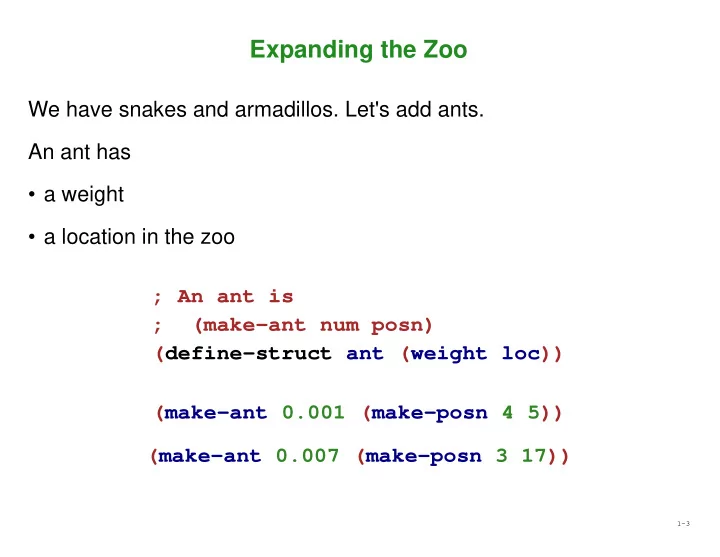
Expanding the Zoo We have snakes and armadillos. Let's add ants. An ant has a weight a location in the zoo ; An ant is ; (make-ant num posn) (define-struct ant (weight loc)) (make-ant 0.001 (make-posn 4 5)) (make-ant 0.007


slide-1
SLIDE 1

Expanding the Zoo

We have snakes and armadillos. Let's add ants. An ant has

  • a weight
  • a location in the zoo

; An ant is ; (make-ant num posn) (define-struct ant (weight loc)) (make-ant 0.001 (make-posn 4 5)) (make-ant 0.007 (make-posn 3 17))

1-3

slide-2
SLIDE 2

Programming with Ants

  • Define ant-at-home?, which takes an ant and reports whether it is at

the origin

4

slide-3
SLIDE 3

Programming with Ants

Contract, Purpose, and Header ; ant-at-home? : ant -> bool

5

slide-4
SLIDE 4

Programming with Ants

Contract, Purpose, and Header ; ant-at-home? : ant -> bool ; Check whether ant a is home

6

slide-5
SLIDE 5

Programming with Ants

Contract, Purpose, and Header ; ant-at-home? : ant -> bool ; Check whether ant a is home (define (ant-at-home? a) ...)

7

slide-6
SLIDE 6

Programming with Ants

Examples ; ant-at-home? : ant -> bool ; Check whether ant a is home (define (ant-at-home? a) ...)

(ant-at-home? (make-ant 0.001 (make-posn 0 0))) '= true (ant-at-home? (make-ant 0.001 (make-posn 1 1))) '= false

8

slide-7
SLIDE 7

Programming with Ants

Template ; ant-at-home? : ant -> bool ; Check whether ant a is home (define (ant-at-home? a) ... (ant-weight a) ... (ant-loc a) ...)

(ant-at-home? (make-ant 0.001 (make-posn 0 0))) '= true (ant-at-home? (make-ant 0.001 (make-posn 1 1))) '= false

9

slide-8
SLIDE 8

Programming with Ants

Template ; ant-at-home? : ant -> bool ; Check whether ant a is home (define (ant-at-home? a) ... (ant-weight a) ... (posn-at-home? (ant-loc a)) ...) New template rule: data-defn reference ⇒ template reference Add templates for referenced data, if needed, and implement body for referenced data

(ant-at-home? (make-ant 0.001 (make-posn 0 0))) '= true (ant-at-home? (make-ant 0.001 (make-posn 1 1))) '= false

10

slide-9
SLIDE 9

Programming with Ants

Template ; ant-at-home? : ant -> bool ; Check whether ant a is home (define (ant-at-home? a) ... (ant-weight a) ... (posn-at-home? (ant-loc a)) ...) (define (posn-at-home? p) ... (posn-x p) ... (posn-y p) ...)

(ant-at-home? (make-ant 0.001 (make-posn 0 0))) '= true (ant-at-home? (make-ant 0.001 (make-posn 1 1))) '= false

11

slide-10
SLIDE 10

Programming with Ants

Body ; ant-at-home? : ant -> bool ; Check whether ant a is home ; ; ; (define (ant-at-home? a) ... (ant-weight a) ... (posn-at-home? (ant-loc a)) ...) ; ; (define (posn-at-home? p) ... (posn-x p) ... (posn-y p) ...) (define (ant-at-home? a) (posn-at-home? (ant-loc a))) (define (posn-at-home? p) (and (= (posn-x p) 0) (= (posn-y p) 0)))

(ant-at-home? (make-ant 0.001 (make-posn 0 0))) '= true (ant-at-home? (make-ant 0.001 (make-posn 1 1))) '= false

12

slide-11
SLIDE 11

Shapes of Data and Templates

The shape of the template matches the shape of the data ; An ant is ; (make-ant num posn) ; A posn is ; (make-posn num num) (define (ant-at-home? a) ... (ant-weight a) ... (posn-at-home? (ant-loc a)) ...) (define (posn-at-home? p) ... (posn-x p) ... (posn-y p) ...)

13

slide-12
SLIDE 12

Programming with Ants

  • Define feed-ant, which feeds an ant 0.001 lbs of food
  • Define move-ant, which takes an ant, an amount to move X, and an

amount to move Y, and returns a moved ant

14

slide-13
SLIDE 13

Animals

All animals need to eat...

  • Define feed-animal, which takes an animal (snake, dillo, or ant) and

feeds it (5 lbs, 2 lbs, or 0.001 lbs, respectively) What is an animal?

15-16

slide-14
SLIDE 14

Animal Data Definition

; An animal is either ; - snake ; - dillo ; - ant The "either" above makes this a new kind of data definition: data with varieties Examples: (make-snake 'slinky 10 'rats) (make-dillo 2 true) (make-ant 0.002 (make-posn 3 4))

17-19

slide-15
SLIDE 15

Feeding Animals

; feed-animal : animal -> animal ; To feed the animal a (define (feed-animal a) ...) (feed-animal (make-snake 'slinky 10 'rats)) "should be" (make-snake 'slinky 15 'rats) (feed-animal (make-dillo 2 true)) "should be" (make-dillo 4 true) (feed-animal (make-ant 0.002 (make-posn 3 4))) "should be" (make-ant 0.003 (make-posn 3 4))

20-21

slide-16
SLIDE 16

Template for Animals

For the template step... (define (feed-animal a) ...)

  • Is a compound data?
  • Technically yes, but the definition animal doesn't have

make-something, so we don't use the compound-data template rule

22-23

slide-17
SLIDE 17

Template for Varieties

Choice in the data definition ; An animal is either ; - snake ; - dillo ; - ant means cond in the template: (define (feed-animal a) (cond [... ...] [... ...] [... ...])) Three data choices means three cond cases

24

slide-18
SLIDE 18

Questions for Varieties

(define (feed-animal a) (cond [... ...] [... ...] [... ...])) How do we write a question for each case? It turns out that (define-struct snake (name weight food)) provides snake? (snake? (make-snake 'slinky 5 'rats)) → true (snake? (make-dillo 2 true)) → false (snake? 17) → false

25-26

slide-19
SLIDE 19

Template (define (feed-animal a) (cond [(snake? a) ...] [(dillo? a) ...] [(ant? a) ...])) New template rule: varieties ⇒ cond Now continue template case-by-case...

27-28

slide-20
SLIDE 20

Template (define (feed-animal a) (cond [(snake? a) ... (feed-snake a) ...] [(dillo? a) ... (feed-dillo a) ...] [(ant? a) ... (feed-ant a) ...])) Remember: references in the data definition ⇒ template references ; An animal is either ; - snake ; - dillo ; - ant

29-30

slide-21
SLIDE 21

Shapes of Data and Templates

; An animal is either ; - snake ; - dillo ; - ant ; A snake is ; (make-snake sym num sym) ; A dillo is ; (make-dillo num bool) ; An ant is ; (make-ant num posn) ; A posn is ; (make-posn num num) (define (feed-animal a) (cond [(snake? a) ... (feed-snake a) ...] [(dillo? a) ... (feed-dillo a) ...] [(ant? a) ... (feed-ant a) ...])) (define (feed-snake s) ... (snake-name s) ... (snake-weight s) ... (snake-food s) ...) (define (feed-dillo d) ... (dillo-weight d) ... (dillo-alive? d) ...) (define (feed-ant a) ... (ant-weight d) ... (feed-posn (ant-loc d)) ...) (define (feed-posn p) ... (posn-x p) ... (posn-y p) ...)

31

slide-22
SLIDE 22

Design Recipe III

Data

  • Understand the input data

Contract, Purpose, and Header

  • Describe (but don't write) the function

Examples

  • Show what will happen when the function is done

Template

  • Set up the body based on the input data (and only the input)

Body

  • The most creative step: implement the function body

Test

  • Run the examples

32

slide-23
SLIDE 23

Data When the problem statement mentions N different varieties of a thing, write a data definition of the form ; A thing is ; - variety1 ; ... ; - varietyN

33

slide-24
SLIDE 24

Examples When the input data has varieties, be sure to pick each variety at least once. ; An animal is either ; - snake ; - dillo ; - ant (feed-animal (make-snake 'slinky 10 'rats)) "should be" (make-snake 'slinky 15 'rats) (feed-animal (make-dillo 2 true)) "should be" (make-dillo 4 true) (feed-animal (make-ant 0.002 (make-posn 3 4))) "should be" (make-ant 0.003 (make-posn 3 4))

35

slide-25
SLIDE 25

Template When the input data has varieties, start with cond

  • N varieties ⇒ N cond lines
  • Formulate a question to match each corresponding variety
  • Continue template steps case-by-case

(define (feed-animal a) (cond [(snake? a) ...] [(dillo? a) ...] [(ant? a) ...]))

37

slide-26
SLIDE 26

Template When the input data has varieties, start with cond

  • N varieties ⇒ N cond lines
  • Formulate a question to match each corresponding variety
  • Continue template steps case-by-case

When the data definition refers to a data definition, make the template refer to a template (define (ant-at-home? a) ... (ant-weight a) ... (posn-at-home? (ant-loc a)) ...) (define (posn-at-home? p) ... (posn-x p) ... (posn-y p) ...)

38

slide-27
SLIDE 27

Template When the input data has varieties, start with cond

  • N varieties ⇒ N cond lines
  • Formulate a question to match each corresponding variety
  • Continue template steps case-by-case

When the data definition refers to a data definition, make the template refer to a template (define (feed-animal a) (cond [(snake? a) ... (feed-snake a) ...] [(dillo? a) ... (feed-dillo a) ...] [(ant? a) ... (feed-ant a) ...]))

39