Little Rock Zoo Task Force Findings & Recommendations Final - - PowerPoint PPT Presentation

little rock zoo
SMART_READER_LITE
LIVE PREVIEW

Little Rock Zoo Task Force Findings & Recommendations Final - - PowerPoint PPT Presentation

Little Rock Zoo Task Force Findings & Recommendations Final Report Overview The Zoo Task Force engaged Zoo Advisors Relevant Strategies & Solutions (RS&S) Zoo Foundation paid for fees associated with RS&S RS&S


slide-1
SLIDE 1

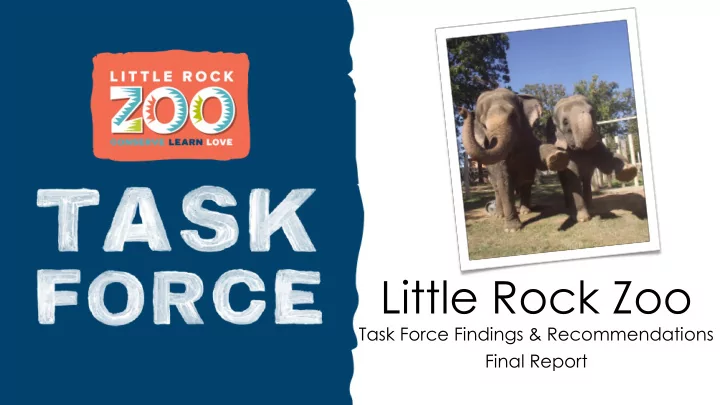
Little Rock Zoo

Task Force Findings & Recommendations Final Report
slide-2
SLIDE 2

Overview

  • The Zoo Task Force engaged

Zoo Advisors Relevant Strategies & Solutions (RS&S)

  • Zoo Foundation paid for fees

associated with RS&S

  • RS&S advised the task force and

helped develop a plan to secure the Zoo’s long-term sustainability

  • This presentation shares an
  • verview of the process, findings

and recommendations to support the Zoo in pursuing its vision

slide-3
SLIDE 3

Little Rock Zoo’s Current Situation

  • The Zoo has a compelling facility master plan.
  • However, there has been minimal investment in the projects
  • utlined in the plan.
  • With no new major exhibits or programs (due to the minimal

capital investment), the Zoo is not realizing its full potential.

  • With no new major exhibits or programs, the Zoo’s annual

attendance is decreasing.

  • With minimal capital investment, the Zoo’s deferred

maintenance needs are steadily increasing.

  • An aging facility only compounds facility issues – maintenance

issues continue to get worse and worse.

slide-4
SLIDE 4

Little Rock Zoo’s Current Situation

72,500 145,000 217,500 290,000 362,500 2014 2015 2016 2017 2018

Attendance Trend Over the Last Five Years

slide-5
SLIDE 5

Little Rock Zoo’s Current Situation

  • Challenged staffing model
  • Unbalanced mix of FT and PT

employees

  • Large number of FT position

vacancies over the years

  • Instability makes strategic planning

for the Zoo challenging

  • The lack of capital and staffing

investment in the Zoo places the Zoo’s accreditation status with the AZA (Association of Zoos and Aquariums) at risk

  • Maintaining AZA accreditation was

identified as a significant “must-have” in a recent research poll with City of Little Rock citizens

slide-6
SLIDE 6

Zoos Recently Losing Accreditation

slide-7
SLIDE 7

Little Rock Zoo’s Current Situation

  • Findings from a recently conducted fundraising feasibility study

revealed donors’ reluctance to contribute private support without a significant investment from the City first.

  • The Zoo’s current annual operating budget is currently

underfunded by nearly $2 million annually. This excludes its capital needs.

  • The City’s annual funding investment in the Zoo has been

somewhat uncertain subject to funding cuts.

  • This challenges the Zoo’s ability to commit to more ambitious,

multi-year planning and/or implementation projects and undercuts the Zoo’s ability to build up donor confidence and leverage additional support.

slide-8
SLIDE 8

Creating a Forward Roadmap for the Zoo

  • A Task Force of community stakeholders was convened, in

partnership with the Arkansas Zoological Foundation. The Task Force was supported by consulting firm, RS&S.

  • The Task Force was charged with:
  • Providing leadership in assessing the current financial and operational

status of the Little Rock Zoo;

  • Exploring new sustainable funding strategies and options; and
  • Outlining next steps to strengthen the Little Rock Zoo’s viable and

sustainable business model.

  • The Task Force explored public-sector funding models (City,

County, State and regional funding models) that have successfully been implemented at AZA zoos throughout the country.

slide-9
SLIDE 9

Task Force Members

Name Affiliation Brad Cazort Chair of the Zoo Board of Governors Lisa Buehler Chair of the Arkansas Zoological Foundation Owner, Allegra Little Rock State Senator Joyce Elliott Vice-Chair of the Mayor’s Quality of Life Subcommittee for the Scott Script Kathy Webb* City Ward 3 Director; Liaison to the Zoo Board of Governors Mallory Jayroe Generational Zoo Young Professionals Chad Causey Causey Law Firm; Board Member, Arkansas Zoological Foundation Joni Lee Vice Chancellor of University Affairs, University of Arkansas at Little Rock Hank Kelley CEO/Partner, Flake & Kelley Commercial & President of Little Rock Rotary Club Tab Townsell Executive Director, Metroplan Rhonna Wade Chair, Create Little Rock Gretchen Hall Executive Director, Little Rock Convention & Visitors Bureau Brandon Bibby Associate AIA, WER Architects/Planners Nate Coulter Director, Central Arkansas Library System Susan Altrui, Ex Officio Zoo Director Bruce Moore, Ex Officio City Manager Jay Chessir, Ex Officio President & CEO, Greater Little Rock Chamber of Commerce

*Kathy Webb was unable to attend one meeting and Director Capi Peck attended in her absence

slide-10
SLIDE 10

Task Force Meetings

  • Two Task Force Meetings

conducted

  • July 2019
  • November 2019
  • Kids Task Force Convened &

Met Over a Two-Day Program

  • Zoo conducted online public
  • pinion surveys (pre and post

in March and September)

  • Research poll conducted

summer 2019 with LR citizens

slide-11
SLIDE 11

The Planning Process

  • Focus for the Task Force was to

define the “why,” “what” and “how”

  • Why is a new funding model

important for the Zoo now?

  • What is needed to get the funding?
  • How does the Zoo ensure its success

and what does success look like?

slide-12
SLIDE 12

Why – The Vision for the Zoo

slide-13
SLIDE 13

The Why Behind the Vision

  • Allows the Zoo to fully deliver its mission – to create

engaging guest experiences that connect and educate audiences with nature

  • Positions the Zoo for long-term sustainability
  • Ensures the Zoo remains an AZA accredited institution
  • Helps the Zoo become a stronger top tier destination and

community asset

  • Makes the Zoo a community asset and resource
slide-14
SLIDE 14

Kid’s Task Force Results

  • Kids’ Task Force consisted of a group of children ages 7-11 that

represented all Wards in the City of Little Rock

  • Gave input on what animals they wanted to see and what kinds
  • f experiences they want
  • Met over two days at the Little Rock Zoo through guided Zoo

program experience led by Zoo education staff

  • Through focus group activities we were able to determine the

following:

  • Kids want more up-close encounters with animals
  • Kids want to see animals active & in natural habitats
  • Kids want active learning spaces where they can “play” like the animals
slide-15
SLIDE 15

Summary of Online Polls

  • Two Major Online Polls Conducted to Gain Public Input
  • Total of 6,539 respondents representing all City Wards
  • Guests ranked the following amenities:
  • #1 Restaurant open after hours overlooking animals
  • #2 Large Ferris Wheel ride
  • #3 Rope mazes/zip lines
  • Guest ranked the following as desired new animal habitats:
  • #1 New Multi-Species African Habitat with Giraffes
  • #2 New Asia Habitat with Sloth Bears
  • #3 New “Aquatorium” with large fish tanks and other touch tank
  • pportunities
slide-16
SLIDE 16

OUR VISION New Giraffe Habitat

slide-17
SLIDE 17

OUR VISION Giraffe Habitat with Feeding Deck

slide-18
SLIDE 18

OUR VISION

New Rhino Feeding Deck in African Habitat

slide-19
SLIDE 19

OUR VISION New Bear Habitat

slide-20
SLIDE 20

OUR VISION New Red Wolf & Razorback Hog Habitat

slide-21
SLIDE 21

Potential Impacts of the Buildout of the Master Plan

  • With the facility master plan

buildout, the Zoo has the following potential:

– The Zoo’s annual visitation could increase to over 550,000 visitors, doubling its annual attendance – This would make it one of the largest attractions in the state and region – The Zoo could support an annual

  • perating budget of $12-13 million –

with most funds coming from non- City sources – The Zoo could generate an annual economic impact from operations of

  • ver $20 million, with a five year

impact of over $100 million.

slide-22
SLIDE 22

Potential Impacts of the Buildout of the Master Plan

  • With a new funding model, the Little Rock Zoo can establish new

public‐private partnerships that will realize several critical

  • bjectives:

– Establish a sound financial base for Zoo operations – Position the Zoo for stability and annual growth in revenues – Promote partnerships to leverage private funding – Create mutually beneficial connections with other cultural, recreational, and educational organizations throughout Little Rock – Spur additional opportunities for smart development and growth in and around Mid-town and the 12th Street Corridor

slide-23
SLIDE 23

The What – The Zoo’s Need

slide-24
SLIDE 24

The What – the Funding Need

  • LRZoo’s Master Plan is estimated to cost $90-100 million over 10

years.

  • The addition of a multi-species African habitat with giraffes, the

expansion of the Zoo into the three golf course holes north into War Memorial Park and the connectivity of the park south over I-630 all

  • ffer huge opportunity.
  • In addition, the Zoo needs an increase in support for its operations of

at least $2MM annually at the end of 10 years to successfully implement a master plan.

  • Resources are needed now to secure the Zoo’s AZA accreditation.
  • To achieve this vision, the Zoo needs at least $5M in operations and

at least $10M in capital annually

slide-25
SLIDE 25

The How – Primary Opportunities to Secure the Zoo’s Viability and Financial Sustainability

slide-26
SLIDE 26

The How – The Solutions Secure a New Dedicated Source of Revenue through a Public Funding Initiative

  • One Recommended Solution = City Referendum with Parks
  • Sales Tax Initiative
  • Could Generate $25MM - $50MM annually (1/2 cent - one cent)
  • While securing Zoo’s Vision, we could;
  • Create free school field trips for all public school children in Little Rock
  • Offer quarterly free days to Little Rock residents
  • Inject nearly $1MM into education programming partnering with STEM learning
  • The “new” revenue would be a “savings” to the City – once Zoo is generating

more earned revenue as a result of capital improvements – its current annual investment in the Zoo – up to $3.2MM – goes back to the City General Fund.

slide-27
SLIDE 27

The How – The Solutions

  • When Zoos are on ballots, they win
  • St. Louis County passed a dedicated sales tax last year for its Zoo
  • This is in addition to a dedicated local property tax the Zoo already gets
  • The City of Tulsa passed a bond initiative for its Zoo
  • Kansas City has two counties with taxes supporting its Zoo
  • Oklahoma City Zoo has a dedicated sales tax supporting its Zoo
  • The City of Tucson, AZ just passed a dedicated sales tax for its Zoo
  • Dozens of other cities have passed major dedicated funding

initiatives for their zoos AZA Zoos are popular attractions that citizens support!

slide-28
SLIDE 28

Results of Likely Voter Poll

  • Little Rock Voters Support a Zoo/Parks Initiative
  • Poll conducted by InVeritas in July of 2019
  • Covered likely voters in all City Wards
  • Found high support for a dedicated tax for Zoo/Parks
  • Strong support from all Wards and all demographic groups
  • Support rises to two thirds of respondents with the following:
  • Free school group tours at the Zoo
  • STEM education partnerships in learning
  • Solidifying the Zoo’s accreditation with AZA
  • Updating old facilities into dynamic attractions that attract tourism
slide-29
SLIDE 29

The How – The Solutions

  • Modernizing Governance to a new Public-Private Partnership
  • With a new dedicated funding model, the Zoo will need a more

effective operating and governance model to administer and maximize these funds.

  • Outcomes from Modernizing Governance:
  • Maintaining AZA accreditation
  • Enhance the guest experience
  • Increase ability to raise private donations
  • Streamline City operations
  • Streamline processes/procedures for business operations
  • Provide more resources for Zoo staff
  • Provide a cost savings to the City over the long-term
slide-30
SLIDE 30

Conclusion

  • A great zoo is a hallmark of a great

city.

  • The new vision for the Little Rock Zoo will

become a rally point and source of pride for the community.

  • This opportunity will allow the Zoo to

perform with maximum efficiency, but will also engage partners who will work together to guarantee the Zoo’s continued viability and sustainability.

  • This benefits the residents of and visitors

to the City of Little Rock and the entire state of Arkansas.