(Fundamental) Physics of Elementary Particles Asymmetry of weak - - PowerPoint PPT Presentation

fundamental physics of elementary particles
SMART_READER_LITE
LIVE PREVIEW

(Fundamental) Physics of Elementary Particles Asymmetry of weak - - PowerPoint PPT Presentation

(Fundamental) Physics of Elementary Particles Asymmetry of weak interactions; T e GIM mechanism & anomaly; Weak angle; Feynman rules Tristan Hbsch Department of Physics and Astronomy Howard University, Washington DC Prirodno-Matemati


slide-1
SLIDE 1

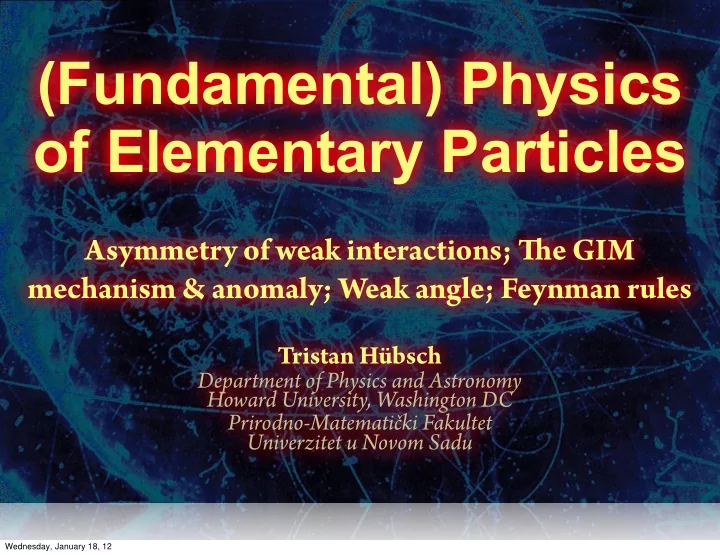
(Fundamental) Physics

  • f Elementary Particles

Asymmetry of weak interactions; Te GIM mechanism & anomaly; Weak angle; Feynman rules

Tristan Hübsch

Department of Physics and Astronomy Howard University, Washington DC Prirodno-Matematički Fakultet Univerzitet u Novom Sadu

Wednesday, January 18, 12

slide-2
SLIDE 2

Program

Fundamental Physics of Elementary Particles

2

Lef-right asymmetry in weak interactions

Dirac’s gamma matrices & the Clifford algebra Dirac and Weyl spinors and equations

Te GIM mechanism

1st order effect 2nd order effect

Te U(1)A anomaly

Two classical symmetries & their anomalies Te Adler-Bell-Jackiw (triangle) anomaly

Te interactions of mater fermions with weak gauge bosons Cabbibo-Kobayashi-Maskawa mixing Feynman’s rules for weak interactions

Wednesday, January 18, 12

slide-3
SLIDE 3

Dirac’s gamma matrices & the Clifford algebra

Left-right asymmetry in weak interactions

3

Recall the non-relativistic Hamiltonian Using the familiar classical ↔ quantum correspondence the Hamiltonian becomes which is the well known classical relationship between energy, linear momentum, mass and the potential.

i¯ h ∂ ∂t = H = 1 2m ⇣ ¯ h i

~ r

⌘2

+ V( ~

r, t)

~

p $ ~

p = ¯

h i

~ r,

and E $ H = i¯ h ∂ ∂t. E = ~ p 2 2m + V(

~

r, t),

Wednesday, January 18, 12

slide-4
SLIDE 4

Dirac’s gamma matrices & the Clifford algebra

Left-right asymmetry in weak interactions

4

Reverse-engineering then the relativistic relationship we obtain the Klein-Gordon equation. Here, is the d’Alembertian (wave) operator.

~

p2c2 + m2c4 = E2 h c2⇣ ¯ h i

~ r

⌘2

+ m2c4i

Ψ(

~

r, t) = ⇣ i¯ h ∂ ∂t ⌘2 Ψ(

~

r, t), h ⇣mc ⌘2i h ⇣ i r ⌘ i ⇣

)

h

⇤ +

⇣mc ¯ h ⌘2i Ψ(

~

r, t) = 0,

⇤ :=

h 1 c2 ∂2 ∂t2 ~

r2i

Wednesday, January 18, 12

slide-5
SLIDE 5

Dirac’s gamma matrices & the Clifford algebra

Left-right asymmetry in weak interactions

5

Motivated by the rest-frame factorization Dirac atempted to factorize the Klein-Gordon equation: As no term in the Klein-Gordon equation is linear in the linear momentum, βμ = γμ. Equating the quadratic terms then yields Since pμpν = pνpμ, Tis defines the Clifford algebra Cl(1,3)= —(4).

E2 − m2c4 = 0

⇒ (E + mc2)(E − mc2) = 0,

p2 − m2c2 = 0

0 = (βµpµ + mc)(γ γ γ γνpν − mc),

− = βµγ

γ γ γν pµpν + mc(γ γ γ γµ − βµ)pµ − m2c2. γ γ γ γµγ γ γ γν pµpν = p2 ≡ ηµν pµpν,

  • γ

γ γ γµ , γ γ γ γν = 2ηµν,

Wednesday, January 18, 12

slide-6
SLIDE 6

Dirac’s gamma matrices & the Clifford algebra

Left-right asymmetry in weak interactions

6

Some canonical identities: and similarly: and completeness:

b γ γ γ γ := iγ γ γ γ0γ γ γ γ1γ γ γ γ2γ γ γ γ3 := i

4!εµνρσγ

γ γ γµγ γ γ γνγ γ γ γργ γ γ γσ, b γ γ γ γ , γ γ γ γµ = 0,

(b

γ γ γ γ)2 = 1; γ γ γ γ± := 1

2[1 ± b

γ γ γ γ], ⇥ γ γ γ γ+ , γ γ γ γ− ⇤ = 0, γ γ γ γ+ + γ γ γ γ− = 1,

γ γ γ±)2 = γ γ γ γ±, γ γ γ γµν := i 4[γ γ γ γµ, γ γ γ γν], ⇥ γ γ γ γµν , γ γ γ γρσ ⇤ = ηµργ γ γ γνσ − ηµσγ γ γ γνρ + ηνσγ γ γ γµρ − ηνργ γ γ γµσ.

γ γ γ γµγ γ γ γµ = 4 1, γ γ γ γµγ γ γ γνγ γ γ γργ γ γ γµ = 4γ γ γ γνγ γ γ γρ, γ γ γ γµγ γ γ γνγ γ γ γµ = −2γ γ γ γν, γ γ γ γµγ γ γ γνγ γ γ γργ γ γ γσγ γ γ γµ = −2γ γ γ γνγ γ γ γργ γ γ γσ, γ γ γ γµγ γ γ γνγ γ γ γρ = ηµνγ γ γ γρ − ηµργ γ γ γν + ηνργ γ γ γµ + iεµνρσγ γ γ γσb γ γ γ γ f (γ γ γ γ) = C01 + Cµγ γ γ γµ + 1

2Cµνγ

γ γ γµν + b Cµγ γ γ γµb γ γ γ γ + b C0b γ γ γ γ.

Wednesday, January 18, 12
slide-7
SLIDE 7

Dirac’s gamma matrices & the Clifford algebra

Left-right asymmetry in weak interactions

7

Finally, we also have Feynman’s slash-notation whereupon

/

p := γ γ γ γµpµ

Tr[γ γ γ γµ] = 0, Tr[γ γ γ γµγ γ γ γνγ γ γ γρ] = 0, Tr[γ γ γ γµγ γ γ γνγ γ γ γργ γ γ γσγ γ γ γλ] = 0, etc. Tr[γ γ γ γµγ γ γ γν] = 4ηµν, Tr[γ γ γ γµγ γ γ γνγ γ γ γργ γ γ γσ] = 4(ηµνηρσ − ηµρηνσ + ηµσηνρ), Tr[b γ γ γ γ] = 0, Tr[γ γ γ γµγ γ γ γνb γ γ γ γ] = 0, Tr[γ γ γ γµγ γ γ γµγ γ γ γργ γ γ γσb γ γ γ γ] = −4iεµνρσ.

/

p/ p = p2 1,

/

p/ q = (p·q − 2ipµγµνqν)1;

/

p/ q + / q/ p = 2(p·q) 1,

/

p/ q − / q/ p = −4i(pµγµνqν)1; Tr[/ p/ q] = 4p·q 1, Tr[/ p/ q/ r / s ] = 4[(p·q)(r·s) − (p·r)(q·s) + (p·s)(q·r)]; Tr[/ p] = 0 = Tr[/ p/ q/ r ], Tr[b γ γ γ γ/ p/ q/ r / s ] = 4iεµνρσpµ qν rρ sσ; γ γ γ γµ / p/ qγ γ γ γµ = 4p·q 1, γ γ γ γµ / pγ γ γ γµ = −2/ p, γ γ γ γµ / p/ q/ r γ γ γ γµ = −2/ r/ q/ p.

Wednesday, January 18, 12

slide-8
SLIDE 8

Dirac’s gamma matrices & the Clifford algebra

Left-right asymmetry in weak interactions

8

Dirac conjugation so that Roughly, ΨL = Ψ–, and ΨR = Ψ+: lef/right-handed helicity vs. chirality; identical for massless particles only.

γ γ γ0)† = γ γ γ γ0, and

γ γ γi)† = −γ γ γ γi, i = 1, 2, 3,

⇔ (γ

γ γ γµ)† = γ γ γ γ0γ γ γ γµγ γ γ γ0. b b b Ψ := Ψ†γ γ γ γ0

γ γ γ γµ := γ γ γ γ0(γ γ γ γµ)†γ γ γ γ0 = γ γ γ γµ. b γ γ γ γ := γ γ γ γ0(iγ γ γ γ0γ γ γ γ1γ γ γ γ2γ γ γ γ3)†γ γ γ γ0 = γ γ γ γ0 i(γ γ γ γ3)†(γ γ γ γ2)†(γ γ γ γ1)†(γ γ γ γ0)† γ γ γ γ0,

= iγ

γ γ γ3 γ γ γ γ2 γ γ γ γ1 γ γ γ γ0 = iγ γ γ γ3γ γ γ γ2γ γ γ γ1γ γ γ γ0 = iγ γ γ γ0γ γ γ γ1γ γ γ γ2γ γ γ γ3,

= b

γ γ γ γ,

)

γ γ γ γ± := 1

2[1 ± b

γ γ γ γ] = 1

2[1 ⌥ b

γ γ γ γ] =: γ γ γ γ⌥. Ψ± = γ γ γ γ±Ψ = Ψ γ γ γ γ± = Ψγ γ γ γ⌥ = Ψ⌥.

Wednesday, January 18, 12

slide-9
SLIDE 9

Dirac’s gamma matrices & the Clifford algebra

Left-right asymmetry in weak interactions

9

In case you prefer 4 × 4 matrices… Te Dirac basis: Te Weyl (chiral) basis: Te Majorana basis: However, “canonical computations” are preferable.

γ γ γ γ0 =  O σ σ σ σ2 σ σ σ σ2 O

  • ,

γ γ γ γ1 = iσ σ σ σ3 O O iσ σ σ σ3

  • ,

γ γ γ γ2 =  O

−σ

σ σ σ2 σ σ σ σ2 O

  • ,

γ γ γ γ3 = −iσ σ σ σ1 O O

−iσ

σ σ σ1

  • ,

b γ γ γ γ = σ σ σ σ2 O O σ σ σ σ2

  • ,

in which all components of the Dirac spinor Ψ are real, γ γ γ γ0 =  O

−1 −1

O

  • ,

γ γ γ γi =  O σ σ σ σi

−σ

σ σ σi O

  • ,

b γ γ γ γ =  1 O O

−1

  • ,

ΨDirac = Ψ+ Ψ−

  • ;

γ γ γ γ0 =  1 O O

−1

  • ,

γ γ γ γi =  O σ σ σ σi

−σ

σ σ σi O

  • ,

b γ γ γ γ = O 1 1 O

  • ,

Wednesday, January 18, 12

slide-10
SLIDE 10

Dirac and Weyl spinors and equations

Left-right asymmetry in weak interactions

10

Te Dirac equation: leads to the choice: where Te Weyl decomposition:

p2 − m2c2 = 0 = (γ γ γ γµpµ − mc)(γ γ γ γµpµ + mc), pµ → ¯ h i ∂µ

⇥ i¯ hγ γ γ γµ∂µ − mc ⇤ Ψ(x) = 0, ∂µ := ∂ ∂xµ ,

  • ! ( 1

c ∂t, ~

r),

Ψ = Ψ+ + Ψ−, Ψ± :=

  • γ

γ γ γ±Ψ

  • ,

γ γ γ γ± = 1

2[1 ± b

γ γ γ γ]. Ψ ⇥ i¯ hcγ γ γ γµDµ − mc

¯ h 1

⇤ Ψ

= Ψ+

⇥ i¯ hcγ γ γ γµDµ ⇤ Ψ+ + Ψ− ⇥ i¯ hcγ γ γ γµDµ ⇤ Ψ− − mc

¯ h Ψ−Ψ+.

Wednesday, January 18, 12

slide-11
SLIDE 11

Dirac and Weyl spinors and equations

Left-right asymmetry in weak interactions

11

So, the (Dirac) mass-term mixes fermions of lef- and right- handed chirality. If the mass is zero (or negligible)

lef- and right-handed fermions (approximately) decouple and can satisfy different boundary conditions.

Notice that charge conjugation ⇔ Dirac conjugation For a chargeless fermion (neutrino), can Ψ → Ψc: Tis allows a Majorana mass-term for chargeless particles, but not for charged particles (quarks, charged leptons).

| {z } b | {z } Ψc := (Ψ)T,

(Ψ±)c = (Ψ±)T = (Ψγ

γ γ γ⌥)T = (γ γ γ γ±)TΨc Ψ±(Ψ±)c = Ψγ γ γ γ⌥(γ γ γ γ⌥)TΨc = Ψγ γ γ γ⌥Ψc, in Dirac & Weyl bases.

Wednesday, January 18, 12

slide-12
SLIDE 12

Dirac and Weyl spinors and equations

Left-right asymmetry in weak interactions

12

Now add gauge potentials: Whence the “V–A coupling”:

Ψ

(ν,e)

⇥ i¯ hcγ γ γ γµ 1∂µ + i gw

¯ hc Wµ

⇤ Ψ

(ν,e)

− ,

Wµ := 1

σ σ σaWa

µ,

= Ψ(ν,e)γ

γ γ γ− ⇥ i¯ hcγ γ γ γµ 1∂µ + i gw

¯ hc Wµ

⇤(γ γ γ γ−Ψ(ν,e)),

= Ψ(ν,e)γ

γ γ γ+ ⇥ i¯ hcγ γ γ γµ 1∂µ+ i gw

¯ hc Wµ

⇤ γ γ γ γ−Ψ(ν,e),

= Ψ(ν,e)⇥

i¯ hcγ γ γ γ+γ γ γ γµγ γ γ γ−

  • 1∂µ+ i gw

¯ hc Wµ

⇤ Ψ(ν,e),

= Ψ(ν,e)⇥

i¯ hcγ γ γ γµγ γ γ γ 2

  • 1∂µ + i gw

¯ hc Wµ

⇤ Ψ(ν,e),

= Ψ(ν,e)⇥

i¯ hcγ γ γ γµγ γ γ γ−

  • 1∂µ + i gw

¯ hc Wµ

⇤ Ψ(ν,e).

Ψ

(ν,e)

− γ

γ γ γµWµΨ

(ν,e)

= Ψ(ν,e)γ

γ γ γµγ γ γ γ−WµΨ(ν,e) = 1

2Ψ(ν,e)γ

γ γ γµ[1 − b γ γ γ γ]WµΨ(ν,e),

= 1

2

h Ψ(ν,e)γ γ γ γµ 1

σ σ σaΨ(ν,e) | {z }

vector

− Ψ(ν,e)γ

γ γ γµb γ γ γ γ 1

σ σ σaΨ(ν,e) | {z }

axial vector

i Wa

µ.

Wednesday, January 18, 12

slide-13
SLIDE 13

Weak eigenstates

The GIM mechanism

13

1963, Nicola Cabibbo: Since both exist, the isospin/strangeness eigenstates, |u〉, |d〉 and |s〉, are not the eigenstates of the weak interactions. Instead, so the “currents” that couple to the charged weak bosons are

d → W− + u, and s → W− + u.

|ui, |dwi := cos θc|di + sin θc|si, |swi := cos θc|si sin θc|di,

so

|di = cos θc|dwi sin θc|swi, |si = cos θc|swi + sin θc|dwi,

+ :

+ = dw Lγ

γ γ γµuL

→ cos θc du + sin θc su,

− :

− = uLγ

γ γ γµdw L

→ cos θc ud + sin θc us,

Wednesday, January 18, 12

slide-14
SLIDE 14

Weak eigenstates

The GIM mechanism

14

But the “current” that couples to the neutral weak gauge boson becomes Tis implies the following interaction Feynman diagrams

Z0 : Jµ

0 = uLγ

γ γ γµuL − dw Lγ γ γ γµdw L,

→ uu − cos2 θc dd − cos θc sin θc(ds + sd) − sin2 θc ss.

(a)

W+ u d cos θc

(b)

W− d u cos θc

(c)

W+ u s sin θc

(d)

W− s u sin θc

(a)

Z0 d d cos2 θc

(b)

Z0 s s sin2 θc

(c)

Z0 s d

1 2 sin(2θc)

(d)

Z0 d s

1 2 sin(2θc)

Wednesday, January 18, 12

slide-15
SLIDE 15

1st order effect

The GIM mechanism

15

With these, one easily constructs which should occur in the ratio

u s sin θc W+ µ+ νµ

| {z } K+ (a)

d s

1 2 sin(2θc)

Z0 µ− µ+

| {z } K0 (b)

  • 1

2 sin(2θc)

sin(θc)

  • 2

= cos2(θc) ≈ O( 1

2)–O(1)

Wednesday, January 18, 12

slide-16
SLIDE 16

1st order effect

The GIM mechanism

16

However, To repair this 8-orders-of-magnitude error of Cabibbo’s model, Sheldon Glashow, John Iliopoulos and Luigi Maiani proposed in 1970 the existence of the 4th quark. Ten Tis changes nothing about the known interactions of the W- bosons, but eliminates the Z-mediated flavor-changing events.

Γ(K+ → µ+ + νµ) Γ(K+ → all)

≈ 64%,

Γ(K0 → µ−+µ+) Γ(K0 → all)

< 9×10⁻⁹

W+

µ :

+ = dw Lγ

γ γ γµuL + sw Lγ γ γ γµcL → cos θc du + sin θc su − sin θc dc + cos θc sc, W−

µ :

− = uLγ

γ γ γµdw L + cLγ γ γ γµsw L → cos θc ud + sin θc us − sin θc cd + cos θc cs, Z0 : Jµ

0 = uLγ

γ γ γµuL − dw Lγ γ γ γµdw L + cLγ γ γ γµcL − sw Lγ γ γ γµds L

→ uu + cc − dd − ss.

Wednesday, January 18, 12

slide-17
SLIDE 17

2nd order effect

The GIM mechanism

17

Tat is, to 1st order. Consider the 2nd order (sub-)processes: Tese are identical, except for the u→c substitution. Te first is proportional to (cos θc)(–sin θc), and the second to (sin θc)(cos θc). If mc = mu, they would cancel. Te net effect must depend on ((mc – mu)2/(mW)2)2≈ 10–8. Detailed computations check out.

a d s u W− q W+ νµ µ− µ+ | {z }

K0

b d s c W− q W+ νµ µ− µ+ | {z }

K0

Wednesday, January 18, 12

slide-18
SLIDE 18

Lesson

The GIM mechanism

18

Notice the conceptual parallel between: Glashow, Iliopoulos and Maiani’s postulation

  • f a new quark so as to

preserve the logical consistency of the model and agreement with experiments and Pauli’s postulation of the neutrino so as to preserve the energy conservation law and agreement with experiments.

Wednesday, January 18, 12

slide-19
SLIDE 19

Two classical symmetries & their anomalies

The U(1)A anomaly

19

Te c-quark was experimentally detected in 1974. Te GIM mechanism predicted it in 1970, but was ignored. As ignored as the 1969 prediction based on a discovery by

  • S. Adler, J.S. Bell and R. Jackiw.

Compute: Tus,

h∂µ[Ψ1γ γ γ γµΨ2] = (i¯ h∂µΨ1γ γ γ γµ)Ψ2 + Ψ1γ γ γ γµ(i¯ h∂µΨ2) = −(i¯ h / ∂Ψ1)Ψ2 + Ψ1(i¯ h / ∂Ψ2),

= −(m1cΨ1)Ψ2 + Ψ1(m2cΨ2) = (m2−m1)cΨ1Ψ2, − −

i¯ h∂µ[Ψ1b γ γ γ γγ γ γ γµΨ2] =

h∂µΨ1(−γ γ γ γµb γ γ γ γ)

  • Ψ2 + Ψ1b

γ γ γ γγ γ γ γµ(i¯ h∂µΨ2) = (i¯ h / ∂Ψ1)b γ γ γ γΨ2 + Ψ1b γ γ γ γ(i¯ h / ∂Ψ2),

= (m1cΨ1)b

γ γ γ γΨ2 + Ψ1b γ γ γ γ(m2cΨ2) = (m1+m2)cΨ1b γ γ γ γΨ2.

ij := [Ψiγ

γ γ γµΨj] ∂µ Jµ

ij = 0

iff mi = mj. b Jµ

ij := [Ψib

γ γ γ γγ γ γ γµΨj] ∂µ b Jµ

ij = 0

iff mi = mj = 0.

Wednesday, January 18, 12

slide-20
SLIDE 20

Two classical symmetries & their anomalies

The U(1)A anomaly

20

Continuity equations imply “charge”-conservations: and symmetries. (Noether’s theorem, backwards.) For example, 3Σi Qii (restr. to quarks) = the baryon number. Quantum effects need not respect these symmetries! where the right-hand side quantities (called anomalies) measure quantum breaking of classical symmetries.

Approximate symmetries: pseudo-Goldstone (light) bosons. Global symmetries: OK, but are characteristic/invariant. Local (gauge) symmetries: self-contradiction.

Qij :=

Z

d3~ r J0

ij

and b Qij :=

Z

d3~ r b J0

ij

∂µ Jµ

ij = Aij,

and ∂µ b Jµ

ij = b

Aij,

Wednesday, January 18, 12

slide-21
SLIDE 21

The Adler-Bell-Jackiw (triangle) anomaly

The U(1)A anomaly

21

ABJ realized the importance of gauge anomaly cancellations. Te familiar electromagnetic current can develop such an anomaly owing to its quantum coupling to the axial current. All contributions are proportional to the same incurably divergent integral, premultiplied by a numerical factor. Te numerical factors are proportional to the electric charges. So within a “family” {u, d; νe, e–}: Te strange quark with no charge +⅔ partner makes the electromagnetic current/charge/symmetry anomalous, and so inconsistent! Quantum consistency thus predicted the c-quark in 1969.

{ }

i

Qi = 3 ⇥ + 2

3

+ − 1

3

⇤ + (0) + (−1) = 0,

Wednesday, January 18, 12

slide-22
SLIDE 22

The Adler-Bell-Jackiw (triangle) anomaly

The U(1)A anomaly

22

In fact, there’s more to this! Produce anomalies of the same type, but they again cancel:

∈ { · · · }

time W3 γ γ fL time W3 γ γ fL

fL

Iw( fL)

  • Q( fL)

2 = 3 h+ 1

2

+ 2

3

2 + − 1

2

− 1

3

2i

+

+ 1

2

(0)2 + − 1

2

−1 2,

= 3

h

+ 2

9 − 1 18

i

− 1

2 = 3

+ 3

18

− 1

2 = 0.

Wednesday, January 18, 12

slide-23
SLIDE 23

The Adler-Bell-Jackiw (triangle) anomaly

The U(1)A anomaly

23

And yet more: Produce anomalies of the same type, but they again cancel:

time B γ γ fL time B γ γ fL

fL

Yw( fL)

  • Q( fL)

2 = 3 h+ 1

3

⇣+ 2

3

2 + − 1

3

2⌘i

+

−1 (0)2 + −1 −1 2

+ 3

h− 4

3

− 2

3

2 + + 2

3

+ 1

3

2i

+

+2 +1 2 + (0)(0)2,

= 3

1 3· 4+1 9

− 4

3· 4 9 + 2 3· 1 9

− 1 + 2 = 5−16+2

9

+ 1 = 0.

Wednesday, January 18, 12

slide-24
SLIDE 24

The Adler-Bell-Jackiw (triangle) anomaly

The U(1)A anomaly

24

In fact, all such triangle diagrams (in 1+3-dimensional spacetime) produce the same type anomalies. As long as the “external” legs of the diagram are gauge fields (photons, W±, Z0, gluons), or even their couplings to non- gauge fields, …the numerical coefficients of like (divergent) integrals must cancel. Tis forces lef-chiral mater fermions to occur in “families”:

h u

d

i , h νe

e−

i | {z } ; h c

s

i , h νµ

µ−

i | {z } ; h t

b

i , h ντ

τ−

i | {z } .

Wednesday, January 18, 12

slide-25
SLIDE 25

(Almost) all together

The weak interactions

25

Te Standard Model then consists of mater fermions:

fermion family charges

1 2 3 Q Iw Yw Ψ− = γ γ γ γ−Ψ | {z }

left-handed

8 > < > : h u

d

i

L

h c

s

i

L

h t

b

i

L

+2

/

3

−1

/

3

+1

/

2

−1

/

2

+1

/

3

+1

/

3

h νe

e−

i

L

νµ µ−

  • L

h ντ

τ−

i

L

−1 +1

/

2

−1

/

2

−1 −1

Ψ+ = γ γ γ γ+Ψ | {z }

right-handed

8 > > < > > : uR cR tR

+2

/

3

+4

/

3

dR sR bR

−1

/

3

−2

/

3

e−

R

µ−

R

τ−

R

−1 −2

νeR νµR ντR

Wednesday, January 18, 12

slide-26
SLIDE 26

26

Te Glashow-Weinberg-Salam theory of weak interactions then has

LGWS 3 gw

  • W+

µ Jµ

+ + W

µ Jµ

+ W3

µ Jµ 3

+ gyBµ Jµ

y ,

3

+ :=

[uL γ γ γ γµ dwL] + [cL γ γ γ γµ swL] + [tL γ γ γ γµ bwL] , Jµ

:=

[dwL γ γ γ γµ uL] + [swL γ γ γ γµ cL] + [bwL γ γ γ γµ tL] , Jµ

3 :=

n

1 2

[uL γ

γ γ γµ uL] + [cL γ γ γ γµ cL] + [tL γ γ γ γµ tL] + [νeL γ γ γ γµ νeL] + [νµL γ γ γ γµ νµL] + [ντL γ γ γ γµ ντL] ⌘

1

2

[dL γ

γ γ γµ dL] + [sL γ γ γ γµ sL] + [bL γ γ γ γµ bL] + [e

L γ

γ γ γµ e

L ] + [µ L γ

γ γ γµ µ

L ] + [τ L γ

γ γ γµ τ

L ]

⌘o , Jµ

y :=

n

1 6

[uL γ

γ γ γµ uL] + [cL γ γ γ γµ cL] + [tL γ γ γ γµ tL] + [dL γ γ γ γµ dL] + [sL γ γ γ γµ sL] + [bL γ γ γ γµ bL] ⌘

1

2

[νeL γ

γ γ γµ νeL] + [νµL γ γ γ γµ νµL] + [ντL γ γ γ γµ ντL] + [e

L γ

γ γ γµ e

L ] + [µ L γ

γ γ γµ µ

L ] + [τ L γ

γ γ γµ τ

L ]

+ 2

3

[uR γ

γ γ γµ uR] + [cR γ γ γ γµ cR] + [tR γ γ γ γµ tR] ⌘

1

3

[dR γ

γ γ γµ dR] + [sR γ γ γ γµ sR] + [bR γ γ γ γµ bR] ⌘

[e

R γ

γ γ γµ e

R ] + [µ R γ

γ γ γµ µ

R ] + [τ R γ

γ γ γµ τ

R ]

⌘o .

The weak interactions

(Almost) all together

Wednesday, January 18, 12

slide-27
SLIDE 27

27

We still need to describe the SU(2)w ×U(1)y → U(1)Q symmetry breaking. Introduce a complex Higgs doublet and identify: Te Lagrangian is and has minima at Pick

The weak interactions

H = h H1

H2

i , with ⇢ Iw(H1)

= + 1

2

Yw(H1)

= +1

Q(H1)

= +1,

Iw(H2)

= − 1

2

Yw(H2)

= +1

Q(H2)

= 0.

identify H1 = H+, (H1)† = H−, H2 = H0 and (H2)† = H 0.

f LH =

  • (∂µ − igwWα

µ

1 2σ

σ σ σα − igyBµ 1

21)H

  • 2

η + 1 2

µc

¯ h

2 H†H − 1

  • H†H

2,

  • H1
  • 2 +
  • H2
  • 2 = H 2

1r + H 2 1i + H 2 2r + H 2 2i =

µc

λ¯ h

2

  • is H =

µc

λ¯ h

⇥ 0

1

⇤ .

(Almost) all together

Wednesday, January 18, 12

slide-28
SLIDE 28

28

As usual, shif the Higgs field and find that weak bosons became massive: Intro and rewrite Tis one linear combination becomes massive, the orthogonal

  • ne remains massless.

The weak interactions

(Almost) all together

e H := H hHi,

hHi =

µc

λ¯ h

⇥ 0

1

⇤ ,

· · ·

  • h

− −

⇥ ⇤i h

− = · · · + 1

4

µc

λ¯ h

2(gwW3

µ − gyBµ)†ηµν(gwW3 ν − gyBν) + . . .

θw = arccos ⇣

gw q g 2

w +g 2 y

⌘ , so cos θw =

gw q g 2

w +g 2 y

and sin θw =

gy q g 2

w +g 2 y

,

· · · + 1

2

  • µc

2λ¯ h

2(g2

w+g2 y)

  • cos(θw)W3

µ − sin(θw)Bµ

  • 2

η + . . .

Wednesday, January 18, 12

slide-29
SLIDE 29

29

So Te charged bosons are simpler so that since By design, W3μ and Bμ couple to “charges” Iw and Yw, so that Aμ would couple the the electric charge; Q = Iw+½Yw.

The weak interactions

(Almost) all together

· · ·

  • h

= · · · + g2

w

  • µc

2λ¯ h

2W+

µ ηµνW− ν + . . .

MW = cos(θw) MZ.

c i g

hq h gw

  • µc

2λ¯ h

i

=

gw q g2

w+g2 y

hq g2

w+g2 y

  • µc

2λ¯ h

i .

Aµ := cos(θw)Bµ + sin(θw)W3

µ,

with the mass = 0, Zµ := − sin(θw)Bµ + cos(θw)W3

µ,

with the mass =

µc

2λ¯ h

q g2

w + g2 y.

Wednesday, January 18, 12

slide-30
SLIDE 30

30

In particular,

The weak interactions

(Almost) all together

em :=

⇥ Jµ

3 + Jµ y

= [Jµ

em L + Jµ em R

⇤ , Jµ

Z :=

1 cos(θw)

⇥ Jµ

3 − sin2(θw)Jµ em L

⇤ =

1 cos(θw)

⇥ cos2(θw)Jµ

3 − sin2(θw)Jµ y

⇤ ,

h gw sin(θw) Jµ

3 + gy cos(θw) Jµ y

i

= ge Jµ

em.

gw sin(θw) = gy cos(θw) = ge. gw cos(θw) Jµ

3 − gy sin(θw) Jµ y = gz

h Jµ

3 − sin2(θw) Jµ em

i , gz = gw/ cos(θw).

Wednesday, January 18, 12

slide-31
SLIDE 31

Free field vs. interaction eigenstates

Cabbibo-Kobayashi-Maskawa mixing

31

And, that’s still not all. Generalizing Cabibbo’s mixing (freely propagating eigenstates are not the weak interaction eigenstates), in 1973, Makoto Kobayashi and Toshihide Maskawa introduced Notice the appearance of a phase! Teorem: need 3 families for a phase to exist. Without a phase, there’s no CP-violation. Without CP-violation, there’s no baryon asymmetry, nor us.

 

|dwi |swi |bwi

  :=   Vud Vus Vub Vcd Vcs Vcb Vtd Vts Vtb    

|di |si |bi

  ,  c c   

| i

   c12c13 s12c13 s13 eiδ13

s12c23 c12s23s13 eiδ13

c12c23 s12s23s13 eiδ13 s23c13 s12s23 c12c23s13 eiδ13

c12s23 s12c23s13 eiδ13

c23c13  

Wednesday, January 18, 12

slide-32
SLIDE 32

Putting it all together, in pictures

Feynman’s rules for weak interactions

32

Tis complicates maters…

Ψ Ψ0 Z0

7 ! igw

2

p

γ γ γµ[cV1 cAb γ γ γ γ]δΨ0

Ψ

Ψ cV cA νn

1 2 1 2

`n 1

2 +2 sin2(θw)

1

2

Un

1 2 4 3 sin2(θw) 1 2

Dn

1

2+ 2 3 sin2(θw)

1

2

Dw n Un0 W

7 ! igw

2

p

γ γ γµ[1 b γ γ γ γ] δn0

n

 Un Dw n

  • =

 u dw

  • n=1

,  c sw

  • n=2

,  t bw

  • n=3

,

`n

νn0 W

7 ! igw

2

p

γ γ γµ[1 b γ γ γ γ] δn0

n

νn

`n

  • =

 νe e

  • n=1

,  νµ µ

  • n=2

,  ντ τ

  • n=3

,

Wednesday, January 18, 12

slide-33
SLIDE 33

Thanks!

Tristan Hubsch

Department of Physics and Astronomy Howard University, Washington DC Prirodno-Matematički Fakultet Univerzitet u Novom Sadu

http://homepage.mac.com/thubsch/

Wednesday, January 18, 12