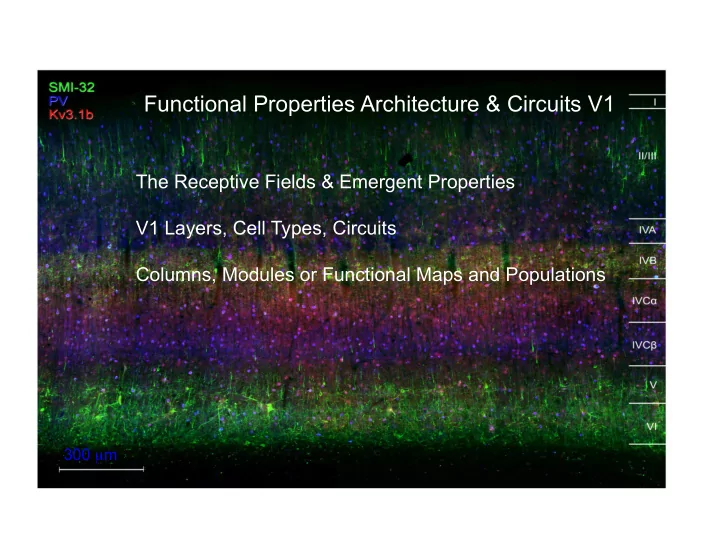
SLIDE 1
300 µm
Functional Properties Architecture & Circuits V1
The Receptive Fields & Emergent Properties V1 Layers, Cell Types, Circuits Columns, Modules or Functional Maps and Populations
SLIDE 2
Magno – 10% Parvo – 80% Konio < 10% Total afferents > 1,000,000 per optic nerve
SLIDE 3 consider V1 How are the inputs
Is there segregation? Volume ~ 1,400 mm3 Density (neurons) ~ 200 x 103/mm3 Total neurons 280,000,000
SLIDE 4
Hubel & Wiesel 1976
SLIDE 5 LGN properties (primate)
Parvo/Magno/Konio distinctions R-G opponent/non-opponent/B- Y opponent SF tuning Low/High/? Achromatic Contrast gain Long/short/Long latency and integration times Sustained/transient/? – low/ bandpass TF tuning Selectivity Unselective for orientation, direction, spatial freq (SF), temp Freq (TF)
V1 properties
Selectivity Orientation, direction, SF, TF, size (eCRF), binocular disparity, chromatically double opponent Different populations with different degrees of selectivity along a range
SLIDE 6
Functional Characterization
Layer 4c alpha Simple Cells
SLIDE 7
Functional Characterization
Layer 6 DS Complex Cell
SLIDE 8
RF Maps, orientation, SF and TF tuning: simple cells in layer 4b
SLIDE 9
Maps, SF and Orientation Tuning for Single Color Opponent Neuron from L6 Johnson et al 2008
SLIDE 10
Johnson et al 2008
O/P ratio 0.2
Maps, SF and Orientation Tuning for Double Color Opponent Neuron from L6
SLIDE 11
Disparity Selectivity of Neurons in Monkey V1, V2, MT & MST : from Parker 2007 Disparity Selectivity of Neurons Cat Area 17 : from Barlow, Blakemore and Pettigrew 1967
SLIDE 12
- CRF: orientation, spatial frequency, temporal frequency, direction, contrast, color, size --
area
- eCRF: modulates the CRF responses -- influence that is the CONTEXT
Blakemore & Tobin
Allman et al DeAngelis, Ozhawa, Freeman Knierim & Van Essen Sengpiel et al Lamme, Ziper et al Cavanaugh et al . Williford & von der Heydt (2013)
- What is the relationship to perception?
- Relationship to normalization and attention
- Feedback and modulation in population coding and modeling
SLIDE 13
From DeFelipe, 2005
SLIDE 14
- Laminar organization of cortex
- Ocular Dominance
- Cell Types, excitatory, inhibitory
- Circuits and projections
Layers, Columns, Cell Types and Circuits
SLIDE 15
300 µm
SLIDE 16 CO blobs and stripes (Sincich & Horton 2005)
V2
thick thin inter
SLIDE 17
Intracolumnar feedforward and feedback connections (Sincich & Horton 2005)
SLIDE 18
Federer et al 2013 Projections from V1 to V2 in primate
SLIDE 19
Segregated color selective inputs (from Chatterjee & Callaway, 2003)
SLIDE 20
Tripartite view of V1--V2 (Livingstone-Hubel)
SLIDE 21
The canonical cortical micro- circuit
from Martin & Douglas 2010
SLIDE 22
Radial and Lateral connections (from Lund et al 2003)
SLIDE 23
Layer 4cβ projections
SLIDE 24
Layer 4cα projections
SLIDE 25
Lateral connections in layer 2/3
SLIDE 26
Layer 2 projections
From Wiser & Callaway 1996
Layer 5 projections
SLIDE 27
Layer 6 Classes and projections
SLIDE 28
From Rudy et al 2010
SLIDE 29
Inhibitory interneurons in Primate V1 From Defelipe 1999
SLIDE 30