From Criticality Incredible Project Plan to Facility Hazard - - PowerPoint PPT Presentation

from criticality incredible project plan to facility
SMART_READER_LITE
LIVE PREVIEW

From Criticality Incredible Project Plan to Facility Hazard - - PowerPoint PPT Presentation

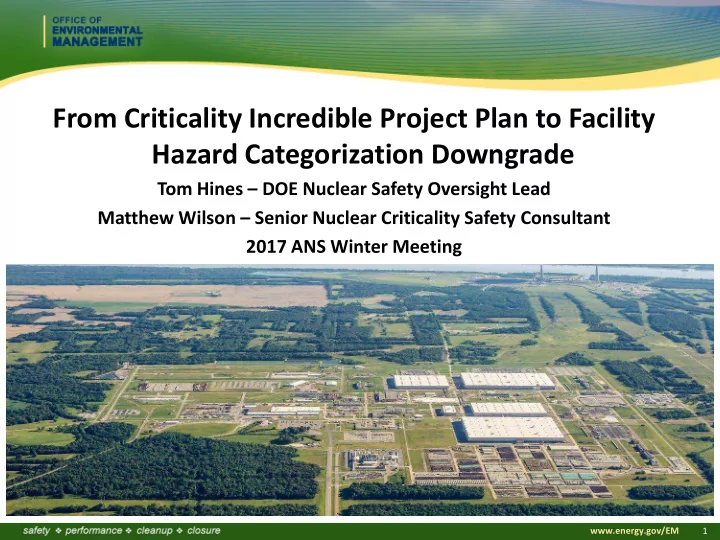
From Criticality Incredible Project Plan to Facility Hazard Categorization Downgrade Tom Hines DOE Nuclear Safety Oversight Lead Matthew Wilson Senior Nuclear Criticality Safety Consultant 2017 ANS Winter Meeting www.energy.gov/EM 1


slide-1
SLIDE 1

www.energy.gov/EM 1

From Criticality Incredible Project Plan to Facility Hazard Categorization Downgrade

Tom Hines – DOE Nuclear Safety Oversight Lead Matthew Wilson – Senior Nuclear Criticality Safety Consultant 2017 ANS Winter Meeting

slide-2
SLIDE 2

www.energy.gov/EM 2

  • Portsmouth/Paducah Project Office (PPPO) Mission - To conduct the safe, secure, compliant,

and cost effective environmental legacy cleanup of the Portsmouth and Paducah Uranium Enrichment Sites on behalf of the local communities and the American taxpayer. C-340 Metals Plant Complex C-340 Metals Plant Complex Slab

From Criticality Incredible Project Plan to Facility Hazard Categorization Downgrade

slide-3
SLIDE 3

www.energy.gov/EM 3

From Criticality Incredible Project Plan to Facility Hazard Categorization Downgrade Fissile Material Operation with NCS Admin. & Engineering Controls Characterized Facility where NCS Controls are not needed due to Nature of Process or Segmentation

Operations Shutdown Surveillance & Maintenance Deactivation & Characterization Surveillance & Maintenance Decontamination & Decommissioning Final Disposition

Facility Lifecycle

Hazard Categorization per DOE-STD-1027

Construction No Radionuclides

< HC-3 and No NCS Controls

slide-4
SLIDE 4

www.energy.gov/EM 4

  • Facility Hazard Categorization
  • Demonstrating CI will allow the DOE-STD-1027-92 Attachment 1 isotope values to be used for

Hazard Categorization rather than the ANSI-ANS-8.1 type limits.

From Criticality Incredible Project Plan to Facility Hazard Categorization Downgrade

4,185-pounds 235U vs. 1.5-pounds 235U Factoid: 4,185-pounds of

235U at 5 % assay

equals 54-tons uranyl fluoride

slide-5
SLIDE 5

www.energy.gov/EM 5

  • Facility Hazard Categorization
  • Current Condition – Most Gaseous Diffusion Plant facilities are HC-2 because of history and lack
  • f characterization

From Criticality Incredible Project Plan to Facility Hazard Categorization Downgrade

slide-6
SLIDE 6

www.energy.gov/EM 6

From Criticality Incredible Project Plan to Facility Hazard Categorization Downgrade

Fissile Material Operation with NCS Admin. & Engineering Controls Characterized Facility where NCS Controls are not needed due to Nature

  • f Process or

Segmentation

Operations Shutdown Surveillance & Maintenance Deactivation & Characterization Surveillance & Maintenance Decontamination & Decommissioning Final Disposition

Facility Lifecycle Hazard Categorization per DOE-STD- 1027

slide-7
SLIDE 7

www.energy.gov/EM 7

  • Residual quantities over very large systems can represent a significant inventory of

fissile material.

For example:

Given: 30-inch diameter header that is 500-feet long CI limit is 22-grams 235U/foot Total 235U mass in example pipe section could be as much as 11-kgs

(MUCH MORE THAN A CRITICAL MASS IF IT ALL GOT TOGETHER)

From Criticality Incredible Project Plan to Facility Hazard Categorization Downgrade

slide-8
SLIDE 8

www.energy.gov/EM 8

  • Residual quantities over very large systems can represent a significant inventory of

fissile material (continued)

Inside of a 12” G-17 Valve Body with Equipment Size Perspective a Uranyl Fluoride (UO2F2) coating

From Criticality Incredible Project Plan to Facility Hazard Categorization Downgrade

slide-9
SLIDE 9

www.energy.gov/EM 9

  • Residual fissile material in large and complex systems present many challenges!!!

One Stage Cell Difficult to find and measure residual radionuclides. Inside process equipment Surface area can be very large and complex (e.g., converters) Not easily observed (e.g., visual examination is not conclusive)

From Criticality Incredible Project Plan to Facility Hazard Categorization Downgrade

slide-10
SLIDE 10

www.energy.gov/EM 10

There are 1820 Stages at Paducah and 4080 Stages at Portsmouth with miles of process piping.

Characterization will take many, many measurements!

From Criticality Incredible Project Plan to Facility Hazard Categorization Downgrade

slide-11
SLIDE 11

www.energy.gov/EM 11

From Criticality Incredible Project Plan to Facility Hazard Categorization Downgrade

Fissile Material Operation with NCS Admin. & Engineering Controls Characterized Facility where NCS Controls are not needed due to Nature

  • f Process or

Segmentation

Operations Shutdown Surveillance & Maintenance Deactivation & Characterization Surveillance & Maintenance Decontamination & Decommissioning Final Disposition

Facility Lifecycle Hazard Categorization per DOE-STD- 1027 CHANGED ACTIVITIES & HAZARDS!!!

slide-12
SLIDE 12

www.energy.gov/EM 12

So How Does a Facility Get to CI?

From Criticality Incredible Project Plan to Facility Hazard Categorization Downgrade

How much fissile material is left? Mobility of fissile material? How clean does it need to be? Segmentation needed? Where? What is the facility end-state? Will the residual FM remain CI thru the end state?

slide-13
SLIDE 13

www.energy.gov/EM 13

DOE APPROVES FACILITY DOWNGRADE

From Criticality Incredible Project Plan to Facility Hazard Categorization Downgrade

Fissile Material Operation with NCS Admin. & Engineering Controls Characterized Facility where NCS Controls are not needed due to Nature

  • f Process or

Segmentation

Operations Shutdown Surveillance & Maintenance Deactivation & Characterization Surveillance & Maintenance Decontamination & Decommissioning Final Disposition

Facility Lifecycle Hazard Categorization per DOE-STD- 1027

slide-14
SLIDE 14

www.energy.gov/EM 14

From Criticality Incredible Project Plan to Facility Hazard Categorization Downgrade

slide-15
SLIDE 15

www.energy.gov/EM 15

Examples of a path to CI that is being used at a facility at Portsmouth and a path to CI that is being used at a facility at Paducah.

  • PORTS (X-326)
  • Remove and ship off-site the major equipment (converters,

compressors, coolers)

  • Develop CI limits based on nature of process for remaining equipment

(primarily piping and valves)

  • Characterize equipment (~ 1.3 million measurements)
  • If < CI then leave in building
  • If > CI, decontaminate to < limit, or remove
  • Paducah (C-400)
  • Remove and ship off-site most processing equipment
  • Characterize what remains
  • Characterization demonstrated remaining fissile material in facility is less

than 700 grams 235U

From Criticality Incredible Project Plan to Facility Hazard Categorization Downgrade

slide-16
SLIDE 16

www.energy.gov/EM 16

Planning

For the PORTS X-326 cascade facility, a “plan” has been developed. The plan includes and discusses in length:

  • Facility History
  • Current Facility Status
  • Strategy for Achieving CI
  • Characterization Approach
  • Project Completion Criteria
  • Data Management System
  • Schedule

This plan is required to be approved by DOE via the contract!!!

From Criticality Incredible Project Plan to Facility Hazard Categorization Downgrade

slide-17
SLIDE 17

www.energy.gov/EM 17

Characterization – The process used to determine and document the type and quantity of radionuclides in an item of interest.

  • Deposit material

Enrichment (wt. % 235U, 235U/234U ratio

  • Media sampling

Transuranic content

  • NDA

99Tc

  • Metal coupon
  • Visual verification
  • Etc………….

From Criticality Incredible Project Plan to Facility Hazard Categorization Downgrade

slide-18
SLIDE 18

www.energy.gov/EM 18

Challenges of Data Gathering & Analysis

Evaluate sample data Process Knowledge

  • Collection

Confirmatory sampling considerations

  • Analysis

Exceptions should be anticipated

  • Raw Data
  • Uncertainty
  • Interpretation
  • Range of Applicability
  • Validation

If data is wrong, how wrong can it be?

From Criticality Incredible Project Plan to Facility Hazard Categorization Downgrade

slide-19
SLIDE 19

www.energy.gov/EM 19

Evaluation

1. CCIPP contains the initial CI limits based on an NCSD 2. Compare the CI limits to the collected data 3. Margin of Safety is the difference between the initial limit and the measured fissile material content 4. Technical basis for Facility Downgrade – DOE needs to know that CI is met and that the Margin of Safety is determined

From Criticality Incredible Project Plan to Facility Hazard Categorization Downgrade

slide-20
SLIDE 20

www.energy.gov/EM 20

Documentation

  • Documentation is the complete

facility data and evaluation records with supporting information that demonstrates the status of the facility.

  • Provides the basis for DOE

approval of the facility hazard categorization downgrade

From Criticality Incredible Project Plan to Facility Hazard Categorization Downgrade

slide-21
SLIDE 21

www.energy.gov/EM 21

Conclusion

  • A consensus standard for a criticality incredible

definition and how to implement does not exist that provides guidance for the methodical downgrade of facilities.

  • PPPO has established its definition and method

for implementing CI.

  • The PPPO method could be used as a starting

point for a consensus standard.

Moderation Control Challenges in a Shutdown Facility

slide-22
SLIDE 22

www.energy.gov/EM 22

Questions/Open Forum

Moderation Control Challenges in a Shutdown Facility