Frequency Distributions Frequency Distributions q q y y SLIDES - - PDF document

frequency distributions frequency distributions q q y y
SMART_READER_LITE
LIVE PREVIEW

Frequency Distributions Frequency Distributions q q y y SLIDES - - PDF document

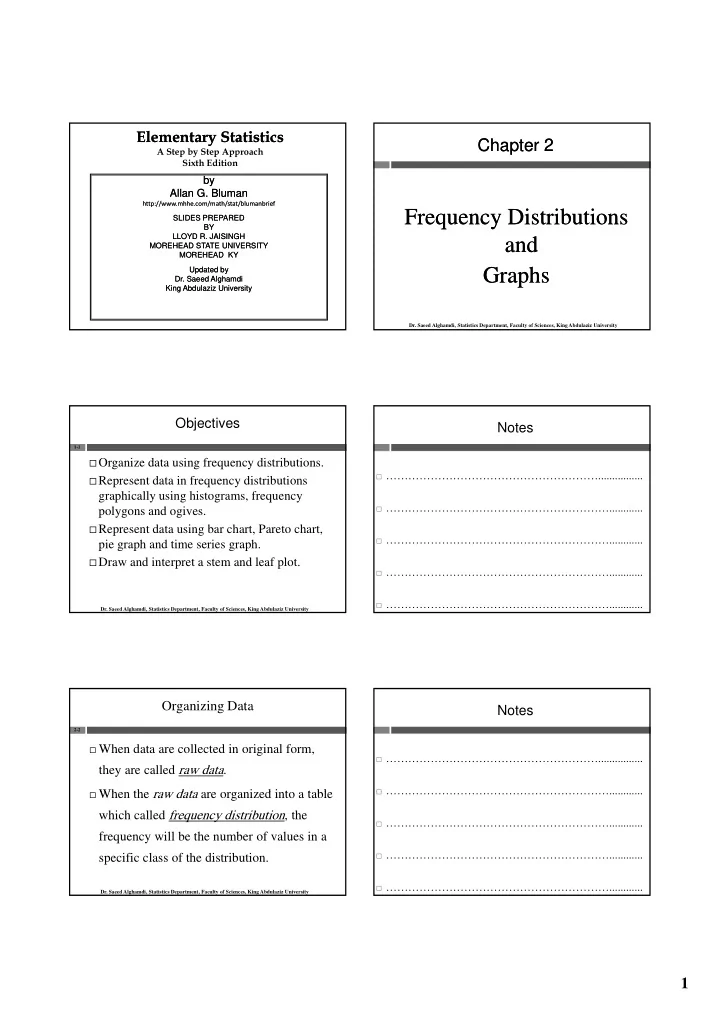
Elementary Statistics Elementary Statistics Chapter 2 Chapter 2 A Step by Step Approach Sixth Edition by by Allan G. Bluman Allan G. Bluman http://www.mhhe.com/math/stat/blumanbrief http://www.mhhe.com/math/stat/blumanbrief Frequency


slide-1
SLIDE 1

1

by by Allan G. Allan G. Bluman Bluman

http://www.mhhe.com/math/stat/blumanbrief http://www.mhhe.com/math/stat/blumanbrief

SLIDES PREPARED SLIDES PREPARED BY BY

Elementary Statistics Elementary Statistics

A Step by Step Approach Sixth Edition

BY BY LLOYD R. LLOYD R. JAISINGH JAISINGH MOREHEAD STATE UNIVERSITY MOREHEAD STATE UNIVERSITY MOREHEAD KY MOREHEAD KY Updated by Updated by Dr.

  • Dr. Saeed

Saeed Alghamdi Alghamdi King King Abdulaziz Abdulaziz University University

Chapter Chapter 2 2

Frequency Distributions Frequency Distributions q y q y and and Graphs Graphs

  • Dr. Saeed Alghamdi, Statistics Department, Faculty of Sciences, King Abdulaziz University

1-1

Organize data using frequency distributions. Represent data in frequency distributions

graphically using histograms, frequency l d i

Objectives

  • Dr. Saeed Alghamdi, Statistics Department, Faculty of Sciences, King Abdulaziz University

polygons and ogives.

Represent data using bar chart, Pareto chart,

pie graph and time series graph.

Draw and interpret a stem and leaf plot.

Notes

 …………………………………………………................  ……………………………………………………............  ……………………………………………………............  ……………………………………………………............  ……………………………………………………............

2-2

 When data are collected in original form,

they are called raw data. Wh th d t i d i t t bl

Organizing Data

 When the raw data are organized into a table

which called frequency distribution, the frequency will be the number of values in a specific class of the distribution.

  • Dr. Saeed Alghamdi, Statistics Department, Faculty of Sciences, King Abdulaziz University

Notes

 …………………………………………………................  ……………………………………………………............  ……………………………………………………............  ……………………………………………………............  ……………………………………………………............

slide-2
SLIDE 2

2

2-3

 A frequency distribution is the organization of

raw data in a table form, using classes and frequencies

Organizing Data

frequencies.

 Types of frequency distributions are

categorical frequency distribution, ungrouped frequency distribution and grouped frequency distribution.

  • Dr. Saeed Alghamdi, Statistics Department, Faculty of Sciences, King Abdulaziz University

Notes

 …………………………………………………................  ……………………………………………………............  ……………………………………………………............  ……………………………………………………............  ……………………………………………………............

Why Construct Frequency Distributions?

2-4

To enable the reader to make comparisons among different data sets. To organize the data in a meaningful, intelligible way. To facilitate computational procedures for measures of average and spread. To enable the reader to determine the nature or shape of the distribution. To enable the researcher to draw charts and graphs for the presentation of data.

  • Dr. Saeed Alghamdi, Statistics Department, Faculty of Sciences, King Abdulaziz University

Notes

 …………………………………………………................  ……………………………………………………............  ……………………………………………………............  ……………………………………………………............  ……………………………………………………............

2-5

When the sample size (n) is large, the data

must be grouped into categories. C t i l F Di t ib ti

Categorical Frequency Distributions

 Categorical Frequency Distributions are

used for data that can be placed in specific categories, such as nominal or ordinal level data.

  • Dr. Saeed Alghamdi, Statistics Department, Faculty of Sciences, King Abdulaziz University

Notes

 …………………………………………………................  ……………………………………………………............  ……………………………………………………............  ……………………………………………………............  ……………………………………………………............

slide-3
SLIDE 3

3

2-6

Example: Blood Type Frequency Distribution

Blood Type Frequency Distribution

Categorical Frequency Distributions

A B B AB O O A O O B A B O AB O AB B B A A O B B O O O A O Class Frequency Percent A 6 21% B 8 29% O 11 39% AB 3 11% Total 28 100% 100 100 100 % frequency f Total f f n     

Sample Size

  • Dr. Saeed Alghamdi, Statistics Department, Faculty of Sciences, King Abdulaziz University

Notes

 …………………………………………………................  ……………………………………………………............  ……………………………………………………............  ……………………………………………………............  ……………………………………………………............

2-7

 Ungrouped frequency distributions are used

for data that can be enumerated and when the range of values in the data set is small

Ungrouped Frequency Distributions

the range of values in the data set is small and the sample size (n) is large.

 Example: number of patients in the clinics

within a hospital.

  • Dr. Saeed Alghamdi, Statistics Department, Faculty of Sciences, King Abdulaziz University

Notes

 …………………………………………………................  ……………………………………………………............  ……………………………………………………............  ……………………………………………………............  ……………………………………………………............

2-8

 Example: Number of patients in the waiting rooms

  • f 16

6 clinics within a hospital at a specific time. clinics within a hospital at a specific time.

Ungrouped Frequency Distributions

Class Frequency Cumulative %

5 4 4 8

Statistics Department, Faculty of Sciences, King Abdulaziz University

Class Frequency Frequency % 4 8 8 50% 5 3 8+3=11 19% 8 5 11+5=16 31% Total 16 ‐ 100%

8 5 8 4 4 4 8 4 5 8 4 4

Notes

 …………………………………………………................  ……………………………………………………............  ……………………………………………………............  ……………………………………………………............  ……………………………………………………............

slide-4
SLIDE 4

4

2-9

 When the range of values in a data set is large,

the data must be grouped into classes that are more than one unit in width, e.g., 24 – 30.

 The lower class limit represents the smallest data

Grouped Frequency Distributions

 The lower class limit represents the smallest data

value that can be included in a class, e.g., 24 in the class limit 24 – 30.

 The upper class limit represents the largest value

that can be included in the class, e.g., 30 in the class limit 24 – 30.

  • Dr. Saeed Alghamdi, Statistics Department, Faculty of Sciences, King Abdulaziz University

Notes

 …………………………………………………................  ……………………………………………………............  ……………………………………………………............  ……………………………………………………............  ……………………………………………………............

2-10

 The class boundaries are used to separate the classes

so that there are no gaps in the frequency

  • distribution. It can be found by subtracting 0.5 from

the last digit in the lower class limit and adding 0.5 to h l di i i h l li i

Grouped Frequency Distributions

the last digit in the upper class limit e.g., 23.5 – 30.5 for the class limit 24 – 30 and 2.65 – 6.85 for the class limit 2.7 – 6.8.

 Rule of Thumb: Class limits should have the same

decimal place value as the data, but the class boundaries have one additional place value and end in a 5.

  • Dr. Saeed Alghamdi, Statistics Department, Faculty of Sciences, King Abdulaziz University

Notes

 …………………………………………………................  ……………………………………………………............  ……………………………………………………............  ……………………………………………………............  ……………………………………………………............

2-11

Finding Class Boundaries

The class width for a class in a frequency

distribution is found by subtracting the lower (or upper) class limit of one class from the lower (or upper) class limit of the next class.

The class midpoint is found by adding the

lower and upper boundaries (or limits) and dividing by 2.

  • Dr. Saeed Alghamdi, Statistics Department, Faculty of Sciences, King Abdulaziz University

Notes

 …………………………………………………................  ……………………………………………………............  ……………………………………………………............  ……………………………………………………............  ……………………………………………………............

slide-5
SLIDE 5

5

Class Rules

2-12

 There should be between 5 and 20 classes.

As a guide line, the number of classes can be found using Th l idth h ld b dd b

Number of Classes 1 3.3 log( ) n   

 The class width should be an odd number.  The classes must be mutually exclusive.  The classes must be continuous.  The classes must be exhaustive.  The classes must be equal in width.

  • Dr. Saeed Alghamdi, Statistics Department, Faculty of Sciences, King Abdulaziz University

Notes

 …………………………………………………................  ……………………………………………………............  ……………………………………………………............  ……………………………………………………............  ……………………………………………………............

2-13

Procedure for Constructing Procedure for Constructing a Grouped Frequency Distribution a Grouped Frequency Distribution

 Find the highest (H) and lowest (L) value.  Find the range (R). R=H – L  Select the number of classes desired, usually

between 5 and 20.

 Find the width by dividing the range by the

number of classes and rounding up.

  • Dr. Saeed Alghamdi, Statistics Department, Faculty of Sciences, King Abdulaziz University

Notes

 …………………………………………………................  ……………………………………………………............  ……………………………………………………............  ……………………………………………………............  ……………………………………………………............

2-14

 Select a starting point (usually the lowest

value); add the width to get the lower limits.

 Find the upper class limits.

Fi d th b d i

Procedure for Constructing Procedure for Constructing a Grouped Frequency Distribution a Grouped Frequency Distribution

 Find the boundaries.  Tally the data.  Find the numerical frequencies from the

tallies.

 Find the cumulative frequencies.

  • Dr. Saeed Alghamdi, Statistics Department, Faculty of Sciences, King Abdulaziz University

Notes

 …………………………………………………................  ……………………………………………………............  ……………………………………………………............  ……………………………………………………............  ……………………………………………………............

slide-6
SLIDE 6

6

2-15

Example: Sample of birthweight (oz) from 40

consecutive deliveries.

Grouped Frequency Distributions

Class Limits Class Tally 58 118 92 108 132 Class Limits Boundary Tally 32—50 31.5—50.5 / 51—69 50.5—69.5 // 70—88 69.5—88.5 /// 89—107 88.5—107.5 //// //// 108—126 107.5—126.5 //// //// // 127—145 126.5—145.5 //// //// 146—164 145.5—164.5 /// Total 40 32 140 138 96 161 120 86 115 118 95 83 112 128 127 124 123 134 94 67 124 155 105 100 112 141 104 132 98 146 132 93 85 94 116 113

  • Dr. Saeed Alghamdi, Statistics Department, Faculty of Sciences, King Abdulaziz University

Notes

 …………………………………………………................  ……………………………………………………............  ……………………………………………………............  ……………………………………………………............  ……………………………………………………............

2-16

Example: Sample of birthweight (oz) from 40

consecutive deliveries.

Grouped Frequency Distributions

Class Limits Class Class Frequency Cumulative %

2 U p p e r L o w e r 

Class Limits Boundary Midpoint Frequency Frequency % 32—50 31.5—50.5 41 1 1 2.5% 51—69 50.5—69.5 60 2 3 5% 70—88 69.5—88.5 79 3 6 7.5% 89—107 88.5—107.5 98 10 16 25% 108—126 107.5—126.5 117 12 28 30% 127—145 126.5—145.5 136 9 37 22.5% 146—164 145.5—164.5 155 3 40 7.5% Total ‐ ‐ 40 ‐ 100%

  • Dr. Saeed Alghamdi, Statistics Department, Faculty of Sciences, King Abdulaziz University

Notes

 …………………………………………………................  ……………………………………………………............  ……………………………………………………............  ……………………………………………………............  ……………………………………………………............

The Role of Graphs

2-17

 The purpose of graphs in statistics is to

represent the data to the viewer in pictorial form form.

 Graphs are useful in getting the audience’s

attention in a publication or a presentation.

  • Dr. Saeed Alghamdi, Statistics Department, Faculty of Sciences, King Abdulaziz University

Notes

 …………………………………………………................  ……………………………………………………............  ……………………………………………………............  ……………………………………………………............  ……………………………………………………............

slide-7
SLIDE 7

7

2-18

 The histogram displays the continuous data that are

  • rganized in a grouped frequency distribution by

using vertical bars of various heights to represent the frequencies.

The Most Common Graphs

Class Boundary Frequency 31.5—50.5 1 50.5—69.5 2 69.5—88.5 3 88.5—107.5 10 107.5—126.5 12 126.5—145.5 9 145.5—164.5 3 Total 40

  • Dr. Saeed Alghamdi, Statistics Department, Faculty of Sciences, King Abdulaziz University

2 4 6 8 10 12 14 Frequency Birthweights (Class Boundary)

Sample of birthweight (oz) from 40 consecutive deliveries

350.5 369.5 388.5 3107.5 3126.5 3145.5 3164.5 331.5

Notes

 …………………………………………………................  ……………………………………………………............  ……………………………………………………............  ……………………………………………………............  ……………………………………………………............

2-19

 The frequency polygon displays the continuous data

that are organized in a grouped frequency distribution by using lines that connect points plotted for the frequencies at the midpoints of the classes.

The Most Common Graphs

  • Dr. Saeed Alghamdi, Statistics Department, Faculty of Sciences, King Abdulaziz University

Class Midpoint Frequency 41 1 60 2 79 3 98 10 117 12 136 9 155 3

2 4 6 8 10 12 14 22 41 60 79 98 117 136 155 174

Frequency Class Midpoint

Sample of birtgweight (oz) from 40 consecutive

deliveries

Notes

 …………………………………………………................  ……………………………………………………............  ……………………………………………………............  ……………………………………………………............  ……………………………………………………............

2-20

 The cumulative frequency graph or ogive represents

the cumulative frequencies for the classes in a grouped frequency distribution.

The Most Common Graphs

S f i i ( ) f 40

  • Dr. Saeed Alghamdi, Statistics Department, Faculty of Sciences, King Abdulaziz University

Class Boundary Cumulative Frequency 31.5—50.5 1 50.5—69.5 3 69.5—88.5 6 88.5—107.5 16 107.5—126.5 28 126.5—145.5 37 145.5—164.5 40

5 10 15 20 25 30 35 40 45 31.5 50.5 69.5 88.5 107.5 126.5 145.5 164.5 Cumulative Frequency Class Boundary

Sample of birthweight (oz) from 40 consecutive deliveries

Notes

 …………………………………………………................  ……………………………………………………............  ……………………………………………………............  ……………………………………………………............  ……………………………………………………............

slide-8
SLIDE 8

8

2-21

 Relative frequency graph

Graphs of relative frequencies are used instead

  • f frequencies when the proportion of data

The Most Common Graphs

  • f frequencies when the proportion of data

values that fall into a given class is more important than the actual number of data values that fall into that class.

  • Dr. Saeed Alghamdi, Statistics Department, Faculty of Sciences, King Abdulaziz University

Notes

 …………………………………………………................  ……………………………………………………............  ……………………………………………………............  ……………………………………………………............  ……………………………………………………............

2-22

 Relative frequency example:

The Most Common Graphs

Class Boundary Frequency Relative Frequency Cumulative Frequency Cumulative Relative Frequency

frequency f f Total f n  

Frequency 31.5—50.5 1 0.025 1 0.025 50.5—69.5 2 0.05 3 0.075 69.5—88.5 3 0.075 6 0.15 88.5—107.5 10 0.25 16 0.4 107.5—126.5 12 0.3 28 0.7 126.5—145.5 9 0.225 37 0.925 145.5—164.5 3 0.075 40 1 Total 40 1 ‐ ‐

  • Dr. Saeed Alghamdi, Statistics Department, Faculty of Sciences, King Abdulaziz University

n f  

Notes

 …………………………………………………................  ……………………………………………………............  ……………………………………………………............  ……………………………………………………............  ……………………………………………………............

2-23

 The histogram

The Most Common Graphs

0 3 0.35

Sample of birthweight (oz) from 40 consecutive deliveries

  • Dr. Saeed Alghamdi, Statistics Department, Faculty of Sciences, King Abdulaziz University

0.05 0.1 0.15 0.2 0.25 0.3

Relative Frequency Birthweights (Class Boundary)

50.5 69.5 88.5 107.5 126.5 145.5 164.5 31.5

Notes

 …………………………………………………................  ……………………………………………………............  ……………………………………………………............  ……………………………………………………............  ……………………………………………………............

slide-9
SLIDE 9

9

2-24

 The frequency polygon

The Most Common Graphs

0.3 0.35

Sample of birthweight (oz) from 40 consecutive deliveries

  • Dr. Saeed Alghamdi, Statistics Department, Faculty of Sciences, King Abdulaziz University

0.05 0.1 0.15 0.2 0.25 22 41 60 79 98 117 136 155 174

Relative Frequency Class Midpoint

Notes

 …………………………………………………................  ……………………………………………………............  ……………………………………………………............  ……………………………………………………............  ……………………………………………………............

2-25

 The cumulative frequency graph or ogive

The Most Common Graphs

0 8 0.9 1.0

y

Sample of birthweight (oz) from 40 consecutive deliveries

  • Dr. Saeed Alghamdi, Statistics Department, Faculty of Sciences, King Abdulaziz University

0.0 0.1 0.2 0.3 0.4 0.5 0.6 0.7 0.8 31.5 50.5 69.5 88.5 107.5 126.5 145.5 164.5

Cumulative Relative Frequenc Class Boundary

Notes

 …………………………………………………................  ……………………………………………………............  ……………………………………………………............  ……………………………………………………............  ……………………………………………………............

2-26

 The bar charts displays the data by using vertical

bars of various heights to represent the frequencies

  • f discrete or categorical variables.

Other Types of Graphs

Cause of Death Frequency Motor Vehicle 47 Drowning 15 House Fire 12 Homicide 7 Other 19 Total 100

  • Dr. Saeed Alghamdi, Statistics Department, Faculty of Sciences, King Abdulaziz University

5 10 15 20 25 30 35 40 45 50 Motor Vehicle Other Drowning House Fire Homicide Frequency Cause of Death

Notes

 …………………………………………………................  ……………………………………………………............  ……………………………………………………............  ……………………………………………………............  ……………………………………………………............

slide-10
SLIDE 10

10

2-27

Other Types of Graphs

 A Pareto chart is used to represent a frequency

distribution for categorical variable. The frequencies are displayed by the heights of vertical bars, which are arranged in order from highest to lowest are arranged in order from highest to lowest.

Cause of Death Frequency Motor Vehicle 47 Drowning 15 House Fire 12 Homicide 7 Other 19 Total 100

  • Dr. Saeed Alghamdi, Statistics Department, Faculty of Sciences, King Abdulaziz University

5 10 15 20 25 30 35 40 45 50 Motor Vehicle Other Drowning House Fire Homicide Frequency Cause of Death

Notes

 …………………………………………………................  ……………………………………………………............  ……………………………………………………............  ……………………………………………………............  ……………………………………………………............

2-28

 The pie graph is a circle that is divided into sections

according to the percentage of frequencies in each category of the distribution, .

360 f Degree n  

Other Types of Graphs

Class Frequency Percentage Degree A 6 21.43% 77.14 B 8 28.57% 102.86 O 11 39.29% 141.43 AB 3 10.71% 38.57 Total 28 100% 360

21.43% 28.57% 10.71% 39.29%

Blood Type

n

  • Dr. Saeed Alghamdi, Statistics Department, Faculty of Sciences, King Abdulaziz University

Notes

 …………………………………………………................  ……………………………………………………............  ……………………………………………………............  ……………………………………………………............  ……………………………………………………............

2-29

 The time series graph represents data that occur over

a specific period of time.

Year Domestic

Other Types of Graphs

  • U. S. A. Cigarette Consumption, 1900-1990

1900 54 1910 151 1920 665 1930 1485 1940 1976 1950 3522 1960 4171 1970 3985 1980 3851 1990 2828

  • Dr. Saeed Alghamdi, Statistics Department, Faculty of Sciences, King Abdulaziz University

500 1000 1500 2000 2500 3000 3500 4000 4500 1900 1910 1920 1930 1940 1950 1960 1970 1980 1990 Number of Cigarettes Year

  • U. S.

. C ga ette Co su pt o , 900 990

Notes

 …………………………………………………................  ……………………………………………………............  ……………………………………………………............  ……………………………………………………............  ……………………………………………………............

slide-11
SLIDE 11

11

2-30

 A stem-and-leaf plot is a data plot that uses

part of a data value as the stem, the most significant digit (i.e. the ‘tens’), and the other part of the data value as the leaf the less

Other Types of Graphs

part of the data value as the leaf, the less significant digits (the ‘units’), to form groups

  • r classes.

 It has the advantage over grouped frequency

distribution of retaining the actual data while showing them in a graphic form.

  • Dr. Saeed Alghamdi, Statistics Department, Faculty of Sciences, King Abdulaziz University

Notes

 …………………………………………………................  ……………………………………………………............  ……………………………………………………............  ……………………………………………………............  ……………………………………………………............

2-32

Sample of birthweight (oz) from 40 consecutive deliveries.

58 118 92 108 132 32 140 138 96 161

Other Types of Graphs

32 140 138 96 161 120 86 115 118 95 83 112 128 127 124 123 134 94 67 124 155 105 100 112 141 104 132 98 146 132 93 85 94 116 113

  • Dr. Saeed Alghamdi, Statistics Department, Faculty of Sciences, King Abdulaziz University

Notes

 …………………………………………………................  ……………………………………………………............  ……………………………………………………............  ……………………………………………………............  ……………………………………………………............

2-33

3 2 4 5 8 6 7 7 8 3 5 6

Other Types of Graphs

8 3 5 6 9 2 3 4 4 5 6 8 10 4 5 8 11 2 3 5 6 8 8 12 2 3 4 4 7 8 13 2 2 2 4 8 14 1 6 15 5 16 1

  • Dr. Saeed Alghamdi, Statistics Department, Faculty of Sciences, King Abdulaziz University

Notes

 …………………………………………………................  ……………………………………………………............  ……………………………………………………............  ……………………………………………………............  ……………………………………………………............