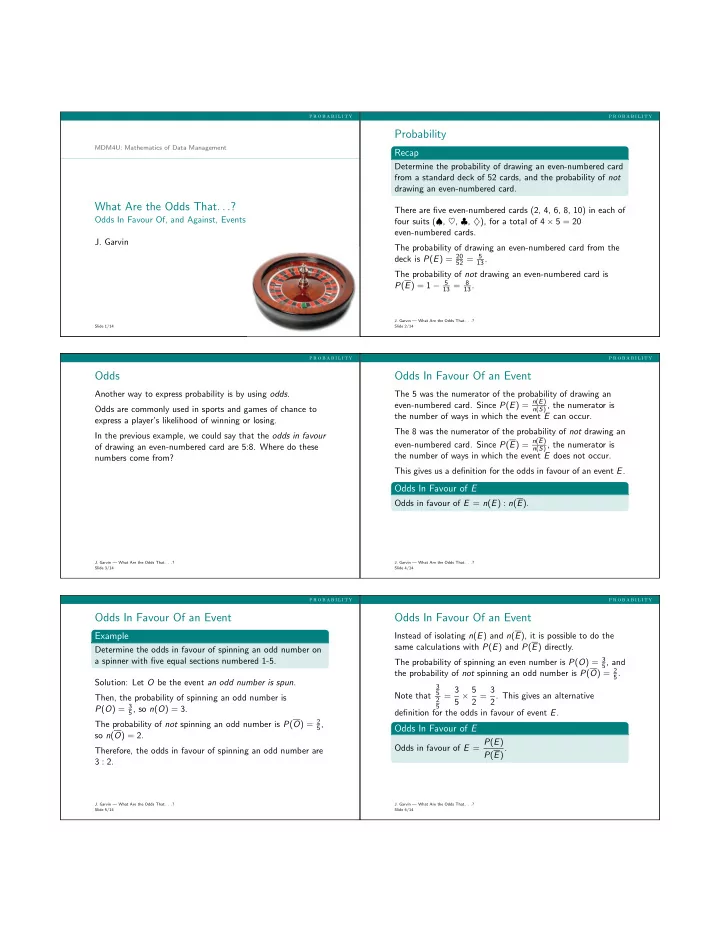

SLIDE 1
p r o b a b i l i t y
MDM4U: Mathematics of Data Management
What Are the Odds That. . .?
Odds In Favour Of, and Against, Events
- J. Garvin
Slide 1/14
p r o b a b i l i t y
Probability
Recap
Determine the probability of drawing an even-numbered card from a standard deck of 52 cards, and the probability of not drawing an even-numbered card. There are five even-numbered cards (2, 4, 6, 8, 10) in each of four suits (♠, ♥, ♣, ♦), for a total of 4 × 5 = 20 even-numbered cards. The probability of drawing an even-numbered card from the deck is P(E) = 20
52 = 5 13.
The probability of not drawing an even-numbered card is P(E) = 1 − 5
13 = 8 13.
- J. Garvin — What Are the Odds That. . .?
Slide 2/14
p r o b a b i l i t y
Odds
Another way to express probability is by using odds. Odds are commonly used in sports and games of chance to express a player’s likelihood of winning or losing. In the previous example, we could say that the odds in favour
- f drawing an even-numbered card are 5:8. Where do these
numbers come from?
- J. Garvin — What Are the Odds That. . .?
Slide 3/14
p r o b a b i l i t y
Odds In Favour Of an Event
The 5 was the numerator of the probability of drawing an even-numbered card. Since P(E) = n(E)
n(S), the numerator is
the number of ways in which the event E can occur. The 8 was the numerator of the probability of not drawing an even-numbered card. Since P(E) = n(E)
n(S), the numerator is
the number of ways in which the event E does not occur. This gives us a definition for the odds in favour of an event E.
Odds In Favour of E
Odds in favour of E = n(E) : n(E).
- J. Garvin — What Are the Odds That. . .?
Slide 4/14
p r o b a b i l i t y
Odds In Favour Of an Event
Example
Determine the odds in favour of spinning an odd number on a spinner with five equal sections numbered 1-5. Solution: Let O be the event an odd number is spun. Then, the probability of spinning an odd number is P(O) = 3
5, so n(O) = 3.
The probability of not spinning an odd number is P(O) = 2
5,
so n(O) = 2. Therefore, the odds in favour of spinning an odd number are 3 : 2.
- J. Garvin — What Are the Odds That. . .?
Slide 5/14
p r o b a b i l i t y
Odds In Favour Of an Event
Instead of isolating n(E) and n(E), it is possible to do the same calculations with P(E) and P(E) directly. The probability of spinning an even number is P(O) = 3
5, and
the probability of not spinning an odd number is P(O) = 2
5.
Note that
3 5 2 5
= 3 5 × 5 2 = 3
- 2. This gives an alternative
definition for the odds in favour of event E.
Odds In Favour of E
Odds in favour of E = P(E) P(E).
- J. Garvin — What Are the Odds That. . .?
Slide 6/14