Framingham Public Schools has accessed assistance for Schools - - PDF document

framingham public schools has accessed assistance for
SMART_READER_LITE
LIVE PREVIEW

Framingham Public Schools has accessed assistance for Schools - - PDF document

Framingham Public Schools has accessed assistance for Schools Designated as Level 3 by Partnering with the Greater Boston District and School Improvement Center [DSAC] 2009 - present Mary Ann Jackman, Director Hilary Bresnahan, Data


slide-1
SLIDE 1

Framingham Public Schools has accessed assistance for Schools Designated as Level 3 by Partnering with the Greater Boston District and School Improvement Center [DSAC] 2009 - present

Mary Ann Jackman, Director Hilary Bresnahan, Data Specialist Rebecca Hyde, Support Facilitator Lauren McBride, Literacy Specialist Leah Tuckman, Math Specialist

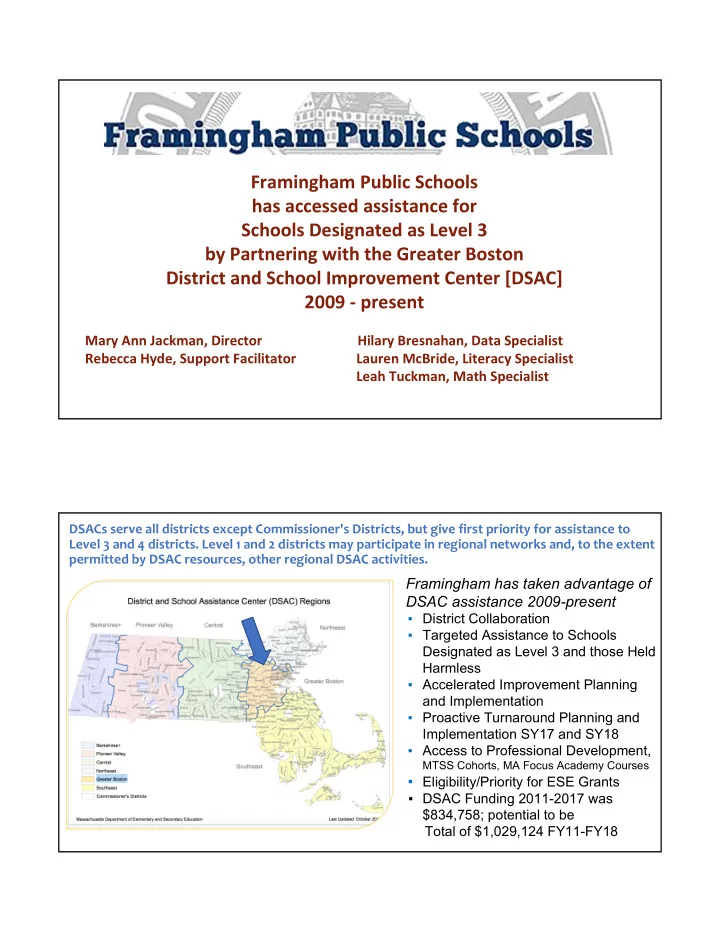
DSACs serve all districts except Commissioner's Districts, but give first priority for assistance to Level 3 and 4 districts. Level 1 and 2 districts may participate in regional networks and, to the extent permitted by DSAC resources, other regional DSAC activities.

Framingham has taken advantage of DSAC assistance 2009-present

▪ District Collaboration ▪ Targeted Assistance to Schools Designated as Level 3 and those Held Harmless ▪ Accelerated Improvement Planning and Implementation ▪ Proactive Turnaround Planning and Implementation SY17 and SY18 ▪ Access to Professional Development,

MTSS Cohorts, MA Focus Academy Courses

▪ Eligibility/Priority for ESE Grants

▪ DSAC Funding 2011-2017 was $834,758; potential to be Total of $1,029,124 FY11-FY18

slide-2
SLIDE 2

All Massachusetts districts and schools with sufficient data are classified into one of five accountability and assistance levels. In general, a district is classified into the level of its lowest performing school, unless the district was classified into Level 4 or 5 as a result of action by the Board of Elementary and Secondary Education. Massachusetts used [2011-2016] the Progress and Performance Index (PPI) to assess the improvement of each district and school toward its own targets.

Every Student Succeeds Act [ESSA]

approved September 17, 2017

  • n ESE Board Meeting September 26, 2017
slide-3
SLIDE 3

ESE Accountability and Assistance System 2011-2017

A Brief History Of The Work That Has Been Done In Framingham

2009 -2011 Focus/Reflection/Planning based on Conditions for School Effectiveness District Collaboration ESE PD/Courses, 2011 Frameworks, Data, Internal Principals Network

Barbieri, Brophy, Wilson, Fuller

2012-2016 Accelerated Improvement Plans [AIP] as Set of Strategies/Progress Monitored based on School Improvement Plans Support for school-based activities related to AIP, Instructional Leadership and Data Teams Learning Walks, Edwin Analytics, Data, Inquiry Cycles, Turning Data Into Action, Root Cause Analysis and Action Planning

Barbieri, Stapleton, Fuller, Brophy, McCarthy, Wilson

District Collaboration/Level 3 AIP including Studying Skillful Teaching Cohorts, Data Teams, Consult per grant guidelines with Title I and other grants

slide-4
SLIDE 4

A Brief History Of The Work That Has Been Done In Framingham continued

2016-2017 Accelerated Improvement Plans [AIP] and Progress Monitoring

Barbieri, Stapleton, Fuller, Brophy, McCarthy, Wilson

District Collaboration-Standards, Literacy/Math Support, consult per grant guidelines-Title I and other grants 2017-2018 Implementation and Progress Monitoring of Collective Turnaround Plan [CTAP]

Brophy, McCarthy, Wilson

Coordination with District regarding Focus School and Schools with percentiles 11-20

Fuller/Focus School, Barbieri and Stapleton/percentiles 11-20

District Collaboration, including Assessments K-5, Early Grades Literacy Grant, consult per grant guidelines -Title I and other grants Involvement in District Improvement Planning Process

DSAC Assistance 2017-2018

❏ Brophy, McCarthy, Wilson

Targeted Assistance/Proactive Turnaround/DSAC funding for schools with percentiles 10 or less (percentiles are on a 1-99 scale and based on 2016 designation).

❏ Barbieri and Stapleton

Schools with percentiles 11-20 (Level 3 and Held Harmless) previously received targeted assistance/funding; as of SY18 informational meetings with opportunities to network with

  • ther schools; no DSAC funding.

❏ Fuller

Focus Schools with overall percentiles of 21 or higher; as of SY18 informational meetings with opportunities to network with other schools; no DSAC funding.

❏ All Framingham Schools are eligible to apply for Level 3, 4, 5 competitive grants, MTSS Academies, MA Focus Academy Courses, etc. ❏

Note: No Framingham Schools are in this assistance designation. SY18 Targeted Assistance/

DSAC Funding for Focus Schools with overall percentiles 20 or less. Focus Schools are those where sub-groups are performing in percentiles 20 or less.

slide-5
SLIDE 5

What Is Happening Now vs. The Work Of The Past Seven Years?

Proactive Turnaround Opportunity Brophy, McCarthy, Wilson Schools Proactive Turnaround Opportunity

proactively catalyze improvement experience and research with Level 4 school turnaround efforts has identified high priority strategies that successful, excited Level 4 schools have leveraged for dramatic school

  • improvement. Much of this research,

documented in the Turnaround Practices Report 2014, can be applied to Level 3 school improvement efforts. reflective planning, evidence based improvement activities based on the Turnaround Practices, and data collection to track progress

slide-6
SLIDE 6

Turnaround Practices

Categories of Findings from Research

Massachusetts Department of Elementary and Secondary Education

Leadership & Shared Responsibility Intentional Practices for Improving Instruction Using Data to Target Student - Specific Instruction School Safe & Respectful Environment – Collaborative Culture District Use Turnaround Authorities & Remove Obstacles Systems to Support, Monitor, and Sustain Allocate Funding & Resources Based on Need Turnaround Practices Field Guide 2016 Turnaround Practices in Action 2014

Sampling of Structures and Highlights of the Turnaround Planning Process

School-Based Instructional Leadership Team supported by DSAC - scheduled bi-monthly/weekly based on work District Matters

Informing and engaging support and autonomies

Assistant Superintendent as Liaison monthly updates Presentation to all District Leaders 5/16/17

We Believe development of beliefs Future Protocol Preferred State 3/17 Turnaround Practices Turnaround Leadership Competencies unpack-study-develop (continuous) Consultancy Hooks/Brophy McCarthy Wilson Schools 6/12/16

Teachers Matter Teachers Association

Informing and engaging support and autonomies

3/1/17 4/6/17 6/14/17

Effective Instructional Practices Research and Development

Stakeholders Matter

Informing and seeking feedback 6/26/17 TA Plan Operational Principles 6/17

September 2016 through June 2017

Turnaround Site Visits SW 3/17 4/17

School Visits – Hooks 1/24/17 3/7/17

Turnaround Plan development and tuning 4/17 - presesnt Assessment Collaboration District Leaders Framingham and Chelsea 6/13

Principals Network Coaches Network

slide-7
SLIDE 7

Sampling of Structures and Highlights of the Turnaround Planning Process

Principals Network Coaches Network School-Based Instructional Leadership Team supported by DSAC - scheduled bi-monthly/weekly based on work District Matters

Informing and engaging support and autonomies

Assistant Superintendent as Liaison monthly updates Presentation to all District Leaders 5/16/17

We Believe development of beliefs Future Protocol Preferred State 3/17 Turnaround Practices Turnaround Leadership Competencies unpack-study-develop (continuous) Consultancy Hooks/Brophy McCarthy Wilson Schools 6/12/16

Teachers Matter Teachers Association

Informing and engaging support and autonomies

3/1/17 4/6/17 6/14/17

Effective Instructional Practices Research and Development

Stakeholders Matter

Informing and seeking feedback 6/26/17 TA Plan Operational Principles 6/17

September 2016 through June 2017

Turnaround Site Visits SW 3/17 4/17

School Visits – Hooks 1/24/17 3/7/17

Turnaround Plan development and tuning 4/17 - presesnt Assessment Collaboration District Leaders Framingham and Chelsea 6/13

Sampling of Structures and Highlights of the Turnaround Planning Process

Principals Network Coaches Network School-Based Instructional Leadership Team supported by DSAC - scheduled bi-monthly/weekly based on work District Matters

Informing and engaging support and autonomies

Assistant Superintendent as Liaison monthly updates Presentation to all District Leaders 5/16/17

We Believe development of beliefs Future Protocol Preferred State 3/17 Turnaround Practices Turnaround Leadership Competencies unpack-study-develop (continuous) Consultancy Hooks/Brophy McCarthy Wilson Schools 6/12/16

Teachers Matter Teachers Association

Informing and engaging support and autonomies

3/1/17 4/6/17 6/14/17

Effective Instructional Practices Research and Development

Stakeholders Matter

Informing and seeking feedback 6/26/17 TA Plan Operational Principles 6/17

September 2016 through June 2017

Turnaround Site Visits SW 3/17 4/17

School Visits – Hooks 1/24/17 3/7/17

Turnaround Plan development and tuning 4/17 - present Assessment Collaboration District Leaders Framingham and Chelsea 6/13

slide-8
SLIDE 8

Shared leadership with Instructional Leadership Team and Grade Level Teams focused

  • n improving student achievement.

Shared understanding of high quality instruction including content, instructional strategies, and pedagogy by all staff and executed in all classrooms and instructional settings.

Turnaround Practice 1 Turnaround Practice 2

Why a Collective Turnaround Plan

slide-9
SLIDE 9

How Is The Work Moving Towards Results?

Why

Equitable Access to High Quality Instruction for All Students: Student Learning and Achievement/Supported by Student Well-Being At The Center of Everything

What

Identification of High Leverage Goals and Levers.

How

  • Investing in teachers by giving them

voice, opportunity, structures, and supports for developing collective efficacy

  • Providing high quality instruction for all

students

  • Prioritizing and, where it makes sense,

strategically abandoning competing initiatives

  • Shifting energy and effort to

standards-based, collaboratively planned, implemented, assessed instruction that is more closely aligned to student needs and which can make better use of installed programs and supplied resources.

How Will We Know We Are Reaching Our Goals?

  • Progress monitored benchmarks for

implementation and student achievement

  • Two rubrics aligned with CTAP Levers

and feedback used with fidelity

  • Turnaround Site Visits by SchoolWorks

to monitor implementation and identify goals for 2018-2019

  • District collaboration and shared

accountability

  • District demonstrated intent to scale
  • ut this improvement process and

construct throughlines

slide-10
SLIDE 10

An Update On The Three Turnaround Schools Brophy, McCarthy, Wilson Schools

Lever 1.1 Collective, distributed leadership structures for improving student achievement: collaborative planning, PLCs, instructional leadership teams Lever 1.2 Cohesive

instruction through frequent and timely formative feedback on best practice and what rigorous instruction looks like: Administration and peer observation and formative feedback focused on high quality instruction levers

Lever 2.1 Deepen content knowledge in ELA and Math standards and shifts: knowledge of the progression of standards across grade levels Lever 2.3 Multiple,

varied groupings with meaningful learning tasks: supporting all students in academics and social emotional development are part of the design

Lever 2.4 Assessments to differentiate and adjust instruction: use of assessments to adjust practice Lever 2.2

Collaborative lesson planning and reflection: grade level collaboration to develop, implement, reflect, and refine common lessons and the use of a common learning plan template; use

  • f a common

learning plan template

Continuing Supports: Level 3 Turnaround Planning and Support

Proactive Approach To Assisting Level 3 Schools Focus On Schools in the Lowest 10 percentiles

2016-2017 Schools in Commissioner’s Districts and DSAC-served districts proactively engaged in external Turnaround Site Visits and a processes that resulted in the development of Turnaround Plans 2017-2018 Proactive Turnaround Schools will implement the plans they developed and receive support with implementation and benchmarking from DSAC

(Commissioner’s Districts receive support from ESE/ODST Liaisons).

There will be another external Turnaround Site Visit Another set of Level 3 schools will be identified to engage in the proactive turnaround plan development process

slide-11
SLIDE 11

What Is Happening Now vs.The Work Of The Past Seven Years?

❖ Focus on equitable access to high quality instruction for all students

❖ Investment in/involvement of teachers as critical to realizing desired state

❖ Transformational change vs. incremental change

❖ ❖

❖ Data, not only MCAS, but self-assessments, external visits/prioritization

❖ Process that is multi-level and multifaceted ❖ Beliefs and visioning for high quality instruction shared, distributed leadership

❖ Visits and collaboration with Hooks School, consultancy, teacher panel

❖ Turnaround Plan with high leverage goals and levers that are progress monitored at regular intervals

❖ PD tightly linked, focused, and embedded ❖ PLC training ❖ Development of assessments

A master schedule structure and aligned instructional resources Consistent identification and analysis of assessments for planning and differentiating instruction Through the development of an assessment collection system, educators will have access to the information they need to identify student growth and mastery of standards and skills to plan instruction A focus on multiple varied groupings with

  • pportunities identified for co-teaching can support

the growth of student skills for self-awareness, self- management, social relationships, and responsible decision making. All teachers are co- teachers and have the potential to be co-teachers and collaboratively planned lesson/learning plans are the foundation for multiple people working with students Feedback from administrators will focus on multiple varied groupings and standards-aligned instruction to monitor implementation of the key instructional levers

When students participate in small group learning with meaningful tasks, they have greater opportunities for discourse and engagement with tasks When engagement increases behavioral challenges decrease and achievement increases When teachers use assessment data to drive and differentiate instruction, activities planned are matched to the needs of the learner When activities are matched to the needs of the learner engagement increases