Framing and error detec.on 1 1 0 1 1 0 0 1 1 0 1 0 1 0 1 1 1 0 - - PowerPoint PPT Presentation

framing and error detec on
SMART_READER_LITE
LIVE PREVIEW

Framing and error detec.on 1 1 0 1 1 0 0 1 1 0 1 0 1 0 1 1 1 0 - - PowerPoint PPT Presentation

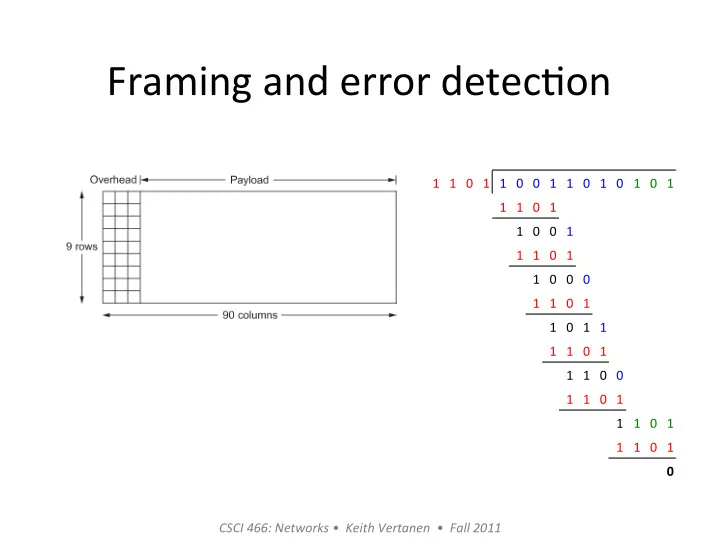
Framing and error detec.on 1 1 0 1 1 0 0 1 1 0 1 0 1 0 1 1 1 0 1 1 0 0 1 1 1 0 1 1 0 0 0 1 1 0 1 1 0 1 1 1 1 0 1 1 1 0 0 1 1 0 1 1 1 0 1 1 1 0 1 0 CSCI 466: Networks Keith Vertanen


slide-1
SLIDE 1

Framing ¡and ¡error ¡detec.on ¡

CSCI ¡466: ¡Networks ¡• ¡ ¡Keith ¡Vertanen ¡ ¡• ¡ ¡Fall ¡2011 ¡ 1 1 0 1 1 0 0 1 1 0 1 0 1 0 1 1 1 0 1 1 0 0 1 1 1 0 1 1 0 0 0 1 1 0 1 1 0 1 1 1 1 0 1 1 1 0 0 1 1 0 1 1 1 0 1 1 1 0 1
slide-2
SLIDE 2

Overview ¡

  • Chapter ¡2: ¡
  • 1. How ¡do ¡we ¡transmit ¡bits ¡from ¡one ¡place ¡to ¡

another? ¡

  • 2. How ¡do ¡we ¡aggregate ¡bits ¡into ¡frames? ¡
  • 3. How ¡do ¡we ¡detect ¡errors? ¡
  • 4. How ¡do ¡we ¡make ¡links ¡appear ¡reliable? ¡
  • 5. How ¡do ¡we ¡share ¡links ¡between ¡mul.ple ¡hosts? ¡

2 ¡

slide-3
SLIDE 3

Overview ¡

  • 1. How ¡do ¡we ¡aggregate ¡bits ¡into ¡frames? ¡
  • Determine ¡bits ¡that ¡cons.tutes ¡a ¡frame ¡

– Byte-­‑oriented ¡protocols ¡ – Bit-­‑oriented ¡protocols ¡ – Clock-­‑based ¡protocols ¡

  • 2. How ¡do ¡we ¡detect ¡errors? ¡
  • Parity ¡
  • Checksums ¡
  • Cyclic ¡redundancy ¡check ¡

¡

3 ¡

slide-4
SLIDE 4

Byte-­‑oriented ¡protocols ¡

  • View ¡frame ¡as ¡collec.on ¡of ¡bytes ¡

– Sen.nel-­‑based ¡approaches ¡

  • BISYNC ¡
  • Point-­‑to-­‑point ¡protocol ¡

– Byte-­‑coun.ng ¡approaches ¡

  • DDCMP ¡

4 ¡

slide-5
SLIDE 5

Sen.nel-­‑based ¡

  • BISYNC, ¡Binary ¡Synchronous ¡Communica.on ¡

– Developed ¡by ¡IBM ¡in ¡the ¡1967 ¡for ¡System/360 ¡ – Special ¡SYN, ¡SOH, ¡STX, ¡ETX ¡flag ¡byte ¡values ¡ – Escape ¡occurrences ¡of ¡ETX ¡in ¡body ¡ – CRC ¡→ ¡error ¡detec.on ¡

5 ¡ “If ¡somehow ¡all ¡of ¡the ¡bisync ¡interconnected ¡machines ¡in ¡the ¡world ¡were ¡to ¡stop ¡all ¡at ¡once, ¡the ¡results ¡would ¡be ¡

  • catastrophic. ¡Many ¡banks ¡would ¡cease ¡to ¡func.on. ¡Some ¡air ¡traffic ¡control ¡systems ¡would ¡collapse. ¡Many ¡of ¡the ¡

point-­‑of-­‑sale ¡systems ¡in ¡retail ¡stores ¡would ¡fail. ¡Many ¡credit ¡and ¡debit ¡cards ¡would ¡become ¡useless. ¡EDI ¡(electronic ¡ data ¡interchange) ¡networks ¡that ¡manage ¡much ¡of ¡the ¡business-­‑to-­‑business ¡commerce ¡would ¡crash, ¡We ¡don't ¡mean ¡ to ¡suggest ¡that ¡there ¡would ¡be ¡a ¡total ¡collapse ¡of ¡all, ¡or ¡even ¡most, ¡of ¡these ¡systems ¡but ¡nonetheless, ¡bisync ¡is ¡s.ll ¡a ¡ vital ¡link ¡in ¡the ¡chain ¡of ¡the ¡world's ¡computer ¡infrastructure.” ¡ ¡ ¡ ¡ ¡ ¡ ¡-­‑Serenge. ¡Systems ¡

slide-6
SLIDE 6

Sen.nel-­‑based ¡

  • PPP, ¡Point-­‑to-­‑Point ¡Protocol ¡

– Common ¡on ¡Internet ¡links, ¡e.g. ¡dialup ¡& ¡DSL ¡

  • PPPoE ¡(PPP ¡over ¡Ethernet), ¡PPPoA ¡(PPP ¡over ¡ATM) ¡

– Special ¡flag ¡value, ¡0111 ¡1110 ¡ – Address, ¡control ¡→ ¡uninteres.ng ¡default ¡values ¡ – Protocol ¡code, ¡e.g. ¡IP/IPX/LCP ¡ – Payload ¡nego.ated ¡via ¡LCP ¡(link ¡control ¡protocol) ¡ – Checksum ¡→ ¡error ¡detec.on ¡

6 ¡

slide-7
SLIDE 7

Byte-­‑coun.ng ¡

  • Byte-­‑coun.ng ¡approach ¡

– Instead ¡of ¡sen.nels, ¡include ¡count ¡of ¡items ¡ – DDCMP ¡(Digital ¡Data ¡Communica.ons ¡Message ¡ Protocol) ¡

  • Created ¡by ¡DEC ¡in ¡1974 ¡

– If ¡count ¡corrupted, ¡causes ¡framing ¡error ¡ ¡

  • May ¡result ¡in ¡incorrect ¡back-­‑to-­‑back ¡frames ¡
  • Sen.nel-­‑based ¡approaches ¡have ¡same ¡problem ¡

7 ¡

slide-8
SLIDE 8

Bit-­‑oriented ¡protocols ¡

  • Frame ¡is ¡a ¡collec.on ¡of ¡bits ¡

– HDLC ¡(high-­‑level ¡data ¡link ¡control) ¡ – Begin ¡and ¡end ¡frame ¡with ¡0111 ¡1110 ¡ – Sender: ¡except ¡for ¡begin/end, ¡ader ¡sending ¡five ¡ consecu.ve ¡1’s, ¡stuff ¡a ¡0 ¡ – Receiver: ¡ader ¡receiving ¡five ¡consecu.ve ¡1’s, ¡if ¡ next ¡bit ¡is ¡0 ¡discard, ¡else: ¡

  • If ¡next ¡bit ¡0, ¡end-­‑of-­‑frame ¡else ¡frame ¡error ¡

8 ¡

slide-9
SLIDE 9

Clock-­‑based ¡framing ¡

  • SONET ¡-­‑ ¡Synchronous ¡Op.cal ¡Network ¡

– Dominant ¡standard ¡for ¡long ¡haul ¡data ¡ – No ¡bit ¡stuffing, ¡fixed ¡frame ¡size, ¡125 ¡µs ¡ – First ¡two ¡bytes ¡of ¡frame ¡contain ¡special ¡bit ¡pajern ¡ – Look ¡for ¡special ¡pajern ¡every ¡810 ¡bytes ¡ – Payload ¡XOR ¡scrambled ¡to ¡ensure ¡bit ¡transi.ons ¡

9 ¡

slide-10
SLIDE 10

SONET ¡

  • Fixed ¡set ¡of ¡data ¡rates ¡
  • Mul.ple ¡low-­‑speed ¡links ¡combined ¡

– Time ¡division ¡mul.plexing ¡(TDM) ¡

10 ¡

Op$cal ¡carrier ¡level ¡ Frame ¡format ¡ Rate ¡ OC-­‑1 ¡ STS-­‑1 ¡ 51.84 ¡Mbps ¡ OC-­‑3 ¡ STS-­‑3 ¡ 155.520 ¡Mbps ¡ OC-­‑12 ¡ STS-­‑12 ¡ 622.080 ¡Mbps ¡ OC-­‑24 ¡ STS-­‑24 ¡ 1.255 ¡Gbps ¡ OC-­‑48 ¡ STS-­‑48 ¡ 2.488 ¡Gbps ¡ OC-­‑192 ¡ STS-­‑192 ¡ 9.953 ¡Gbps ¡ OC-­‑768 ¡ STS-­‑768 ¡ 39.813 ¡Gbps ¡

slide-11
SLIDE 11
  • hjp://www.youtube.com/watch?v=DM-­‑

pLPy8Md0 ¡

  • hjp://www.youtube.com/watch?

v=dOyKdJWPlZY ¡

11 ¡

slide-12
SLIDE 12

Error ¡detec.on ¡

  • Error ¡detec.on ¡

– Parity ¡checking ¡ – Checksum ¡ – Cyclic ¡Redundancy ¡Check ¡

  • Error ¡correc.on ¡

– Retransmission ¡ – Forward ¡error ¡correc.on ¡(ECC) ¡

  • Hamming ¡codes, ¡Reed-­‑Solomon ¡codes, ¡low-­‑density ¡

parity ¡check ¡code ¡(LDPC) ¡

  • Examples: ¡DVDs, ¡WiMax, ¡802.11n ¡

12 ¡

slide-13
SLIDE 13

Error ¡detec.on ¡

  • Basic ¡idea: ¡add ¡redundant ¡data ¡

– Simple ¡scheme: ¡

  • Send ¡two ¡copies ¡of ¡data ¡
  • Compare ¡copies, ¡any ¡differences ¡implies ¡error ¡
  • High ¡overhead, ¡2n ¡bits ¡to ¡send ¡n ¡bits ¡data ¡

– ¡More ¡complex ¡schemes: ¡

  • Strong ¡error ¡detec.on ¡with ¡k ¡redundant ¡bits ¡
  • k ¡<< ¡n ¡
  • e.g. ¡Ethernet ¡frame ¡with ¡12K ¡bits, ¡32-­‑bit ¡CRC ¡

13 ¡

slide-14
SLIDE 14

Parity ¡checking ¡

  • One ¡dimensional ¡parity ¡

– Set ¡parity ¡bit ¡so ¡number ¡of ¡1s ¡odd ¡or ¡even ¡ – Detects ¡all ¡single ¡bit ¡errors ¡ – Example ¡(7 ¡bits ¡data, ¡1 ¡bit ¡data): ¡

14 ¡

data ¡ even ¡parity ¡

  • dd ¡parity ¡

0010 ¡101 ¡ 0010 ¡1011 ¡ 0010 ¡1010 ¡ 1100 ¡110 ¡ 1100 ¡1100 ¡ 1100 ¡1101 ¡ 0000 ¡000 ¡ 0000 ¡0000 ¡ 0000 ¡0001 ¡

slide-15
SLIDE 15

Parity ¡checking ¡

  • Two-­‑dimensional ¡parity ¡

– Arrange ¡bytes ¡in ¡a ¡table ¡ – Parity ¡over ¡rows ¡and ¡over ¡columns ¡ – Catches ¡all ¡1-­‑3 ¡bit ¡errors ¡ – Catches ¡most ¡4 ¡bit ¡errors ¡

15 ¡

slide-16
SLIDE 16

Checksum ¡

  • Internet ¡checksum ¡algorithm ¡

– Add ¡up ¡16-­‑bit ¡words ¡and ¡transmit ¡result ¡ – Not ¡used ¡in ¡link-­‑layer ¡

  • Used ¡in ¡higher ¡layers ¡like ¡TCP ¡and ¡UDP ¡

– Advantages: ¡

  • Small ¡number ¡of ¡redundant ¡bits ¡
  • Easy ¡to ¡implement ¡ ¡

– Disadvantages: ¡

  • Weak ¡protec.on ¡

16 ¡

slide-17
SLIDE 17

Checksum ¡

  • Algorithm: ¡

– Add ¡data ¡using ¡one’s ¡complement ¡ – Checksum ¡is ¡complement ¡of ¡summa.on ¡ – One’s ¡complement: ¡

  • Nega.ve ¡numbers ¡are ¡bit ¡complement ¡of ¡posi.ve ¡
  • Carry ¡out ¡from ¡most ¡significant ¡bit, ¡increment ¡by ¡1 ¡

17 ¡

1 ¡ 1 ¡ 1 ¡ 1 ¡ 1 ¡ 1 ¡ 1 ¡ 0 ¡ 0 ¡ 0 ¡ 0 ¡ 1 ¡ 1 ¡ 1 ¡ 1 ¡ + ¡ 1 ¡ 1 ¡ 1 ¡ 1 ¡ 1 ¡ 0 ¡ 1 ¡ 0 ¡ 0 ¡ 0 ¡ 0 ¡ 0 ¡ 1 ¡ 0 ¡ 0 ¡ 1 ¡ + ¡ 1 ¡ 0 ¡ 0 ¡ 0 ¡ 0 ¡ 1 ¡ 0 ¡ 1 ¡ 0 ¡ 15 ¡ + ¡

  • ­‑5 ¡

10 ¡

slide-18
SLIDE 18

Checksum ¡algorithm ¡

18 ¡

u_short cksum(u_short *buf, int count) { register u_long sum = 0; while (count--) { sum += *buf++; if (sum & 0xFFFF0000) { /* carry occurred so wrap around */ sum &= 0xFFFF; sum++; } } return ~(sum & 0xFFFF); }

slide-19
SLIDE 19

Cyclic ¡redundancy ¡check ¡

  • CRC ¡(cyclic ¡redundancy ¡check) ¡

– Maximize ¡detec.on ¡while ¡minimizing ¡redundancy ¡ – (n+1) ¡bit ¡message ¡= ¡n ¡degree ¡polynomial ¡ – Sender/receiver ¡agree ¡on ¡divisor ¡polynomial ¡C(x) ¡ ¡

  • C(x) ¡is ¡polynomial ¡of ¡degree ¡k ¡(k ¡<< ¡n) ¡

– Extend ¡message ¡M(x) ¡to ¡include ¡extra ¡bits ¡that ¡ make ¡it ¡evenly ¡divisible ¡by ¡C(x) ¡

19 ¡

Message ¡(x) ¡ polynomial ¡M(x) ¡ 1001 ¡1010 ¡ 1x7 ¡+ ¡0x6 ¡+ ¡0x5 ¡+ ¡1x4 ¡+ ¡1x3 ¡+ ¡0x2 ¡+ ¡1x1 ¡+ ¡0x0 ¡ = ¡x7 ¡+ ¡x4 ¡+ ¡x3 ¡+ ¡x1 ¡ ¡

slide-20
SLIDE 20

Common ¡CRC ¡polynomials ¡

20 ¡

Name ¡ Used ¡in ¡ C(x) ¡ Generator ¡ CRC-­‑8 ¡ ATM ¡ x8 ¡+ ¡x2 ¡+ ¡x1 ¡+ ¡1 ¡ ¡ 1 ¡0000 ¡0111 ¡ CRC-­‑10 ¡ ATM ¡ x10 ¡+ ¡x9 ¡+ ¡x5 ¡+ ¡x4 ¡+ ¡x1 ¡+ ¡1 ¡ ¡ 110 ¡0011 ¡0011 ¡ CRC-­‑12 ¡ Telecom ¡systems ¡ x12 ¡+ ¡x11 ¡+ ¡x3 ¡+ ¡x2 ¡+ ¡x1 ¡+ ¡1 ¡ ¡ 1 ¡1000 ¡0000 ¡1111 ¡ CRC-­‑16 ¡ USB, ¡Bisync ¡ x16 ¡+ ¡x15 ¡+ ¡x2 ¡+ ¡1 ¡ ¡ 1 ¡1000 ¡0000 ¡0000 ¡0011 ¡ CRC-­‑CCITT ¡ Bluetooth, ¡X.25, ¡SD, ¡HDLC ¡ x16 ¡+ ¡x12 ¡+ ¡x5 ¡+ ¡1 ¡ ¡

1 ¡0001 ¡0000 ¡0010 ¡0001 ¡

CRC-­‑32 ¡ Ethernet, ¡SATA, ¡MPEG-­‑2, ¡ Gzip, ¡PKZIP, ¡PNG, ¡ATM ¡ x32 ¡+ ¡x26 ¡+ ¡x23 ¡+ ¡x22 ¡+ ¡x16 ¡+ ¡x12 ¡+ ¡x11 ¡+ ¡ x10 ¡+ ¡x8 ¡+ ¡x7 ¡+ ¡x5 ¡+ ¡x4 ¡+ ¡x2 ¡+ ¡x1 ¡+ ¡1 ¡

¡

1 ¡0000 ¡0100 ¡1100 ¡0001 ¡ 0001 ¡1101 ¡1011 ¡0111 ¡

  • CRC ¡will ¡detect: ¡

– All ¡single-­‑bit ¡errors, ¡if ¡xk ¡and ¡x0 ¡are ¡nonzero ¡ – All ¡double-­‑bit ¡errors, ¡if ¡C(x) ¡has ¡a ¡factor ¡with ¡3 ¡or ¡more ¡terms ¡ – Any ¡odd ¡number ¡of ¡errors, ¡if ¡C(x) ¡contains ¡the ¡factor ¡(x+1) ¡ – Any ¡burst ¡error, ¡if ¡burst ¡is ¡less ¡than ¡k ¡bits ¡

slide-21
SLIDE 21

Genera.ng ¡a ¡CRC ¡

  • Adding ¡a ¡CRC ¡to ¡a ¡message: ¡

– Assume: ¡

  • Message ¡M(x) ¡of ¡(n+1) ¡bits ¡ ¡
  • Generator ¡polynomial ¡C(x) ¡of ¡degree ¡k ¡

– Add ¡k ¡zeros ¡to ¡right ¡side ¡of ¡M(x) ¡ – Find ¡remainder ¡by ¡dividing ¡by ¡C(x) ¡ – Replace ¡k ¡zeros ¡on ¡right ¡of ¡M(X) ¡with ¡remainder ¡

21 ¡

slide-22
SLIDE 22

Example ¡CRC ¡genera.on ¡

22 ¡

Message ¡ 1001 ¡1010 ¡ M(x) ¡= ¡x7 ¡+ ¡x4 ¡+ ¡x3 ¡+ ¡x1 ¡ ¡ Generator ¡ 1101 ¡ C(x) ¡= ¡x3 ¡+ ¡x2 ¡+ ¡1 ¡

1 1 0 1 1 0 0 1 1 0 1 0 0 0 0 1 1 0 1 1 0 0 1 1 1 0 1 1 0 0 0 1 1 0 1 1 0 1 1 1 1 0 1 1 1 0 0 1 1 0 1 1 0 0 0 1 1 0 1 1 0 1

  • Repeatedly ¡XOR ¡generator ¡with ¡

bits ¡from ¡augmented ¡M(x) ¡ ¡

  • Final ¡remainder ¡is ¡CRC ¡
  • Final ¡message: ¡

1001 ¡1010 ¡101 ¡

slide-23
SLIDE 23

Checking ¡a ¡CRC ¡

  • Checking ¡a ¡received ¡message: ¡

– Receiver ¡gets ¡M(x) ¡+ ¡calculated ¡CRC ¡ ¡ – Divides ¡by ¡agreed ¡C(x) ¡ – If ¡remainder ¡= ¡0, ¡no ¡error ¡detected ¡

23 ¡

slide-24
SLIDE 24

Example ¡uncorrupted ¡message ¡

24 ¡

Message ¡ 1001 ¡1010 ¡ M(x) ¡= ¡x7 ¡+ ¡x4 ¡+ ¡x3 ¡+ ¡x1 ¡ ¡ Generator ¡ 1101 ¡ C(x) ¡= ¡x3 ¡+ ¡x2 ¡+ ¡1 ¡ CRC ¡ 101 ¡

1 1 0 1 1 0 0 1 1 0 1 0 1 0 1 1 1 0 1 1 0 0 1 1 1 0 1 1 0 0 0 1 1 0 1 1 0 1 1 1 1 0 1 1 1 0 0 1 1 0 1 1 1 0 1 1 1 0 1

  • Repeatedly ¡XOR ¡generator ¡with ¡

bits ¡from ¡message ¡+ ¡CRC ¡ ¡

  • Final ¡remainder ¡should ¡be ¡zero ¡
slide-25
SLIDE 25

Example ¡corrupted ¡message ¡

25 ¡

Message ¡ 1001 ¡1010 ¡ M(x) ¡= ¡x7 ¡+ ¡x4 ¡+ ¡x3 ¡+ ¡x1 ¡ ¡ Generator ¡ 1101 ¡ C(x) ¡= ¡x3 ¡+ ¡x2 ¡+ ¡1 ¡ CRC ¡ 101 ¡

1 1 0 1 1 0 0 1 1 0 0 0 1 0 1 1 1 0 1 1 0 0 1 1 1 0 1 1 0 0 0 1 1 0 1 1 0 1 0 1 1 0 1 1 1 1 0 1 1 0 1 1 1 1 0 1 1 0 1 1 1 1

  • Repeatedly ¡XOR ¡generator ¡with ¡

bits ¡from ¡message ¡+ ¡CRC ¡ ¡

  • Final ¡remainder ¡not ¡zero ¡so ¡

must ¡be ¡an ¡error ¡in ¡transmijed ¡ message ¡or ¡CRC ¡

slide-26
SLIDE 26

Error ¡detec.on ¡rate ¡

26 ¡

Type ¡ Length ¡ Error ¡detec$on ¡ checksum ¡ 8-­‑bit ¡ 99.6094% ¡ checksum ¡ 16-­‑bit ¡ 99.9985% ¡ CRC ¡ 32-­‑bit ¡ 99.9999% ¡

slide-27
SLIDE 27

Summary ¡

27 ¡

  • Framing ¡

– Numerous ¡ways ¡to ¡separate ¡blocks ¡of ¡data: ¡

  • Sen.nel ¡sequences, ¡count ¡fields, ¡clock ¡synchroniza.on ¡
  • Error ¡detec.on ¡

– Small ¡amount ¡of ¡redundancy ¡provides ¡strong ¡ error ¡detec.on ¡

  • Checksum ¡(used ¡in ¡transport ¡layer) ¡
  • CRC ¡(used ¡in ¡link ¡layer) ¡