Formal editing: jEdit-MMT 1. Developer defines new logic - - PowerPoint PPT Presentation

formal editing jedit mmt
SMART_READER_LITE
LIVE PREVIEW

Formal editing: jEdit-MMT 1. Developer defines new logic - - PowerPoint PPT Presentation

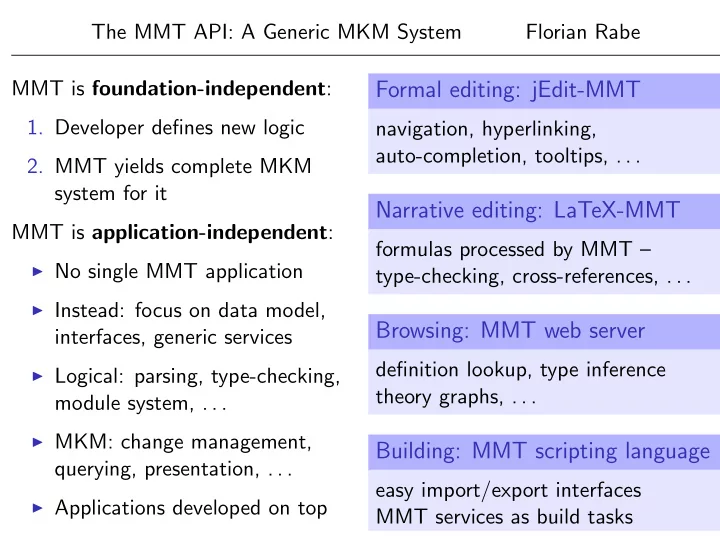
The MMT API: A Generic MKM System Florian Rabe MMT is foundation-independent : Formal editing: jEdit-MMT 1. Developer defines new logic navigation, hyperlinking, auto-completion, tooltips, . . . 2. MMT yields complete MKM system for it


slide-1
SLIDE 1

The MMT API: A Generic MKM System Florian Rabe MMT is foundation-independent:

  • 1. Developer defines new logic
  • 2. MMT yields complete MKM

system for it MMT is application-independent:

◮ No single MMT application ◮ Instead: focus on data model,

interfaces, generic services

◮ Logical: parsing, type-checking,

module system, . . .

◮ MKM: change management,

querying, presentation, . . .

◮ Applications developed on top

Formal editing: jEdit-MMT

navigation, hyperlinking, auto-completion, tooltips, . . .

Narrative editing: LaTeX-MMT

formulas processed by MMT – type-checking, cross-references, . . .

Browsing: MMT web server

definition lookup, type inference theory graphs, . . .

Building: MMT scripting language

easy import/export interfaces MMT services as build tasks

slide-2
SLIDE 2

The MMT API: A Generic MKM System

Florian Rabe

Jacobs University Bremen

CICM System Description (S&P Track), July 2013 See https://trac.kwarc.info/MMT for papers, source code, etc.

1

slide-3
SLIDE 3

MMT Overview

◮ Universal framework for formal mathematical/logical content ◮ Continuous development since 2007 [5] ◮ Close relatives

◮ logical frameworks like LF, Isabelle

but: even more generic, knowledge management, more system integration

◮ OMDoc/OpenMath

but with formal semantics, more automation

◮ MMT System:

◮ MMT data structures ◮ logical and knowledge management services ◮ ∼ 10 CICM papers on individual services ◮ various individual applications utilizing the services ◮ ∼ 30,000 lines of Scala code total 2

slide-4
SLIDE 4

Central Idea: Foundation-Independence

  • 1. We can fix and implement a logical theory

e.g., set theory

  • 2. We can fix and implement a logic

then define many theories in it e.g., first-order logic

  • 3. We can fix and implement a logical framework

then define many logics in it the foundation, e.g., LF

  • 4. We can fix and implement a meta-framework

then define many logical frameworks in it foundation-independence: MMT

3

slide-5
SLIDE 5

Highly Reusable Results through Foundation-Independence

◮ Conceptual

◮ intuitions, documentation, teaching ◮ definitions, meta-theorems ◮ algorithms

◮ Knowledge management

◮ editing, parsing ◮ change management [2] ◮ project management, distribution [1] ◮ search, querying [4] ◮ interactive browsing ◮ system integration, semantic interfaces

◮ Logical

◮ module system, namespace management [5] ◮ type reconstruction ◮ computation [3] 4

slide-6
SLIDE 6

MMT Design Methodology

  • 1. Choose a typical problem

logical: e.g., type reconstruction, module system MKM: e.g., change management, querying

  • 2. Survey and analyze the existing solutions
  • 3. Differentiate between foundation-specific and

foundation-independent definitions/theorems/algorithms

  • 4. Integrate the foundation-independent aspects into MMT

language and system

  • 5. Define interfaces to supply the logic-specific aspects

formal theory and plugin interfaces

  • 6. Repeat

5

slide-7
SLIDE 7

MMT Language Features

few primitives . . . that unify different domain concepts

◮ Judgments as types, proofs as terms

unifies expressions and derivations

◮ Higher-order abstract syntax

unifies operators and binders

◮ Category of theories

unifies logical theories, logics, foundations

◮ languages as theories ◮ relations as theory morphisms

◮ Module system (little theories)

unifies inheritance and representation theorems

◮ Models as morphisms (categorical logic)

unifies syntactical translations and semantic interpretations

6

slide-8
SLIDE 8

A Small Formalization Example in MMT

The logical framework LF in MMT:

theory Types { type } theory LF { i n c l u d e Types , Π , → , λ , @ }

First-order Logic defined in MMT/LF:

theory Logic meta LF {o : type , ded :

  • → type }

theory FOL meta LF { i n c l u d e Logic u : type . imp :

  • → o → o , . . .

}

Algebraic theories in MMT/LF/FOL:

theory Magma meta FOL { ◦ : u → u → u } . . . theory Ring meta FOL { a d d i t i v e : CommutativeGroup m u l t i p l i c a t i v e : Semigroup . . . }

7

slide-9
SLIDE 9

Key Idea: Application-independence

  • 1. No a-priori commitment to a particular application
  • 2. Focus on API for MMT data model
  • 3. Abstraction from physical storage

MMT works with file systems, databases, remote servers

  • 4. Abstraction from user interfaces

MMT provides API, HTTP, shell interfaces

  • 5. Advanced functionality as independent, reusable services

parsing, type-checking, presentation, . . . that are customized by plugins typing rules, presentation styles, . . . Individual applications are built flexibly on top of the API.

8

slide-10
SLIDE 10

Application Example: Editing

◮ IDE-like editor for MMT projects ◮ MMT acting as a plugin for jEdit text editor ◮ MMT handles data model aspects

◮ parsing (based on plugins, notations) ◮ type checking (based on plugins for typing rules) ◮ auto-completion suggestions

◮ jEdit handles GUI aspects

◮ outline view ◮ error highlighting ◮ hyperlinks (= click on operator, jump to declaration/definition) ◮ context-sensitive auto-completion: show identifiers that ◮ are in scope ◮ have the right type 9

slide-11
SLIDE 11

Application Example: Editing

Example feature: pop up shows reconstructed arguments

10

slide-12
SLIDE 12

Application Example: Editing

Example feature: auto-completion shows only identifiers that are in scope and have the right type

11

slide-13
SLIDE 13

Application Example: Mathematical Documents

◮ Unified document format LaTeX-MMT ◮ Processed by LaTeX ◮ MMT-relevant aspects represented in special macros

◮ mmt.sty sends them to MMT via HTTP during compilation ◮ MMT returns LaTeX snippet, which LaTeX processes further

◮ MMT processing includes

  • 1. parsing
  • 2. type reconstruction
  • 3. generation of high-quality LaTeX that includes

◮ reconstructed information ◮ cross-references ◮ tooltips 12

slide-14
SLIDE 14

Application Example: Mathematical Documents

◮ upper part: L AT

EX-MMT source for highlighted line

◮ lower part: pdf after compiling with L AT

EX-MMT

◮ enhanced LaTeX features generated by MMT

◮ type argument M of equality symbol is inferred and added ◮ cross-references from each symbol to its definition (works

across pdfs)

13

slide-15
SLIDE 15

Application Example: Interactive Browsing

◮ MMT API exposed through HTTP server ◮ Javascript/Ajax for interactive browsing of MMT projects

e.g., definition lookup, dynamic type inference

◮ Interactive graph view based on SVG

14

slide-16
SLIDE 16

Application Example: Build Tool

MMT chains build steps on MMT projects

◮ Import

MMT native syntax, Twelf, Mizar, OWL, TPTP, . . .

◮ Computation

◮ validation, type reconstruction ◮ flattening

◮ Indexing

◮ theory graph ◮ document hierarchy ◮ substitution tree of formulas (via MathWebSearch) ◮ relational index (MMT ontology)

◮ Export

HTML+presentation MathML, SVG diagrams, Scala code [3], . . .

15

slide-17
SLIDE 17

Videos

◮ Editing (jEdit-MMT)

  • utline view, error highlighting, smart auto-completion

display of inferred information, hyperlinking http://youtu.be/tdd45Uv7j_g (left QR code)

◮ Interactive browsing (MMT web server)

semantic highlighting, showing reconstructed information dynamic type inference, navigation, theory graph display http://youtu.be/MPTzW86voI4 (right QR code)

16

slide-18
SLIDE 18

[1] F. Horozal, A. Iacob, C. Jucovschi, M. Kohlhase, and F. Rabe. Combining Source, Content, Presentation, Narration, and Relational Representation. In J. Davenport, W. Farmer, F. Rabe, and J. Urban, editors, Intelligent Computer Mathematics, pages 212–227. Springer, 2011. [2] M. Iancu and F. Rabe. Management of Change in Declarative Languages. In J. Campbell, J. Carette, G. Dos Reis, J. Jeuring, P. Sojka, V. Sorge, and M. Wenzel, editors, Intelligent Computer Mathematics, pages 325–340. Springer, 2012. [3] M. Kohlhase, F. Mance, and F. Rabe. A Universal Machine for Biform Theory Graphs. In J. Carette, D. Aspinall, C. Lange, P. Sojka, and W. Windsteiger, editors, Intelligent Computer Mathematics, pages 82–97. Springer, 2013. [4] F. Rabe. A Query Language for Formal Mathematical Libraries. In J. Campbell, J. Carette, G. Dos Reis, J. Jeuring, P. Sojka, V. Sorge, and M. Wenzel, editors, Intelligent Computer Mathematics, pages 142–157. Springer, 2012. [5] F. Rabe and M. Kohlhase. A Scalable Module System. Information and Computation, 2013. to appear; see http://kwarc.info/frabe/Research/RK_mmt_10.pdf.

17