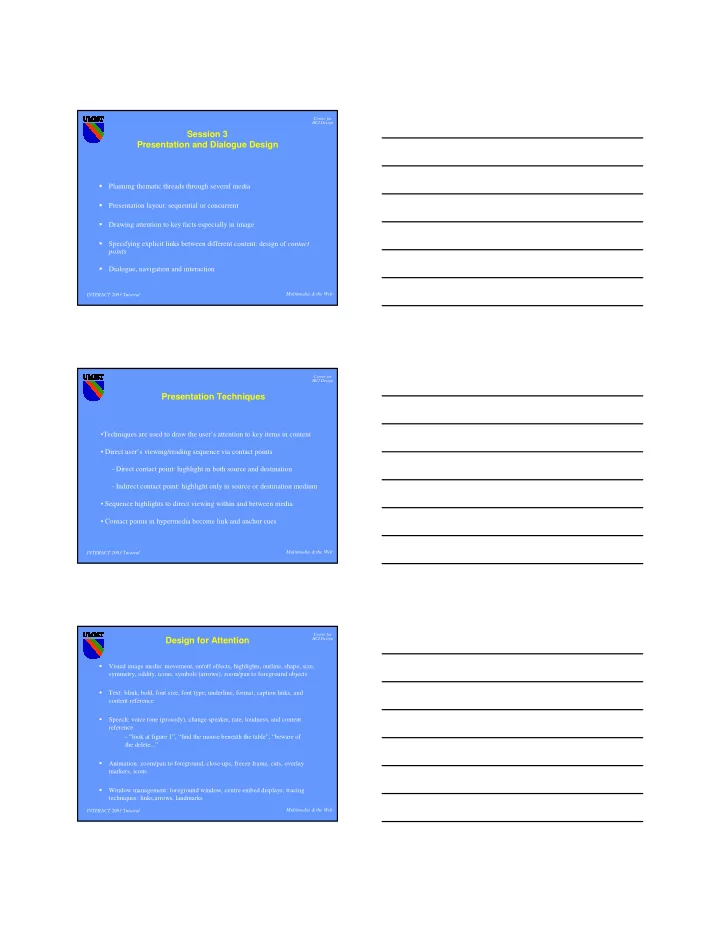
Session 3 Presentation and Dialogue Design Planning thematic - - PDF document

session 3 presentation and dialogue design
SMART_READER_LITE
LIVE PREVIEW

Session 3 Presentation and Dialogue Design Planning thematic - - PDF document

Centre for HCI Design Session 3 Presentation and Dialogue Design Planning thematic threads through several media Presentation layout: sequential or concurrent Drawing attention to key facts especially in image Specifying


slide-1
SLIDE 1 Centre for HCI Design

INTERACT 2003 Tutorial Multimedia & the Web

  • Planning thematic threads through several media
  • Presentation layout: sequential or concurrent
  • Drawing attention to key facts especially in image
  • Specifying explicit links between different content: design of contact

points

  • Dialogue, navigation and interaction

Session 3 Presentation and Dialogue Design

Centre for HCI Design

INTERACT 2003 Tutorial Multimedia & the Web

  • Techniques are used to draw the user’s attention to key items in content
  • Direct user’s viewing/reading sequence via contact points
  • Direct contact point: highlight in both source and destination
  • Indirect contact point: highlight only in source or destination medium
  • Sequence highlights to direct viewing within and between media
  • Contact points in hypermedia become link and anchor cues

Presentation Techniques

Centre for HCI Design

INTERACT 2003 Tutorial Multimedia & the Web

Design for Attention

  • Visual image media: movement, on/off effects, highlights, outline, shape, size,

symmetry, oddity, icons, symbols (arrows), zoom/pan to foreground objects

  • Text: blink, bold, font size, font type, underline, format, caption links, and

content reference

  • Speech: voice tone (prosody), change speaker, rate, loudness, and content

reference

  • “look at figure 1”, “find the mouse beneath the table”, “beware of

the delete...”

  • Animation: zoom/pan to foreground, close-ups, freeze frame, cuts, overlay

markers, icons

  • Window management: foreground window, centre embed displays; tracing

techniques: links,arrows, landmarks

slide-2
SLIDE 2 Centre for HCI Design

INTERACT 2003 Tutorial Multimedia & the Web

Contact point example

Text and speech linked to image with boundary effect

Centre for HCI Design

INTERACT 2003 Tutorial Multimedia & the Web N ext, the protein pyrimidine complex absorbs light This causes the D NA to be repaired from the visible range

speech contact point visible highlights

Contact point: text, speech & image

Centre for HCI Design

INTERACT 2003 Tutorial Multimedia & the Web

Contact points: text to video segments

buttons access video segments

slide-3
SLIDE 3 Centre for HCI Design

INTERACT 2003 Tutorial Multimedia & the Web

Interaction

  • Interaction engages users: motivating also improves learning
  • Ideas? - interactive metaphors for navigation, games, quiz, user as

actor in presentation

  • Dialogue plans from task analysis, scenarios
  • Prototype and/or storyboards for early evaluation; feedback from users
Centre for HCI Design

INTERACT 2003 Tutorial Multimedia & the Web

  • Dialogue sequences based on scenarios, use cases or task analysis
  • For information-intensive applications, dialogue becomes access and

navigation problem

  • Navigation links & controls based on information architecture: list,

hierarchy, network, lattice

  • Design access paths are menus (hierarchies), links and maps

(networks), tables (lattice)

  • Add controls for media resources, user interaction/ manipulation

Structuring Dialogues

Centre for HCI Design

INTERACT 2003 Tutorial Multimedia & the Web

Navigation Metaphor: Example

Conceptual explanation: notion of direction and navigation Abstract objects and actions…… space, vectors, directions, move on bearing Metaphor of real world used with designed image and text

slide-4
SLIDE 4 Centre for HCI Design

INTERACT 2003 Tutorial Multimedia & the Web

Navigation/Control Metaphors

  • Zoom/Pan controls
  • Compass metaphor: movement within image/ structure
  • Timeline: navigation by sequence, date, history
  • Card index: content structure
  • Agent metaphors: move self/presence

always test metaphors; your interpretation might not be the user’s

Centre for HCI Design

INTERACT 2003 Tutorial Multimedia & the Web

Simple controls

Browser style controls, more complex metaphors, e.g. compass to navigation within an image or media stream

Centre for HCI Design

INTERACT 2003 Tutorial Multimedia & the Web

  • Web Browser-style controls: Back,

Forward, Home

  • Video metaphor controls for dynamic

media << | Stop| Play | >>

  • Content-addressable browsing:

thumbnails, video segments

  • Bookmarks, visit-lists, overview maps
  • f navigation space, you-are-here

markers

  • Guided tours, active links (destination

hints & queries)

Navigation Controls

slide-5
SLIDE 5 Centre for HCI Design

INTERACT 2003 Tutorial Multimedia & the Web

Pondworld (Rogers & Scaife, 1999)

Integrates real world view with abstract diagram + interaction

Centre for HCI Design

INTERACT 2003 Tutorial Multimedia & the Web

  • Dialogue network diagram/site map: specify navigation paths,

dialogue/interaction

  • Facilities provided for navigation support
  • Cues, prompts & metaphors for navigation and interactive support;

predictability

  • Feedback, status messages, and presentation; observability and

understanding

  • Designs for interactive functions to support user’s task (or learning)

Summary of Session 3

Centre for HCI Design

INTERACT 2003 Tutorial Multimedia & the Web

  • Multimedia needs to be used more effectively and knowledge of

psychology can help

  • Planning a coherent message and presentation is vital; design trade-offs

between effective presentation, attraction and engagement.

  • Design of multimedia is important to deliver key messages: media

selection and design for attention

  • Integration of multimedia and control of attention also vital: picking out

the key points, making the thematic thread clear

Conclusions

slide-6
SLIDE 6 Centre for HCI Design

INTERACT 2003 Tutorial Multimedia & the Web

For more information Sutcliffe, A.G. Multimedia and virtual reality: Designing multi-sensory user interfaces Lawrence Erlbaum Associates 2003