Isabelle/jEdit for seasoned Isabelle users Isabelle/jEdit NEWS - - PowerPoint PPT Presentation

isabelle jedit for seasoned isabelle users isabelle jedit
SMART_READER_LITE
LIVE PREVIEW

Isabelle/jEdit for seasoned Isabelle users Isabelle/jEdit NEWS - - PowerPoint PPT Presentation

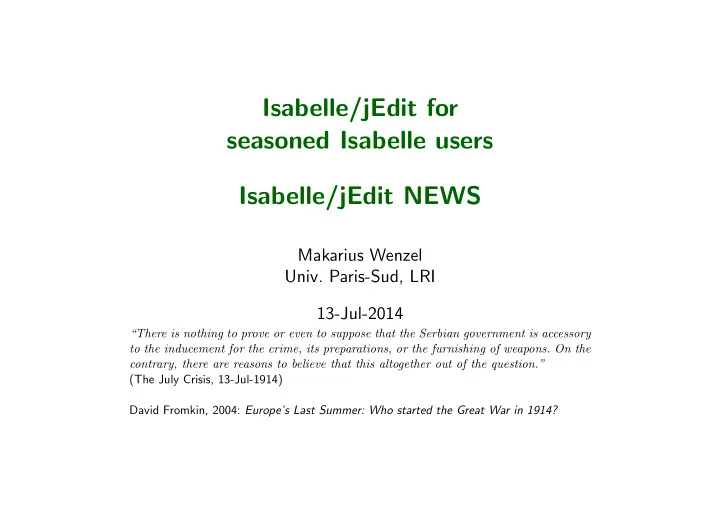
Isabelle/jEdit for seasoned Isabelle users Isabelle/jEdit NEWS Makarius Wenzel Univ. Paris-Sud, LRI 13-Jul-2014 There is nothing to prove or even to suppose that the Serbian government is accessory to the inducement for the crime, its


slide-1
SLIDE 1

Isabelle/jEdit for seasoned Isabelle users Isabelle/jEdit NEWS

Makarius Wenzel

  • Univ. Paris-Sud, LRI

13-Jul-2014

“There is nothing to prove or even to suppose that the Serbian government is accessory to the inducement for the crime, its preparations, or the furnishing of weapons. On the contrary, there are reasons to believe that this altogether out of the question.” (The July Crisis, 13-Jul-1914) David Fromkin, 2004: Europe’s Last Summer: Who started the Great War in 1914?

slide-2
SLIDE 2

History

slide-3
SLIDE 3

2009 (experimental)

History 2

slide-4
SLIDE 4

2010 (experimental)

History 3

slide-5
SLIDE 5

2011 (experimental stable)

History 4

slide-6
SLIDE 6

2012 (stable)

History 5

slide-7
SLIDE 7

2013 (stable, rich client)

History 6

slide-8
SLIDE 8

2014 (stable, filthy rich client)

History 7

slide-9
SLIDE 9

jEdit 5.1

slide-10
SLIDE 10

What is jEdit?

Logo: Website: http://www.jedit.org User’s guide: http://www.jedit.org/users-guide Official blurb:

“jEdit is a mature programmer’s text editor with hundreds [. . . ] of person-years

  • f development behind it. [. . . ] The jEdit core, together with a large collection
  • f plugins is maintained by a world-wide developer team.”

Vox populi:

“The legendary jEdit text editor.”

jEdit 5.1 9

slide-11
SLIDE 11

Notable jEdit features

  • multiple views, buffers, text areas
  • dockable windows
  • status bar and action bar
  • advanced file management: browser, URLs, reload events
  • advanced selections: range, rectangular, tall-caret, multi-selections
  • copy-paste registers
  • persistent markers
  • advanced search-replace: hypersearch, multi-file search, search bar
  • bracket matching and block selection
  • folding and narrowing
  • macros and BeanShell scripting
  • open-ended plugin interface for JVM languages (Java, Scala)

jEdit 5.1 10

slide-12
SLIDE 12

Notable jEdit plugins

  • Console: BeanShell, System shell, Scala toplevel
  • Highlight: regular expression “text markers”
  • SideKick: tree view
  • Navigator (Isabelle2014)
  • Isabelle

but: Isabelle/jEdit is not just another jEdit plugin – all-inclusive application bundle – different implementation language: Scala instead of Java – different intention: Prover IDE instead of plain text editor

jEdit 5.1 11

slide-13
SLIDE 13

Isabelle/jEdit in Isabelle2013-2

slide-14
SLIDE 14

Prover IDE functionality

  • File-system access: mixed-platform notation; Isabelle settings from

environment; hyperlinks for formal file references

  • Text buffers and theories: Theories panel; management of editor

buffers versus PIDE document-nodes; editor perspective as hint for theory processing; rendering of semantic markup

  • Prover output: in-source messages; gutter area; text overview area;

Output panel as imitation of old-style terminal

  • Tooltips and hyperlinks: C-hover idiom to ask for more infor-

mation; nested tooltips with same recursive structure (including hyperlinks); detachable tooltips and Info windows

  • Text completion: completion tables from outer syntax and Isabelle

symbols; completion popups with minimal key event handling; explicit or implicit completion

Isabelle/jEdit in Isabelle2013-2 13

slide-15
SLIDE 15
  • Isabelle symbols: custom encoding; custom font with all required

glyphs; various input methods, including Symbols panel; control symbols for change of font style

  • Automatically tried tools: methods, nitpick, quickcheck, sledge-

hammer, solve-direct

  • Sledgehammer: GUI control panel
  • Find theorems: GUI control panel

Isabelle/jEdit in Isabelle2013-2 14

slide-16
SLIDE 16

Miscellaneous tools

  • SikeKick: NEWS file; alternative parser isabelle-markup for PIDE

document content

  • Timing: separate panel to analyze command transactions
  • Isabelle/Scala console: direct access to running PIDE front-end
  • Low-level output: side-channels for system diagnostics

Isabelle/jEdit in Isabelle2013-2 15

slide-17
SLIDE 17

Isabelle/jEdit NEWS

slide-18
SLIDE 18

Forthcoming Isabelle2014 (August 2014)

  • syntactic and semantic completion, including spell-checking
  • editor navigation (like web browser)
  • auxiliary files within the document model

– Isabelle/ML files, e.g. direct editing of Isabelle/HOL – Standard ML files: IDE for SML’97, independently of theory and proof development

  • systematic nesting of sub-languages via text cartouches

funny quotes with arbitrary nesting

  • improved platform support: Windows, Mac OS X

but: continued decay of Linux desktop environments

Isabelle/jEdit NEWS 17

slide-19
SLIDE 19

Syntactic and semantic completion

slide-20
SLIDE 20

Completion

Goal: “Do what I mean” for the Prover IDE Problems:

  • timing of GUI events: keyboard input, mouse, popups

− → potential loss of events, deadlocks, confusing display

  • need for adequate information from editor and prover

− → asynchronous document-model opens new possibilities, but also challenges: non-determinism Approach:

  • interpretation of GUI events wrt. semantic completion context
  • particular completion information from prover,

e.g. failed name lookups

Syntactic and semantic completion 19

slide-21
SLIDE 21

Applications in Isabelle/jEdit

Syntactic completion:

  • built-in templates (quotations, antiquotations)
  • outer syntax keywords
  • Isabelle symbols (--> vs. −

→) Semantic completion:

  • name-space entries
  • file-system paths
  • spell-checking

Syntactic and semantic completion 20

slide-22
SLIDE 22

Example: spell-checking and name completion

Syntactic and semantic completion 21

slide-23
SLIDE 23

Editor navigation

slide-24
SLIDE 24

Editor navigation

Approach: browsing PIDE document content via tooltips and hyperlinks

Editor navigation 23

slide-25
SLIDE 25

Auxiliary files within the document model

slide-26
SLIDE 26

Document blobs

Principle: IDE manages collection of sources and results of processing So far:

  • acyclic graph of document nodes (theories)
  • linear chain of command spans within each node

Now also:

  • collection of document blobs (uninterpreted byte vectors)
  • load commands refer to blobs in value-oriented manner:

no direct file-system access

Auxiliary files within the document model 25

slide-27
SLIDE 27

Applications in Isabelle/jEdit

Isabelle/ML:

  • load command ML file for .ML files
  • seamless editing of theories together with ML modules
  • special tricks (via asynchronous print functions) to allow editing
  • f Isabelle/HOL with only 4 GB

Official Standard ML:

  • load command SML file for .sml and .sig files
  • commands SML import, SML export

for exchange of toplevel ML bindings − → IDE for SML’97, with or without Isabelle/ML library

Auxiliary files within the document model 26

slide-28
SLIDE 28

Example: editing Isabelle/HOL ML tools

Auxiliary files within the document model 27

slide-29
SLIDE 29

Conclusions

slide-30
SLIDE 30

Conclusions

PIDE in 2014:

  • Numerous increments towards full-scale Prover IDE.
  • More and more integration of development in the environment of

Isabelle: theories, documents, add-on tools, embedded languages.

  • The more it advances, the higher the ambitions.

Ultimate challenge:

Introducing genuine interaction into ITP

  • many conceptual problems
  • many technical problems
  • many social problems

Conclusions 29