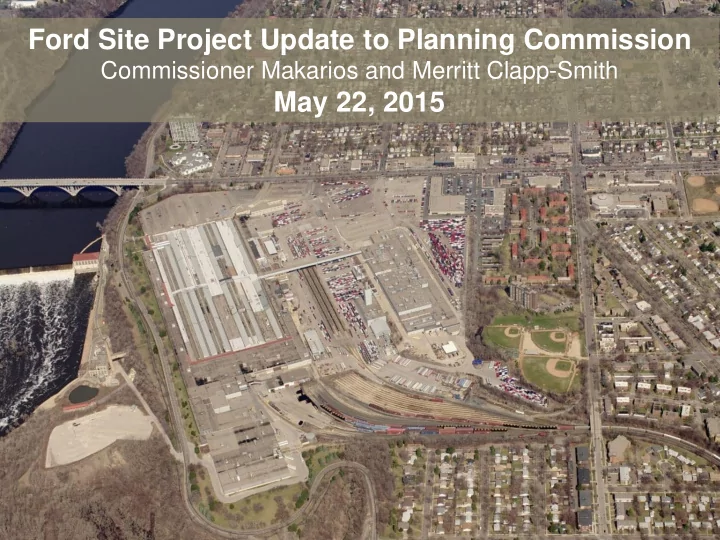
Ford Site Project Update to Planning Commission Commissioner - - PowerPoint PPT Presentation

ford site project update to planning commission
SMART_READER_LITE
LIVE PREVIEW

Ford Site Project Update to Planning Commission Commissioner - - PowerPoint PPT Presentation

Ford Site Project Update to Planning Commission Commissioner Makarios and Merritt Clapp-Smith May 22, 2015 DECOMMISSIONING STATUS May 2014 May 2015 Created stormwater ponds and erosion control features Removed slabs, foundations and


slide-1
SLIDE 1

Ford Site Project Update to Planning Commission

Commissioner Makarios and Merritt Clapp-Smith

May 22, 2015

slide-2
SLIDE 2

DECOMMISSIONING STATUS

May 2014 May 2015

  • Created stormwater ponds and erosion control features
  • Removed slabs, foundations and sub-surface features
  • Sorted building materials and soils into those for recycling or removal
  • Filling basements, shallow tunnels, and the old elevator shaft
slide-3
SLIDE 3

ENVIRONMENTAL ASSESSMENT

Main Site

  • Ford has done soil and water testing on and around the main parcel since 2008.
  • Ford just added almost 800 new borings to the main parcel to test the site to

Ford’s corporate policy standards for potential residential reuse. (This “delineation” coverage is denser than what the MN Pollution Control Agency requires.)

  • Soils and foundations from demolition are tested and stockpiled according to

their status -- clean materials can be recycled on site and impacted materials are removed. Area C – on the river parcel

  • Ford is adding new test trenches, borings and well water monitoring to the Area

C mound, in compliance with a request to do so from the MN Pollution Control

  • Agency. The extent and current composition of former waste dumped at the

location will be better understood following the tests.

slide-4
SLIDE 4

ENVIRONMENTAL ASSESSMENT

Phase I Environmental Site Assessment (6-29-07) Soil Investigation Report - Baseball Fields - Feature 139 (9-7-07) Soil Investigation and Risk Assessment Work Plan - Baseball Fields - Feature 139 (9-7-07) Initial Phase II - Exterior Investigation Report (10-31-07) Additional Soil Investigation and Surface Soil Risk Assessment - Baseball Fields - Feature 139 (12-19-07) Briefing Letter; Executive Summary; Full Report; Figures; Tables; Appendices Response Action Implementation Report - Baseball Fields - Feature 139 (3-13-8) Groundwater Seep & Mississippi River Sampling Work Plan (4-11-08) Supplemental Phase II Exterior Investigation Work Plan (5-3-08) North Parking Area Supplemental Phase II - Exterior Investigation Work Plan (5-19-08) Quarterly Groundwater Sampling Event (6-27-08) Quarterly Groundwater Sampling Event (12-31-08) Phase II - Interior Investigation Work Plan (5-28-10) Tunnel 1A Response Action Implementation Report (1-1-11) Seep and River Sampling Events (2- 22-11) Final/Initial Receptor Survey (7-18-11) Underground Storage Tank (UST) Sump Sampling Events (12-5-12) MPCA Approval - UST Sump Sampling Report (2-8-13) Final Supplemental Phase II Exterior Investigation Report (5-31-12) MPCA Response - Revise Supplm Phase II Exterior Report (2-4-13) Revised - Final Supplm Phase II Exterior Investigation Report (40MB) (5-29-13) MPCA Approval - Revised Supplm Phase II Exterior Investig. Report (9-5-13) North Parking Area Statistical Analysis NFA Request (July 2012, 2013) MPCA Response - North Parking Area NFA Request (2-7-13) Final Propane Sampling of tank removals (5-6-13) Underground Storage Tank (UST) Removal - Environmental Contingency Plan (4-9-13) MPCA Approval - UST Removal Contingency Plan (5-28-13) Subsurface Investigation Work Plan - Element 1 (7-15-13) MPCA Approval - Subsurface Investigation Work Plan - Element 1 (9- 17-13) Site-Wide Environmental Contingency Plan during demolition (7-17-13) MPCA Approval - Environmental and Site-Wide Contigency Plan (8-14- 13) Area C - Comprehensive Site History and Investigation Report (60 MB) (4-4-14) Subsurface Investigation Work Plan - Element 2 (6-6-14) Retention Pond Work Plan (7-11-14) Data Collected from Monitoring Wells Along the Mississippi (9-2-14) Area C Investigation Work Plan (3-17-15) Underground Gasoline Storage Tank Removal Report (4-13-15)

All reports available of City’s Ford web pages

slide-5
SLIDE 5

FORD PROJECT TIMELINE

Site Demolition, Envr & Prep

2013-14 2015 2017 Set market expectations on the vision, design and form of development Infrastructure design, platting and site plan approval

Ford Puts Site on the Market Development Begins

2018

Master Plan Approved

Ford–City– Developer negotiations & Environmental Review City adopts Rezoning & Public Realm Plan

slide-6
SLIDE 6

 Conceptual design for a site- wide, integrated energy system using renewable energy and efficiency to reduce demand and reuse energy  Consultants  Technical Advisory Group

FORD ENERGY STUDY

Report will be complete by August 2015 Will identify three (3) energy concepts for the Ford site and outline the technical and financial feasibility of each.

slide-7
SLIDE 7

Identify Ford Site employment niche and recruitment strategy  PED  Greater MSP  DEED  Chamber of Commerce  Port Authority  St Paul Regional Labor Federation

FORD JOBS STRATEGY WORKGROUP

  • Group has been meeting

monthly since Fall 2014

  • Report will be complete by

Fall 2015

  • Preliminary findings will be

reviewed by the public at the July 22nd meeting

slide-8
SLIDE 8

ZONING AND PUBLIC REALM PLAN

Components:

  • Zoning districts (range of mixed use)
  • Scale and density
  • Modest design standards
  • Sustainability standards
  • Right-of-way standards and locations,

including streets and stormwater infrastructure

  • Park & open space locations

Review Timeline

  • Planning Commission - Nov 2014 to

Jan/Feb 2015

  • City Council – Feb to April 2015

Above: Illustrious image only

slide-9
SLIDE 9

FORD PUBLIC MEETINGS FOR 2015

PURPOSE

  • Share information
  • Provide background
  • Identify choices and trade-offs
  • Clarify expectations
  • Seek input on priorities / questions
  • Use input to refine priorities
  • Prepare zoning & public realm plan

TOPICS and DATES Ford Energy Study - January 29 Parks & Open Space - February 26 Bikes, Pedestrians & Transit - April 30 Streets, Parking & Traffic - May 27 Stormwater & Infrastructure - June 23 Jobs & Housing - July 22 Zoning – September or October Date dependent on availability of site environmental information

slide-10
SLIDE 10

FORD TASK FORCE - 2015

1. Kyle Makarios, Co-Chair - Saint Planning Commission representative 2. William Klein, Co-Chair - Attorney, Gray Plant Mooty 3. Tony Schertler, Co-Chair - Consultant, Springsted Incorporated 4. Peter Armstrong - Independent Manufacturer’s Representative 5. James Bricher - Friends of the Parks and Trails; Retired CPA 6. Richard Broderick - Journalist 7. Ronnie Brooks - Director Shannon Leadership Institute, Wilder Foundation 8. David Drach - Director Real Estate U.S., Canadian Pacific 9. Rob Cory - Director of Real Estate, Ford Land

  • 10. Charles Hathaway - Senior Water Resources

Engineer, Barr Engineering

  • 11. Deborah Karasov - Executive Director, Great

River Greening

  • 12. Angela Kline – Energy Efficiency Consultant
  • 13. Gary Marx - Highland Park resident
  • 14. Jim Reinitz – Former UAW Local 879 member
  • 15. Matthew Schuerger - Owner and President,

Energy Systems Consulting Services

  • 16. Morgan Tamsky – Retired 3M Technical Director
  • 17. Bruce Valen - Attorney, UAW Legal Services Plan
  • 18. Stephanie Warne - Real Estate Services and

Condemnation Commissioner

  • 19. Ellen Watters - Consultant, Economic

Development

  • 20. Pamela Wheelock - MN Commissioner of Finance

(1999-2002); Director of PED, Saint Paul (1996- 1999)

slide-11
SLIDE 11

Mix of Uses & Activity Housing Variety Jobs & Ta Tax Base Energy & Sustainability Transportation Choice Parks & Amenities

CREATE A NEW PLACE AT FORD VISION & KEY THEMES

The redeveloped Ford site will balance economic, social and environmental sustainability in a way that conserves and improves the qualities and characteristics of the unique Highland park neighborhood and Mississippi River valley in which it sits while advancing the City’s economic wealth and community goals, resulting in a forward- thinking 21st Century development.

slide-12
SLIDE 12

 Vibrant place to live, work, and recreate for all people.  Services and amenities that meet local needs to reduce auto dependency.  Well-designed urban neighborhood that complements and integrates into the Highland Park area and broader community.  Mix of traditional and modern building forms, styles and materials.

MIX OF USES AND ACTIVITIES

slide-13
SLIDE 13

 Range of housing types and affordability that expand choices in the area and in the city.

HOUSING VARIETY

75% of retiring baby- boomers prefer mixed- age and mixed-income communities in urban

  • settings. (2009 survey)
slide-14
SLIDE 14

JOBS AND TAX BASE

 Significant increase in the tax base over time that strengthens surrounding property values.  Increased regional significance and economic value.  Range of business and employment opportunities with an emphasis on family supporting jobs.

slide-15
SLIDE 15

 Regional, national, and global model for sustainable planning, design, and day-to-day living that protects our air, water and natural resources for future generations.  Locally generated power from an integrated, renewable, site - based energy system.  Best technologies in infrastructure and buildings to save money, increase efficiency, and reduce impacts on the environment.

ENERGY AND SUSTAINABILITY

slide-16
SLIDE 16

 Mix and density of activities to support transit through and around the site.  Interconnected system of streets, bikeways, and walkways that is safe and accessible for people of various ages and abilities.  Urban design and site layout to reduce auto trips and manage traffic impacts.

TRANSPORTATION CHOICE

slide-17
SLIDE 17

PARKS AND AMENITIES

 Natural spaces and active places for people to play, relax, and interact, including the Ford Little League fields.  Greenery, public art, and cultural activities to create an attractive and vibrant community.  Reflect the heritage of the Ford plant and its employees through design and amenities.  Strong connections to the Mississippi River, within the site and to the neighborhood.

slide-18
SLIDE 18

Principles for Redevelopment

Ford Site Study Tour March 14 - 19

“Das Leben ist kein Ponyhof.”

slide-19
SLIDE 19

The Katherine B. Andersen Fund

Of the Saint Paul Foundation

A word from our sponsor s…

…and the many

  • rganizations

and individuals that paid their

  • wn way.
slide-20
SLIDE 20

ATTENDEES ON EUROPE TRIP

1. Mayor Coleman 2. Council Member Chris Tolbert 3. Joe Spencer, Mayor’s Of fice 4. Anne Hunt, Mayor’s Of fice 5. Jonathan Sage-Martinson, Saint Paul Planning and Economic Development 6. Merritt Clapp-Smith, Saint Paul Planning and Economic Development 7. John Maczko, Saint Paul Public Works 8. Kathleen Anglo, Parks and Recreation 9. Kyle Makarios, North Central States Regional Council of Carpenters (Ford Planning Task Force) 10. Ellen Watters, consultant (Ford Planning Task Force ) 11. Louis Jambois, Saint Paul Port Authority (Ford Jobs Task Force) 12. Cecile Bedor, Greater MSP (Ford Jobs Task Force) 13. Matt Kramer, Saint Paul Area Chamber of Commerce (Ford Jobs and Energy Task Forces ) 14. Laura McCarten, Xcel Energy (Ford Energy Task Force ) 15. Ken Smith, Saint Paul District Energy (Ford Energy Task Force) 16. Eric Engh, Ryan Companies (Ford Energy Task Force) 17. John Carmody, University of Minnesota College of Design (Ford Energy Task Force) 18. Rob Cory, Ford Land 19. Jens Unterhansberg, Ford Land Europe 20. County Commissioner Rafael Ortega 21. Tim Mayasitch, Ramsey County Regional Rail Authority 22. Patrick Seeb, Saint Paul Riverfront Corporation 23. Shawntera Hardy, Fresh Energy 24. Lee Sheehy, McKnight Foundation 25. Carrie Jo Short, The Saint Paul Foundation 26. Wendy Helgeson, consultant

slide-21
SLIDE 21

Berlin

  • Berlin TXL
  • Aldershof

Copenhagen

  • Orestad
  • Carlsberg Byen
  • Nordhavn
  • Tuborg

Malmo

  • Hyllie
  • Bo01 City of Tomorrow

Stockholm

  • Stockholm Royal

Seaport

  • Hammarby Sjöstad

LEARNING FROM OTHERS

3 3 COUNTRIES, 4 CITIES, 10 SITES, 5 DAYS!

Malmo

slide-22
SLIDE 22

KEY LESSONS

Big plans for livable places Energy and sustainable design Design & Architecture matter Water as a resource Mixed transportation Places for people Lead to the future

slide-23
SLIDE 23

BIG PLANS FOR LIVABLE PLACES

Flatten and integrate planning and development processes.

slide-24
SLIDE 24

ENERGY AND SUSTAINABLE DESIGN

Sustainability seamlessly integrated into life and design – start with it and then bring in jobs, etc.

slide-25
SLIDE 25

DESIGN & ARCHITECTURE MATTER

slide-26
SLIDE 26

SCALE OF PUBLIC TO PRIVATE SPACE

Density creates intimacy and intimacy creates enjoyment

slide-27
SLIDE 27

WATER AS A RESOURCE

slide-28
SLIDE 28

MIXED TRANSPORTATION

Design where cars are guests

  • n the

street.

slide-29
SLIDE 29

PLACES FOR PEOPLE

We think about how people want to live and how we can make a place that people want to be.

slide-30
SLIDE 30

LEAD TO THE FUTURE

The idea of experimentation to push the edge and learn was common at many sites. Communities take pride in being sustainable, cutting edge – they market that. “Best practice” is conservative planning – it’s looking back.

slide-31
SLIDE 31

LEAD TO THE FUTURE

We all need to be on the same bus going in the same direction and have some fun. The goal is to do something that Danes want to come and see!

Rob Cory, Ford Land

slide-32
SLIDE 32

Market Dynamics

  • Fast growing regions

Policy on Climate Action

  • Aggressive goals and requirements

Ownership

  • 9 sites were publicly owned

Economic/Political

  • European Union; national & city subsidies

Competition

  • To drive development, design, performance

CONTEXT OF NORTHERN EUROPE

slide-33
SLIDE 33

REFLECTIONS FROM THE GROUP

Density works – with a variety of heights, design and great public realm. Quality architecture matters – use zoning to set expectations and encourage significant innovation in building and infrastructure design. You can’t do everything – set key priorities and pursue them aggressively. Use creative people to drive the vision and innovation; don’t let the “we can’t do that” folks hold things back. There are incredible developments happening due to a long-term vision

  • f sustainable, dense, people-
  • riented neighborhoods.

Critical elements needed to make complicated, large projects a success -

  • strong leadership, buy-in from key

stakeholders, livability, and the vision to design for the future instead of today. Innovative financing and project implementation are critical to success. The places visited are moving many more people in less transportation space by supporting all modes – ped, bike, transit and cars. Set aspirations high and realize that it takes patience and adaptive vision to achieve.

slide-34
SLIDE 34

NEXT STEPS

  • Create short fact sheets with insights for each site visited
  • Identify “lessons learned” from the attendees’ reflections
  • Debrief meeting with trip attendees to identify next steps
  • Prepare a short report about the trip and findings
  • Provide public presentations about the trip
  • Share trip information and video with public on Ford website
  • Initiate next steps with key project partners
slide-35
SLIDE 35

A SUSTAINABLE FORD SITE

slide-36
SLIDE 36

www.stpaul.gov/21stCenturyCommunity Sign up for E-newsletters & Notifications Open Saint Paul – Ford project questions Mobile meeting truck Ford table at community events

FORD SITE: A 21ST CENTURY COMMUNITY STAY CONNECTED