
SLIDE 1
For students from 4 to 8 years How to they introduce STEM areas? - - PowerPoint PPT Presentation
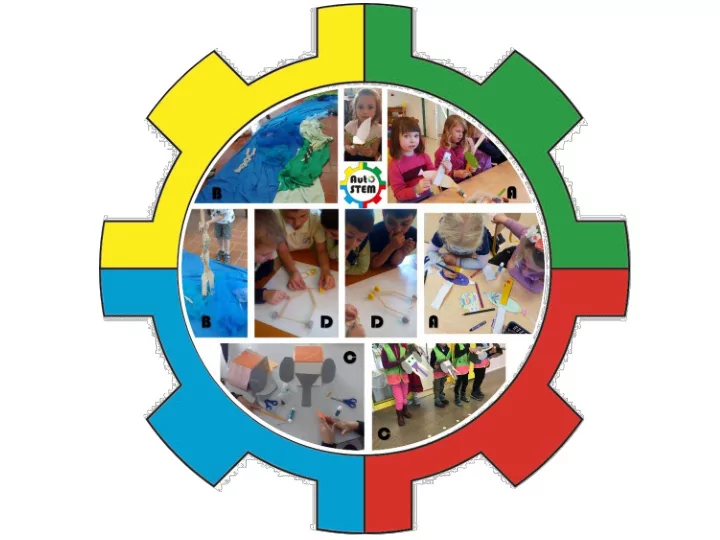
AutoSTEM automata to teach STEM subjects to young learners Erasmus KA201 large-scale project to create innovative resources For students from 4 to 8 years How to they introduce STEM areas? What are automata? What are they made from?
With the support of the Erasmus+ Programme of the European Union. The content reflects only the author’s view and the European Agency and the European Commission are not responsible for any use that may be made of the information it contains
AutoSTEM – automata to teach STEM subjects to young learners Partners
University of Coimbra Portugal, Queen Maud University College Trondheim Norway, 32 SU School “Sv.Kliment Ohridski” Sofia Bulgaria, Eurek@ Perugia Italy, Kindersite UK
Erasmus KA201 large-scale project to create innovative resources For students from 4 to 8 years How to they introduce STEM areas? What are automata? What are they made from?
physics biology geology
locating playing counting tools machines
zoology environment
art
AutoSTEM – Resources produced
Step by Step Teacher Guide
Automata Pedagogical Guidelines and Construction Instructions
Scenarios to implement Automata
Resources for planning and reflection Videos
With the support of the Erasmus+ Programme of the European Union. The content reflects only the author’s view and the European Agency and the European Commission are not responsible for any use that may be made of the information it contains
AutoSTEM – Choosing an Automata to Use
What areas of STEM learning are included How to make video Full teachers step by step guide Media examples of children making the automata Templates to print off
AutoSTEM – Automata Step by Step guide
Parts and tools Method
The body is round, but not a circle. It is pointed at one end and round at the other There is a left-hand side and a right-hand side of the body. The wings are rectangles. A rectangle has four sides and is an oblong. There will be one wing on either side of the bird. The eyes are round, almost like circles. There will be one eye on either side of the body. The beak is a triangle. It has three corners. The sharp corner points
front. The tail is a trapezium. It has four sides. The widest side points
AutoSTEM – Evaluation
Children’s play with automata is important The project facilitates creativity and wonder The workshop is interdisciplinary Do not do too much Provide enough time to build automata for exploration to test and play with the automata Do not have too many children in the group
Website Videos
Email : https://www.autostem.info : https://www.youtube.com/channel/UCaVYKg0qYXnUNNdqwNtLAVQ : https://www.facebook.com/AutomataforStem : joel@kindersite.info