for Enabling Tools Korea-US Nano Forum, October 14-15, 2003 Seoul - - PDF document

for enabling tools korea us nano forum october 14 15 2003
SMART_READER_LITE
LIVE PREVIEW

for Enabling Tools Korea-US Nano Forum, October 14-15, 2003 Seoul - - PDF document

The New England Nanomanufacturing Center for Enabling Tools Korea-US Nano Forum, October 14-15, 2003 Seoul Three Dimensional Nanomanufacturing: NSF Three Dimensional Nanomanufacturing: NSF Workshop Report and Activities at the New England


slide-1
SLIDE 1

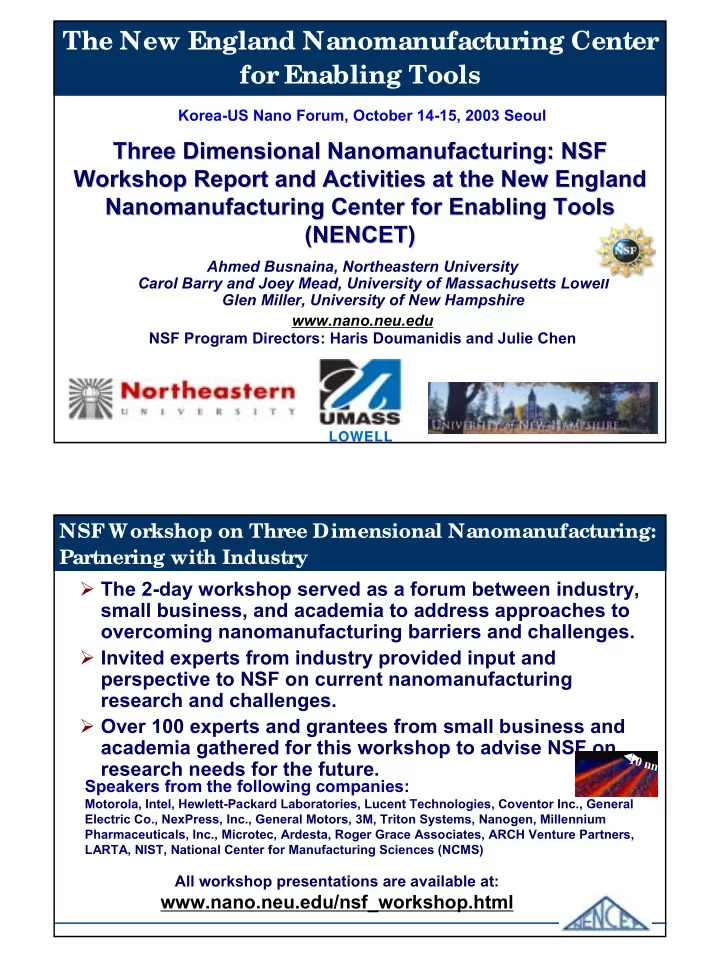
The New England Nanomanufacturing Center for Enabling Tools

LOWELL LOWELL

Three Dimensional Nanomanufacturing: NSF Three Dimensional Nanomanufacturing: NSF Workshop Report and Activities at the New England Workshop Report and Activities at the New England Nanomanufacturing Center for Enabling Tools Nanomanufacturing Center for Enabling Tools (NENCET) (NENCET)

Ahmed Busnaina, Northeastern University Carol Barry and Joey Mead, University of Massachusetts Lowell Glen Miller, University of New Hampshire www.nano.neu.edu NSF Program Directors: Haris Doumanidis and Julie Chen Korea-US Nano Forum, October 14-15, 2003 Seoul

NSF Workshop on Three Dimensional Nanomanufacturing: Partnering with Industry The 2-day workshop served as a forum between industry, small business, and academia to address approaches to

  • vercoming nanomanufacturing barriers and challenges.

Invited experts from industry provided input and perspective to NSF on current nanomanufacturing research and challenges. Over 100 experts and grantees from small business and academia gathered for this workshop to advise NSF on research needs for the future.

Speakers from the following companies:

Motorola, Intel, Hewlett-Packard Laboratories, Lucent Technologies, Coventor Inc., General Electric Co., NexPress, Inc., General Motors, 3M, Triton Systems, Nanogen, Millennium Pharmaceuticals, Inc., Microtec, Ardesta, Roger Grace Associates, ARCH Venture Partners, LARTA, NIST, National Center for Manufacturing Sciences (NCMS) 10 nm

All workshop presentations are available at:

www.nano.neu.edu/nsf_workshop.html

slide-2
SLIDE 2

Panel and Attendee Input

What is the current state of the art? Where are we headed? What are the barriers?

Technical Cultural/Infrastructure

What should be done to help accelerate

nanomanufacturing success?

What is the Current State of the Art? Commercial Products

3M: CMP fixed micro fabricated abrasive pad Triton: Nanocomposite air pouch for athletic shoes, packaging, and chemical-biological protective clothing GM: Thermoplastic nanocomposites for automotive components

M-Van Step Assist

slide-3
SLIDE 3

What is the current state of the art? Products in Progress

HP: High density (6.4 Gbit/cm2) electronically addressable memory (Molecular Switch Crossbar Circuits) Intel: Nano-transistors for logic technology Lucent: Rubber stamps and plastic circuits for electronic paper (plastic or paper display) Lucent: 3D microfabrication via printing on curved objects Lucent: Large area nanoreplication with a flexible mold Motorola: Nano elements of an OFET Triton: Nanoparticles cancer therapy Triton: Organic electronic materials

PNAS, 98(9), 4835 (2001) Science, 291, 1502 (2001)

Possible Products; Nanotube Memory Chip

2

Cell Density (Gbit/cm2) Year of DRAM Introduction

Current CMOS “red brick wall”

0.1 100 10 1 1000 HP molecular switch DARPA goal (2004) Nanotube memory Chip goal 2001 2004 2007 2010 2013 2016

Application

  • Nanotube sw itch based

storage device capable of 3 - 5 orders of m agnitude m ore storage than today’s devices Requires

  • Massive precise parallel

assem bly of CNTs

slide-4
SLIDE 4

Example of Work in Progress; Molecular Electronics, HP

  • I t’s sm all
  • I t functions
  • I t’s cheap

Roxtaxane

  • F. Stoddart, UCLA

Utilizes Sw itchable Molecules

Nanoscale Molecular Devices

US Patent# 6407443

SiO2/Si Pt Ti Pt

slide-5
SLIDE 5

Nanoscale Molecular Devices

US Patent# 6407443

Pt Pt Ti 1 mm

Molecular Crossbar Circuits

100 µm 10 µm 1 µm 100 nm

slide-6
SLIDE 6

Where are we headed?

Development of processing methods for fabrication of nanomaterials New materials with unique properties Environmentally friendly nanomanufacturing processes Process models

Heterogeneous, multi-scale

materials/device integration and assembly. SiO2

Pt

Ti/Pt

4 n m

What are the barriers? Technical

Assembly of 3D heterogeneous systems

Low rates of 3D manufacturing Alignment and registration - multilayers and interconnects Interconnection at three dimensions, various length scales, different materials, and functionalities Packaging

Quality

Low reliability and yield are key issues for nanoscale devices that need to be solved Reproducibility and repeatability of nanomanufacturing Control of contamination and development of fault /defect tolerant devices Control of morphology to produce an engineered structure.

slide-7
SLIDE 7

What are the barriers? Technical

Modeling Limited understanding of fundamental physics Lack of component specifications, material specifications, reliability models, simulation models Materials Cost and availability of materials for scale up Metrology of nanodevices Lack of real time characterization methods Requirement for manufacturing processes that are robust under commercial environments (not Class 1 clean rooms)

What are the barriers? Cultural/Infrastructure

Infrastructure

Lack of standards, instrumentation, and tools Lack of affordable infrastructure (facilities, equipment, design tools, skilled personnel) Lack of nanotechnology roadmaps

Cultural

Limited knowledge of nanomanufacturing processes within traditional manufacturing community Education needed for both scientists and engineers IP issues “Nano-fear”

slide-8
SLIDE 8

Funding and Resources

Spread roles, risks, and rewards among industry, academia, and government, motivate & reward risk taking Existing approaches Government funding (e.g., GOALI, STTR, ATP projects) Research centers of excellence programs at universities that include small and large business participation Additional approaches Support more applied academic researchers to bridge the gap to meet industrial needs Government-Industry support of university associated incubator programs. Expand national R&D infrastructure with not for profit applied research centers emulating CSEM or Fraunhofer Institutes.

How to accelerate nanomanufacturing success? How to accelerate nanomanufacturing success?

Communication Constant feedback and information dissemination between industry and academia Creation of user groups Workshops Connecting small companies with VC (e.g., Matchmaker) Integration between academia and industry Education and clarification on IP issues Exchange of industrial workers with faculty and students Better consideration of technology scale-up issues by academia

Application focus required to accelerate development

slide-9
SLIDE 9

The New England Nanomanufacturing Center for Enabling Tools

LOWELL LOWELL

Research Activities at the New England Research Activities at the New England Nanomanufacturing Center for Enabling Tools Nanomanufacturing Center for Enabling Tools (NENCET) (NENCET)

Ahmed Busnaina, Northeastern University Carol Barry and Joey Mead, University of Massachusetts Lowell Glen Miller, University of New Hampshire

Overcoming Barriers to Commercialization

  • To move scientific discoveries from the

laboratory to commercial products, a completely different set of fundamental research issues must be addressed.

  • The field of nanomanufacturing is

incredibly broad,

  • Nevertheless, three critical and

fundamental technical barriers to manufacturing surface repeatedly: (1) Smart t ooling (guided self - assembly using nano t emplat es) and wiring (2) High- rat e/ high- volume processing. (3) Reliabilit y and t est ing

Industrial Collaboration Com m ercial Products

Current Nanoscience Knowledge Base Barriers to Nanomanufacturing

Enabling Nanom anufacturing Tools

Reel- to- Reel Manufacturing, Molecular Tem plates, Accelerated Life Testing, Process Design Tools

High- Rate/ Volum e Processing Reliability and Testing Assem bly and Connectivity

Thrust 1 Thrust 2 Thrust 3

ercoming Barriers to Commercializat

slide-10
SLIDE 10

Nanotube Memory Chip

2

Potential $100 billion market Non-volatile memory Nanotube based storage device capable

  • f 3-5 orders of magnitude more storage

Memory accessible at orders of magnitude faster

than silicon chips.

Breakthroughs needed for: Large-scale precise, economic assembly of CNTs with specific orientation and functionality with connection to the micro/macro level at high rate and volume

Other SWNT Scientific Roadblocks:

► One size does not fit all where applications are concerned ► Structure-property relationships unknown. How do properties vary as a function of precise molecular dimensions? ► Lack of Solubility ► Organic Chemistry of SWNTs, Lack of chemical functionality

How Can Nano Templates Be Used To Assemble Nanoelements (SWNT, DNA, Nanorods)?

  • 1. Electrostatically

addressable nanowires

  • +

+ + +

  • 2. Nanotubes align
  • n negatively

charged nanowires via noncovalent, electrostatic attraction stronger attractive interactions

  • 3. A new

Substrate is brought with a few nano- meters

  • 4. Nanotube

transfer is complete self-ordering growth

  • f nanowires on

strained interfaces

slide-11
SLIDE 11

How Can Nano Templates Be Used To Assemble Nanotube Interconnects?

  • 1. Polymer

Modified molecular template

  • 2. Attractive

interaction pull nanotubes of correct diameter into channels

  • 3. Chemical or

photochemical

  • xidation of

nanotubes to the required length

  • 4. A new

substrate with stronger attractive interaction Ordered networks of misfit dislocations (2 nm islands and a 5 nm pitch) where feature sizes and densities can be varied1. Possible applications: Nanotube Interconnect and magnetic media. 2-5 nm

  • 1. K. Pohl et al., Nature, 397, 238

(1999).

How Can Nano Templates Be Used To Assemble Nanotube Interconnects?

  • 5. A new substrate with stronger

attractive interactions is brought into contact

  • 6. Nanotube transfer is complete

stronger attractive interactions

slide-12
SLIDE 12

+ IgG

Insulating polymer Conducting polymer

Increased sensitivity

Flexible Molecular Templates from Rigid Molecular Templates

Flexible Electronics Biosensors

Biosensors (radiation, cancer, anthrax, etc.)

Flexible Nano Templates from Rigid Molecular Templates

Polymer B Polymer A

without templating

MEMs Nanoscale Characterization and Reliability Testbed

Conceptual layout of a MEMs test structure capable of applyings maximum strain at the nanowire location. SiO2 (2um) Si Substrate Si (2um) Si Contacts SiO2 Nanowire Contacts

N anow ire

Si Substrate Suspended Structure SiO2 (2um) Si (2um) Nanowire Si Contacts

Si (Substrate) SiO2 (2um) Si (2um) SiO2 (500Ang) Si Contacts Nanowire contacts Nano wire

Innovative MEMS-based test beds are designed and fabricated to characterize nanowires (also nanotubes, nanorods & nanofibers) and conduct accelerated lifetime testing allowing rapid mechanical, electrical, and thermal cycling.

slide-13
SLIDE 13

Another option in considered for SWNT memory device.

  • A non-volatile memory device based on

the One Pea in a Pod

  • Provides fast writing speed that’s higher

than 1 THz and high Packing density greater than 5 TB/cm2

Synthesis Processes

Single Walled Nanotubes On Demand

► Bottom-up synthesis of soluble, functional SWNTs ► Controlled molecular dimensions and properties ► Solubility and selectivity built into each structure ► Water soluble SWNTs or Oil soluble SWNTs ► Sites that selectively bind/recognize various chemical or biological agents?

  • 1. Young-Kyun Kwon, David Tománek, and Sumio Iijima, Phys. Rev. Lett. 82, 1470 (1999)
  • 2. U.S. Patent 6,473,351

Collaboration and Interaction

23 COMPANIES Facilities Researcher s Students Faculty Faculty Researchers Students Faculty Researcher s Students Government Labs NSECs & Outreach Universities

slide-14
SLIDE 14

The NENCET center is developing the science and technology needed to enable:

  • Massive parallel assembly of nanoelements such carbon nanotubes,

inorganic nanotubes, proteins, etc.

  • Assembly and sorting of nanoelements in two or three dimensions and

their transfer to a new surface.

  • Delivery of nanoelements in a pattern that reflects the feature sizes and

densities of the nano pattern on the Nanotemplate.

  • Test the reliability of nanoelements and their connections and

characterize their nanoscale electrical and material properties.

  • Bottom-up synthesis of SWNTs (On Demand) where SWNT to produce

set of uniform SWNTs with desired functionality (such as transistor, magnetic SWNT, Higher adhesion, etc.)

Summary

Workshop Summary

What is the current state of the art?

Very few commercial products entering marketplace some

  • n the way

Where are we headed?

Need Development of new manufacturing processes

What are the barriers?

Many fundamental questions still remain Infrastructure and education required

How to accelerate nanomanufacturing success?

More industry-academe collaboration More support $$$$

slide-15
SLIDE 15

NSF Center for Micro and Nanoscale Contamination; Goals and Objectives

Our goal is to provide solutions and state of the art techniques for micro and nanoscale contaminants characterization, control and removal In manufacturing and fabrication processes.

Fundamentals of surface cleaning and preparation. Cleaning of nanoscale particles, trenches and vias. New Nanoparticle removal Technologies: Laser Shock Removal High frequency streaming removal Super critical CO2 removal

  • Nano Particle adhesion and removal mechanisms.

Consider particle adhesion on Cu and low-K dielectrics

  • Development and fabrication of contamination

micro sensors technology.

  • Nano Particle generation, transport and deposition.

Collaboration with Hanyang University

funded by NSF and KOSF

0.05 0.1 0.15 0.2 D istance Along W afer S urface (cm) time = 3 .9s 0.02 0.04 0.06 0.08 0.1 0.12 0.14 Distance From Wafer Surface(cm) S teady Flow u = 4.3 cm /s S treamlines and C oncentration Contour 0.05 0.1 0.15 0.2 D istance Along W afer S urface(cm ) t/T= 1.5 0, time= .05 79s 0.05 0.1 Distance From Wafer Surface(cm) 1 E+12 1 E+11 1 E+10 1 E+09 1 E+08 1 E+07 OSCILLATING FLOW f = 25.9 Hz us = 0 up = 13.5 cm /s uA vg = 4.3 cm /s W = 1mm , D =0.7m m

Plasma

Coil Capacitor S pectrometer R eflective Coatings Gas I nlet Plasma Chamber E lectronics

L ight

Photodiode