For an analy alysi sis o of real al-time IR IRI M Map aps s - - PowerPoint PPT Presentation

for an analy alysi sis o of real al time ir iri m map aps
SMART_READER_LITE
LIVE PREVIEW

For an analy alysi sis o of real al-time IR IRI M Map aps s - - PowerPoint PPT Presentation

Ivan Galkin 1 Artem Vesnin 1 Xueqin Huang 2 Alexander Sasha Kozlov 1 Paul Song 1 Bodo Reinisch 1,2 1 University of Massachusetts Lowell, Space Science Laboratory 2 Lowell Digisonde International, LCC For an analy alysi sis o of real


slide-1
SLIDE 1

For an analy alysi sis o

  • f real

al-time IR IRI M Map aps s of foF2 an and h d hmF mF2

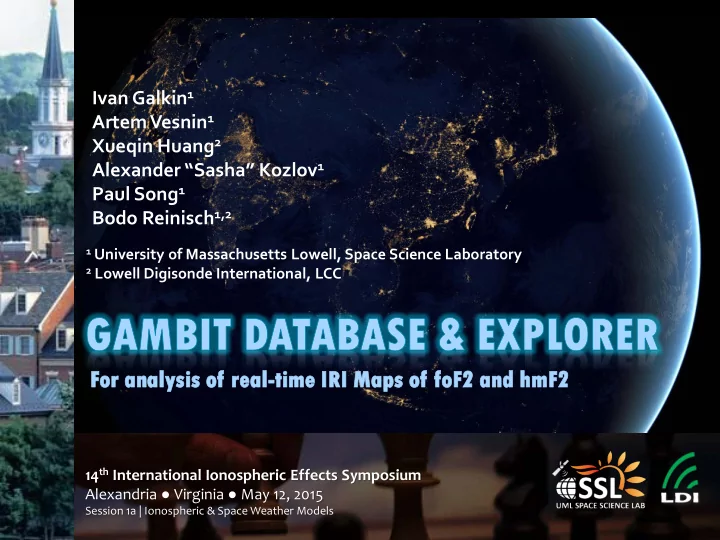
Ivan Galkin1 Artem Vesnin1 Xueqin Huang2 Alexander “Sasha” Kozlov1 Paul Song1 Bodo Reinisch1,2

1 University of Massachusetts Lowell, Space Science Laboratory 2 Lowell Digisonde International, LCC

14th International Ionospheric Effects Symposium Alexandria ● Virginia ● May 12, 2015

Session 1a | Ionospheric & Space Weather Models

slide-2
SLIDE 2

Alexandria ● VA ● May 12, 2015

Session 1a | Ionospheric & Space Weather Models

IES 2015

Outline

  • Assimilation Techniques for IRI [model of Ne]

 1. GIRO: source of real-time ionogram-derived data  2. IRI empirical model formalism  3. NECTAR assimilative “model morphing” technique  = IRTAM: real-time global nowcasting  4D Data Assimilation (4DDA): 24 hour context  foF2 and hmF2 maps vs TEC maps

  • GAMBIT Database and Explorer

 Public access to IRTAM results and analysis tools  Open source (2015)

  • Outlook: where do we go from here?
  • IRTAM versus physics-based assimilative modeling
  • Spatial prediction capability: covariances?
  • Time forecast capability
slide-3
SLIDE 3

Alexandria ● VA ● May 12, 2015

Session 1a | Ionospheric & Space Weather Models

IES 2015 1. Global Ionosphere Radio Observatory

Real-time GIRO ionosondes, ~50 locations

slide-4
SLIDE 4

Alexandria ● VA ● May 12, 2015

Session 1a | Ionospheric & Space Weather Models

IES 2015

IRI Real-Time Extension

+ =

Height of maximum F2 Layer Ionization (hmF2)

Ionosonde Network Real-Time hmF2 Global hmF2 Weather Global hmF2 “Climatology” IRI

  • Credits to the Real-Time IRI Task Force (2009)
slide-5
SLIDE 5

Alexandria ● VA ● May 12, 2015

Session 1a | Ionospheric & Space Weather Models

IES 2015

IRTAM 24-hour History

slide-6
SLIDE 6

Alexandria ● VA ● May 12, 2015

Session 1a | Ionospheric & Space Weather Models

IES 2015 IRTAM Deviation Maps

HOW IONOSPHERE IS DIFFERENT FROM ITS QUIET-TIME STATE

Is this real?

slide-7
SLIDE 7

Alexandria ● VA ● May 12, 2015

Session 1a | Ionospheric & Space Weather Models

IES 2015

IRTAM complementary to TEC maps

∆TEC ∆foF2 ∆hmF2

100s sensors (no interpolation) 10s sensors

Substorm March 17, 2015 23:22UT TEC maps courtesy Madrigal Node at MIT Haystack Observatory; [Coster et al., 2008]

slide-8
SLIDE 8

Alexandria ● VA ● May 12, 2015

Session 1a | Ionospheric & Space Weather Models

IES 2015

Under the Hood: IRI Formalism

slide-9
SLIDE 9

Alexandria ● VA ● May 12, 2015

Session 1a | Ionospheric & Space Weather Models

IES 2015

Assimilation Technique

  • NECTAR: Non-linear Error Compensating

Technique for Associative Restoration

  • Keep IRI expansion basis unchanged

 Jones-Gallet geographic functions Gk – 76 functions  6th order of diurnal harmonic analysis – 13 functions

  • Compute new coefficients Cij that minimize data-

model error

  • Disseminate new 988 coefficients to existing IRI

users

 Small, efficient, no changes to the IRI engine

necessary

slide-10
SLIDE 10

Alexandria ● VA ● May 12, 2015

Session 1a | Ionospheric & Space Weather Models

IES 2015

4D Data Assimilation (4DDA)

  • One nowcasting calculation = match of 24-hour

history of data with 24-hour model = 24-hour 4DDA scheme

 Overdeter

ermi mined ned in n ti time (96 e (96 ti times es, 13 13 coef efficien ents)

 Und

nder erdeter ermined ed i in n spa pace (40 e (40 observato tories, 76 76 coeffici ficients)

 Not

t a cla classic K Kalman filt filter m mated t to

  • a fir

first-princip ciple les model… l…

 Ionospher

ere i in ter n terms of i its ts “ “Eigen func ncti tions” describing the the essenc ence o e of its ts ti timeline b e beha havior

slide-11
SLIDE 11

Alexandria ● VA ● May 12, 2015

Session 1a | Ionospheric & Space Weather Models

IES 2015

Empirical vs Physics-Based Assimilation

COMPLEMENTARY TECHNIQUES EMPIR IRICA CAL PHYSIC SICS-BASED ED

PREDICTION

INITIALIZATION

UPDATE Next time

50 x 96

data points

988 Cij nowcast

(24 hours)

4DDA FORECAST UPDATE

50 x 1

data points

Model drivers nowcast 3DDA Next time

climatology

  • utput
  • utput

Describes system in terms of constituent processes Represents processes yet to be understood

slide-12
SLIDE 12

Alexandria ● VA ● May 12, 2015

Session 1a | Ionospheric & Space Weather Models

IES 2015 24-hour Temporal Harmonics Expansion

4DDA approach is robust to autoscaling blunders

Eglin AFB foF2 series courtesy AFWA NEXION program

slide-13
SLIDE 13

Alexandria ● VA ● May 12, 2015

Session 1a | Ionospheric & Space Weather Models

IES 2015

Near Future: Global Realistic Ionosphere

using GIRO Real-time Data Feeds

foF2 hmF2

FAS

Realistic Ionosphere

Background 3D TID modulation

To raytracing

slide-14
SLIDE 14

Alexandria ● VA ● May 12, 2015

Session 1a | Ionospheric & Space Weather Models

IES 2015

GAMBIT Database and Explorer

http://giro.uml.edu/GAMBIT

Public access to IRTAM retrospective and current results IRTAM foF2 and hmF2 timelines since 2000 + real-time data with 10 min delay

slide-15
SLIDE 15

Alexandria ● VA ● May 12, 2015

Session 1a | Ionospheric & Space Weather Models

IES 2015 GAMBIT Explorer

Global Assimilative Model for Bottomside Ionospheric Timelines

http://giro.uml.edu/GAMBIT

slide-16
SLIDE 16

Alexandria ● VA ● May 12, 2015

Session 1a | Ionospheric & Space Weather Models

IES 2015

Outline

  • Assimilation Techniques for IRI [model of Ne]

 1. GIRO: source of real-time ionogram-derived data  2. IRI empirical model formalism  3. NECTAR assimilative “model morphing” technique  = IRTAM: real-time global nowcasting  4D Data Assimilation (4DDA): 24 hour context  foF2 and hmF2 maps vs TEC maps

  • GAMBIT Database and Explorer

 Public access to IRTAM results and analysis tools  Open source (2015)

  • Outlook: where do we go from here?
  • IRTAM versus physics-based assimilative modeling
  • Spatial prediction capability: covariances?
  • Time forecast capability
slide-17
SLIDE 17

Alexandria ● VA ● May 12, 2015

Session 1a | Ionospheric & Space Weather Models

IES 2015

Future work: Covariance study

∆foF2 ∆foF2

Slow attenuation

(large covariance)

Fast attenuation

(small covariance)

vs.

slide-18
SLIDE 18

Alexandria ● VA ● May 12, 2015

Session 1a | Ionospheric & Space Weather Models

IES 2015

IRTAM resolution = IRI resolution?

slide-19
SLIDE 19

Alexandria ● VA ● May 12, 2015

Session 1a | Ionospheric & Space Weather Models

IES 2015

Managing the Day Boundary Issue

Inertia of the model? 13 million data fits Average Error

Average error of IRTAM matching source data [Vesnin, UML, 2014]

SOLUTION: 24-hour expansion using 21 hours of data

slide-20
SLIDE 20

Alexandria ● VA ● May 12, 2015

Session 1a | Ionospheric & Space Weather Models

IES 2015

IRTAM in Forecast Mode

slide-21
SLIDE 21

Alexandria ● VA ● May 12, 2015

Session 1a | Ionospheric & Space Weather Models

IES 2015

Outlook

  • URSI INAG Working Group G.1 actively pursues real-time

ionosonde network operation

  • IRI-based Real-Time Assimilative Model is in operation since

January 2013; IRTAM validation in progress

  • RETID (USA) and Net-TIDE (Europe) projects support TID detection

and evaluation using Digisonde data

  • Lowell GIRO Data Center builds a public, open-source

environment for realistic ionosphere nowcast based on ionosonde data feeds

  • Cooperations with CEDAR Madrigal, NASA CCMC and VWO,

European ESPAS are good opportunities to provide single-stop data dissemination portals for realistic ionosphere nowcast

Acknowledgements: AFRL SBIR “RETID”, NATO SfP 984894. Lowell DIDBase