
SLIDE 1
Katie Yurkewicz , Fermilab Communication Director APS DPF Meeting August 2, 2017 @kyurkewicz
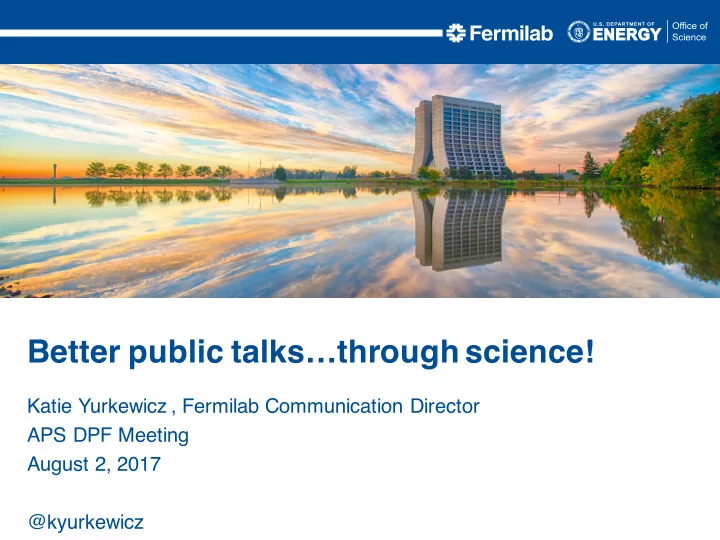
Better public talksthrough science! Katie Yurkewicz , Fermilab - - PowerPoint PPT Presentation
Better public talksthrough science! Katie Yurkewicz , Fermilab Communication Director APS DPF Meeting August 2, 2017 @kyurkewicz 2 8/2/17 @kyurkewicz | APS DPF Meeting 3 8/2/17 @kyurkewicz | APS DPF Meeting 4 8/2/17 @kyurkewicz | APS
Katie Yurkewicz , Fermilab Communication Director APS DPF Meeting August 2, 2017 @kyurkewicz
8/2/17 @kyurkewicz | APS DPF Meeting 2
8/2/17 @kyurkewicz | APS DPF Meeting 3
8/2/17 @kyurkewicz | APS DPF Meeting 4
8/2/17 @kyurkewicz | APS DPF Meeting 5
8/2/17 @kyurkewicz | APS DPF Meeting 6
8/2/17 @kyurkewicz | APS DPF Meeting 7
10 20 30 40 50 60 70 80
What kinds of outreach activities are you engaged in that reach the general public or journalists? Percent
Psychology Sociology Marketing Social marketing Mass communication Health communication Environmental communication Risk communication Journalism Science education Political science
8/2/17 @kyurkewicz | APS DPF Meeting 8
8/2/17 @kyurkewicz | APS DPF Meeting 9
8/2/17 @kyurkewicz | APS DPF Meeting 10
8/2/17 @kyurkewicz | APS DPF Meeting 11
8/2/17 @kyurkewicz | APS DPF Meeting 12
8/2/17 @kyurkewicz | APS DPF Meeting 13
8/2/17 @kyurkewicz | APS DPF Meeting 14
8/2/17 @kyurkewicz | APS DPF Meeting 15
8/2/17 @kyurkewicz | APS DPF Meeting 16
8/2/17 @kyurkewicz | APS DPF Meeting 17
8/2/17 @kyurkewicz | APS DPF Meeting 18
8/2/17 @kyurkewicz | APS DPF Meeting 19 https://commons.wikimedia.org/wiki/File%3ABdna _cropped.gif
8/2/17 @kyurkewicz | APS DPF Meeting 20
By Leonard Leslie Brooke (1862-1940) [Public domain] via Wikimedia Commons
http://www.nasonline.org/programs/sackler-colloquia/
http://journals.sagepub.com/home/scx
8/2/17 @kyurkewicz | APS DPF Meeting 21
https://www.nap.edu/catalog/23674/communicating-science-effectively-a-research-agenda
Slide 8: Snowmass Communication, Education & Outreach Survey
Bardeen, M., Cronin-Hennessy, D., White, H., Yurkewicz, K. (2013). Communication with U.S. Policy Makers and Opinion Leaders, 14. http://www.slac.stanford.edu/econf/C1307292/docs/CommunicationEducationOutreach/PolicyMakers-51.pdf
Slide 11: Warmth/Competence
Fiske, S.T., Cuddy, A.J., and Glick, P . (2007). Universal dimensions of social cognition: Warmth and competence. Trends in Cognitive Sciences, 11(2), 77-83. Chryssochoidis, G., Strada, A., and Krystallis, A. (2009). Public trust in institutions and information sources regarding risk management and communication: Towards integrating extant knowledge. Journal of Risk Research, 12(2), 137-185. Colquitt, J.A., and Rodell, J.B. (2011). Justice, trust, and trustworthiness: A longitudinal analysis integrating three theoretical
Fiske, S.T., and Dupree, C. (2014). Gaining trust as well as respect in communicating to motivated audiences about science
Peters, R.G., Covello, V.T., and McCallum, D.B. (1997). The determinants of trust and credibility in environmental risk communication: An empirical study. Risk Analysis, 17(1), 43-54.
Slide 12: Common interests, honesty, openness, perceived expertise, self-interest, persuasion
Lupia, A. (2013). Communicating science in politicized environments. Proceedings of the National Academy of Sciences of the United States of America, 110(Suppl. 3), 14048-14054. Siegrist, M., Cvetkovich, G., and Roth, C. (2000). Salient value similarity, social trust, and risk/benefit perception. Risk Analysis, 20(3), 353-362. Suhay, E., and Druckman, J.N. (2015). The politics of science political values and the production, communication, and reception
Renn, O., and Levine, D. (1991). Credibility and trust in risk communication. In Communicating Risks to the Public (pp. 175-217). Dordrecht, The Netherlands: Springer. Lang, J.T., and Hallman, W.K. (2005). Who does the public trust? The case of genetically modified food in the United States. Risk Analysis, 25(5), 1241-1252.
8/2/17 @kyurkewicz | APS DPF Meeting 22
Slide 12 continued
Byrne, S., and Hart, P .S. (2009). The boomerang effect: A synthesis of findings and a preliminary theoretical framework. Annals
Jacks, J., and Devine, P .G. (2000). Attitude importance, forewarning of message content, and resistance to persuasion. Basic and Applied Social Psychology, 22(1), 19-29.
Slide 14: We think people know more than they do
Nickerson R. (1999).How we know—and sometimes misjudge—what others know: Imputing one's own knowledge to others. Psychological Bulletin, (125),737–759. Mitchell, A., Gottfried, J., Barthel, M., and Shearer, E. (2016). The Modern News Consumer: News Attitudes and Practices in the Digital Era. Washington, DC: Pew Research Center. Available: http:// http://www.journalism.org/2016/07/07/the-modern-news- consumer/ [November 30, 2016]. National Science Board. (2014). Chapter 7: Science and technology: Public attitudes and public understanding. Science and Engineering Indicators 2014. Arlington, VA: National Science Foundation. National Science Board. (2016). Chapter 7: Science and technology: Public attitudes and understanding. Science and Engineering Indicators 2016. Arlington, VA: National Science Foundation. Available: https://www.nsf.gov/statistics/2016/nsb20161/uploads/1/10/ chapter-7.pdf [November 8, 2016].
Slide 15: What do audiences bring to a science communication interaction?
Corner, A., Whitmarsh, L., and Xenias, D. (2012). Uncertainty, scepticism and attitudes towards climate change: Biased assimilation and attitude polarisation. Climatic Change, 114(3), 463-478. Kahan, D.M., Braman, D., Cohen, G.L., Gastil, J., and Slovic, P . (2010). Who fears the HPV vaccine, who doesn’t, and why? An experimental study of the mechanisms of cultural cognition. Law and Human Behavior, 34(6), 501-516. Lord, C.G., Ross, L., and Lepper, M.R. (1979). Biased assimilation and attitude polarization: The effects of prior theories on subsequently considered evidence. Journal of Personality and Social Psychology, 37(11), 2098-2109. Maibach, E.W., Nisbet, M., Baldwin, P ., Akerlof, K., and Diao, G. (2010). Reframing climate change as a public health issue: An exploratory study of public reactions. BMC Public Health, 10(1), 1.
8/2/17 @kyurkewicz | APS DPF Meeting 23
Slide 15 continued
McCright, A.M., Marquart-Pyatt, S M., Shwom, R.L., Brechin, S.R., and Allen, S. (2016). Ideology, capitalism, and climate: Explaining public views about climate change in the United States. Energy Research and Social Science, 21, 180-189. Munro, G.D., and Ditto, P .H. (1997). Biased assimilation, attitude polarization, and affect in reactions to stereotype-relevant scientific information. Personality and Social Psychology Bulletin, 23(6), 636-653. Schuldt, J.P ., and Pearson, A.R. (2016). The role of race and ethnicity in climate change polarization: Evidence from a U.S. national survey experiment. Climatic Change, 136(3-4), 495-505. Blank, J.M., and Shaw, D. (2015). Does partisanship shape attitudes toward science and public policy? The case for ideology and religion. Annals of the American Academy of Political and Social Science, 658(1), 18-35. National Science Board. (2016). Chapter 7: Science and technology: Public attitudes and understanding. Science and Engineering Indicators 2016. Arlington, VA: National Science Foundation. Available: https://www.nsf.gov/statistics/2016/nsb20161/uploads/1/10/ chapter-7.pdf [November 8, 2016].
Slide 17: Numeracy and narrative
Bekker, H.L., Winterbottom, A.E., Butow, P ., Dillard, A.J., Feldman-Stewart, D., Fowler, F.J., M.L. Jibaja-Weiss, V.A. Shaffer, and Volk, R.J. (2013). Do personal stories make patient decision aids more effective? A critical review of theory and evidence. BMC Medical Informatics and Decision Making, 13(Suppl. 2), S9. Dahlstrom, M.F. (2014). Using narratives and storytelling to communicate science with non-expert audiences. Proceedings of the National Academy of Sciences of the United States of America, 111(Suppl. 4), 13614-13620. Kanouse, D.E., Schlesinger, M., Shaller, D., Martino, S.C., and Rybowski, L. (2016). How patient comments affect consumers’ use of physician performance measures. Medical Care, 54, 24-31. Winterbottom, A., Bekker, H.L., Conner, M., and Mooney, A. (2008). Does narrative information bias individuals’ decision making? Social Science & Medicine, 67(12), 2079-2088. Dieckmann, N.F., Slovic, P ., and Peters, E. (2009). The use of narrative evidence and explicit likelihood by decisionmakers varying in numeracy. Risk Analysis, 29(10), 1473-1488. Institute of Medicine. (2014). Numeracy and the Affordable Care Act: Opportunities and challenges. In E. Peters, L. Meilleur, and
Academies Press
8/2/17 @kyurkewicz | APS DPF Meeting 24
Slide 17 continued
Myers, T.A., Maibach, E., Peters, E., and Leiserowitz, A. (2015). Simple messages help set the record straight about scientific agreement on human-caused climate change: The results of two experiments. PLoS One, 10(3), e0120985. Ritchie, S., Tomas, L. & Tones, M. (2011). Writing Stories to Enhance Scientific Literacy. International Journal of Science Education 33(5), 685-707. Prins, R., Avraamidou, L. & Goedhart, M. (2017). Tell me a Story: the use of narrative as a learning tool for natural selection. Educational Media International 54(1), 20-33.
Slide 18: Mehrabian communication model
Mehrabian, A. (1981). Silent Messages: Implicit Communication of Emotions and Attitudes. Wadsworth. Mehrabian, A. (1972). Non-Verbal Communication. Aldine-Atherton.
Slide 19: Using visuals to communicate
Kernbach, S., Eppler, M. & Bresciani, S. (2014). The Use of Visualization in the Communication of Business Strategies. International Journal of Business Communication 52(2), 164-187. doi:10.1177/2329488414525444 Bucchi, M. & Saracino, B. (2016). Visual Science Literacy. Science Communication 38(6), 812-819. DOI:10.1177/1075547016677833
Slide 20: Rule of three
http://www.visualthinkingmagic.com/rule-of-three https://rule-of-three.co.uk/what-is-the-rule-of-three-copywriting/ http://fairytalez.com/blog/the-power-of-three-why-fairy-tales-often-feature-a-triple/
8/2/17 @kyurkewicz | APS DPF Meeting 25