
SLIDE 1
1
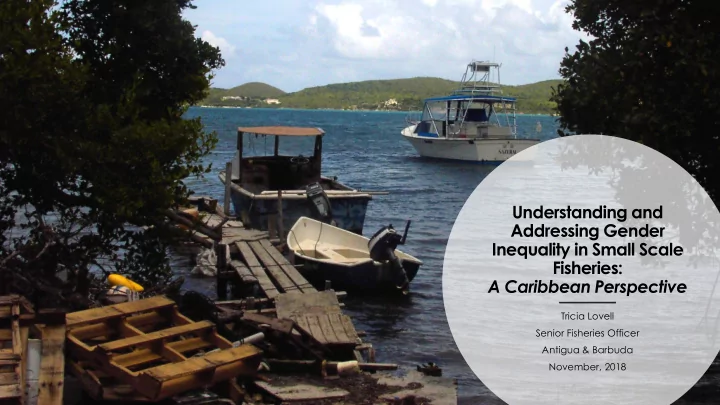
Understanding and Addressing Gender Inequality in Small Scale Fisheries: A Caribbean Perspective
Tricia Lovell Senior Fisheries Officer Antigua & Barbuda November, 2018
Fisheries: A Caribbean Perspective Tricia Lovell Senior Fisheries - - PowerPoint PPT Presentation
Understanding and Addressing Gender Inequality in Small Scale Fisheries: A Caribbean Perspective Tricia Lovell Senior Fisheries Officer Antigua & Barbuda November, 2018 1 Disclaimer The work presented is not my own. It has been
1
Tricia Lovell Senior Fisheries Officer Antigua & Barbuda November, 2018
2
The work presented is not my own. It has been compiled through a review of:
eliminate Gender Inequalities in the Fish Value Chain &
Report on Caribbean Fisheries in the Context of the Small Scale Fisheries Guidelines
3
4
sector of fisheries employing labour-intensive harvesting, processing and distribution technologies to exploit marine and inland water fishery resources.”
countries and regions
low technology gear and vessels, and catch for subsistence and local markets. However increasing numbers of SSF have also begun shifting to export-oriented production (e.g. lobster fishery in Antigua and Barbuda)
5
6
Gender: Refers to socially constructed attributes and opportunities associated with being male and female; what societies define as appropriate masculinity and femininity. Gender balance: The equal and active participation of women and men in all areas of decision-making, and in access to and control over resources and services. Gender discrimination: Any exclusion or restriction made on the basis of gender roles and relations that prevents a person from enjoying full human rights. Gender equality: Men and women enjoy equal rights, opportunities and entitlements in civil and political life Gender mainstreaming: The process of assessing and addressing the implications for men and women of any planned action, including legislation, policies
implementation, monitoring and evaluation of policies and programmes in all political and societal spheres so that women and men benefit equally and inequality is not perpetuated. (Source: GIFT 2018)
7
Source: FAO Good Practice Policies
8
rights to land, ponds and other fisheries related assets are heavily skewed against women.
inequalities in areas such as education and training, access to independent credit, and bargaining power in trade associations and the workplace.
such as focusing on (male- dominated) production at the expense of (female-dominated) fish processing and marketing
neglected through lack of training in improved fish technologies and production methods.
9
10
Redefining Gender Rules: Women in the Fisheries Value Chain
Households Restaurants Supermarkets Retailers Vendors Factory workers Scalers/gutters Fish harvest Aqua/Mariculture Sale of fishing gear Vessel owners
Fisheries Inputs Fisheries Production Post Harvest Processing Marketing Consumers
11 11
Fisheries in the Context of Food Security and Poverty Eradication (SSF Guidelines) are the first internationally negotiated document dedicated specifically to the small-scale fisheries sector that also recognise women’s contributions in fisheries, calling for gender equity and equality.
implementation of the SSF Guidelines by highlighting global examples of women equity and equality in fisheries at a global scale
produced a video competition of women in the seafood industry
12
Promote actions to capture women’s lost potential in fisheries through enabling policies and legislation and through investments
Promote
Invest in knowledge and data systems for collecting, disseminating and analyzing more complete and reliable data, disaggregated by gender
Invest in
Recognize and promote the interrelationships among efficiency, gender equity and women’s empowerment
Recognize and promote
Provide labour-saving technology for domestic and fisheries work that allow for the freeing up of women’s time to take advantage of
Provide
Improve safety, hygiene and health taking into account gender and age sensitive needs
Improve
Strengthen fisheries organisations and women’s roles within them.
Strengthen
Promote gender balanced role small scale fisheries management
Promote
Foster innovations in communication for gender-equitable fisheries development
Foster
Source: FAO 2013
13 13
The Member states of the Caribbean Regional Fisheries Mechanism (CRFM) are taking direct steps to respond to the existing gender inequalities in small scale fisheries of the region. Under the Caribbean Common Fisheries Policy Articles 5d, 9 & 10 address issues of human rights that can be linked to gender (i.e equitable allocation of rights, equal participation and protecting the rights of traditional, subsistence and small-scale fisheries The CRFM Secretariat is developing and finalizing a policy on gender equality mainstreaming in fisheries and aquaculture Centre for Resource Management and Environmental Studies (CERMES) has formed GIFT (Gender in Fisheries Team) which is undertaking a gender in fisheries scoping exercise The Caribbean Network of Fisherfolk Organisation (CNFO) actively leads and supports programmes that promote gender mainstreaming
14 14
Evaluating Caribbean Fisherfolk Perspectives on Gender Equality in Small Scale Fisheries: Work of the Gender in Fisheries Team [GIFT]
research to better understand and assist with policy and practice concerning gender in Caribbean small-scale fisheries
and rapid scoping of perspectives of mainly CNFO fisherfolk leaders on content of the Gender section (No. 8) of the SSF Guidelines in their CRFM countries and fisheries
15 15
development needs met
making
16 16
50% 76% 71% 35% 42% 47% 50% 24% 29% 65% 58% 53% 0% 10% 20% 30% 40% 50% 60% 70% 80% Equal participation in fisherfolk organisations Equal access to fisheries technical training Equal access to formal credit Equal consideration of fisheries management and development needs Discrimination in fisheries Equal participation in fisheries decision- making
Chart Title
Agree Disagree
17 17
role of women in fisheries continues to be
into small scale fisheries development it is necessary to accurately represent the role
CRFM along with the global process through the FAO and other agencies can bring us closer to closing the gender gap in small-scale fisheries once and for all.
18 18
To Learn More Consult the following references”
resource management and environmental policy from the Centre for Resource Management and Environmental Studies (CERMES), Faculty of Science and Technology, University of the West Indies, Cave Hill Campus, Barbados.
scale fisheries governance and development: A Handbook In support of the implementation of the Voluntary Guidelines for Securing Sustainable Small-Scale Fisheries in the Context of Food Security and Poverty
Inequalities in Fish Value Chains. FAO. Rome
Caribbean Fisheries in the Context of the Small-scale fisheries guidelines. Gender in Fisheries Team (GIFT), Centre for Resource Management and Environmental Studies (CERMES), The University of the West Indies, Cave Hill Campus, Barbados. CERMES Technical Report No. 86:60pp.
19 19