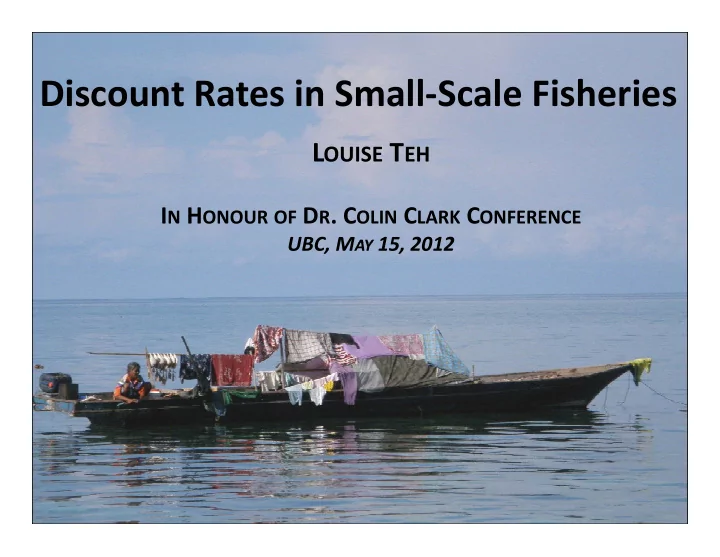
Discount Rates in Small Scale Fisheries Discount Rates in Small - - PowerPoint PPT Presentation
Discount Rates in Small Scale Fisheries Discount Rates in Small Scale Fisheries L OUISE T EH I N H ONOUR OF D R . C OLIN C LARK C ONFERENCE UBC M AY 15 2012 UBC, M AY 15, 2012 C O R A L R E E F S Reef Fisheries Small scale, multi
C O R A L R E E F S
Reef Fisheries
- Small‐scale, multi‐species & multi‐gear;
- Extensive overexploitation;
- Over 55% of coral reefs worldwide
threatened by overfishing and threatened by overfishing and destructive fishing (Burke et al. 2011).
Reef Guardian
Threatened coral reef species
Chris Johnson, Odyssey Reef Guardian
Discount rates and fisheries sustainability fisheries sustainability
How willing are fishers to sacrifice their t fi h b fit i d t j current fishery benefits in order to enjoy higher benefits in the future? g
Discount rates and fisheries
- Private discount rate measures one’s willingness to
f i di b fi i d j f forgo immediate benefits in order to enjoy future, bigger benefits; Di ti ff t l t t i bilit f
- Discounting affects long term sustainability of
fisheries resources (Clark 1973, Sumaila 2004);
- Few empirical studies:
– High discount rates increased intensity of violating fisheries regulations (Akpalu 2008); g ( p ); – Low discount rates associated with less intense fishing pressure (Fehr & Liebbrandt 2008).
Research Questions Research Questions
1 What are the private discount rates of small‐
- 1. What are the private discount rates of small
scale fishers? 2 Under what socio economic conditions do
- 2. Under what socio‐economic conditions do
fishers have low discount rates? 3 A di fl i f fi h
- 3. Are discount rates reflective of fishery
exploitation status?
Study site 1
Study site 2
A li
Fiji
Australia
Fishing Villages
Discount rates of fishers in open access d di i ll d f fi h i
Open access (Sabah):
and traditionally managed reef fisheries
Open access (Sabah):
- No assurance of future benefits from the fishery;
- Forced to entirely discount the future i e use a
- Forced to entirely discount the future, i.e., use a
discount rate of infinity (Clark, 1990). Customary marine tenure (Fiji): Customary marine tenure (Fiji):
- Traditional management of fishing grounds;
- Stewardship of marine resources
lower discount
- Stewardship of marine resources – lower discount
rate.
Teh et al. (submitted)
Eliciting discount rates
- Semi‐structured interviews:
– 75 interviews in Sabah (April/May 2009) – 45 interviews in Fiji (May/June 2008)
- Binary choice series using
hypothetical payments:
– Choose between an immediate, smaller payment or delayed, larger payment
Estimating Discount Rates
Now
($)
1 month
($)
Discount rate (annual%)
Discount Function: ( ) ( )
(annual%)
100 105 29 100 110 86
di t t Discount Function:
100 115 141 100 120 193
r = discount rate y = present value x = future value
100 125 243 100 130 291
t = time delay
100 135 337 100 140 381 100 145 424
Discount rates of fishers in Sabah for 1 month delay
M 265% 33 Mean = 265% 33 Median = 29%
cy requenc Fr Annual discount rate (%)
Discount rates of fishers in Fiji for 1 month delay
Mean = 208% 27 Mean = 208% 27 Median = 121%
cy requenc Fr Annual discount rate (%)
Proportion of fishers choosing each choice i b i
Sabah Fiji
- ption by site
Sabah (%) Fiji (%) ‘Impatient’
30 20
Impatient
30 20
‘Patient’
51 27
Other
19 53
Patience proxy (=ri/r )
0.39* 0.44
( ri/rmax)
*p<0.05
Percentage of respondents at each village who chose the ‘patient’ option who chose the patient option Village Site %
Sibogo Balak Banggi 14 Sibogo Balak Banggi 14 Mabul Semporna 20 Dogoton Banggi 38 Dogoton Banggi 38 Hampalan Laut Semporna 40 Damaran Banggi 67 gg Omadal Semporna 67 Batu Sireh Banggi 70 Sibogo Air Banggi 71 Manawali Banggi 83 Maligu Banggi 100
Defining a low discount rate
Now
($)
1 month
($) Low discount rate = ($) ($)
100 105 100 110
Choosing smallest future payment
- ffered
100 110 100 115 100 120
- ffered
All other choices = non low discount
100 120 100 125 100 130
non-low discount rate
100 130 100 135 100 140 100 140 100 145
Logistic regression model
Identify which socio‐economic factors predict the probability that a fisher chooses a low discount rate a fisher chooses a low discount rate
W Z X Y
Y = Probability of choosing a low discount rate X, Z and W = matrices of demographic, socio-economic and location variables location variables
3 models: (i) pooled (n=118) (ii) Sabah only (n=73) (iii) Fiji only (n=45)
Prevalence of low discount rates among ll l fi h small‐scale fishers
ents respond % of r
Logistic regression output
Significant predictors of low discount rates among fishers
Variable Pooled Sabah Fiji Variable Pooled Sabah Fiji Protection
+ +
Site
+
Boat ownership
+ ‐
Relative catch
‐ +
Relative catch
‐ +
+ Increases likelihood of a fisher choosing a low discount rate ‐ Decreases likelihood of a fisher choosing a low discount rate
Teh et al. (2011) Sustainability
Coral reefs worldwide
Coral reefs
Economics of overexploition
Theory: Even under restricted access, the sole y ,
- wner of a fishery has an incentive to deplete
the resource if their discount rate satisfies the condition
> 2r > 2r
where r = intrinsic population growth rate of h fi h k (Cl k 1973) the fish stock (Clark 1973).
Data
- 1. Economic
Di t t Discount rates
- Managers = official discount rate ()
- Fishers = private discount rate ( )
- Fishers = private discount rate (p)
2 Biological 2. Biological
Intrinsic growth rates
- Species level (r )
Species level (rs)
- Fishery level (rf)
Species % of catch
0.5 5
rs
0.6 20 1 0 10 1.0 10 0.4 15 0.5 5
0.875 yr-1 Fishery level rf
0.2 15 1.8 22 2.2 5 2.2 5 0.3 3
Comparing discount rates to l exploitation status
Status* Official discount rate () rate () Underexploited < rf Overexploited > rf Depleted > 2r Depleted > 2rf
rf : Fishery level intrinsic growth rate * Source: Newton et al. 2007 Current Biology
Inferring private discount rates Inferring private discount rates
Status Private discount rate (p) ( p) Underexploited 0.29* < p < rf O l i d 2 Overexploited rf < p< 2rf Fully exploited p= rf y p
p f
* Minimum discount rate from Fiji and Sabah case studies
Fishery level rf
f)
e per yr (rf rowth rate trinsic gr Mean= 0.88 ±0.02 Fiji In Fiji Sabah
Fishery case
Fishery level rf
rf)
Mauritius
Rabbitfish e per yr (r
Mauritius Philippines
Parrotfish rowth rat Surgeonfish Snapper ntrinsic g Grouper In
Bahamas Turks & Caicos
Fishery case
Caicos Teh et al. (submitted)
Official discount rates
1.8 2
ate
1.4 1.6
scount ra
0 8 1 1.2
nnual dis
0.4 0.6 0.8
Official an
0.2
Fishery cases
O
Fishery cases
Official discount rate vs. fishery rf
1 8 2
y rf
1.4 1.6 1.8
/ Fishery
1 1.2 Fishery rf Official
- unt rate/
0.6 0.8 Official discount rate
ial disco
0.2 0.4
Offic
Fishery cases
Inferred private discount rates
Caribbean 102% Southeast O i 89% Southeast Asia 145% Indian Ocean 142% Sabah 110% Fiji 104% Oceania 89% Sabah 110%
Overall mean = 107%
Official vs. private discount rates
2 5 3 2 2.5
Private
nt rate 1.5
Private discount rate Official discount
discoun 1
discount rate
Annual 0.5
Fishery cases
Concluding Remarks
Need to start paying attention to fishers’ discount rates
A k l d fi h ’ h t ti ti – Acknowledge fishers’ short time perspective – Better understanding about why fishers discount the way they do y
ACKNOWLEDGEMENTS
Rashid Sumaila Colin Clark Mike Meitner Dirk Zeller Rashid Sumaila, Colin Clark, Mike Meitner, Dirk Zeller In the field: Lydia Teh, Prof. Dr. Ridzwan Abdul Rahman, UMS Seaweed Project staff (Banggi) ,WWF team (Kudat & Semporna), Nanise Kuridrani, Vily Tuiwakaya and Fiji Fisheries Department Funding: SSHRC, Kingfisher Foundation, Cosmos International Graduate Travel Award (UBC) ( ) All the fishers who made this research possible… Maksukul, Terima kasih, Vinaka
Estimating intrinsic population h growth rate
- Based on Euler‐Lotka method (McAllister et al
Based on Euler Lotka method (McAllister et al. 2001)
- Solve for r iteratively using a numerical
i i i i f i minimisation function
- Assume Beverton‐Holt recruitment function,