Fisheries Relevant Resources Resource Resource Development - - PDF document

fisheries
SMART_READER_LITE
LIVE PREVIEW

Fisheries Relevant Resources Resource Resource Development - - PDF document

Workshop on Social Simulation of Fisheries and Coastal Management June 6 7 2016 NATURAL ECOSYSTEM MANAGEMENT SYSTEM Community Policy and Resource Planning Management Fisheries Relevant Resources Resource Resource Development


slide-1
SLIDE 1

Workshop on Social Simulation of Fisheries and Coastal Management June 6‐7 2016 1

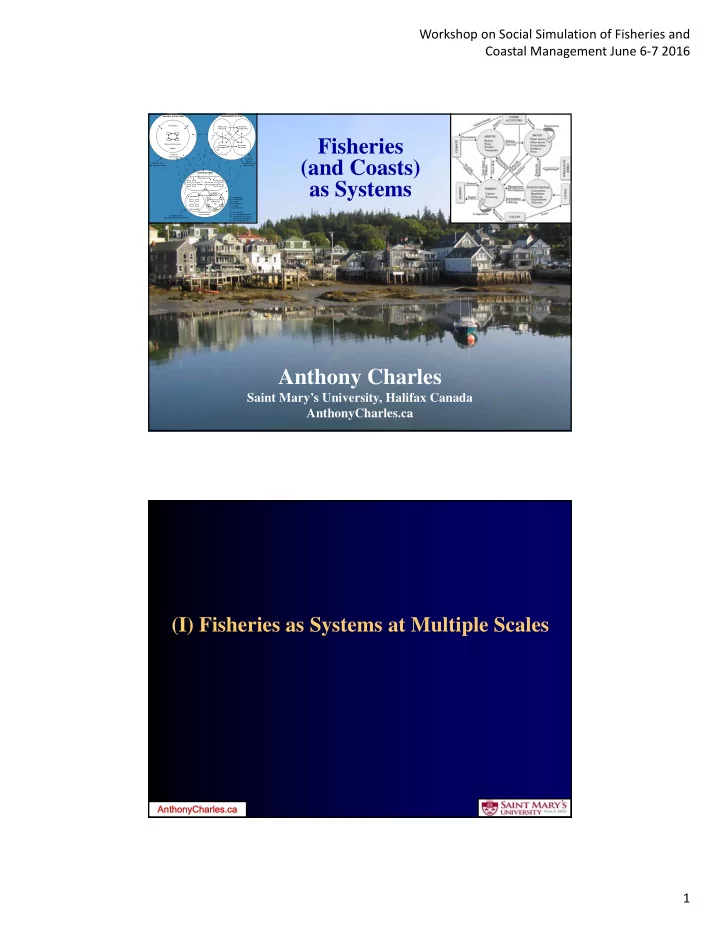
Fisheries (and Coasts) as Systems Anthony Charles

Saint Mary’s University, Halifax Canada AnthonyCharles.ca

External Environment Policy and Planning Resource Management Resource Development Resource Research NATURAL ECOSYSTEM Community MANAGEMENT SYSTEM HUMAN SYSTEM User Groups Resource Technology Resource Users Community Households Processing & Marketing (4) Socioeconomic Environment External Forces (eg. government downsizing) External Forces (eg. macroeconomic policies) External Forces (eg. climate change) (1) User conflicts (2) Technological conflicts (3) Community economics and social interactions (4) Marketing channels P = processing D = distribution M = market W = wholesale R = retail C = consumers Relevant Resources Habitat 1 2 3 P D M W R C

(I) Fisheries as Systems at Multiple Scales

AnthonyCharles.ca

slide-2
SLIDE 2

Workshop on Social Simulation of Fisheries and Coastal Management June 6‐7 2016 2

AnthonyCharles.ca Fleet Fish Harvest Market AnthonyCharles.ca

slide-3
SLIDE 3

Workshop on Social Simulation of Fisheries and Coastal Management June 6‐7 2016 3

Fishery Systems

AnthonyCharles.ca

Fishery System Fish Stock Broaden the Perspective Ecosystem Approach Fishers Broaden the Perspective Livelihoods Approach

A Systems Approach

A Systems Approach:

  • Incorporates the approach of

Ecosystem-Based Management

  • Adds human dimensions
  • Incorporates a ‘bigger picture’

around fish and fishers, which combines both ecosystem- and human-centred thinking…

AnthonyCharles.ca

slide-4
SLIDE 4

Workshop on Social Simulation of Fisheries and Coastal Management June 6‐7 2016 4

AnthonyCharles.ca

External Environment Policy and Planning Resource Management Resource Development Resource Research NATURAL ECOSYSTEM Community MANAGEMENT SYSTEM HUMAN SYSTEM User Groups Resource Technology Resource Users Community Households Processing & Marketing (4) Socioeconomic Environment External Forces (eg. government downsizing) External Forces (eg. macroeconomic policies) External Forces (eg. climate change) (1) User conflicts (2) Technological conflicts (3) Community economics and social interactions (4) Marketing channels P = processing D = distribution M = market W = wholesale R = retail C = consumers Relevant Resources Habitat 1 2 3 P D M W R C

Adapted from A. Charles, Sustainable Fishery Systems, Blackwell Science, Oxford UK (2001). AnthonyCharles.ca

slide-5
SLIDE 5

Workshop on Social Simulation of Fisheries and Coastal Management June 6‐7 2016 5

Source: Garcia et al. (2003)

AnthonyCharles.ca AnthonyCharles.ca

slide-6
SLIDE 6

Workshop on Social Simulation of Fisheries and Coastal Management June 6‐7 2016 6

Science community Integrated model & Assessment Public / Stakeholders

Participatory process Analytical process

Values, Knowledge Issues Goals Policy makers Regulations Facts, Data Advice Options Validation Expectations Communication Models Scenarios Mental models Perceptions Experts Stakeholders

by Serge Garcia

AnthonyCharles.ca

Complex System Adaptive System CARIBBEAN (with P. McConney, UWI Barbados) MARINE SES

HUMAN SYSTEM COASTAL RESOURCE SYSTEM

Reeffish Mangrove Sea grass Coral reef Fishing Tourism Agriculture Shipping

Multi-Sectoral Systems

AnthonyCharles.ca

slide-7
SLIDE 7

Workshop on Social Simulation of Fisheries and Coastal Management June 6‐7 2016 7

Scale

Local Fishing Ground Fishing Community Management Region National Jurisdiction Multiple Nations Ecosystem Multiple Ecosystems Large-scale Spatial Scale

Daily In-Season Annual Multi-Year Long Term Time Scale Management Portfolio Objectives and Policy Operational Management Tactical Management Strategic Management Local Openings Catch Monitoring Setting TAC

AnthonyCharles.ca

Organizational Scales

AnthonyCharles.ca

slide-8
SLIDE 8

Workshop on Social Simulation of Fisheries and Coastal Management June 6‐7 2016 8

Northwest Atlantic

Gulf of Maine

Gulf of Maine

Bay of Fundy

slide-9
SLIDE 9

Workshop on Social Simulation of Fisheries and Coastal Management June 6‐7 2016 9

Bay of Fundy

Annapolis Basin

Annapolis Basin, Nova Scotia

slide-10
SLIDE 10

Workshop on Social Simulation of Fisheries and Coastal Management June 6‐7 2016 10

Annapolis Basin, Nova Scotia

Tidal power Clam Harvest Stream Restoration Fish Farms Sewage Spills Agricultural Run-off

(II) Ingredients of a Systems Approach

AnthonyCharles.ca

slide-11
SLIDE 11

Workshop on Social Simulation of Fisheries and Coastal Management June 6‐7 2016 11

A Systems Perspective

Governance Livelihoods Well‐Being Resilience Adaptation Climate Change Level & Scale Communities

AnthonyCharles.ca

  • 1. Values

Building consensus Valuing community Food security

AnthonyCharles.ca

slide-12
SLIDE 12

Workshop on Social Simulation of Fisheries and Coastal Management June 6‐7 2016 12

  • 2. Objectives
  • 3. Pillars of Sustainability

Ecological Sustainability Institutional Sustainability Social Economic Sustainability Sustainability

AnthonyCharles.ca

slide-13
SLIDE 13

Workshop on Social Simulation of Fisheries and Coastal Management June 6‐7 2016 13

  • 4. System Drivers
  • Climate Change
  • Demand Shifts
  • Globalization of Markets
  • Technological Change
  • Urbanization
  • Evolving Governance

AnthonyCharles.ca AnthonyCharles.ca

  • 5. Governance
slide-14
SLIDE 14

Workshop on Social Simulation of Fisheries and Coastal Management June 6‐7 2016 14

  • 5a. Participation

Community Participation Fisher Participation Government Participation The Triangle of Co-Management

AnthonyCharles.ca

  • 5b. Some Ingredients of Good Governance

1.

Get the Rights Right

2.

Support Local Communities

3.

Deal with Equity & Power Issues

4.

See the the Bigger Picture

Charles, A. and L. Wilson (2009) Human dimensions of Marine Protected Areas. ICES Journal of Marine Science 66: 6-15.

AnthonyCharles.ca

slide-15
SLIDE 15

Workshop on Social Simulation of Fisheries and Coastal Management June 6‐7 2016 15

  • 6. Coping with Uncertainty

The solution is Robust Management which seeks ‘reasonable’ success in meeting fishery objectives, even when faced with: – faulty understanding of the fishery system; – highly imperfect capability to control resource use.

Fallacy of Controllability Illusion of Certainty

AnthonyCharles.ca

Approaches for Robust Management

  • Incorporate a precautionary approach within policy
  • Mutually-reinforcing management ‘portfolio’
  • Mechanisms to facilitate adaptation/learning
  • Use all sources of knowledge
  • Promote local management and stewardship
  • Self-regulatory institutions, appropriate use rights
  • Diversity: Multiple species, multiple livelihoods

AnthonyCharles.ca

slide-16
SLIDE 16

Workshop on Social Simulation of Fisheries and Coastal Management June 6‐7 2016 16

Integrated Indicator Frameworks

M E A S U R I N G S U S T A I N A B L E D E V E L O P M E N T A P PL I C AT I O N O F T H E G E N U I N E PR O G R E S S I N D E X T O N O V A S C O T I A

THE NOVA SCOTIA GPI FISHERIES & MARINE ENVIRONMENT ACCOUNTS

A PRELIMINARY SET OF ECOLOGICAL, SOCIOECONOMIC AND INSTITUTIONAL INDICATORS FOR NOVA SCOTIA’S FISHERIES AND MARINE ENVIRONMENT

Prepared by: Anthony Charles Heather Boyd Amanda Lavers Cheryl Benjamin

– Ecological Indicators – Social Indicators – Economic Indicators – Community Indicators – Institutional Indicators

AnthonyCharles.ca

  • 7. Monitoring

A Broad Range of Indicators

Economic Total Landed Value Total Processed Value Fishery Gross Domestic Product Value of Fishery Exports Profit per Fisher Return on Investment Depreciation in Natural Capital Value of Ecosystem Services Diversity of Employment Sources Economic Diversity Debt Levels of Fishers Social Employment Equity Community well-being Diversity of employment Institutional Acceptability of governance Robustness of management Management portfolio Participation in decision-making Effectiveness of incentives

AnthonyCharles.ca

slide-17
SLIDE 17

Workshop on Social Simulation of Fisheries and Coastal Management June 6‐7 2016 17 Mean trophic level in fishery, 1972–2007 (weighted by landed weight)

3.53.5 3.4 3.3 3.3 3.2 3.3 3.4 3.53.5 3.6 3.6 3.7 3.63.6 3.53.5 3.43.43.4 3.4 3.2 3.13.0 3.1 3.13.0 3.0 2.92.92.92.82.9 2.92.92.9 3.3 3.4 3.2 3.2 3.1 3.0 3.0 3.1 3.23.1 3.2 3.2 3.33.33.2 3.23.2 3.13.1 3.2 3.23.1 3.03.0 3.1 3.03.0 2.9 2.82.82.82.82.8 2.92.92.9 2.6 2.8 3.0 3.2 3.4 3.6 3.8 1972 1974 1976 1978 1980 1982 1984 1986 1988 1990 1992 1994 1996 1998 2000 2002 2004 2006 Year Mean Trophic Level Total Landings Excluding Cod

25.5 22.1 20.8 20.8 22.9 21.7 22.7 8.9 10.9 42.0 44.4 48.2 43.2 49.8 52.1 51.4 55.2 45.7 32.5 33.5 31.0 36.1 27.3 26.2 26.1 35.9 43.4 0.0 10.0 20.0 30.0 40.0 50.0 60.0 1931 1941 1951 1971 1981 1986 1991 2001 2006 Year 15-24 25-44 45-64

Age distribution of fishers in Nova Scotia, 1931–2006 (in three age classes)

Novel Indicators

AnthonyCharles.ca

(III) Local Fishery/Coastal Systems

AnthonyCharles.ca

slide-18
SLIDE 18

Workshop on Social Simulation of Fisheries and Coastal Management June 6‐7 2016 18

Successful community environmental stewardship, sustainable livelihoods, and government engagement.

AnthonyCharles.ca

www.CommunityConservation.net

CCRN Research Themes

Meaning of Conservation

Social-Ecological Systems Lens

Motivation for Conservation Governance of Conservation Conservation & Livelihood Outcomes

slide-19
SLIDE 19

Workshop on Social Simulation of Fisheries and Coastal Management June 6‐7 2016 19

37

AnthonyCharles.ca

www.CommunityConservation.net

(IV) Addressing a Global Policy Issue through a Spatial Bioeconomic Model

AnthonyCharles.ca

slide-20
SLIDE 20

Workshop on Social Simulation of Fisheries and Coastal Management June 6‐7 2016 20

Global Policy: Protected Areas

  • Through the Convention on Biological

Diversity (CBD), the world has agreed

  • n increasing the amount of protected

areas globally, to reach certain targets.

  • This target is treated on a country by

country basis, so signatory countries are now working to reach this target.

  • In the ocean, the target is 10% of ocean

space by 2020, using Marine Protected Areas (MPAs), ocean areas designated for protection, e.g., in fishery closures, no-take areas, zoning.

AnthonyCharles.ca

What are the Impacts of this Global Policy & Creation of MPAs?

  • MPAs may have benefits e.g. protecting spawning/juvenile fish;

consumptive and non-consumptive uses; existence/option values.

  • There are also costs. In particular, an MPA can cause winners and

losers… notably if the MPA is ‘no-take’, no fishing is allowed, so what happens to those who traditionally fished inside the area?

– compensate for loss of livelihood or provide alternative employment – allow continued fishing within the no-take zone – provide fishing rights to nearest stock outside MPA

  • All of these can cause negative impacts on the fishing people!

AnthonyCharles.ca

slide-21
SLIDE 21

Workshop on Social Simulation of Fisheries and Coastal Management June 6‐7 2016 21

A Bioeconomic Model

Charles, A. 2010. Fisheries and marine protected areas: A spatial bioeconomic analysis of distributional impacts. Natural Resources Modeling 23(2):218-252.

  • multiple fish stocks {Si} self-reproducing but intermingling
  • multiple fishing communities {Ci} arrayed along a coastline

Fish Stocks  1 S1 S2 S3 S4 S5 S6 S7 S8 S9 S10 C1 C2 C3 C4 C5 C6 C7 C8 C9 C10  1 Fishing Communities

AnthonyCharles.ca

The Model: Implementing an MPA

MPA 0  a  b 1  1

S1 S2 S3 S4 S5 S6 S7 S8 S9 S10 C1 C2 C3 C4 C5 C6 C7 C8 C9 C10

 1

AnthonyCharles.ca

Note: If the MPA includes stock Si, then the set of communities most directly affected includes corresponding community Ci

slide-22
SLIDE 22

Workshop on Social Simulation of Fisheries and Coastal Management June 6‐7 2016 22

Population Dynamics

Next year’s stock = survival from last year + in-migration from adjoining areas + recruitment into stock s = survival rate; r = intrinsic growth rate; K = carrying capacity m = fraction of post-fishery fish migrating in each direction k = fractional increase in carrying capacity inside the MPA (Ability to produce new fish depends on ecosystem health) Xi,n+1 = (1-2m)s(Xi,n-hi,n) + ms(Xi-1,n-hi-1,n) + ms(Xi+1,n-hi+1,n) + r(Xi,n-hi,n)[1-(Xi,n-hi,n)/K(1+kMPA)]

AnthonyCharles.ca

Fishing Process

  • Assume fishery regulated / limited by effort (time)
  • Assume N fishers per community, f trips each per year
  • Assume time T is available per trip
  • ttravel (j) = time required to and from fishing ground
  • Annual fishing effort per capita  N  f  [T-ttravel (j)]
  • Harvest of the ith stock by community j in year n:

hi,j,n = q  Xi,n  N  f  [T-ttravel (j)] where Xi,n = size of ith stock Si in year n

AnthonyCharles.ca

slide-23
SLIDE 23

Workshop on Social Simulation of Fisheries and Coastal Management June 6‐7 2016 23

Fisher Economics

j,n= ph - ctravelNfttravel - cfishingNf[T-ttravel] - Ncfixed

Profit for each fisher in community j in year n = Gross revenue - ‘Steaming Costs’ - Fishing Costs - Fixed Costs

Negative impacts on fishery profits due to:

  • extra costs to travel further to their new fishing grounds;
  • less time available for fishing due to greater travel time;
  • crowding on the fishing grounds outside the MPA
  • (also possible opposition to those entering new fishing areas)

AnthonyCharles.ca

Results: No MPA

Profits 'Inside' vs Outside MPA

0.0 10.0 20.0 30.0 40.0 1 5 9 13 17 21 25 Year Pro fit Adjacent MPA Distant

PV, Profits and Stock Size

0.0 20.0 40.0 1 2 3 4 5 6 7 8 9 10 Stock/Community PV, Profits & Stocks PV/25 Average Profit Fin Stock Size

AnthonyCharles.ca

slide-24
SLIDE 24

Workshop on Social Simulation of Fisheries and Coastal Management June 6‐7 2016 24

Results: Typical Scenario

Profits 'Inside' vs Outside MPA

0.0 10.0 20.0 30.0 1 5 9 13 17 21 25 Year Profit Adjacent MPA Distant

PV, Profits and Stock Size

0.0 20.0 40.0 60.0 1 2 3 4 5 6 7 8 9 10 Stock/Community PV, Profits & Stocks PV/25 Average Profit Fin Stock Size

AnthonyCharles.ca

Results: Displaced can be Winners with Sufficient Ecosystem Benefits

Profits 'Inside' vs Outside MPA

0.0 41.5 1 5 9 13 17 21 25

Year Profit

Adjacent MPA Distant

PV, Profits and Stock Size

0.0 20.0 40.0 60.0 1 2 3 4 5 6 7 8 9 10 Stock/Community PV, Profits & Stocks PV/25 Average Profit Fin Stock Size

AnthonyCharles.ca

slide-25
SLIDE 25

Workshop on Social Simulation of Fisheries and Coastal Management June 6‐7 2016 25

Results: Displaced can be Winners with High Migration

PV, Profits and Stock Size

0.0 20.0 40.0 1 2 3 4 5 6 7 8 9 10 Stock/Community PV, Profits & Stocks PV/25 Average Profit Fin Stock Size

Profits 'Inside' vs Outside MPA

0.0 41.5 1 5 9 13 17 21 25 Year Profit Adjacent MPA Distant

AnthonyCharles.ca

Policy Impacts of MPAs: Conclusions

  • The design of an MPA can affect its acceptance - especially

if an MPA is mis-placed or mis-sized.

  • Acceptance issues can arise through the distribution of

benefits and costs arising from an MPA.

  • This model helps to identify factors leading to distributional

issues in creation of MPAs, relating to impacts on fishers.

  • Unless ecosystem benefits of a no-take MPA are large,

those displaced will be disadvantaged more than others.

  • Possible remedies: avoid no-take MPAs, provide suitable

compensation measures, or ensure that displaced fishers explicitly gain in other ways from the MPA.

AnthonyCharles.ca

slide-26
SLIDE 26

Workshop on Social Simulation of Fisheries and Coastal Management June 6‐7 2016 26

External Environment Policy and Planning Resource Management Resource Development Resource Research NATURAL ECOSYSTEM Community MANAGEMENT SYSTEM HUMAN SYSTEM User Groups Resource Technology Resource Users Community Households Processing & Marketing (4) Socioeconomic Environment External Forces (eg. government downsizing) External Forces (eg. macroeconomic policies) External Forces (eg. climate change) (1) User conflicts (2) Technological conflicts (3) Community economics and social interactions (4) Marketing channels P = processing D = distribution M = market W = wholesale R = retail C = consumers Relevant Resources Habitat 1 2 3 P D M W R C

AnthonyCharles.ca

Thank You!