Sustainable Welfare, Green Social Work P h o and the Impacts of - - PowerPoint PPT Presentation

sustainable welfare green social work
SMART_READER_LITE
LIVE PREVIEW

Sustainable Welfare, Green Social Work P h o and the Impacts of - - PowerPoint PPT Presentation

Sustainable Welfare, Green Social Work P h o and the Impacts of the Corona Crisis t o g r a p h Webinar 9 June 2020, 16:00 18:00 (Italy tjme) : E m i l i o M o r e n a t t i / A P Su Sustai ainable able Welf


slide-1
SLIDE 1

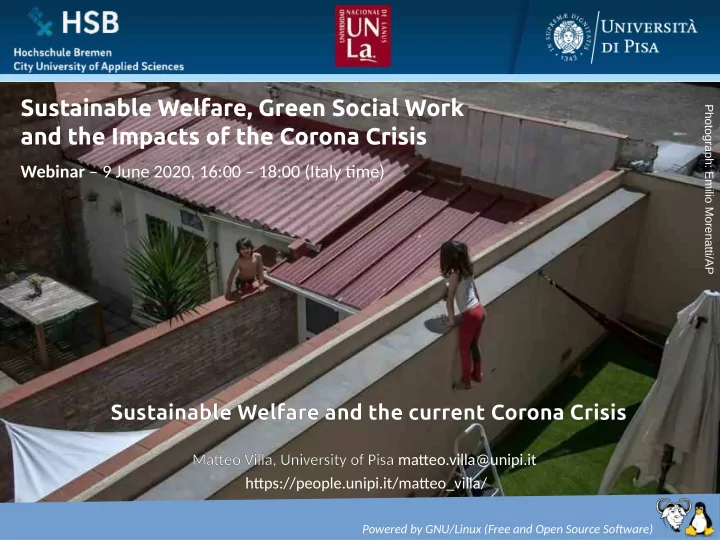
Sustainable Welfare, Green Social Work and the Impacts of the Corona Crisis

Webinar – 9 June 2020, 16:00 – 18:00 (Italy tjme)

Su Sustai ainable able Welf lfar are an and d the cu current Corona a Crisis

Matu tueo

  • Villa,

, University of Pi Pisa matueo.villa@unipi.it htups://people.unipi.it/matueo_villa/

Powered by GNU/Linux (Free and Open Source Sofuware)
P h

  • t
  • g

r a p h : E m i l i

  • M
  • r

e n a t t i / A P

slide-2
SLIDE 2

Presentation

Powered by GNU/Linux (Free and Open Source Sofuware)

  • 1. Coronavirus: an ecological crisis?
  • 2. The double bind of the ecological crisis
  • 3. Towards a sustainable welfare
  • 4. Conclusions
  • F. Hundertwasser
slide-3
SLIDE 3

Powered by GNU/Linux (Free and Open Source Sofuware)

  • 1. Coronavirus: an ecological crisis?
  • F. Hundertwasser
slide-4
SLIDE 4

Coronavirus: an ecological crisis?

Powered by GNU/Linux (Free and Open Source Sofuware)

With diffjculty and poor results, growing confmicts and ecological disasters, the ecological issues were beginning to come to the fore in a completely inadequate way ... And then Coronavirus came... Suddenly? Not really: “Experts warned of a pandemic decades ago. Why weren't we ready?” (Natjonal Geographic, and so many others….)

slide-5
SLIDE 5

Coronavirus: an ecological crisis? What kind of crisis is the coronavirus crisis?

Part of the debate prefers talking about war, enemy, state of exceptjon, normality, etc…. waitjng for a defjnitjve solutjon The war ? The normality ? The exceptjon ?

Powered by GNU/Linux (Free and Open Source Sofuware)

What about the ecological and socio-economic roots and dilemmas of Covid-19?

slide-6
SLIDE 6

Coronavirus: an ecological crisis?

“There is a single species that is responsible for the COVID-19 pandemic – us”,

The Intergovernmental Science-Policy Platform on Biodiversity and Ecosystem Services (IPBES)

  • Biodiversity destructjon
  • Forced proximity between animal and human species
  • Food industry and markets
  • Pollutjon and health efgects
  • Urbanizatjon

And political responses:

  • Health care systems and organizatjons
  • Fragmented policy (global / natjonal / local)
  • Primate of economism

Powered by GNU/Linux (Free and Open Source Sofuware)

Zone selvagge rimanentj

slide-7
SLIDE 7

Coronavirus: an ecological crisis?

A need for a deeper understanding

  • 1. Analyzing origins, spread and patuerns
  • f care and contrast of such phenomena:
  • how socio-economic and environmental

factors interact?

  • What difgerence do specifjc contexts

and eco-systems make?

  • What difgerence do specifjc

welfare systems make?

  • One example: the Lombardy-Region case

Powered by GNU/Linux (Free and Open Source Sofuware)

slide-8
SLIDE 8

Coronavirus: an ecological crisis?

A need for a deeper understanding

  • 2. Puttjng things into a wider perspectjve
  • Difgerent spatjal scales (global and local)
  • Difgerent tjme perspectjves

How we make phenomena made more or less visible through viewpoints, modes of communicatjon and rhetoric One example: the case of TBC The example: climate change

Powered by GNU/Linux (Free and Open Source Sofuware)

slide-9
SLIDE 9

Powered by GNU/Linux (Free and Open Source Sofuware)

  • 2. The double bind of the ecological crisis
  • F. Hundertwasser
slide-10
SLIDE 10
  • 2. The double bind of the ecological crisis

Refmectjng some difgerence

  • between the visibility of the coronovirus

and the one of ecological crisis (climate change, etc.)?

  • between our ways of understanding these phenomena?
  • between our way/ability to react both them?

Powered by GNU/Linux (Free and Open Source Sofuware)

How long have we been warned about climate change and its efgects?

‘ 50, ‘60, ‘70, ‘80, ‘90, …. ?

slide-11
SLIDE 11

The double bind of the ecological crisis

Powered by GNU/Linux (Free and Open Source Sofuware)

What kind of crisis is climate change?

There are strategies

  • Doing nothing (wait and see)
  • Adaptatjon
  • Conservatjon
  • Mitjgatjon
  • Geo-engineering and

technological innovatjon

Portorico 2017, Hurricane Maria. One year later

What about the ecological, socio-economic and politjcal dilemmas of climate change?

Earth th is on th the ve verge of disaster! That' t' a shame, , it t was such a co compe peti titi tive planet

slide-12
SLIDE 12

The double bind of the ecological crisis

Powered by GNU/Linux (Free and Open Source Sofuware)

  • 1. Political dilemmas ("Climate change is essentially political", Ruser 2018)
  • Need for translatjon and understanding:
  • Trade-ofgs and confmicts and approaches to deal with them.
  • No purely technical and/or economistjc solutjons:
  • Top-down and/or botuom-up strategies
  • Democratjc or undemocratjc decision-making
slide-13
SLIDE 13

The double bind of the ecological crisis

Powered by GNU/Linux (Free and Open Source Sofuware)

  • 2. Socio-economic dilemmas (ecological paradox of welfare systems)
  • I. Critjcisms: depends on growth, fuels growth, does not reduce inequalitjes.
  • Productjvism
  • Natjonal and short-term vision
  • Sometjmes brings exclusion / inequality
  • Unsustainable
  • Paradoxical efgects of care systems (inequality and medical nemesis / I. Illich)
  • II. Positjve visions: essentjal to reconcile environmental and economic challenges
  • Social justjce → environmental justjce.
  • Reducing inequalitjes that hinder environmental policies.
  • Containing efgects of environmental disasters.
  • Developing skills for supportjng mitjgatjon strategies and eco-transitjons.
slide-14
SLIDE 14

The double bind of the ecological crisis

  • 3. Ecological dilemma: Lewis Carroll's 'bread-and-butterfmy'

The fanciful dilemma of in Lewis Carroll's bread-and-butuerfmy in the story of Alice in Wonderland was that it had wings made of thin slices of bread and butuer and a head made of a lump of sugar. When Alice asks what the creature lives on, the reply comes back: 'weak tea with cream in it/ Obviously if the creature ate its food, it would die; so an optjmistjc Alice asks what would happen if it cannot fjnd any

  • food. She receives the same answer: 'it dies/

The point of Lewis Carroll's fable, Bateson repeated, was that bread-and-butuerfmies became extjnct, not for any material reason – because their heads were made of sugar, or because they could not fjnd food - but because of the impossibility of contradictory adaptatjon. 'The answer is that they became extjnct because they were caught in a dilemma, and the world is made up that way, and it is not made the linear single-purpose way [of materialist causality]. And so on ad infjnitum' (Gregory Bateson, I978c: 54; Sacred 1991: 211). (In P. Harries-Jones, 1995)

Powered by GNU/Linux (Free and Open Source Sofuware)

slide-15
SLIDE 15

Powered by GNU/Linux (Free and Open Source Sofuware)

  • 3. Towards a sustainable welfare?

(dealing with the double bind of ecological crisis)

  • F. Hundertwasser
slide-16
SLIDE 16
  • 3. Towards a sustainable welfare?

Powered by GNU/Linux (Free and Open Source Sofuware)

What can we learn from the coronavirus crisis?

  • “Discovering” values and needs kept on the margins
  • Overturning the value of work and jobs
  • Inequalities in the crisis, inequalities emerging from the crisis
  • Environmental efgects of lockdown measures
  • It is possible to do something extraordinary
  • It is possible to do it in difgerent ways (imposition / trust / accompaniment …)
  • It is possible to do things difgerently
  • ...
  • What about the welfare systems?
slide-17
SLIDE 17

Towards a sustainable welfare?

Powered by GNU/Linux (Free and Open Source Sofuware)

Some points in the sustainable welfare debate

  • 1. Eco-social investments to combine climate & social policies:
  • Social Investment welfare state? (e.g. Nordic countries)
  • Life course, fmexicurity, human capital development
  • Productjvism risks and ecological paradoxes …
  • 2. Retrenchment and/or post-growth strategies?
  • Pros, cons, difgerences of retrenchment and de-growth
  • Distjnguish between 'less' and 'difgerent’ (what is negentropic?)
  • Methodological complexitjes (degrowth by design)
  • 3. Local and botuom-up approaches?
  • Social work - social policy nexus
  • Combining difgerences and inequalitjes
  • Botuom-up and Top-down, and difgerent scale strategies
  • Methodological complexitjes and difgerent kinds of investments

We We have to change the he de develo lopment nt mode del Ple lease, fil fill l out the he fo forms

slide-18
SLIDE 18

Towards a sustainable welfare?

Powered by GNU/Linux (Free and Open Source Sofuware)

Meanings and implicatjons in terms of:

  • which social risks, needs, rights and goals
  • operatjon, organizatjon, partjcipatjon
  • scale and tjme
  • funding and resources
slide-19
SLIDE 19

Towards a sustainable welfare?

Powered by GNU/Linux (Free and Open Source Sofuware)

Work and housing

  • More or less work? More or less qualifjed? Distributed how?
  • Which / how many households for whom?
  • Compensatjon, preventjon and/or transformatjon?
  • Which policy instruments for transitjon?
slide-20
SLIDE 20

Towards a sustainable welfare?

Powered by GNU/Linux (Free and Open Source Sofuware)

Organization of production, reproduction, redistribution

  • Environmental and social as well as economic indicators, interests and goals
  • Integratjon between technological and eco-social innovatjon
  • Theory and practjce of value
slide-21
SLIDE 21

Powered by GNU/Linux (Free and Open Source Sofuware)

Conclusions

  • F. Hundertwasser
slide-22
SLIDE 22

Conclusions

Powered by GNU/Linux (Free and Open Source Sofuware)

Dealing with our obsolete ideas and previous levels of consciousness and learning

What is the nature of the problem we seek to address? “The major problems in the world are the result of the difgerence between how nature works and the way people think” (Gregory Bateson)

slide-23
SLIDE 23

Conclusions

Powered by GNU/Linux (Free and Open Source Sofuware)

Some examples:

  • The more the betuer? (Gregory Bateson)

Maximisatjon or Economics of Flexibility?

  • Which unit of survival:
  • rganism vs. organism + environment = co-evolutjon
  • Fictjtjous commoditjes (land, work, money)

and economic fallacy (Karl Polanyi)

  • Body, mind, environment (Antonio Damasio)

and ideas and approaches to wellbeing

slide-24
SLIDE 24

Conclusions

Powered by GNU/Linux (Free and Open Source Sofuware)

3 main points:

  • Overcoming the anthropocentric vision: ecological understanding
  • Dealing with organizatjonal and trans-contextual processes (nature included)
  • Learning methods for ecological transitjon

vs.

slide-25
SLIDE 25

Conclusions

  • Excluded or marginalized the understanding of the living

from social systems...

  • Designed a deeply antj-ecological socio-economic organizatjon

around short-term advantages, consuming fmexibility for adaptatjon Sustainable transitjons:

➔ No simple, linear solutjons, no easy way out ➔ Need to change even if we don't know exactly how to do it yet ➔ Looking out of the box of our ideas/experience

  • possibility to experiment
  • experiences we can learn from

Powered by GNU/Linux (Free and Open Source Sofuware)

Friedensreich Hundertwasser: “The Straight Line is Godless”

slide-26
SLIDE 26

References

  • G. Bateson (1972). Steps to an Ecology of Mind. New York: Chandler Publishing Co.
  • G. Bateson (1979). Mind and Nature. A Necessary Unity. Toronto: Bantam Books.
  • D. Bailey, (2015), The Environmental Paradox of the Welfare State: The Dynamics of Sustainability, New Politjcal Economy, Vol. 20, No. 6.
  • M. Büchs, and M. Koch (2017). Postgrowth and Wellbeing. Challenges to Sustainable Welfare, PalgraveMacMillan.
  • T.H. Eriksen, (2017), Overheatjng. An anthropology of accelelrated change, Pluto Press, London
  • A. Espinosa and J. Walker, (2011). A Complexity Approach to Sustainability. Theory and Applicatjon, Imperial College
  • T. Fitzpatrick, ed. (2011). Understanding the Environment and Social Policy. Bristol: Policy Press. Press, London.
  • I. Gough, (2017), Heat, Greed and Human Need. Climate Change, Capitalism and Sustainable Wellbeing, Eward Elgar, Cheltenham
  • P. Harries-Jones (1995). A recursive vision. Ecological Understanding and Gregory Bateson, Toronto: University of Toronto Press.
  • M. Koch and O. Mont, (2016). Sustainability and the Politjcal Economy of Welfare, London: Routledge.
  • A-L. Matuhies and K. Narhi, (2017), The ecosocial transitjon of society. The contributjon of social work and social policy. Routledge, New York.
  • K. Polanyi, (1977), The livelihood of man, New York: Academic Press.
  • A. Ruser (2018), Climate Politjcs and the Impact of Think Tanks. Scientjfjc Expertjse in Germany and the US, Palgrave MacMillan.
  • C.L.Spash (ed.) (2017). Routledge Handbook of Ecological Economics. Nature and Society. London, Routledge.
  • M. Villa, (2015), Autonomia, individualismo e paradigmi di welfare capitalism: una letuura in chiave ecologica secondo Bateson e Polanyi, in

AA.VV., Ecologia, esistenza, lavoro, a cura di M. Iofrida, Mucchi Editore, Bologna, pp. 51-70.

  • M. Villa, (2016), The transformatjve role of the social investment welfare state towards sustainability. Critjcisms and potentjalitjes in fragile

areas, Sociologia e Politjche Sociali, N. 3/2016

  • M. Villa (2019), Welfare state and ecological crisis: actjon-research perspectjves towards sustainable social policies, AGROCHIMICA.

Internatjonal Journal of Plant Chemistry, Soil Science and Plant Nutritjon of the University of Pisa, ISSN 0002-1857

  • M. Villa (2020), Crisi ecologica e nuovi rischi sociali: verso una ricerca integrata in materia di politjca sociale e sostenibilità, in Tomei G. (a cura

di), Le retj della conoscenza nella società globale, Carocci, Roma

  • M. Villa (2020) Dire, fare, pensare qualcosa di diverso: il Coronavirus come crisi ecologica, Scienza e Pace Magazine, 7 aprile 2020

Powered by GNU/Linux (Free and Open Source Sofuware)