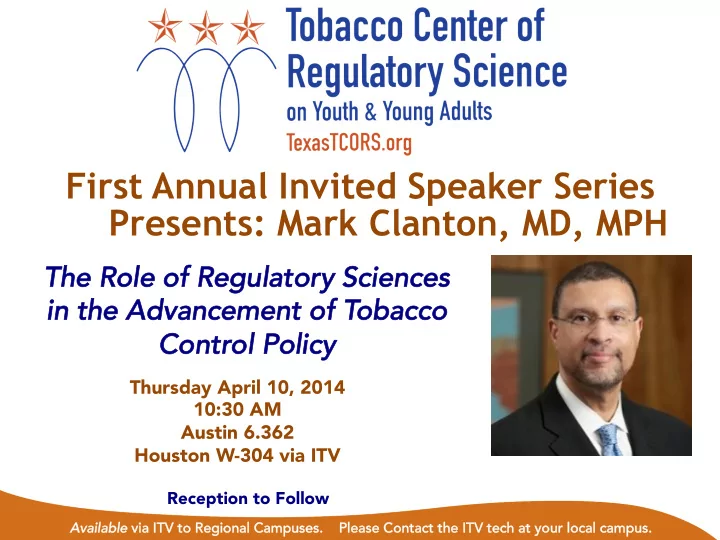
First Annual Invited Speaker Series Presents: Mark Clanton, MD, MPH - - PowerPoint PPT Presentation

first annual invited speaker series presents mark clanton
SMART_READER_LITE
LIVE PREVIEW

First Annual Invited Speaker Series Presents: Mark Clanton, MD, MPH - - PowerPoint PPT Presentation

First Annual Invited Speaker Series Presents: Mark Clanton, MD, MPH The Role of Regulatory Sciences The Role of Regulatory Sciences in the Advancement of T in the Advancement of Tobacco obacco Contr Control Policy ol Policy Thursday April


slide-1
SLIDE 1

First Annual Invited Speaker Series Presents: Mark Clanton, MD, MPH

The Role of Regulatory Sciences The Role of Regulatory Sciences in the Advancement of T in the Advancement of Tobacco

  • bacco

Contr Control Policy

  • l Policy

Thursday April 10, 2014 10:30 AM Austin 6.362 Houston W-304 via ITV

Available vailable via ITV to Regional Campuses. Please Contact the ITV tech at your local campus. via ITV to Regional Campuses. Please Contact the ITV tech at your local campus.

Reception to Follow

slide-2
SLIDE 2

Mark ¡S. ¡Clanton, ¡MD, ¡MPH ¡

  • Independent health care consultant for National Cancer Institute designated Cancer

Centers

  • Inaugural voting member of the Food and Drug Administration's Tobacco Products

Scientific Advisory Committee

  • Deputy director of National Cancer Institute-2004 to 2006 Recipient of two Secretary
  • f Health and Human Service Distinguished Service Awards during his NCI tenure.
  • Former Chief Medical Officer and VP of Pharmacy

Programs of Blue Cross Blue Shield of Texas. Undergraduate degree from Howard University in Washington, D.C.

  • Medical degree from Tulane University Medical School in

New Orleans, LA

  • Pediatric training at Baylor Pediatric Residency Program

in Houston, TX

  • MPH with a concentration in Health Policy and

Management from the Harvard University School of Public Health. ¡

slide-3
SLIDE 3

The Tobacco Center of Regulatory Science on Youth and Young Adults 1st Annual Invited Speaker Series April 10 University of Texas School of Public Health

  • Dr. Mark Clanton, M.D., M.P.H

THE ROLE OF REGULATORY SCIENCES IN THE ADVANCEMENT OF TOBACCO CONTROL POLICY

slide-4
SLIDE 4

DISCLOSURE

  • Former Inaugural Tobacco Products Scientific Advisory Committee voting member
  • Current Special Government employee of the U.S. Food and Drug Administration
  • Views represented in this presentation are the speakers alone and do not represent

any official position or policy of the Food and Drug Administration or the Tobacco Product Scientific Advisory Committee.

  • No financial conflicts to disclose
slide-5
SLIDE 5

KEY CONCEPTS

  • A word about knowledge creation and translation and Tobacco Centers for Regulatory

Science

  • Family Tobacco Prevention Act Authorization of the FDA to regulated Tobacco Products
  • U.S. Food and Drug Administrations Tobacco Regulatory role
  • FDA Center for Tobacco Products Tobacco Products Scientific Advisory Committee
slide-6
SLIDE 6

KEY CONCEPTS

  • Tobacco Centers for Regulatory of Regulatory Science (TCORS)
  • Translational Engines supporting regulatory science for

tobacco policy

  • Translational Science (Regulatory Science)
slide-7
SLIDE 7

KEY CONCEPTS

  • Unregulated tobacco products and research into taste

perception, tobacco initiation, use and mixed use

  • Concepts important to the performance of the TCORs
  • The importance of Translational and Regulatory Science as

applied to or expressed through the TCORs

slide-8
SLIDE 8

EPISTEMOLOGY AND HUMAN HEALTH RESEARCH

  • Epistemology is a branch of philosophy concerned with the

nature, scope and acquisition of knowledge

  • Practical aspects of the field:
  • The field also focuses on how knowledge relates to the

connected notions of truth, belief and justification

  • This field provides the philosophical underpinnings of Basic

Scientific Inquiry (pure science)

  • 1. Encyclopedia of Philosophy, Vol. 3, 1969. 2. http://en.wikipedia.org/wiki/Epistemology
slide-9
SLIDE 9

THE YIN AND YANG OF BASIC VS. TRANSLATIONAL SCIENCE

  • Hence, we do not view basic and translational science as one being more

important than the other but rather as complementary areas of human endeavor, with the important distinction that basic science findings often precede advances in translational science.

  • We also note that observations in translational or applied science can

generate new questions for fundamental research, as illustrated from the fact that vaccination preceded the field of immunology.

  • Hence, the epistemological flow is bidirectional, and investments in both

types of science are needed.

Lost in Translation-Basic Science in the Era of Translational Research, Fang, Casadevall Infect Immun. Feb 2010; 78(2); 563-566

slide-10
SLIDE 10

EPISTEMOLOGY AND HUMAN HEALTH

  • The study of knowledge and knowing speaks directly to the

belief that scientific inquiry for its own sake is sufficient.

  • However the epistemological notions of truth (evidence) and

belief (behavior) are also central to understanding human health.

  • Biomedical and public health research will always target the

ultimate goal of use (translation) of basic research knowledge for the purpose of preventing premature death and the elimination of suffer from disease

slide-11
SLIDE 11

TCOR TEAMS

  • TCOR investigators and teams while attempting to understand

the answers to specific research questions(knowledge), must vigilantly keep a eye toward translation.

  • The findings will be used both to inform the field and specifically used to

shape

  • Tobacco Regulatory Science
  • Tobacco Regulator Policy
  • Tobacco Legislation
  • High Utility to Tobacco control interventions
slide-12
SLIDE 12

JOHANN WOLFGANG GOETHE

Knowing is not enough, we must apply Willing is not enough; we must do

slide-13
SLIDE 13

FAMILY SMOKING PREVENTION AND TOBACCO CONTROL ACT

slide-14
SLIDE 14

FAMILY SMOKING PREVENTION AND TOBACCO CONTROL ACT

The legislation was sponsored by

U.S. Reps. Henry Waxman (D-CA) and Todd Platts (R-PA) and the late U.S. Senator Edward Kennedy (D- MA).

June 22, 2009, President Obama

signed into law the Family Smoking Prevention and Tobacco Control Act, which gives the U.S. Food and Drug Administration the authority to regulate tobacco. Pub. L. 111-31

slide-15
SLIDE 15

FSPTCA AND THE FDA

Amends the Federal Food, Drug, and Cosmetic Act (FFDCA) to provide for the regulation of tobacco products by the Secretary of Health and Human Services through the Food and Drug Administration (FDA) Defines a tobacco product as any product made or derived from tobacco that is intended for human consumption.

slide-16
SLIDE 16

DIRECTS THE SECRETARY TO ESTABLISH THE CTP WITHIN THE FDA

(1) the Center for Tobacco Products to implement this Act; (2) an identifiable office to provide technical and other nonfinancial assistance to assist small tobacco product manufacturers in complying with this Act.

slide-17
SLIDE 17

ALLOWS THE SECRETARY TO REQUEST ADDITIONAL INFORMATION FROM A TOBACCO PRODUCT MANUFACTURER OR IMPORTER

(1) research activities or findings on the effects of

tobacco products and their constituents and on whether the health risk can be reduced if the manufacturer employs known or available technology; (2) marketing research or practices used by manufacturers or distributors. (3) Sets forth notifications that manufacturers must make to the Secretary regarding any change in a tobacco product. Requires the Secretary to publicly display and annually publish a list (that is understandable and not misleading to a lay person) of harmful or potentially harmful constituents in each tobacco product by brand and quantity.

slide-18
SLIDE 18

REQUIRES TOBACCO MANUFACTURERS OR IMPORTERS TO SUBMIT TO THE SECRETARY

(1) a listing of all ingredients, including ingredients added by the manufacturer to the tobacco, paper, or filter, by brand and quantity; (2) a description of the content, delivery, and form of nicotine in each tobacco product; (3) a listing of all constituents, including smoke constituents, identified by the Secretary as harmful or potentially harmful to health in each tobacco product; (4) all documents developed that relate to the health, toxicological, behavioral, or physiologic effects of tobacco products and their constituents, ingredients, components, and additives.

slide-19
SLIDE 19

ALLOWS THE SECRETARY TO REQUIRE PRIOR APPROVAL OF ALL LABEL STATEMENTS ON TOBACCO PRODUCTS TO ENSURE THAT SUCH STATEMENTS

(1) do not violate misbranding

provisions;

(2) comply with other

provisions of this Act.

slide-20
SLIDE 20

THE FSPTA ACT PROVIDES FOR AN FDA SCIENTIFIC ADVISORY COMMITTEE

  • The ACT creates, along with the Center for Tobacco Products,

the Tobacco Products Scientific Advisory Committee

  • TPSAC review and advisory responsibilities and authority
  • TPSAS Congressionally mandated reports
slide-21
SLIDE 21

The Committee may review

new tobacco products or petitions for exemptions under Section 906(e)

The Committee may provide

recommendations to the Secretary regarding any regulations to be promulgated under the act

TOBACCO PRODUCTS SCIENTIFIC ADVISORY COMMITTEE

slide-22
SLIDE 22

TPSAC reviews and evaluates

safety, dependence, and health issues relating to tobacco products and provides appropriate advice, information and recommendations to the Commissioner of Food and Drugs.

TOBACCO PRODUCTS SCIENTIFIC ADVISORY COMMITTEE

slide-23
SLIDE 23

The TPSAC advises the

commissioner in discharging responsibilities as they relate to the regulation of tobacco products

TOBACCO PRODUCTS SCIENTIFIC ADVISORY COMMITTEE

slide-24
SLIDE 24

Effects of the alteration of

nicotine yields from tobacco products

Level where nicotine

yields do not produce dependence

TOBACCO PRODUCTS SCIENTIFIC ADVISORY COMMITTEE

slide-25
SLIDE 25

Any application submitted by a

manufacturer for a modified risk tobacco product

TOBACCO PRODUCTS SCIENTIFIC ADVISORY COMMITTEE

slide-26
SLIDE 26

CONGRESSIONALLY MANDATED REPORTS

slide-27
SLIDE 27
  • The Committee will submit reports or

recommendations on tobacco related topics including:

  • Impact of the use of menthol in

cigarettes on the public health

  • Children
  • African Americans
  • Hispanics
  • Other racial and ethnic minorities

TOBACCO PRODUCTS SCIENTIFIC ADVISORY COMMITTEE

slide-28
SLIDE 28

Nature and impact of the

use of dissolvable tobacco products

  • Public health
  • Children

TOBACCO PRODUCTS SCIENTIFIC ADVISORY COMMITTEE

slide-29
SLIDE 29

TRANSLATIONAL AND REGULATORY SCIENCE

  • The translation of knowledge (define) is the process by which scientific

knowledge is used to address human health

  • Regulatory Science is a subset of Translational science and refers broadly to the

scientific and technical foundations upon which regulations are based in various industries- particularly those involving heath and safety

  • Consistent with its mission, the FDA suggest that,
  • “Regulatory science is the science of developing new tools, standards and

approaches to assess the safety, efficacy, quality and performance of FDA- related products”.

FDA (Food and Drug Administration) The Promise of regulatory science FDA 2010 www.fda.gov/scienceResearch/specialtopics/RegulatoryScience/ucm2282002.htm, http://en.wikipedia.org/wiki/Regulatory_science

slide-30
SLIDE 30

TRANSLATIONAL RESEARCH

"Translational research transforms scientific discoveries arising from laboratory, clinical, or population studies into clinical applications to reduce cancer incidence, morbidity, and mortality.” President’s Cancer Panel 2004-2005

slide-31
SLIDE 31
slide-32
SLIDE 32

FLAVORED TOBACCO PRODUCTS OTHER THAN CIGARETTES NOT REGULATED UNDER THE FSPTCA

  • Flavored little cigars/cigarillos
  • E-cigarettes including flavored e-cigarettes.
  • Hookahs
  • Flavored smokeless
slide-33
SLIDE 33

FLAVORED PRODUCT MAY SUGGEST LOWER RISK AND THAT THE PRODUCTS ARE HEALTHY

slide-34
SLIDE 34

TEAM ORIENTED APPROACHES TO ADVANCE REGULATORY RESEARCH ON UNREGULATED FLAVORED TOBACCO

  • Very little in known about how young adult cigarette smokers form risk

perceptions of flavored little cigars and cigarillos (LCC) and how these perceptions influence susceptibility and intention to use these products among current smokers. Flavored LCCs are popular among young adults aged 18-34 and racial ethnic groups including African Americans, Hispanics and Whites. In order to accurately determine risk perceptions, sensitive and reliable measures are urgently needed.

slide-35
SLIDE 35

REGULATORY SCIENCE 1R21CA180934-01: ASSESSING RISK PERCEPTIONS OF FLAVORED SMALL CIGARS/ CIGARILLOS AMONG YOUNG ADULTS

PI: Kymberle Sterling, Dr.PH, M.P.H., Georgia State University Co-Investigators: Pebbles Fagan, Ph.D., M.P.H., University of Hawaii; Craig Fryer, Dr.PH., M.P.H., University of Maryland Study Aims: Aim 1: Use qualitative methods to elicit young adult cigarette smokers’ beliefs, feelings, and knowledge about flavored LCCs and their risks. 12 focus groups are being conducted in Atlanta to elicit these beliefs, which will inform Aim 2, scale construction. Aim 2: To develop a new LCC risk perceptions scale.

  • Tobacco control experts will review the scale and determine if the scale items represent specific

domains of interest. Aim 3: Based on the Theory of Planned Behavior, the team will determine what factors predict flavored LCC susceptibility and intention to smoke flavored LCCs. An online survey will be conducted using a national probability sample of 18-34 year old cigarette smokers who are African American, Hispanic, and White (N=900).

slide-36
SLIDE 36

REGULATORY SCIENCE R21: ASSESSING RISK PERCEPTIONS OF FLAVORED SMALL CIGARS/ CIGARILLOS AMONG YOUNG ADULTS

Intended Outcomes 1) produce a tool to assesses LCC risk perceptions that will inform health communication messages that convey accurate risks about LCC smoking 2) provide data that will assist the the prevention of initiation of LCCs; and 3) help the FDA make a determination about the appropriateness to exert its jurisdiction

  • ver flavored LCCs.

The LCC risk perception scale can be modified easily to explore risk perceptions for other tobacco products (i.e. hookah) that are not covered by the regulatory jurisdiction of the FDA.

slide-37
SLIDE 37

PENDING GRANTS ON FLAVORED TOBACCO USE

Sensory Perceptions and Smoking Maintenance Among Young Adult Daily Smokers (R01 FDA/NCI)

  • Goal: increase our understanding of how menthol’s sensory effects appeal to different taster

groups and reinforce smoking behaviors among vulnerable young adult racial ethnic groups.

  • M-PIs: Pebbles Fagan, Andy Johnson, Kymberle Sterling
  • Co-Is: Thaddeus Herzog, Pallav Pokhrel, Dennis Trinidad, Reinhold Penner
  • Consultant Team Member: Mark Clanton

Sensory Perceptions of Flavored Tobacco Products Among Vulnerable Young Adults (ACS)

  • Goal: Develop a sensory perception scale and revised sensory outcome expectancy scale for

flavored tobacco/nicotine users (menthol, e-cigarettes, little cigars/cigarillos)

  • PI: Pebbles Fagan
  • Co-Is: Thaddeus Herzog, Pallav Pokhrel, Kevin Cassel, Ian Pagano
  • Consultant Team Member: Mark Clanton
slide-38
SLIDE 38

CHALLENGES WITH UNREGULATED PRODUCTS AND RESEARCH TRANSLATION

  • Scientific findings related to these products may not have broad-based

population impact to reduce associated disease risk.

  • FDA has been slow to introduce new product regulation and its been 3 years

since the first TPSAC on menthol cigarettes was published in 2011.

  • Industry has the opportunity to continue to put new products on the market,

including new nicotine delivery devices that could be helpful, but could also be harmful to consumers including young vulnerable groups.

  • Thus, there are opportunities for the diffusion of new products much faster

than the rate of translation to benefit populations.

slide-39
SLIDE 39

TIME TO TRANSLATION

Discovery Translation FDA Translation to Practice Wide Acceptance

Time Line: Greater than 17 to 20 years

slide-40
SLIDE 40

Team Science: Important to Regulatory Science and Translation

  • Team science is a collaborative effort to address a

scientific challenge that leverages the strengths and expertise of professionals trained in different fields (NCI).

  • Single/individual researchersè integrated

approaches.

  • Brings together researchers who otherwise would

not work together.

  • Provides opportunity to raise/explore hypotheses

that would otherwise not be addressed.

  • Diverse expertise pushes researchers beyond

comfort zones to address complex problems.

slide-41
SLIDE 41

CONCLUSION: TCOR RAISON D’ETRE

  • Collaborative research team approach
  • The NIH Tobacco Regulatory Science Program in the Office of Disease Prevention is

collaborating with the FDA Center for Tobacco Products to fund the TCOR.

  • Develop regulatory scientific knowledge
  • The TCORs where developed to support the development of regulatory scientific

knowledge that will be used to regulate the manufacture, marketing and labeling of tobacco products

  • Create and Synthesize knowledge for regulatory action
  • The purpose of the TCORs to ensure that U.S. tobacco regulatory actions are

based on sound and relevant scientific evidence.

slide-42
SLIDE 42

“The important thing in science is not so much to obtain new facts as to discover new ways of thinking about them.”

  • Sir William Braggs (Noble Prize in Physics)
slide-43
SLIDE 43

“THE HIGHEST AND BEST PURPOSE OF BIOMEDICAL SCIENCE IS REALIZED WHEN THE KNOWLEDGE DERIVED FROM RESEARCH IS USED TO IMPROVE THE HUMAN CONDITION.”

Mark Clanton, MD, MPH NIH Clinical Center MLK Day Proceedings