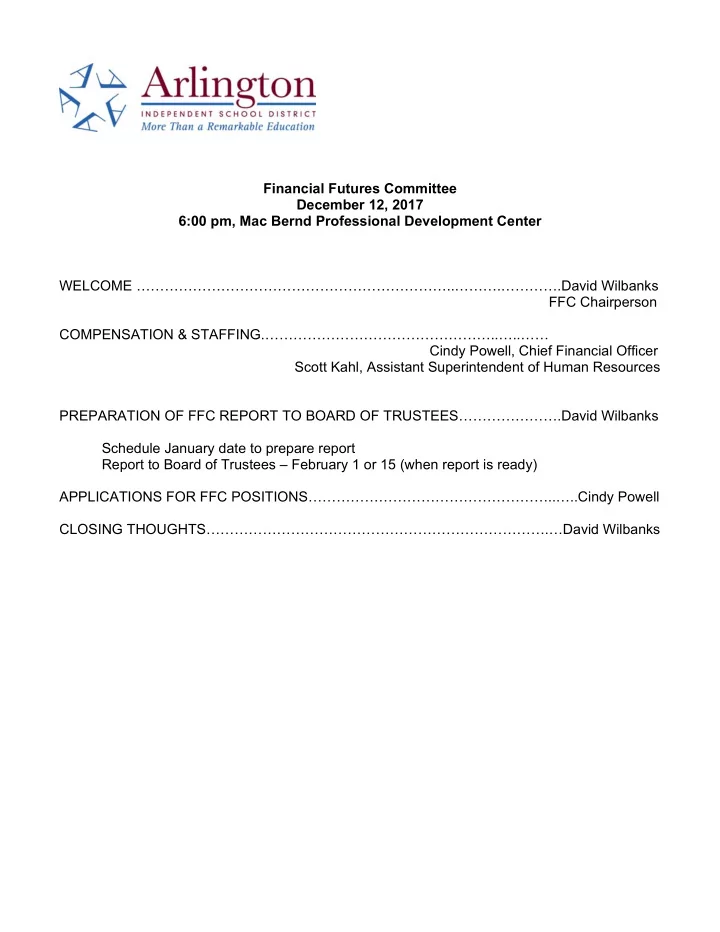
Financial Futures Committee December 12, 2017 6:00 pm, Mac Bernd Professional Development Center WELCOME …………………………………………………………..……….………….David Wilbanks FFC Chairperson COMPENSATION & STAFFING.…………………………………………..…..…… Cindy Powell, Chief Financial Officer Scott Kahl, Assistant Superintendent of Human Resources PREPARATION OF FFC REPORT TO BOARD OF TRUSTEES………………….David Wilbanks Schedule January date to prepare report Report to Board of Trustees – February 1 or 15 (when report is ready) APPLICATIONS FOR FFC POSITIONS……………………………………………..…..Cindy Powell CLOSING THOUGHTS……………………………………………………………….…David Wilbanks
Financial Futures Committee December 12, 2017 6:00 pm, Mac Bernd - - PDF document
Financial Futures Committee December 12, 2017 6:00 pm, Mac Bernd Professional Development Center WELCOME ....David Wilbanks FFC Chairperson COMPENSATION
12/12/2017 1
Staffing & Compensation
December 12, 2017
FFC Purpose
- to provide findings and recommendations from
community stakeholders to the Board of Trustees (“Board”) relating to budgets and long-range financial planning to support the District’s Strategic Plan.
2
12/12/2017 2
FFC Charge
- Review external and internal data on issues relating to
Texas public education, including the school finance and accountability systems and Texas bond election laws, to understand how those issues affect AISD’s budget, tax rates and long-range financial planning.
- Review the District’s strategic plan to understand the
impact that the strategic plan may have on the budget, tax rates and long-range financial planning.
- Review the current general operating budget to gain an
understanding of cost drivers and financial trends.
3
FFC Charge
- Review data including, but not limited to, the following topics
in order to assess the impact on AISD budgets and provide input, as appropriate:
- Enrollment trends and projections
- Property value trends and projections
- Academic Services priorities and operational efficiency priorities
presented to the Committee by the AISD administration
- Current staffing methods in relation to state education law
and current administration protocol
- Compensation and benefits, including available salary market
information, health insurance and wellness plan
- Operating costs associated with bond projects
4
12/12/2017 3
FFC Charge
- Present advisory, consensus reports and
recommendations to the administration and Board annually or more frequently, if necessary, regarding the AISD budget and long-range financial plans.
5
Big Picture
- Long-range planning must consider strategic plan,
budget, legislative actions & inactions, program
- fferings & designs, facility needs
6
12/12/2017 4
FFC Review
FFC Meeting Topics Covered 3‐28‐17 Review of General Operating Budget 4‐11‐17
- Texas School Finance System
- Property Values
5‐15‐17
- Strategic Plan: Strategies & Activities for 2017‐18
- Financial Comparison Data
8‐15‐17
- Overview of 2017‐18 Budget & Tax Rate
- Legislative Update (no additional state aid approved)
10‐10‐17 Enrollment Trends & Enrollment Management 12‐12‐17 Staffing and Compensation
7
Achieve Today. Excel Tomorrow. Strategic Plan
8
12/12/2017 5
- Target resources to support achievement growth
- Competitive compensation
- Staffing ratios approved before staffing process
begins
- Balanced budget with limited use of fund
balance
- Prioritize budget reductions with least negative
impact on classroom
Budget Parameters Board Policy CE (LOCAL)
9
Board Policy CE (LOCAL)
Competitive Compensation:
“The Board seeks to maintain competitive compensation levels in an effort to recruit and retain a highly qualified workforce and shall consider adjustments necessary for the District to be competitive in this area.”
Staffing Ratios:
“Staffing ratios shall meet or exceed state standards and shall be approved by the Board before the staffing process begins.”
10
12/12/2017 6
Expenditure Budget
Payroll 86%
Purchased & Contr. Services 7% Supplies & Materials 3% Other Oper. Costs 2% Debt Service 0% Capital Outlay 2%
2017‐18 Expenditures $527,264,863
11
2017-18 Adopted Budget General Fund Budget
2016‐17 Original Budget 2016‐17 Actual 2017‐18 Adopted Budget
- Diff. From
16‐17 Orig. Budget Beginning Fund Balance $204,724,888 $204,724,888 $194,182,743 Revenues $497,219,744 $515,346,024 $497,836,694 $616,950 Expenditures $511,854,280 $501,541,438 $516,517,343 4,663,063 Operating Surplus/(Deficit) ($14,634,536) $13,804,586 ($18,680,649) ($4,046,113)
12
12/12/2017 7
2017-18 Adopted Budget General Fund Budget
2016‐17 Original Budget 2016‐17 Actual 2017‐18 Adopted Budget
- Diff. From
16‐17 Orig. Budget Beginning Fund Balance $204,724,888 $204,724,888 $194,182,743 Revenues $497,219,744 $515,346,024 $497,836,694 $616,950 Expenditures $511,854,280 $501,541,438 $516,517,343 4,663,063 Operating Surplus/(Deficit) ($14,634,536) $13,804,586 ($18,680,649) ($4,046,113) Capital Projects from Surplus Fund Balance
(Sam Houston 9th Grade Center, Property Acquisition)
$17,100,000 $19,076,239 $10,747,520 ($6,352,480) Net Surplus/(Deficit) ($31,734,536) ($5,271,653) ($29,428,169) $2,306,367 Ending Fund Balance $172,990,352 $199,453,235 $164,754,574
Key Points
- Success depends on effective teaching and leadership
- Relevant, innovative and rigorous learning experiences
- Align resources, including staffing, to curriculum outcomes
and instructional priorities
Strategic Plan
- Staff tightly to enrollment projections (i.e., “right‐size” staff
to enrollment) to manage the budget
- Competitive, responsible compensation
Budget Control
- Campus staffing is based on district enrollment projections
and is a formulaic process.
- Exceptions are made where appropriate to address special
circumstances
Staffing
14
12/12/2017 8
Student Enrollment History
62,863 63,045 63,487 64,484 64,705 65,001 64,688 63,893 63,405 62,180 61,133 ‐ 10,000 20,000 30,000 40,000 50,000 60,000 70,000 07‐08 08‐09 09‐10 10‐11 11‐12 12‐13 13‐14 14‐15 15‐16 16‐17 17‐18 Est.
2,821 (or 4.3%) decline since 12-13
Data Source: Fall PEIMS submissions
15
General Fund Highlights
- Net change in staff FTEs:
- Campus staffing formulas
(195.9)
- Gifted & Talented teachers
17.0
- Dan Dipert Career Tech Center
13.0
- STEM lab managers
34.0
- Administrative Recommendations
22.0*
- Net Reduction
(109.9) * Including 3 positions that have $0 impact on budget because their cost will be completely offset by reductions in contracted services or workers compensation.
16
12/12/2017 9
Compensation
Scott Kahl Assistant Superintendent of Human Resources
17
PAY SYSTEM OBJECTIVES
- Recruit Employees
– Competitive entry rates – Competitive pay for experienced new hires
- Retain Employees
– Pay increases – Market competitive
- Pay for Job Value
– Maintain fairness – Prevent
- verpayment or
underpayment
- Control Costs
– Salary plan and increases driven by budget
18
12/12/2017 10
Pay System Basics
- Salary schedule is organized by different employee
groups
- Teachers, administrative/professional, educational aides,
technology, administrative support, auxiliary
- Separate pay grades within each group
- Each pay grade has a salary/wage range representing
market value
- Minimum, mid-point, maximum
- Mid-point represents market median for each pay grade
- Positions are assigned to the pay grade reflecting
market value
19
Pay System Review
- Performed annually in conjunction with TASB
- Salary range adjustments are made, as appropriate, to reflect
market
- The goal of this study is a balance between internal equity
and external competitiveness
- Compensation Objectives
- Employer of Choice
- Offerings that distinguish AISD from other districts
- Market Competitiveness
- Strive to pay at market
- Compensation Components
- Benefits/incentives that provide balance to salaries
20
12/12/2017 11
2016-17 AISD Salary Market Comparison
$52,496 $53,630 $54,366 $56,102 $58,733 $51,100 $53,000 $54,805 $56,600 $57,943 $46,000 $48,000 $50,000 $52,000 $54,000 $56,000 $58,000 $60,000 0 Years 5 Years 10 Years 15 Years 20 Years AISD Local Market
21 22
12/12/2017 12
23 24
12/12/2017 13
25 26
12/12/2017 14
2017-18 Salary Increases
- A 2.25% increase was granted to all employees
- Returning teachers and librarians with 8-18 years of
experience were granted equity adjustments to close the gap with comparison districts by 50%
27
68% 17% 6% 5% 4%
Total Experience of Newly Hired Teachers, Librarians, and Nurses, 2016‐2017
0 Years (394) 1 to 5 Years (98) 6 to 10 Years (37) 11 to 15 Years (28) 16+ Years (23)
28
12/12/2017 15
Annual Considerations
- Market analysis and salary range modification
- Market analysis of stipends
- New positions
- Academic Services Priorities
- Operations
- New Facilities
- Salary increases to effect market competitiveness
- 1% salary increase costs $3.7 million based on actual salaries
- 1% salary increase costs $4.0 million based on mid-point
- Ongoing review of competitive starting rates and equity
- Targeted reviews/adjustments to address specific recruitment & retention
challenges
- Benefits – TRS options; ACA Compliance
29
Staffing Ratios
30
12/12/2017 16
Overview
- Campus administration and district departments (Human
Resources, Curriculum & Instruction and Finance) work collaboratively to ensure staffing is aligned with the priorities
- f the strategic plan.
- Student enrollment and program needs are the driving
components of the staffing process.
- Staffing of teachers is based on district enrollment projections
and is a formulaic process.
- Formulas are used to staff schools equitably & to control costs
31
Key Points
- Elementary staffing is driven by state compliance ratios and
district initiatives
- Secondary principals have discretion in terms of subject area,
how to expend local FTEs to best meet needs of individual campus
- Secondary staffing is also driven by the master schedule.
Developing the master schedule at the secondary level is a very complex process with multiple variables
32
12/12/2017 17
2018-19 Staffing Ratios & Formulas
Campus Core
2017-18 Ratio/Units 2018-19 Ratio/Units Area Elementary Junior High High School Elementary Junior High High School Pre K – 4th
22:1 N/A N/A
Unchanged N/A N/A 5th
26:1 (target) N/A N/A
Unchanged N/A N/A 6th
26:1 (target) N/A N/A
Unchanged N/A N/A Elementary Art, Music, PE Assistant
1 FTE each N/A N/A
Unchanged N/A N/A Elementary PE
1 < 800 2 > 800 N/A N/A
Unchanged N/A N/A Elementary Orchestra
.4 FTE N/A N/A
Unchanged N/A N/A Secondary Staffing
N/A ((Projected Student Enrollment x Total Class Periods) ÷ Average Students Per Class) ÷ Classes Taught By Teacher (target: 27:1)
N/A Unchanged Special Education
Formulas vary by program and allow for flexibility based on student basis or programmatic needs
Unchanged
Administrators
2017-18 Ratio/Units 2018-19 Ratio/Units Position Elementary Junior High High School Elementary Junior High High School Principal
1 1 1
Unchanged Unchanged Unchanged Academic Dean
N/A N/A 1
Unchanged Unchanged Unchanged Assistant Principal
1 < 1,000 2 < 1,000 5 < 2,000
Unchanged Unchanged Unchanged
students students students 2 > 1,000 3 > 1,000 6 > 2,000-2,999 Alt Campus = 1 7 > 3,000 Alt Campus = 1
Counselor
1 350 to 1 ratio 350 to 1 ratio
Unchanged Unchanged Unchanged
33
Campus Support
2017-18 Ratio/Units 2018-19 Ratio/Units Position Elementary Junior High High School Elementary Junior High High School Athletic Coord N/A 1* 1 Unchanged Unchanged Unchanged Attendance Officer N/A N/A 1** Unchanged Unchanged Unchanged Librarian 1 1 1 Unchanged Unchanged Unchanged Library Assistant N/A N/A 1 Unchanged Unchanged Unchanged Campus Tech Mgr 1 1 1 Unchanged Unchanged Unchanged LAN Tech N/A N/A 1 Unchanged Unchanged Unchanged Guidance Tech/ Testing Facilitator 1 1 1 Unchanged Unchanged Unchanged Pre-K TA’s 1/PK Teacher N/A N/A Unchanged Unchanged Unchanged Kinder TA’s 1-4 TA’s depending on # of sections N/A N/A Unchanged Unchanged Unchanged Secretary 1 1 1 Unchanged Unchanged Unchanged Attendance Clerk 1 < 800 1 < 1,000 same as Unchanged Unchanged Unchanged students students number of 2 > 800 2 > 1,000 AP’s Data Clerk N/A 1 2 Unchanged Unchanged Unchanged Bookkeeper N/A N/A 1 Unchanged Unchanged Unchanged PEIMS Clerk N/A N/A 1 Unchanged Unchanged Unchanged Registrar N/A N/A 1 Unchanged Unchanged Unchanged Nurse 1 1 1 Unchanged Unchanged Unchanged SRO N/A .5 – 1*** 1 Unchanged Unchanged Unchanged Security Officer N/A 1 Assignments based on need Unchanged Unchanged Unchanged Custodian 1 per 30,374 sf (3 FTE min) 1 per 30,374 sf (5 FTE min) 1 per 30,374 sf (12 FTE min) Unchanged Unchanged Unchanged Cafeteria Monitor 2 < 500 students 3 > 500 to 999 4 > 1,000 N/A N/A Unchanged Unchanged Unchanged
Adjustments to formulas may be made based on campus specific need: An adjustment to the class size ratios may be made when a principal provides a justification for the request. This request and justification are considered by a committee consisting of the appropriate Area Superintendent, the Chief Financial Officer and the Director of Human Resources - Customer Service. * Junior High Athletic Coordinators are teachers who receive a stipend for duties ** Attendance officers serve the network, not just the high school *** Several JH’s share SRO’s – Young & Boles, Bailey & Gunn
34
12/12/2017 18
FFC Next Steps
35
Big Picture
- Long-range planning must consider strategic plan,
budget, legislative actions & inactions, program
- fferings & designs, facility needs
36
12/12/2017 19
FFC Review
Meeting Topics Covered Key Points 3‐28‐17 Review of General Operating Budget
- Revenues are determined by combination of property
values, tax rate and state aid formulas
- Districts have limited control over revenues
- Align resources with priorities
- Payroll represents 86% of total budget
4‐11‐17
- Texas School Finance System
- Property Values
- As property values increase, state aid decreases
- Modest growth in values if projected over next four
years
- M&O tax rate is $1.04 & can only be raised with voter
approval thru a Tax Ratification Election (TRE)
- Absent additional funding from the state, districts will
be forced at some point to make difficult budget choices
- Raise the M&O tax rate thru a TRE
- Spend fund balance
- Make budget reductions, which may reduce
- pportunities for students
37
FFC Review
Meeting Topics Covered Key Points 5‐15‐17
- Strategic Plan: Strategies & Activities for
2017‐18
- Financial Comparison Data
- Strategic Plan is organized into four performance
- bjective categories with strategies sequenced across
five years
- Strategies include new instructional programming
including a redesign of the elementary G/T program and expanded world language programs
- Strategies may impact budget
- AISD spends less per student than state average and
its 12 comparison districts
- AISD concentrates more of its operating expenditures
- n instruction than 11 of its 12 comparison districts
8‐15‐17
- Overview of 2017‐18 Budget & Tax Rate
- Legislative Update
- 2017‐18 Budget has operating deficit of $18.7 M
- Opening Career Tech Center & Ag Science Center
- Salary increase of 2.25% for all employees & equity
adjustments for teachers with 8‐18 years exp.
- Unassigned fund balance equals approximately 4
months of operating expenditures
- No new funding appropriated by 85th Legislature
38
12/12/2017 20
FFC Review
Meeting Topics Covered Key Points 10‐10‐17 Enrollment Trends & Enrollment Management
- Changes in enrollment impact state aid & expenditures
- Enrollment has declined 4.3% since 12‐13 and is
forecast to continue declining
- Greatest decline has occurred at elementary level
- Competition from charters and neighboring ISDs
- AISD has open transfer policy & plans to eliminate all
transfer fees
- Enrollment management strategies include staffing
tightly to enrollment projects, program offerings, marketing, facilities
- Facilities must provide relevant learning spaces
12‐12‐17 Staffing and Compensation
- Success depends on effective teaching and leadership
- Relevant, innovative and rigorous learning experiences
- Align resources, including staffing, to curriculum
- utcomes and instructional priorities
- Staff tightly to enrollment projections to manage budget
- Competitive, responsible compensation
39
Next Steps
- FFC meets in January (committee sets date) to
develop a report to present to the Board of Trustees
- Discussion to develop recommendations for report
to Board:
- What are our biggest long-range challenges?
- How can we best address those challenges?
40
12/12/2017 21
Questions?
41