
SLIDE 1
Filtering and Robot Localization
Robert Platt Northeastern University
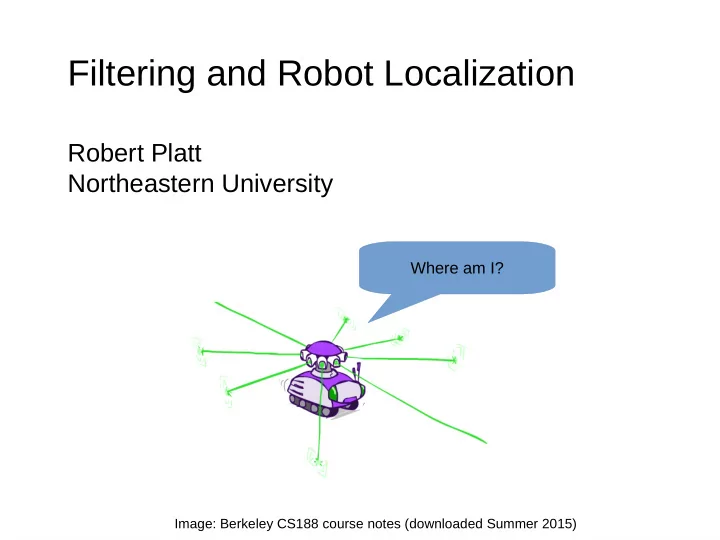
Where am I?
Image: Berkeley CS188 course notes (downloaded Summer 2015)
Filtering and Robot Localization Robert Platt Northeastern - - PowerPoint PPT Presentation
Filtering and Robot Localization Robert Platt Northeastern University Where am I? Image: Berkeley CS188 course notes (downloaded Summer 2015) Robot localization example Robot is actually located here, but it doesn't know it. Prob Gray level
Where am I?
Image: Berkeley CS188 course notes (downloaded Summer 2015)
Image: Berkeley CS188 course notes (downloaded Summer 2015)
Robot is actually located here, but it doesn't know it. Goal: localize the robot based on sequential observations – robot is given a map of the world; robot could be in any square – initially, robot doesn't know which square it's in Gray level denotes estimated probability that robot is in that square
Image: Berkeley CS188 course notes (downloaded Summer 2015)
Gray level denotes estimated probability that robot is in that square On each time step, the robot moves, and then observes the directions in which there are walls. – observes a four-bit binary number – observations are noisy: there is a small chance that each bit will be flipped. Robot perceives that there are walls above and below, but no walls either left or right
Image: Berkeley CS188 course notes (downloaded Summer 2015)
Image: Berkeley CS188 course notes (downloaded Summer 2015)
Image: Berkeley CS188 course notes (downloaded Summer 2015)
Image: Berkeley CS188 course notes (downloaded Summer 2015)
Question: how do we update this probability distribution from time t to t+1?
Process dynamics: Observation dynamics: How the system changes from
What gets observed as a function of what state the system is in
Process dynamics: Observation dynamics: How the system changes from
What gets observed as a function of what state the system is in Let's assume (for now) that these probability distributions are given to us.
Process dynamics: Observation dynamics:
Process dynamics: Observation dynamics: Markov assumptions
Rt Rt+1 P(Rt+1|Rt) +r +r 0.7 +r
0.3
+r 0.3
0.7 Rt Ut P(Ut|Rt) +r +u 0.9 +r
0.1
+u 0.2
0.8
Images: Berkeley CS188 course notes (downloaded Summer 2015)
How do we go from this distribution to this distribution?
Different states from which x_{t+1} can be reached Marginalize over next states
Marginalize over next states Different states from which x_{t+1} can be reached
Image: Thrun, Probabilistic Robotics, 2006
Before process update
Image: Thrun, Probabilistic Robotics, 2006
This is a little like convolution... After process update
Image: Thrun, Probabilistic Robotics, 2006
Each time you execute a process update, belief gets more disbursed – i.e. Shannon entropy increases – this makes sense: as you predict state further into the future, your uncertainty grows. After process update
Probability of seeing observation from state
After observation update Before observation update
Rt
Rt+1 P(Rt+1|Rt)
+r +r 0.7 +r
0.3
+r 0.3
0.7 Rt Ut P(Ut|Rt) +r +u 0.9 +r
0.1
+u 0.2
0.8 Umbrella1 Umbrella2 Rain0 Rain1 Rain2 B(+r) = 0.5 B(-r) = 0.5
Slide: Berkeley CS188 course notes (downloaded Summer 2015)
Rt Rt+1 P(Rt+1|Rt)
+r +r 0.7 +r
0.3
+r 0.3
0.7 Rt Ut P(Ut|Rt) +r +u 0.9 +r
0.1
+u 0.2
0.8 Umbrella1 Umbrella2 Rain0 Rain1 Rain2 B(+r) = 0.5 B(-r) = 0.5 B’(+r) = 0.5 B’(-r) = 0.5
Slide: Berkeley CS188 course notes (downloaded Summer 2015)
Rt Rt+1 P(Rt+1|Rt)
+r +r 0.7 +r
0.3
+r 0.3
0.7 Rt Ut P(Ut|Rt) +r +u 0.9 +r
0.1
+u 0.2
0.8 Umbrella1 Umbrella2 Rain0 Rain1 Rain2 B(+r) = 0.5 B(-r) = 0.5 B’(+r) = 0.5 B’(-r) = 0.5 B(+r) = 0.818 B(-r) = 0.182
Slide: Berkeley CS188 course notes (downloaded Summer 2015)
Rt Rt+1 P(Rt+1|Rt)
+r +r 0.7 +r
0.3
+r 0.3
0.7 Rt Ut P(Ut|Rt) +r +u 0.9 +r
0.1
+u 0.2
0.8 Umbrella1 Umbrella2 Rain0 Rain1 Rain2 B(+r) = 0.5 B(-r) = 0.5 B’(+r) = 0.5 B’(-r) = 0.5 B(+r) = 0.818 B(-r) = 0.182 B’(+r) = 0.627 B’(-r) = 0.373
Slide: Berkeley CS188 course notes (downloaded Summer 2015)
Rt Rt+1 P(Rt+1|Rt)
+r +r 0.7 +r
0.3
+r 0.3
0.7 Rt Ut P(Ut|Rt) +r +u 0.9 +r
0.1
+u 0.2
0.8 Umbrella1 Umbrella2 Rain0 Rain1 Rain2 B(+r) = 0.5 B(-r) = 0.5 B’(+r) = 0.5 B’(-r) = 0.5 B(+r) = 0.818 B(-r) = 0.182 B’(+r) = 0.627 B’(-r) = 0.373 B(+r) = 0.883 B(-r) = 0.117
Slide: Berkeley CS188 course notes (downloaded Summer 2015)
Slide: Berkeley CS188 course notes (downloaded Summer 2015)
Slide: Berkeley CS188 course notes (downloaded Summer 2015)
Slide: Berkeley CS188 course notes (downloaded Summer 2015)
Slide: Berkeley CS188 course notes (downloaded Summer 2015)
Slide: Berkeley CS188 course notes (downloaded Summer 2015)
Slide: Berkeley CS188 course notes (downloaded Summer 2015)
Slide: Berkeley CS188 course notes (downloaded Summer 2015)
Slide: Berkeley CS188 course notes (downloaded Summer 2015)
Slide: Berkeley CS188 course notes (downloaded Summer 2015)
Slide: Berkeley CS188 course notes (downloaded Summer 2015)
Slide: Berkeley CS188 course notes (downloaded Summer 2015)
Image: Berkeley CS188 course notes (downloaded Summer 2015)
Why must I be confined to this grid? Standard Bayes filtering requires discretizing state space into grid cells Can do Bayes filtering w/o discretizing? – yes: particle filtering or Kalman filtering
Image: Thrun CS223b Course Notes (downloaded Summer 2015)
Sequential Bayes Filtering is great, but it's not great for continuous state spaces. – you need to discretize the state space (e.g. a grid) in order to use Bayes filtering – but, doing filtering on a grid is not efficient... Therefore: – particle filters – Kalman filters Two different ways of filtering in continuous state spaces
Image: Thrun CS223b Course Notes (downloaded Summer 2015)
Key idea: represent a probability distribution as a finite set of points – density of points encodes probability mass. – particle filtering is an adaptation of Bayes filtering to this particle representation
Image: Thrun CS223b Course Notes (downloaded Summer 2015)
Suppose you are given an unknown probability distribution, Suppose you can't evaluate the distribution analytically, but you can draw samples from it What can you do with this information? where are samples drawn from
Image: Thrun CS223b Course Notes (downloaded Summer 2015)
Suppose you are given an unknown probability distribution, Suppose you can't evaluate the distribution analytically, but you can draw samples from it What can you do with this information? Suppose you can't even sample from it? Suppose that all you can do is evaluate the function at a given point?
Image: Thrun CS223b Course Notes (downloaded Summer 2015)
Question: how estimate expected values if cannot draw samples from f(x) – suppose all we can do is evaluate f(x) at a given point...
Image: Thrun CS223b Course Notes (downloaded Summer 2015)
Answer: draw samples from a different distribution and weight them Question: how estimate expected values if cannot draw samples from f(x) – suppose all we can do is evaluate f(x) at a given point...
Image: Thrun CS223b Course Notes (downloaded Summer 2015)
where are samples drawn from and Proposal distribution Answer: draw samples from a different distribution and weight them Question: how estimate expected values if cannot draw samples from f(x) – suppose all we can do is evaluate f(x) at a given point...
Prior distribution
Prior distribution Process update
Prior distribution Process update Observation update
Prior distribution Process update Observation update Resample w/ prob Do this n times
Prior distribution
Measurement update Prior distribution
Process update Resampling
Measurement update
Process update Measurement update
Pros: – works in continuous spaces – can represent multi-modal distributions Cons: – parameters to tune – sample impoverishment
Pros: – works in continuous spaces – can represent multi-modal distributions Cons: – parameters to tune – sample impoverishment No particles nearby the true system state
Prior distribution Process update Observation update Resample w/ prob Do this n times If there aren't enough samples, then we might ``resample away'' the true state...
Prior distribution Process update Observation update Resample w/ prob Do this n times If there aren't enough samples, then we might ``resample away'' the true state... One solution: add an additional k samples drawn completely at random
Prior distribution Process update Observation update Resample w/ prob Do this n times If there aren't enough samples, then we might ``resample away'' the true state... One solution: add an additional k samples drawn completely at random BUT: there's always a chance that the true state won't be represented well by the particles...
Image: UBC, Kevin Murphy Matlab toolbox
Another way to adapt Sequential Bayes Filtering to continuous state spaces – relies on representing the probability distribution as a Gaussian – first developed in the early 1960s (before general Bayes filtering); used in Apollo program
update initial position x y x y prediction x y measurement x y
Image: Thrun et al., CS233B course notes
Image: Thrun et al., CS233B course notes
prior Measurement evidence posterior
Image: Thrun et al., CS233B course notes
x y x y
Image: Thrun et al., CS233B course notes
Image: Thrun et al., CS233B course notes
prior Measurement evidence posterior
Image: Thrun et al., CS233B course notes
Image: Thrun et al., CS233B course notes
initial position prediction measurement
update
Image: Thrun et al., CS233B course notes
past measurements prediction
Level of tank Fill rate Process: Observati
Image: Thrun et al., CS233B course notes
Image: Thrun et al., CS233B course notes
Suppose we have a mobile robot wandering around in a 2-d world ... Process noise is assumed to be Gaussian: noise Odometry measurement state Process dynamics:
Process dynamics: noise Odometry measurement
But, wheels slip – odometry is not always correct... How do we localize? Extended Kalman Filter! Actual path of robot Estimated path based
EKF uncertainty estimate Dynamics: Linearized dynamics: Where:
With no observations, uncertainty grows
EKF uncertainty estimate Dynamics: Linearized dynamics: Where:
Process update:
Landmarks (i.e. features of the env't) Observations: range bearing Observations: – range and bearing of a landmark
Observations: where:
Landmarks (i.e. features of the env't)
Process Update: Observation Update:
How do we use the EKF to estimate landmark positions? State: Positions of each of the M landmarks (base frame)
Process update (no new detections): est position of new landmark covariance of new landmark Process update (new detections): where:
Observation update:
Estimate both robot position and landmark positions: Landmark positions robot position Landmark covariance Vehicle covariance Vehicle/landmark covariance
Process update: Vehicle portion of update Map portion of update No new landmarks New landmarks Same observation update, but using:
Image: Thrun
Landmark covariance drops significantly as soon as “loop closure”
T = 1 T = 2 T = 5
Images: Berkeley CS188 course notes (downloaded Summer 2015)
Each time you execute a process update, belief gets more disbursed – i.e. Shannon entropy increases – this makes sense: as you predict state further into the future, your uncertainty grows. This is a little like convolution...
Images: Berkeley CS188 course notes (downloaded Summer 2015)
Process update increases uncertainty Observation update decreases uncertainty – observations give you more information