Figure 2.25 from page 92 of Exploring the Heart of Ma2er - - PowerPoint PPT Presentation

figure 2 25 from page 92 of exploring the heart of ma2er
SMART_READER_LITE
LIVE PREVIEW

Figure 2.25 from page 92 of Exploring the Heart of Ma2er - - PowerPoint PPT Presentation

Figure 2.25 from page 92 of Exploring the Heart of Ma2er Temperature Early Universe The Phases of QCD LHC Experiments RHIC Experiments R H I C E n e r g y Quark-Gluon Plasma S c a n


slide-1
SLIDE 1

Figure ¡2.25 ¡from ¡page ¡92 ¡of ¡Exploring ¡the ¡Heart ¡of ¡Ma2er ¡

Quark-Gluon Plasma

The Phases of QCD

Temperature

Hadron Gas

Early Universe

Future FAIR Experiments

LHC Experiments

Nuclear Matter Vacuum

Color Superconductor

Critical Point

RHIC Experiments

R H I C E n e r g y S c a n

Crossover

Baryon Chemical Potential

~170 MeV 0 MeV 900 MeV 0 MeV Neutron Stars 1

s t

  • r

d e r p h a s e t r a n s i t i

  • n

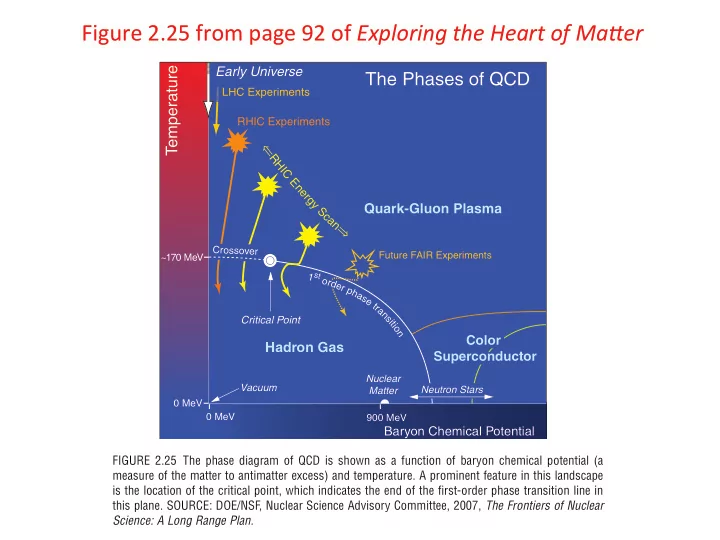
FIGURE 2.25 The phase diagram of QCD is shown as a function of baryon chemical potential (a measure of the matter to antimatter excess) and temperature. A prominent feature in this landscape is the location of the critical point, which indicates the end of the first-order phase transition line in this plane. SOURCE: DOE/NSF, Nuclear Science Advisory Committee, 2007, The Frontiers of Nuclear Science: A Long Range Plan.

slide-2
SLIDE 2

La2ce ¡QCD ¡calcula8ons: ¡Order ¡of ¡the ¡phase ¡transi8on ¡

h@p://quark.phy.bnl.gov/~htding/usqcd/scaling.html ¡

  • As ¡func8on ¡of ¡light ¡quark ¡masses ¡(x-­‑axis) ¡and ¡strange ¡quark ¡mass ¡(y-­‑axis) ¡
slide-3
SLIDE 3

La2ce ¡QCD ¡calcula8ons ¡across ¡phase ¡transi8on ¡

  • Tc ¡is ¡the ¡cri8cal ¡temperature, ¡so ¡phase ¡transi8on ¡at ¡T/Tc ¡= ¡1 ¡
  • LeQ: ¡Wilson ¡loop ¡L, ¡which ¡is ¡a ¡measure ¡of ¡the ¡quark ¡free ¡energy: ¡jumps ¡at ¡deconfinement ¡
  • Right: ¡quark ¡condensate, ¡analogous ¡to ¡magne8za8on ¡in ¡ferromagnet: ¡jumps ¡at ¡restora8on ¡
  • f ¡chiral ¡symmetry ¡(cf. ¡restora8on ¡of ¡rota8on ¡symmetry ¡in ¡magnet ¡at ¡Curie ¡temperature) ¡
  • Deconfinement ¡and ¡chiral ¡symmetry ¡restora8on ¡transi8ons ¡à ¡same ¡temperature! ¡

h@p://www.nupecc.org/report97/report97_nnc/node14.html ¡

slide-4
SLIDE 4

QCD ¡vacuum: ¡Chiral ¡symmetry ¡breaking ¡à ¡quark ¡condensate ¡

  • Massless ¡quarks ¡are ¡either ¡right-­‑handed ¡or ¡leQ-­‑handed ¡(you ¡can ¡think ¡of ¡this ¡as ¡

analogous ¡to ¡leQ ¡or ¡right ¡circularly ¡polarized ¡light): ¡spin ¡S ¡and ¡momentum ¡p ¡

  • Quark ¡condensate ¡acts ¡like ¡a ¡background ¡field ¡to ¡propaga8ng ¡quarks, ¡that ¡gives ¡

them ¡a ¡mass ¡à ¡“cons8tuent ¡quarks” ¡

  • The ¡quark ¡condensate ¡breaks ¡the ¡chiral ¡symmetry ¡in ¡the ¡sense ¡that ¡a ¡non-­‑zero ¡

spontaneous ¡magne8za8on ¡breaks ¡rota8onal ¡invariance ¡in ¡a ¡ferromagnet. ¡

slide-5
SLIDE 5

Figure ¡2.2: ¡Classical ¡mechanics ¡ poten8al ¡model ¡illustra8ng ¡chiral ¡ symmetry ¡breaking. ¡The ¡poten8al ¡ in ¡a) ¡is ¡symmetric. ¡In ¡b) ¡the ¡ poten8al ¡is ¡s8ll ¡symmetric, ¡but ¡ the ¡symmetry ¡of ¡the ¡ground ¡state ¡ is ¡spontaneously ¡broken ¡as ¡the ¡ ball ¡rolls ¡to ¡a ¡certain ¡point ¡in ¡the ¡ poten8al ¡and ¡selects ¡a ¡direc8on, ¡ which ¡breaks ¡the ¡symmetry. ¡ However, ¡a ¡rota8on ¡(moving ¡the ¡ ball ¡in ¡the ¡valley) ¡does ¡not ¡cost ¡ energy ¡[7]. ¡

h@p://www-­‑np.ucy.ac.cy/HADES/physics/physics_main.html ¡

QCD ¡vacuum: ¡Chiral ¡symmetry ¡breaking ¡à ¡classical ¡model ¡